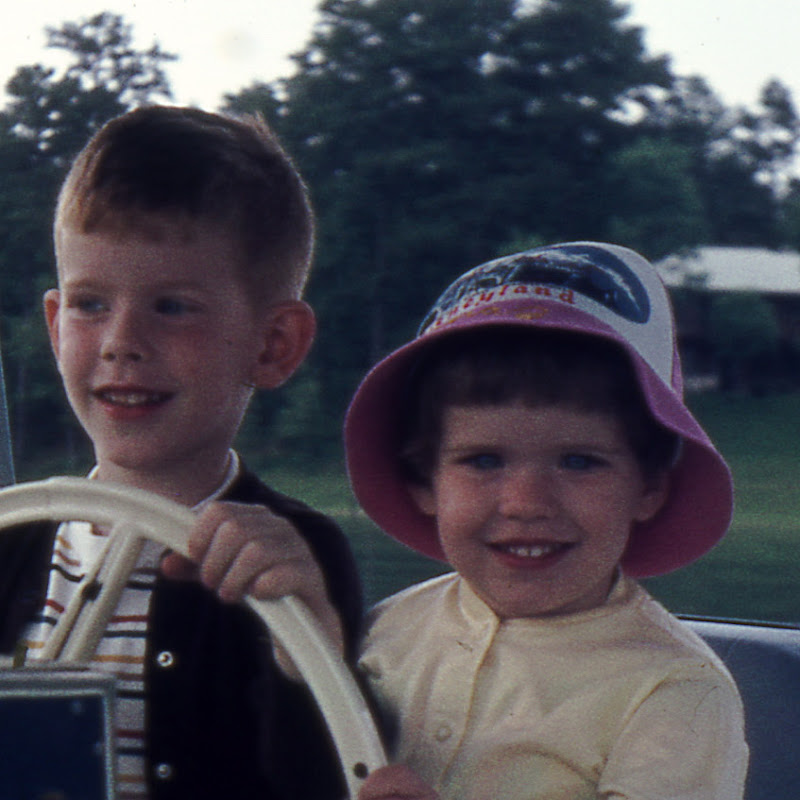
Cady Gray has been wanting her own Ravelry account for some time. I've been posting her projects on my account, and she beams with pride at every "heart" (favorite mark) or comment they get. About a year ago the Ravelry team floated the idea of a parent-monitored account especially for minor children, with the ability for the parent to see the child's activity and limit their access to parts of the site with potentially mature content. But it doesn't appear that feature is anywhere on the near horizon, so after setting CG a goal that she met, I made an account for her. I know the password and can log in as her anytime to see what she's posting and who she's talking to.
It's her first social networking account, or maybe second. Earlier this summer I donated to a Kickstarter campaign for Tinkatolli and in return got a membership to that game-world for Cady Gray. She can make "buddies" on that site and chat with them, and she takes very seriously the rules that are displayed to her while the game is loading (never give out personal information, be kind to other Tinkas). The interactions delight her; every time somebody talks to her Tinka, invites her to their "pad" (a personal space you can decorate), or gives her a gift, she comes running to me bursting with happiness.
The same thing has happened on Ravelry. I suggested she use her Tinka's name, and made her a Ravatar out of her Tinka's picture. She looked forward from the moment of her first login to the welcome message she'd get from a Welcome Wagon member. I suggested she post in the group for newbies, and when she received a reply or two, she clearly felt like a real Raveler. She made a faux pas, posting a generic "hello" message on one of the Big 6 forums, and got some disagrees, which dismayed her. I explained to her that anytime you come into a new situation, it takes a little experience to learn the rules (my example was the etiquette surrounding the tire swing on the school playground), and then I posted in the thread gently redirecting her to a more appropriate forum, and the thread was archived. After listening in on some Harry Potter chatter in the Welcome Mat forum, she asked how she could get involved in some of the HP-related crafting being discussed, and received a kind explanation which she immediately relayed to me in great detail (as a newly minted expert on the Harry Potter Knitting and Crocheting House Cup). When we searched for kids' groups, we came across Harry Potter Kids and Teens, which so perfectly fit her needs and desires that I thought her eyes would get stuck in permanently wide surprise. Now she is reminding me that we need to move her projects to her notebook as soon as possible.
Both Ravelry and Tinkatolli are gentle introductions to social networking. They have well-communicated boundaries and folkways that make them safe and unthreatening. Members are fiercely protective of the hospitality of their community, vigilant at informal enforcement of rules against harassment and spamming, and vigorously work to isolate and remove those who don't adhere to its norms (through shunning, banning, and public shaming). Such incidents are rare and are quickly shunted out of casual view by a vast army of volunteer moderators. I have next to no concerns that she will encounter anything untoward from her fellow gamer-makers or fellow knitters, and I'm confident that she will tell me about anything confusing or concerning that might happen to her online.
Nevertheless, she has crossed a border that didn't exist when I was growing up. I was a teenager when I started to get involved in BBSes -- the kind you dial up on your modem and log into individually -- and nobody knew anything about online safety. I'm probably lucky I didn't get myself into trouble. I'm sure there are seven-year-olds out there with Facebook pages; no reason to cross that bridge anytime soon in this house. You all know that I'm an techno-optimist; treated with the proper respect and constructive attitude, the internet is no more dangerous to kids than a sidewalk or playground, and should be monitored but promoted in the same way: it's good to get outside, meet new friends, and be a part of the civic life of your community, as long as you know a few simple rules that allow you to do it safely. I'm grateful that places like Tinkatoll and Ravelry exist; the playgrounds of the internet, if you will -- places largely free of commercial pressure, places with constructive purposes that promote healthy behaviors and self-images, places where kids can connect with others who share their interests, be inspired, invite and reciprocate friendships. If there are bumps along the way, they are likely to be small, and they will be learning experiences for the bigger social challenges coming down the pike, both on- and offline.
(By the way: If you are a Raveler and friend of mine -- IRL or in cyberspace -- and would like to friend Cady Gray, please leave me a comment or shoot me a message through any convenient channel, and I'll give you her username. The more of my wonderful friends who are part of her online life, the better. Each new friend will give her immeasurable happiness, so please don't hesitate to make her day.)
Showing posts with label social networking. Show all posts
Showing posts with label social networking. Show all posts
Saturday, September 3, 2011


Saturday, March 26, 2011
That hath such people in it
I spent the day at a social media conference called Brave New Media. On the beautiful campus of Harding University in nearby Searcy, a group of bright students and progressively-minded professors invited anyone and everyone to join them in a discussion of the potential of emerging media platforms and social networking, and the lessons we can already learn from its short history.
What I took away from the day, aside from some of the insights of my fellow presenters about topics as diverse as the Egyptian revolution and the #ARwx hashtag, was how powerful a force student initiative can be. I'm a huge proponent of facilitating student projects, rather than setting them to work on my projects. What I saw today was the brainchild of a student, assisted by other students, and supported by professors. That's the ideal. That's how learning happens -- by doing, by pushing against difficulties, by solving problems, and by partnering with others to tap into the right resources.
My hat is off to the professors who participated in making this conference happen, and who showed up today to be a supportive audience for their students' program. Even the first time I met them, they were already demonstrating the ideal of the professoriate that I've come to embrace.
You can read the tweets from the Brave New Media conference by searching the hashtag #bravenewmedia. I think you'll be surprised at the insight and positivity surrounding a topic that, in many a higher education setting, evokes only fear and loathing.
What I took away from the day, aside from some of the insights of my fellow presenters about topics as diverse as the Egyptian revolution and the #ARwx hashtag, was how powerful a force student initiative can be. I'm a huge proponent of facilitating student projects, rather than setting them to work on my projects. What I saw today was the brainchild of a student, assisted by other students, and supported by professors. That's the ideal. That's how learning happens -- by doing, by pushing against difficulties, by solving problems, and by partnering with others to tap into the right resources.
My hat is off to the professors who participated in making this conference happen, and who showed up today to be a supportive audience for their students' program. Even the first time I met them, they were already demonstrating the ideal of the professoriate that I've come to embrace.
You can read the tweets from the Brave New Media conference by searching the hashtag #bravenewmedia. I think you'll be surprised at the insight and positivity surrounding a topic that, in many a higher education setting, evokes only fear and loathing.
Friday, March 25, 2011
To Searcy!
Searcy is a little town a bit more than an hour from here. I've been there exactly once, when I officiated at a wedding of two former students a few years back. Noel briefly lived there when he was a lad, just before his parents' divorce (creating negative impressions of Arkansas that caused him to have misgivings about the prospect of my taking this job).
Tomorrow I'm going to Searcy because it's the home of Harding University. A student group there, HUmanity, has been involved in some interesting initiatives with cutting-edge thought, breaking free of the generally conservative character associated with this private Christian school. They've organized a day-long conference on social networking called Brave New Media.
One of my colleagues has worked with these students over the past couple of years, and when he heard about the topic of the conference, he suggested me as a participant. I agreed to do a classroom session on the relationship of online social networks to the creation of material goods.
The free conference is tomorrow starting at 10 am in Cone Chapel. Casey Neese (social media manager for Heifer International), Alex Cone (online branding for New York City Charter School Center), and Keith Crawford (network engineering and founder of Arkansas Tweetup) are providing the keynotes. I'm looking forward to spending the day with these folks, having some good conversations, and finding out the kind of thinking they do up there in Searcy.
Tomorrow I'm going to Searcy because it's the home of Harding University. A student group there, HUmanity, has been involved in some interesting initiatives with cutting-edge thought, breaking free of the generally conservative character associated with this private Christian school. They've organized a day-long conference on social networking called Brave New Media.
One of my colleagues has worked with these students over the past couple of years, and when he heard about the topic of the conference, he suggested me as a participant. I agreed to do a classroom session on the relationship of online social networks to the creation of material goods.
The free conference is tomorrow starting at 10 am in Cone Chapel. Casey Neese (social media manager for Heifer International), Alex Cone (online branding for New York City Charter School Center), and Keith Crawford (network engineering and founder of Arkansas Tweetup) are providing the keynotes. I'm looking forward to spending the day with these folks, having some good conversations, and finding out the kind of thinking they do up there in Searcy.
Saturday, January 22, 2011
In touch
While discussing the first chapter of Kevin Kelly's new book What Technology Wants with my senior seminar, we started talking about the well-worn topic Social Networking: Bane Or Boon?
A few days earlier, I had sat quietly fuming as the five dozen freshmen in our program fell all over themselves in an introductory class session to denounce Facebook and cyberspace in general as the root of all evil. Not for themselves, mind you -- for their less enlightened peers, and especially for their younger siblings. "I didn't get a cell phone until I was sixteen," one young man interjected, vis-a-vis the inappropriately early introduction of cell phones into the lives of the next generation.
I was amused -- the haphazard adoption of new communications technologies in the last decade thus being turned into ironclad and commonsense principles of The Way Things Should Be -- but also annoyed. Never having not been connected, the eighteen-year-olds were disturbingly quick to identify connectness as the central problem of their time.
Kelly helped my seniors put it in perspective. I paraphrase, not having the book in front of me: "At the exact moment when Americans were said to bowl alone, millions were gathering online." I looked it up. Sure enough, Putnam's famous essay is dated 1995, and what else was happening in 1995? The World Wide Web was entering its adolescence, having come into the lives of the early adopters just a couple of years earlier.
I never fail to be astounded at how quickly the predictions of doom shift. Fifteen years ago (and for the previous several decades), the ruination of American society was our increasing isolation from each other -- we sat before our TVs passively imbibing, amusing ourselves to death, building houses without front porches and cities without coffeeshops or gathering places. Now the ruination of America is that we can't live without each other, that we communicate incessantly, that we are losing the ability to be alone, that we have way too much to say and feel entitled to be heard.
This afternoon I sat at the playground while my kids constructed two elaborate fantasy parks in turn -- one for each of them to run -- complete with tickets, attractions, rewards, challenges, and prizes -- and I knitted while occasionally making an observation on Twitter. A thousand miles away, my husband was standing in line at a movie, making his own observations -- a conversation with our friends and acquaintances, tangentially directed at each other, in real time. Between our tweets flowed the observations, news, appeals, jokes, items of interest, and other ephemera of the conversations we've each chosen to listen in on -- some people we know, some we simply find enlightening. We are connected. Being connected, we are presented with opportunities to care, to touch, to help, to encourage, to critique. Is this not exactly what the doomsayers of the previous generation felt was slipping away forever?
A few days earlier, I had sat quietly fuming as the five dozen freshmen in our program fell all over themselves in an introductory class session to denounce Facebook and cyberspace in general as the root of all evil. Not for themselves, mind you -- for their less enlightened peers, and especially for their younger siblings. "I didn't get a cell phone until I was sixteen," one young man interjected, vis-a-vis the inappropriately early introduction of cell phones into the lives of the next generation.
I was amused -- the haphazard adoption of new communications technologies in the last decade thus being turned into ironclad and commonsense principles of The Way Things Should Be -- but also annoyed. Never having not been connected, the eighteen-year-olds were disturbingly quick to identify connectness as the central problem of their time.
Kelly helped my seniors put it in perspective. I paraphrase, not having the book in front of me: "At the exact moment when Americans were said to bowl alone, millions were gathering online." I looked it up. Sure enough, Putnam's famous essay is dated 1995, and what else was happening in 1995? The World Wide Web was entering its adolescence, having come into the lives of the early adopters just a couple of years earlier.
I never fail to be astounded at how quickly the predictions of doom shift. Fifteen years ago (and for the previous several decades), the ruination of American society was our increasing isolation from each other -- we sat before our TVs passively imbibing, amusing ourselves to death, building houses without front porches and cities without coffeeshops or gathering places. Now the ruination of America is that we can't live without each other, that we communicate incessantly, that we are losing the ability to be alone, that we have way too much to say and feel entitled to be heard.
This afternoon I sat at the playground while my kids constructed two elaborate fantasy parks in turn -- one for each of them to run -- complete with tickets, attractions, rewards, challenges, and prizes -- and I knitted while occasionally making an observation on Twitter. A thousand miles away, my husband was standing in line at a movie, making his own observations -- a conversation with our friends and acquaintances, tangentially directed at each other, in real time. Between our tweets flowed the observations, news, appeals, jokes, items of interest, and other ephemera of the conversations we've each chosen to listen in on -- some people we know, some we simply find enlightening. We are connected. Being connected, we are presented with opportunities to care, to touch, to help, to encourage, to critique. Is this not exactly what the doomsayers of the previous generation felt was slipping away forever?
Sunday, December 26, 2010
A network of warmth
Today was shaping up to be an anxious one. Late in the afternoon on Christmas Day, I noticed that the furnace wasn't working and the temperature in the house had slipped a few degrees below the thermostat setting. (This is a week after we had a similar problem which seemed to have been fixed. And this is a heat pump that is only about 10 months old.)
The repair guy was nice enough to stop by that same night and had a suspciously easy fix -- a drainage hose was sagging, causing the pressure switch to read it as clogged since water wasn't moving through. He clipped the hose to shorten it and reattached it. All seemed well. (Actually, the furnace had kicked in and started blowing again just before he arrived after several hours of fruitless cycling. Ain't it always the way.)
This morning, though, trouble again. Heat had been pumping as late as 6 am this morning (when we have the thermostat set to push the temps up to daytime levels), but when Noel got up at 7 the three flashing red trouble lights were back. Repair guy came back around midday. The hose he had shortened had come unfastened, and he reclamped it. Heat was back on ... but only briefly. Before the furnace managed to get the temperature back up to the themostat setting, it died again. When we called repair guy, he was apologetic but said that he had run out of options. A new pressure switch was all that could be done, and that wouldn't be available until tomorrow afternoon.
Faced with the prospect of a night without central heating and outside temps of 20 degrees, we decided to get proactive. I lit the gas fireplace in the living room, which did a remarkable job of lifting both the comfort level and our spirits. Thinking that we could make it through the night without me losing my mind with worry if we had some kind of heater where the kids sleep, I asked on Twitter and Facebook if any local friends had space heaters they could loan us. A colleague answered immediately; even though she was out of town, she had a housesitter and knew where her electric heaters were. Noel headed off to pick them up, sharing with me a plan to get the kids excited about sleeping over together in the same room in sleeping bags. Within a couple of hours, three more friends responded through social networking offering heaters; we took up the offer from one who lives in our neighborhood, scoring two large radiator-style units.
Throw in one small ceramic heater that Noel picked up at Wal-Mart, reasoning that since this has happened two winters in a row we really ought to have something of our own, and all our sleeping quarters plus the living room were being re-toasted by late afternoon. By dinnertime, the temperature in the kitchen was back to normal, and the hall thermostat was registered an uptick of several degrees from its low point. A virtue of a small house.
So we are snug for the night, with barely any inconvenience registering from our lack of central heat (other than some temporarily elevated gas and electric usage). Here's hoping the part comes in and fixes our problem tomorrow ... but if it doesn't, we'll be fine. Thanks to friends and Facebook, thanks to an attitude adjustment from worry to positivity, the anxiety that accompanies a breakdown like this -- especially for parents charged with keeping kids and guests out of the bitter cold -- has melted away.
The repair guy was nice enough to stop by that same night and had a suspciously easy fix -- a drainage hose was sagging, causing the pressure switch to read it as clogged since water wasn't moving through. He clipped the hose to shorten it and reattached it. All seemed well. (Actually, the furnace had kicked in and started blowing again just before he arrived after several hours of fruitless cycling. Ain't it always the way.)
This morning, though, trouble again. Heat had been pumping as late as 6 am this morning (when we have the thermostat set to push the temps up to daytime levels), but when Noel got up at 7 the three flashing red trouble lights were back. Repair guy came back around midday. The hose he had shortened had come unfastened, and he reclamped it. Heat was back on ... but only briefly. Before the furnace managed to get the temperature back up to the themostat setting, it died again. When we called repair guy, he was apologetic but said that he had run out of options. A new pressure switch was all that could be done, and that wouldn't be available until tomorrow afternoon.
Faced with the prospect of a night without central heating and outside temps of 20 degrees, we decided to get proactive. I lit the gas fireplace in the living room, which did a remarkable job of lifting both the comfort level and our spirits. Thinking that we could make it through the night without me losing my mind with worry if we had some kind of heater where the kids sleep, I asked on Twitter and Facebook if any local friends had space heaters they could loan us. A colleague answered immediately; even though she was out of town, she had a housesitter and knew where her electric heaters were. Noel headed off to pick them up, sharing with me a plan to get the kids excited about sleeping over together in the same room in sleeping bags. Within a couple of hours, three more friends responded through social networking offering heaters; we took up the offer from one who lives in our neighborhood, scoring two large radiator-style units.
Throw in one small ceramic heater that Noel picked up at Wal-Mart, reasoning that since this has happened two winters in a row we really ought to have something of our own, and all our sleeping quarters plus the living room were being re-toasted by late afternoon. By dinnertime, the temperature in the kitchen was back to normal, and the hall thermostat was registered an uptick of several degrees from its low point. A virtue of a small house.
So we are snug for the night, with barely any inconvenience registering from our lack of central heat (other than some temporarily elevated gas and electric usage). Here's hoping the part comes in and fixes our problem tomorrow ... but if it doesn't, we'll be fine. Thanks to friends and Facebook, thanks to an attitude adjustment from worry to positivity, the anxiety that accompanies a breakdown like this -- especially for parents charged with keeping kids and guests out of the bitter cold -- has melted away.
Sunday, November 14, 2010
Two million hands at work
Unless you are a knitter or crocheter -- or a web developer -- you probably don't know exactly what Ravelry is. Yet the site signed up its one millionth member in the wee morning hours of Saturday, November 13.
I've been on Ravelry since August 2007. I still run into fellow knitters who've never heard of it, let alone the general public. And I still find it difficult to explain in a sentence of two why they should be a part of it. It's not just a social network. It's not just a database of materials and patterns. It's a socially-generated database that turns out to be the greatest collaboratively-updated repository of information about a specialized skillset ever produced.
When I wrote about Ravelry in my presentation to the Interdisciplinary Colloquium on Theology and Energy last February, there were a quarter of a million members. When I updated the essay for publication this summer, there were 600,000 members. The join rate keeps accelerating. Of course the number of regular users is much smaller and grows more slowly; yet the daily high point of simultaneous users also keeps climbing. Not only are there more members, but there are also more people logging onto the site regularly.
On January 12, 2008, I sent my first message to a new Raveler as part of the newly-formed Ravelry Welcome Wagon. Almost three years later, I've sent more than 31,000 messages to people within a day or two after they join the site. My Welcome Wagon beat is the G's, which means that I welcome everyone who chooses a username that starts with G. That's 31,000 grandmothers, girls, grrls, glows, and geeks.
It's no exaggeration to say that Ravelry has changed my life. It's brought me hundreds of new friends in the last four years. It's pushed me to acquire new skills and try techniques that I would have thought utterly beyond me. In fact, it's turned me from a person who has managed to learn the basics of knitting, into a knitter. The living, palpable, visible example of thousands of people just like me who transformed string into art and comfort and warmth and adornment -- that's what it took to make me into a maker.
Now I create my life rather than consuming it. Ravelry made it possible. One million members is quite a milestone. But a far more impressive feat, from where I sit, is how Ravelry bridged the distance between me when I picked up the needles, and me now.
Tuesday, June 1, 2010
Crowdsourcing inspiration
One of my favorite features of the twenty-first century world of social networking is how visible inspiration has become. It used to be up to art and technology historians to identify who was an influence on whom. But as we assemble our plans and creative impulses in tiny pieces scattered across the internet, our browser histories themselves become a record of our sources. In addition, it's become customary -- indeed, expected -- for those keeping online project notebooks to note and link to the items and ideas that inspired them.
Inspiration is always a delicate matter in academia. We are socialized simultaneously in the art and ethics of referencing our sources, and in the value of originality. Paying homage to our inspirations, in that environment, can come to feel like a chore and a cheat. We overwhelm our readers with references to convince them of the thoroughness of our research. At the same time, we struggle to assert that we are neverthless doing something new, unique, and valuable -- something worthy, we hope, of being cited as inspiration or authority by another.
Perhaps there's something to the two terms I just juxtaposed. Academia -- well, the humanities, at any rate -- operates according to structures that bestow and honor authority. The fear of the limitless eclectic synthesis ethic of the Internet is based in the horror of lost authority. Yet everywhere I look in my social networks, I see people citing each other -- spreading the word about what others have done, adding their own spin, and putting what they do out there to inspire in its turn. The arts have long understood that there is a distinction between inspiration and authority. Even though originality is far more highly prized in those circles, it stands in tension not with the repetition of truths implied by the notion of authority, but with the participation in a communal process of choosing styles and elements of meaning.
As usual, I see a lot to be optimistic about in the emerging folkways of social networking. My hope is that these environments are socializing their participants into an expectation of generosity and appreciation. It seems unlikely that the need for critical engagement will go unfulfilled by other corners of the 'net -- or even in some activities in the same communities I'm discussing. I seek only to praise the existence and growing normativity of counterbalancing forces.
Monday, July 6, 2009
Life tracking
One of the aspects of social networking that tends to befuddle non-adopters is the sharing of personal life lists. Since I started blogging several years ago, I've kept lists of movies seen and books read in a given year. At a certain point I moved those lists to listography.com, where I also keep private lists of work-related data that I know I'll need for year-end reviews (as well as packing lists, top ten drafts, etc.).
But since I joined Goodreads.com, I've stopped keeping up with the "books read" list on listography. (And the "movies seen" list is languishing, too, as you may have noticed if you clicked the link above.) Because the queueing system in Goodreads is so useful (you can keep track of books you want or plan to read, as well as those currently in progress and those completed), but most importantly because the social aspect encourages me to keep my profile current, I find it much easier to keep track of my reading there. It's kind of effortless, actually; when a book review of mine goes up, I'm usually reminded to hop over to Goodreads and link to it in the "my review" box, simultaneously marking it completed, and that's when I update my shelves to include the next book or two in my pile.
Because I'm not keeping a list of what I have read as much as making available to friends a view of my bedside table -- what I'm reading now -- I don't think of Goodreads in the same way as the "books read" post I used to keep on my blog. Yet behind the scenes, while I'm doing the social networking thing, the site is compiling that very same list for me. When I need it, voila -- there it is.
So now it bugs me that I'm still trying to keep my master list of "films seen in 2009" on listography. Why isn't there a social networking tool that would make compiling that list as effortless as it is on Goodreads? Why can't I invite my friends to see what I'm planning to watch, and what I've seen recently (or back in the mists of time)? Being in the pop culture media means being asked these exact questions all the time.
My former student Holly recommended the site livingsocial.com; it's where she keeps her books-read list, but you can also collect films, iPhone apps, ski slopes, albums, TV shows, and beers there. I'm leery of the kitchen-sink approach, and of course I'm not interested in abandoning Goodreads. Is this the best place to stash my film updates? Or are there any more film-centric sites out there that will aggregate my viewing, motivate me to update, and allow me to share?
But since I joined Goodreads.com, I've stopped keeping up with the "books read" list on listography. (And the "movies seen" list is languishing, too, as you may have noticed if you clicked the link above.) Because the queueing system in Goodreads is so useful (you can keep track of books you want or plan to read, as well as those currently in progress and those completed), but most importantly because the social aspect encourages me to keep my profile current, I find it much easier to keep track of my reading there. It's kind of effortless, actually; when a book review of mine goes up, I'm usually reminded to hop over to Goodreads and link to it in the "my review" box, simultaneously marking it completed, and that's when I update my shelves to include the next book or two in my pile.
Because I'm not keeping a list of what I have read as much as making available to friends a view of my bedside table -- what I'm reading now -- I don't think of Goodreads in the same way as the "books read" post I used to keep on my blog. Yet behind the scenes, while I'm doing the social networking thing, the site is compiling that very same list for me. When I need it, voila -- there it is.
So now it bugs me that I'm still trying to keep my master list of "films seen in 2009" on listography. Why isn't there a social networking tool that would make compiling that list as effortless as it is on Goodreads? Why can't I invite my friends to see what I'm planning to watch, and what I've seen recently (or back in the mists of time)? Being in the pop culture media means being asked these exact questions all the time.
My former student Holly recommended the site livingsocial.com; it's where she keeps her books-read list, but you can also collect films, iPhone apps, ski slopes, albums, TV shows, and beers there. I'm leery of the kitchen-sink approach, and of course I'm not interested in abandoning Goodreads. Is this the best place to stash my film updates? Or are there any more film-centric sites out there that will aggregate my viewing, motivate me to update, and allow me to share?
Tuesday, March 31, 2009
Modern marvels
Two interesting, seemingly unrelated events occurred today. Noel talked to Jim Parsons, the actor who plays Sheldon on The Big Bang Theory. And my dad joined Twitter.
Sheldon has become quite a famous television character in the show's two seasons, at least among a certain community. Although he's portrayed as simply a particularly obsessive and socially tone-deaf scientist, people on the autistic spectrum (and their families) have become convinced that the character has Asperger's syndrome. I certainly see the diagnosis. The way Sheldon interrogates anyone who brings him Chinese food to make sure they got everything exactly right, or the way he tries to explain the possibilities of a potential friendship using a flow chart -- it all seems eerily familiar.
Sheldon, like Archer, is most comfortable with numbers and computers rather than people. On the other hand, my father has always been quite social. But he's a savvy adopter of technology, as well. I'm not sure what led him to create a Twitter persona -- media coverage? Facebook? -- but there he was this morning, sending me a follow request.
I wonder if he'll be a listener, or whether he'll join in with his own status updates. Who wouldn't enjoy seeing what their dad is up to several times a day?
Twitter skeptics -- and technophobes in general -- tend to decry the ascendency of mediated communication over face-to-face interaction. But when you move away from your family and friends, practically all your communication is mediated. As older generations start to adopt social networking tools like Facebook and Twitter, they're finding that these are ways to have more contact with the people you care about, not less.
For people like Sheldon, the mediation is essential; people are bewildering bundles of chaos without some filter to increase the signal and cut the noise. But even for the most socially adept among us, these tools can aggregate our loci of concern and allow us to stay connected with more people, more often.
Sheldon has become quite a famous television character in the show's two seasons, at least among a certain community. Although he's portrayed as simply a particularly obsessive and socially tone-deaf scientist, people on the autistic spectrum (and their families) have become convinced that the character has Asperger's syndrome. I certainly see the diagnosis. The way Sheldon interrogates anyone who brings him Chinese food to make sure they got everything exactly right, or the way he tries to explain the possibilities of a potential friendship using a flow chart -- it all seems eerily familiar.
Sheldon, like Archer, is most comfortable with numbers and computers rather than people. On the other hand, my father has always been quite social. But he's a savvy adopter of technology, as well. I'm not sure what led him to create a Twitter persona -- media coverage? Facebook? -- but there he was this morning, sending me a follow request.
I wonder if he'll be a listener, or whether he'll join in with his own status updates. Who wouldn't enjoy seeing what their dad is up to several times a day?
Twitter skeptics -- and technophobes in general -- tend to decry the ascendency of mediated communication over face-to-face interaction. But when you move away from your family and friends, practically all your communication is mediated. As older generations start to adopt social networking tools like Facebook and Twitter, they're finding that these are ways to have more contact with the people you care about, not less.
For people like Sheldon, the mediation is essential; people are bewildering bundles of chaos without some filter to increase the signal and cut the noise. But even for the most socially adept among us, these tools can aggregate our loci of concern and allow us to stay connected with more people, more often.
Wednesday, December 17, 2008
A life in public
I got a message from a colleague today on Facebook, in response to one of my status updates. I've integrated my Facebook status with Twitter using an app called Tweeter (the actual Twitter app on Facebook doesn't appear to be entirely reliable). So my Facebook statuses always begin with "Donna tweets:" and then the message.
My colleague asked whether I actually found Twitter useful. It's a timely question, because the way I use Twitter, Facebook, Plurk, and other social networking services has evolved since I wrote about their profusion in my life a few weeks ago.
My students are all on Facebook. On Facebook, status updates are a must, because they show up in your friends' minifeeds, and your friends are reassured that you are around and active. I need to be active on Facebook so that my students can contact me there. I need to be there, and be social there, in order to be part of their lives. The key to effective teaching and mentoring is proximity -- and Facebook gives me proximity, so long as I regularly update and therefore appear on my students' pages.
I resisted Twitter for a long time because (a) it seemed redundant since I was already posting statuses on Facebook, and (b) I didn't know why or to whom I was broadcasting my status on Twitter. I have a reason to be active on Facebook, one related to my job. I have a reason to be active on my blog, one related to my personal goals. Why did I need to be active on Twitter?
Thanks to Noel's entrance into Twitter, which allowed me to piggyback off his following list and add a bunch of far-flung friends, acquaintances, and people I admire, the purpose of Twitter has suddenly become clear to me. Twitter is micro-blogging in a social context. It's the place where the dozens of daily thoughts or happenings that are too minor for a blog post, but that nevertheless are worth communicating, can go. And it's where you stay within the orbit of people in whom you are truly interested. The trick to Twitter is to follow only people whose lives you actually want to keep up with -- because you know them, because they lead interesting lives, because they have something to say that you want to hear. And the trick to twittering is that you aren't doing it for yourself -- you're doing it to be a part of the lives of the people who follow you. Presumably they are following you because they're interested in you. Unlike blogging, which I would argue you do primarily for yourself, with an audience as motivation rather than reason, I believe that you don't twitter for yourself, but for your network. It's freeform communication, an ever-reconfiguring cocktail party where you can wander from conversation to conversation, but where you have an obligation to contribute appropriately -- to be interesting, but not overpowering.
And now that my administrative colleagues have joined Plurk, I'm even starting to make use of it in the way I had hoped to do. I listen in (and sometimes comment) on friends' Plurks, but if I used it for status updates or even link sharing, it would be redundant -- I'm already doing that on Twitter. Instead, I can use the time-stamp and private plurk functions -- not part of the Twitter concept -- to keep notes on decisions made and official activities undertaken. It's a notepad where I jot down what I told a student in an advising session, or what we decided to do about a certain policy in an ad hoc meeting. Since it's searchable, I can quickly find plurks I posted about any given student or any given topic, a must for retrieving records of the hundreds of minor decisions we make every week. What did I tell Student X about her scholarship? Did I promise Student Y he could come back into the program? What did we decide about students taking classes for grade forgiveness? Being able to private-plurk a timeline of decision points means a record that can actually be useful, because I'm living in it continually.
Having a bunch of memberships in sites that ask you to be active by posting what you're up to -- that feels like an obligation, a burden, and if you don't know who you're doing it for or why you're doing it (other than that everyone else seems to be), it won't be useful. Now that some of those questions of why and wherefore and who-for have been sorted out for me, I feel a sense of purpose and value in twittering, plurking, and facebooking.
(Kwipping, though? Haven't quite figured that one out.)
My colleague asked whether I actually found Twitter useful. It's a timely question, because the way I use Twitter, Facebook, Plurk, and other social networking services has evolved since I wrote about their profusion in my life a few weeks ago.
My students are all on Facebook. On Facebook, status updates are a must, because they show up in your friends' minifeeds, and your friends are reassured that you are around and active. I need to be active on Facebook so that my students can contact me there. I need to be there, and be social there, in order to be part of their lives. The key to effective teaching and mentoring is proximity -- and Facebook gives me proximity, so long as I regularly update and therefore appear on my students' pages.
I resisted Twitter for a long time because (a) it seemed redundant since I was already posting statuses on Facebook, and (b) I didn't know why or to whom I was broadcasting my status on Twitter. I have a reason to be active on Facebook, one related to my job. I have a reason to be active on my blog, one related to my personal goals. Why did I need to be active on Twitter?
Thanks to Noel's entrance into Twitter, which allowed me to piggyback off his following list and add a bunch of far-flung friends, acquaintances, and people I admire, the purpose of Twitter has suddenly become clear to me. Twitter is micro-blogging in a social context. It's the place where the dozens of daily thoughts or happenings that are too minor for a blog post, but that nevertheless are worth communicating, can go. And it's where you stay within the orbit of people in whom you are truly interested. The trick to Twitter is to follow only people whose lives you actually want to keep up with -- because you know them, because they lead interesting lives, because they have something to say that you want to hear. And the trick to twittering is that you aren't doing it for yourself -- you're doing it to be a part of the lives of the people who follow you. Presumably they are following you because they're interested in you. Unlike blogging, which I would argue you do primarily for yourself, with an audience as motivation rather than reason, I believe that you don't twitter for yourself, but for your network. It's freeform communication, an ever-reconfiguring cocktail party where you can wander from conversation to conversation, but where you have an obligation to contribute appropriately -- to be interesting, but not overpowering.
And now that my administrative colleagues have joined Plurk, I'm even starting to make use of it in the way I had hoped to do. I listen in (and sometimes comment) on friends' Plurks, but if I used it for status updates or even link sharing, it would be redundant -- I'm already doing that on Twitter. Instead, I can use the time-stamp and private plurk functions -- not part of the Twitter concept -- to keep notes on decisions made and official activities undertaken. It's a notepad where I jot down what I told a student in an advising session, or what we decided to do about a certain policy in an ad hoc meeting. Since it's searchable, I can quickly find plurks I posted about any given student or any given topic, a must for retrieving records of the hundreds of minor decisions we make every week. What did I tell Student X about her scholarship? Did I promise Student Y he could come back into the program? What did we decide about students taking classes for grade forgiveness? Being able to private-plurk a timeline of decision points means a record that can actually be useful, because I'm living in it continually.
Having a bunch of memberships in sites that ask you to be active by posting what you're up to -- that feels like an obligation, a burden, and if you don't know who you're doing it for or why you're doing it (other than that everyone else seems to be), it won't be useful. Now that some of those questions of why and wherefore and who-for have been sorted out for me, I feel a sense of purpose and value in twittering, plurking, and facebooking.
(Kwipping, though? Haven't quite figured that one out.)
Subscribe to:
Posts (Atom)