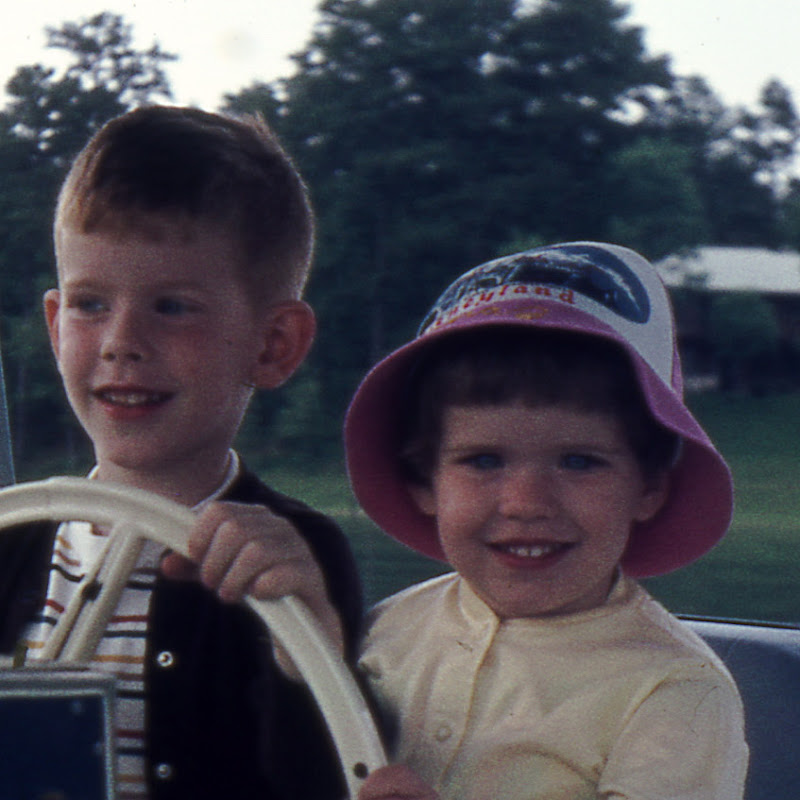
Cady Gray loves playing on Tinkatolli, a great online world for kids that encourages offline creativity. A few weeks ago, she decided to make a toy bed in response to a Tinkatolli challenge. I helped her find materials and put some of the parts together (although she'd completed a lot of it before I got involved. Then I took some pictures of it for her, and she uploaded it into her scrapbook and entered it in the Tinka Fair.
Yesterday she came to me with a plan to delete her project, use another photo, and resubmit it, because she thought that she had submitted too early to be a part of the Tinka Fair. Then she returned excited and thrilled because she found that her project had been accepted and had garnered several votes already. The conversation for the rest of the day was about her competition, the votes she'd gotten, and her chances of getting more.
Just a few minutes ago Cady Gray walked into the living room with the crumpled face of a seven-year-old about to burst into tears. When I asked what was wrong, she said that she actually had deleted her project yesterday before she discovered the Tinka Fair acceptance, and that her bed and all its votes had disappeared from the Fair. She was crushed. The idea that site users she didn't know had looked at the picture and thought enough of it to give it a vote had been a huge revelation to her the day before. She had been looking forward to finding out if her position had improved. And now it was all gone, with no chance to get it back that she could see.
Anybody who's accidentally deleted work or lost something irreplaceable or missed a chance long hoped for will understand how she felt. I haven't seen her this bereft in ages. I told her I understood her disappointment and was sorry, but that there would be other chances. And just now, about 10 minutes later, she came out with dry eyes to ask for a little more time on the computer, and told me she felt better. Tinkatolli had a new challenge she'd just discovered, and she was focused on trying to accomplish it.
We've all had those days or weeks when one downer after another has us wondering if we'll ever start back up. My kids -- and my whole family, really -- have so much going for them. Most of our time is spent in a really happy place. That makes me treat setbacks with anxiety and fear; is this negative incident the start of a avalanche?
The message to a kid weeping over a deleted file and a lost contest is that she has plenty of creativity left to make more things, and plenty of other contests to enter. Archer responded to Cady Gray's distress in typical fashion -- by asking about the limits of the situation. "Could there ever be a problem that has no solution?" he asked, after I reminded him that there's always another chance to do better. "Yes," I said as honestly as I could, "but they're rare. Almost always we can try again and work to improve." The message to myself when things don't go my way is the same: Tomorrow is another day.
Wednesday, January 25, 2012


Tuesday, January 24, 2012
Sundance season
Noel has been in Park City, Utah since last Wednesday, attending the Sundance Film Festival. You can read his daily dispatches here at the A.V. Club. By all accounts, he's had a good run in the screening rooms. And clearly, he's worked very hard, as can be seen by how many films he's logged and how many thousands of words worth of capsules he's written in the wee hours of the morning.
Here at home, we have our own "Sundance Film Festival." It consists of trying to cobble together babysitters, grandparents, and my work schedule so that the kids are delivered to and from school on time, and receive regular meals.
That's been difficult in our 2012 outing. A combination of regularly scheduled spring events -- a freshman book discussion, a sophomore orientation -- and two faculty candidate visits back to back, meant that this is the first weekday night since Noel left home that I have not had to head out in the evening darkness for some work-related event.
I couldn't have managed without my parents coming to handle kid transport and kitchen duties while I was otherwise occupied. They left this morning for the grueling two-day drive back to their home on the Georgia coast.
Noel's last day at the festival is tomorrow; he flies home on Thursday, arriving around the time the kids are getting into their pajamas. I have done a decent job keeping things together (knock on wood). But I've done a poor job communicating with my absent spouse. Normally I post status updates and blog entries regularly, supplementing the occasional phone conversation with public information about how we're getting along. But the faculty candidate visits have thrown any concept of "regularly" out the window. I've had neither the time nor the energy to write, even a hundred and forty characters.
When a big push like faculty hiring coincides with the stressful and difficult conditions of half parental strength, you put your head down and power through it. But it always surprises me how much effort, mental and physical, that it takes. Several nights in the past week, I've sat down in my recliner an hour or so away from bedtime, finally done with everything on my plate, and have felt the bone weariness seep through my shoulders.
Noel knows that feeling well, I'm aware. No one works harder, especially through the 20-hour days of film festival madness. My parents know it, as they bunk down in some motel midway through Alabama, still a day away from their home after driving all day. We all look forward to getting back to the normal pile of deadlines and the usual routine of too much on our plates, rather than this crazy displaced double-time version of our lives.
Saturday, January 21, 2012
The haze I'm wandering around in
Today's post about a sweater that was fated to be is at Toxophily.

Granny Lou and Papa are here, Noel is in Utah, and we're warm, well-fed, and strong. Further dispatches as events warrant.
Granny Lou and Papa are here, Noel is in Utah, and we're warm, well-fed, and strong. Further dispatches as events warrant.
Wednesday, January 18, 2012
Spending energy
It can be daunting, as an administrator, to inaugurate a lot of new inventions, events, or processes at once. Any change takes a lot of energy. Tonight we announced and described in public for the first time two huge new processes for students ending their second year with us and beginning their third. They'll undergo a new planning cycle for volunteerism and civic service, which involves workshopping and an individual presentation. And they will engage in research training as a portal into their junior year, as a cohort, getting help identifying their thesis topic and finding a mentor.
For the faculty, these changes require a big shift in thinking and planning and teaching. It's hard to imagine the amount of energy we'll need to summon to make it happen -- it even seems impossible to begin, for some of us. But for the students, it's different. They aren't carrying around a decade-long legacy of doing it differently. This is the only time they're going to do it. So all they want to know is what we expect of them. Give them their marching orders, and save the handwringing about how new it is and how hard it is to change. The change is on our side, not theirs.
Faced with a big shift that will take a lot of new work and rethinking, the inclination is to put the change off. We can't do it this year. Let's take it up again next year. I see two problems with that line of thinking. First, it's going to be just as much work and thought next year. The extra time in between is not likely to be used to spread out the task of preparation and implementation. And second, there's an unappreciated cost to doing nothing -- to maintaining the status quo. If the change is really needed, then it can be taxing to continue doing what doesn't work, what makes no sense anymore, or what isn't well thought through or structured. That takes energy, too, energy that has to be spent on top of the energy to make the change that you've put off.
Frankly, we've kept on doing some things long beyond the time when we knew we needed to make changes, and the toll has gotten to me. I'm not willing to continue with legacy processes that I don't believe work anymore, that I don't know the reason for, just because imagining what comes next is hazy and difficult. That's energy I am done spending. Change is hard, but stasis is just as hard -- once you've become convinced that it's possible to keep your promises and make your mission real.
Tuesday, January 17, 2012
Whose problem is it?
I encourage my students to knit in class ... or crochet, or play with Play-Doh, or sketch, or make rubber band balls, or whatever they want to do with their hands that doesn't involve language. That means no surfing the net, no texting, no writing poetry.
The sight of someone knitting in class can be surprising to some people. They may even be disturbed by it. They may think that knitting means not paying attention. From what students who knit in other classes tell me, most instructors have no problem with it; they're focused on performance, not appearances, and as long as the students demonstrate clearly that they are engaged and learning, they give their blessing.
But other students in their classes might feel differently. An outstanding student of mine told me about a classmate of hers in a major seminar who found her knitting difficult to take. He made numerous references on Facebook to "the crazy girl who knits," exclaiming: "I fb and text in class but knitting?!"
I hope I don't even have to point out the craziness of that claim of crazy. This guy believes that chatting on Facebook and carrying on text conversations on his phone is his God-given right as a red-blooded student. Maybe he knows that the professor wouldn't exactly like it if it were waved in his face, but playing on your phone is as American as apple pie; you can't really expect someone not to do it. Knitting, though? That's just nuts.
Now, doing anything in class that is unexpected or unconventional draws attention. People wonder if it's okay. They worry that you're setting a bad example, and they suspect that you're getting away with something. My question is whether that is your problem or theirs. If your performance is not being affected -- maybe even is being improved -- is there a reason to be disturbed? Maybe there's concern that others around the knitter are finding it disruptive. My worry is that disruptiveness is a vague idea that has historically been used to keep all kinds of diversity of learning styles, teaching styles, and even student and faculty demographic segments from making an appearance in the classroom.
Knitting in class isn't just a practical act. Taking such an activity out of the sphere to which it's been relegated -- the domestic, private sphere -- and into the larger world is a political act. It's a statement about gender, about the material world, about the body, about value. Is there any reason not to make the classroom safe for knitting? I haven't yet seen the evidence against it, and I can muster several rooms full of outstanding students who will vouch for it.
Sunday, January 15, 2012
Thank you Mr. Carnegie
On Saturday, I took my kids to the library.
It's a supremely ordinary weekend thing to do. Millions upon millions of parents and kids do it every Saturday. Yet it thrills me every time because of what libraries mean to me, and what they mean, period.
I spent countless Saturdays in Chattanooga's downtown library. To this day, when I think of libraries, it is that modern-looking concrete edifice with its steel waterfall sculpture out front that I picture. I came home from those trips with towering stacks of books, as many as I could carry, as thick as I could find. I was blessed with parents who didn't obsess over what I might be reading, but facilitated my habit and left me alone to get on with it.
Sometimes I take my kids to the library just to return the piles of books we've managed to hoard and temporarily lose in various corners of our house. But without exception, we leave with more. Who can resist the treasures therein? Don't we always want to leave with all of them -- or some subset so much larger than our ability to consume, it might as well be all of them?
As we were entering the library yesterday, I commented to the kids how glad I was that we had a library. Imagine if the only people who could read books were people with money, I said. And I ask you to imagine it. Imagine if we had to buy each individual book we wanted our kids to read, or that they wanted to read. How could we feed their minds as full as we need to fill their stomachs? I buy stacks of books for our kids; they come home on Scholastic delivery day with their backpacks bulging. But it's not nearly enough for a hungry mind, for an expansive imagination, for a life stretching decades into the future with so much to learn and do.
Walter Dean Myers, the National Ambassador for Young People's Literature, has taken as his theme "Reading is not optional." I heard him in a radio interview explaining that we tend to promote reading as a wonderful escape, something that can take you around the world and into the past and future. But what so many young people need to escape is not boredom, and what they seek is not entertainment. If the children in our communities are not to be limited by their circumstances, they need the flexible skills to do more than their parents or neighbors, to imagine more than what is in their immediate environment.
If reading is not optional, then libraries are not optional. I'm grateful that I live in the age of libraries, and I hope to high heaven that I don't live to see their end.
Friday, January 13, 2012
First place
When we met Archer's GT teacher (who is also the Quiz Bowl coach) before this school year, we talked to her about his fourth grade experience with Quiz Bowl. You'll remember that in his first tournament, his team earned the top seed then won their bracket. Ms. Haynes let us know that very few fifth graders make her team, and that she tries to field the best teams possible rather than making sure everybody gets time at the buzzer.
So last fall when tryouts were held for the team, we were thrilled that he earned a spot. As they held practices before Christmas break, we hung on Archer's description of his performance, hoping that he'd perform well enough to get some playing time.
Today was the tournament, and while Noel attended the full day of games, I followed along via his tweets. Long story short -- not only did Archer play in every game, becoming part of a three-person first string by the end of the day, but once again his team went to lunch as the top seed having won all the morning's games, and swept on to the championship in the afternoon.
Like any parent with a child in competition, the first thing I want is for Archer to have a chance to compete. Second, I want him to contribute to his team. Third, I want his team to have some success -- to get a win or two. And finally, after all that, making it deep into the elimination rounds and maybe even taking home a trophy would be a cherry on top. You want there to be something positive you can reinforce about the experience of competing -- something you can build on.
Two tournaments, two championships. It's time for us to stop hoping for encouraging outcomes and start planning for a long-delayed lesson in losing gracefully.
Thursday, January 12, 2012
Introductions
My classes are all seminars. That means the students work as a team throughout the class. They need each other to bring up ideas, develop them, and work through discussion topics toward learning and understanding. They don't absorb and respond as separate individuals; they are responsible collectively for generating the material for the class, and they must contribute if they want to have anything to take and make their own.
So on the first day of my classes, we spend a lot of time getting to know each other. I like to have the students fill out a brief questionnaire, and then share some of their answers with the class. This semester I'm co-teaching with a colleague, and we have double the usual number of students. So we built on my usual questionnaire in order to include items from other of our perspectives, while at the same time cutting down the number of questions in order to get through the intros expeditiously.
Today was the first day of our class, and we allotted 20 minutes to go around the room and have everyone speak. There were 27 students, so everybody had less than a minute apiece. And because of the room we were in, they were seated in a large circle with some people in a second row behind.
Yet despite these disadvantages, it was one of the most invigorating introductory sessions I've ever experienced. In the end, it wasn't due to our structure or prep. It was one simple choice that student after student made when they stood to introduce themselves. They turned to speak to their fellow students instead of talking to the instructors.
We didn't tell them to do that. We didn't give any indication about why the introductions were happening at all. But over and over again, it happened. The students stood and told each other, not us, who they were and what movies they liked and where they'd like to live if they could live anywhere and what's unexpectedly changed about them in the last few years.
I was moved, I confess. No lectures about how they needed to work together were needed here. They were already in seminar mode. If that twenty minutes is any indication, it's going to be a great semester.
Wednesday, January 11, 2012
Commencing
Tomorrow is the first day of the spring semester. Students have been trickling back to campus all day. Parking places have gotten harder to come by. And the bookstore has long lines.
Faculty have spent the day printing, collating, notating, xeroxing. I can't think of any I've left undone, but then, that was the case earlier this morning before I thought of fourteen things that hadn't been done yet.
I'm lucky to have a safety net this semester -- a co-teacher in one class, a shared syllabus and an assistant in the other. The only problem with that is that it makes it possible for me not to think everything through ahead of time. I relax a little bit, knowing that there's someone to pick up my slack. Two minds are better than one, but not if both of them are hoping that the other one is paying more attention.
I start the day tomorrow manning a welcome booth on the north side of campus. One would think there would be fewer newbie questions or people needing directions in the spring semester than the fall, but maybe I'm completely off base. There's surely no better way to take the temperature of the campus than sitting behind a table and gauging the expressions of students with 9 am classes in early January. I wonder what I'll find.
Tuesday, January 10, 2012
Continental divide
One reason that some people get drawn to administration -- the dark side, as many faculty call it -- is the chance to actually get some stuff done. You can get stuff done in your classroom, but the reach is limited. People who see a chance to make larger, more systemic impacts move up to the levels where those decisions are made.
It's the role of faculty to be skeptical about change, because those larger initiatives threaten the freedom of the sphere where they get their stuff done: the classroom. The administrative team to which I belong has spent a lot of time and effort thinking about what changes need to be made to solve some persistent, nagging problems in our curriculum and to enact fully for the first time some of the longstanding promises and rhetoric of our program. The changes are big and complicated, with lots of simultaneously moving parts, and the time they need to get started is yesterday, unless we want to give up on them for yet another year and keep doing the same stuff. The rationales and proposals are as daunting as they are sweeping. The challenge is how to meet faculty somewhere in the middle between "here's everything we need to do!" and "why do we need to do anything at all?"
As I move toward more rarefied positions, I'm watching carefully to see how change gets done. It's a little like sausage-making, I must confess. Do you work out a detailed proposal, and risk having your personnel feel like they didn't have enough input? Do you leave much unresolved, and try to corral a larger group of people into the process of invention -- which is often like wordsmithing a document with a dozen people around the conference table, if you've ever experienced that? Present the proposal close to the time it needs to be implemented, and you have a sense of urgency and a deadline that can help you get stuff done, but you also may convey the sense that it's all already decided. Give people lots of lead time and request their involvement, and they wonder why you're pushing them to do extra work on top of what they've already got on their plate.
I'm not sure there's a Solomonic way of doing administrative leadership that cuts these babies in half. I see lots of ways to go wrong, and sometimes the only way that seems to go right is just steeling yourself and bulling through. But that just confirms the divide. Is there any way to get these factions pulling together? And what's the role of meetings, memos, agendas, emails, minutes, reports, and other kinds of communication tools in pulling people together?
Monday, January 9, 2012
Resolutions
I posted my Archies list on January 1. There aren't too many traditions I try to keep up with, personally. But this is one of them.
For the past six years I've chronicled some of the things that have been important to me, good, bad, and indifferent, in a list at the year. No commentary, but a lot of links people can follow if they want.
The best part about writing every day is that you are alert throughout the day to possible topics. You notice things. Gosh, that makes me happy, you think. Or: That's a weird phenomenon. Wonder if anyone else sees that. Some of those observations make their way into posts. Others wait until the end of the year and find their way onto the Archies list.
A few other people find this exercise useful. Or maybe they like summing up something about their experience this way -- in a list, a list that's as individual as they are. Doc Thelma, one of my most vintage friends, always contributes one. Doniamarie, a Ravelry friend and fellow devotee of theological minutiae, joined in this year.
Will you play this year? It could be the start of a tradition. Or just a lark to start 2012. If you decide to participate, leave me a comment or shoot me a message on Facebook or Twitter. I'd love to see the shape of your last 365 days.
Sunday, January 8, 2012
Progress report
On the night before our Craftin' for CASA sale, I spent a couple of hours with students in the class organizing, pricing, and tagging our items. One of them showed up in quite a state. She was nearing the end of a headband, but something had gone wrong several rows back and she didn't know how to identify or fix it. "I've been crying about this for the past hour," she confessed. "Can you help?"
I could -- by doing something that my novice knitter students often regard as a source of dread. I took the needles out of the stitches and ripped back to before the mistake, then showed her where she went wrong. She resumed knitting, and in a few minutes, she was all done. Not only was it a crisis averted, but her relief revealed something larger. Going backwards, she now knew, was a way to go forward.

I spent most of the weekend working on yet another short-sleeve cardigan in beautiful Misti Alpaca Chunky, a yarn from my stash that has been tantalizing me for years. Yesterday I chugged through so much of the second half that I woke up today in an uncharacteristic state of anticipation. When I get close to the end of a sweater, I want to work on it every available second. It's like leaning toward the finish line.
And then I counted my stitches after dividing for the neckline and realized I was missing one. Much more counting ensued, along with looking back at the pattern. Gradually the problem became undeniable: I had neglected to do one set of increases back about a quarter-cardigan ago. I was not only one stitch short, I was two rows short. The left front was not going to match the right front. Two rows in a bulky weight is half an inch. I had to rip out almost all the work done yesterday and today.
After unravelling almost two 100 gram balls of yarn -- about 200 yards -- I put the knitting aside. The day's other project beckoned. I needed to start my next set of drapes, and I knew that the first step would take awhile. These were much longer pieces to cut squarely and accurately than the ones I used for the bedroom. I worked for two and half hours measuring, pressing, folding, cutting carefully and with much hesitation, then spreading one of the drapes and a lining piece out on the biggest chunk of floor space I could find to pin and trim. Two and a half hours on one curtain, and no sewing got done.
I'm not within sight of the end of either of these projects. On one I lost ground; on the other, I barely got through the preliminaries. You'd be hard pressed to call that progress. But I made great strides toward the cardigan I want, rather than the one I was zooming through yesterday heedless of my error. I have a pinned drape ready for the sewing machine next time I get a chance to sew (probably next weekend).
Projects like this don't spoil if they sit. They wait with infinite patience for you to pick them up again. Backwards or forwards, the work you do on them makes a difference. The sense of momentum is not within them, pulling you along; it's all your perception. That means that if you can change your point of view -- ripping out is a step toward the finished product, prep work is work and not just prep -- you can see progress in whatever you've done.
I could -- by doing something that my novice knitter students often regard as a source of dread. I took the needles out of the stitches and ripped back to before the mistake, then showed her where she went wrong. She resumed knitting, and in a few minutes, she was all done. Not only was it a crisis averted, but her relief revealed something larger. Going backwards, she now knew, was a way to go forward.
I spent most of the weekend working on yet another short-sleeve cardigan in beautiful Misti Alpaca Chunky, a yarn from my stash that has been tantalizing me for years. Yesterday I chugged through so much of the second half that I woke up today in an uncharacteristic state of anticipation. When I get close to the end of a sweater, I want to work on it every available second. It's like leaning toward the finish line.
And then I counted my stitches after dividing for the neckline and realized I was missing one. Much more counting ensued, along with looking back at the pattern. Gradually the problem became undeniable: I had neglected to do one set of increases back about a quarter-cardigan ago. I was not only one stitch short, I was two rows short. The left front was not going to match the right front. Two rows in a bulky weight is half an inch. I had to rip out almost all the work done yesterday and today.
After unravelling almost two 100 gram balls of yarn -- about 200 yards -- I put the knitting aside. The day's other project beckoned. I needed to start my next set of drapes, and I knew that the first step would take awhile. These were much longer pieces to cut squarely and accurately than the ones I used for the bedroom. I worked for two and half hours measuring, pressing, folding, cutting carefully and with much hesitation, then spreading one of the drapes and a lining piece out on the biggest chunk of floor space I could find to pin and trim. Two and a half hours on one curtain, and no sewing got done.
I'm not within sight of the end of either of these projects. On one I lost ground; on the other, I barely got through the preliminaries. You'd be hard pressed to call that progress. But I made great strides toward the cardigan I want, rather than the one I was zooming through yesterday heedless of my error. I have a pinned drape ready for the sewing machine next time I get a chance to sew (probably next weekend).
Projects like this don't spoil if they sit. They wait with infinite patience for you to pick them up again. Backwards or forwards, the work you do on them makes a difference. The sense of momentum is not within them, pulling you along; it's all your perception. That means that if you can change your point of view -- ripping out is a step toward the finished product, prep work is work and not just prep -- you can see progress in whatever you've done.
Friday, January 6, 2012
Woo pig sooie
A dozen years living a a place will change a person. I've been an SEC partisan since my childhood days listening to John Majors call Tennessee games on the radio while working outside on fall days with my dad. But I never thought I would become one of the crimson-clad masses in this state calling the Hogs.
At some point the pride and fervor become irresistible, I suppose. I would never consider failing to tune into the Cotton Bowl tonight, along with all my neighbors, to support the flagship institution and the old-school tradition of Arkansas football. All season I've been making the same arguments as I read in the boosterish local sports section for the quality of this team, who lost only two games this year -- to the two teams who are contending for the national championship.
Twelve years ago, I would have looked at the person I am now with bemusement. Now I'm enjoying being caught up in the statewide hysteria. Wooooooooo pig! Sooie!
Thursday, January 5, 2012
Comfort and unease
A few minutes ago I had the bizarre experience of losing my children. Noel was going on his evening walk, and the kids dashed outside to play in the front yard. "I'll go sit in the front yard and keep an eye on them," I told Noel. I settled down on the couch and glanced out the window. They must be on the other side of the garage; they'll come back into view in a moment. I kept glancing for the next minute or two. No sign of them.
Now, I admit that I'm a little paranoid about having my kids play in the front yard. I want to visually or aurally verify that they're still there every couple of minutes. People driving on our street don't always slow down enough for the residential setting, and they don't always obey the stop sign right by our house. And with construction on the main road paralleling ours for the last several months, a lot more cars are coming by, in a lot bigger hurry, as they seek to bypass the construction zone or follow the posted detours when the road is closed.
I went outside and looked everywhere, front and back. I yelled. I went inside and checked everywhere in case they'd snuck back in somehow. I yelled. They were gone.
What had happened was that they tagged along with their dad on his walk. Noel tried to wave at me as they walked off, but I didn't see him. Ted minutes after I first started panicking, they walked up the street all together, safe and sound.
No, that's not quite right. I didn't panic. I called the police because, if they had been snatched somehow, I didn't want to waste a second. But I couldn't quite believe that anything like that had happened. I wasn't as upset as I felt like I needed to be, not knowing where my kids were. I was certain, somewhere underneath the uncertainty, that it wasn't the emergency it seemed to be. And I was right, but it wasn't intuition. It was just the lack of ability to push myself mentally into the situation that, by all indications, I was in. I've put myself in that role in my imagination many times; all parents have, surely. How would we react? Would we be able to function? But when it seemed to be coming true, I stayed in what my kids would call "what the ...?" mode. It was more befuddling than terrifying.
It's been an unseasonably warm winter here so far, as it has in most of the country. This bothers me. I stubbornly put on a coat even when I don't need one, and I resist turning the dials from heat to A/C, as if my unwillingness to acknowledge the weird weather will somehow fix it. I'm comforted by routine, and disturbed when the world refuses to follow its own established habits. Every day I scan the long-range forecast in the hopes that the cold will return to its rightful place. Every night I walk by my kids' bedroom doors and briefly think about peeking in to be sure they're actually there. It's not fear, exactly. It's just the need for reassurance that the things that are supposed to make sense, continue to do so.
Wednesday, January 4, 2012
New Year's Day (Observed)
Noel noted today that the new year doesn't really begin unti the kids go back to school and the routine of work sets back in. That was today. Campus reopened, public school resumed, and at least in terms of our schedule, normalcy was restored.
Now, I can't say that I'm back to my usual routine, and I'm sure glad that's the case. As an administrator, I come back to work a few days before the rest of the faculty, and a little more than a week before classes resume. The office is quiet, there's plenty of time to work without interruption, and few meetings (and no classes) intervene with their repetitive urgency.
I'm happy to ease back into work. My colleague Phil and I are building an entirely new class, and we have a lot of work to do in the next few days to get that underway. But we've worked together closely before, we know each other well, and I have little anxiety about getting it done. There are several long-range projects underway that will be continuing this semester with committees and all that they entail; some of these have been muddling along in a two-steps-forward, one-step-back pattern, and though none of us are eager to get back into them, we'll all be glad to see them done.
And then there are big, intense, short-term efforts for the semester. We're conducting a faculty search, with three candidates visiting in the first three full weeks of classes. Our admissions process will begin with application review after the priority deadline of January 15, and keep up at a steady pace through three full-day interviews and final selection in mid-March. In the midst of all that, I have my usual regional religious studies conference, and I'm teaching a month-long Christian education course on Hell and a three-day short course on the Reformation.
Added all up like that, it seems like a very busy semester. Luckily I only have to live it one day at a time. And even better, I have a few days yet to get up to speed.
Tuesday, January 3, 2012
You know karate now, from a show
Today's post about knitting for myself -- finally -- is at Toxophily.

Have you made your Archies list yet? It's a cherished annual tradition -- or will become one, if you start now! Be sure to leave a comment with a link to your version so I can see what was important to you in 2011.
Have you made your Archies list yet? It's a cherished annual tradition -- or will become one, if you start now! Be sure to leave a comment with a link to your version so I can see what was important to you in 2011.
Sunday, January 1, 2012
The Archies: Sixth Annual Where-Do-We-Go-From-Here-Now-That-All-Of-The-Children-Are-Growing-Up Edition
The Archies, named after my son (or the pride of Riverdale High, take your pick), is a list of the Top ___ (your number here) Things in the World. Listed items must be things in the world, and must have played a significant role in your year. Significance, as will soon become clear, is to be defined solely by subjective criteria.
I refrain from mentioning the perennial Top Things in the World: Noel, Archer, and Cady Gray. To avoid tiresome repetition, immediate family members have been retired as members of the Archies Hall of Fame. Things done by said family members remain eligible for the annual list.
Previous editions: 2006, 2007, 2008, 2009, 2010. Remember: Much like Time Magazine's "Man Of The Year," these need not be your favorite things in the world, only the top things in the world. Play along at your own site or in the comments, anytime through the month of January.
The Archies: Top 60 Things In The World, 2011
- Magic Springs and Crystal Falls
- Janome Magnolia 7330
- Conway roundabouts
- La Huerta margaritas
- mysewingcircle.com
- Runkeeper
- Panera shortbread
- Breaking Bad
- Knitwise
- Canon refurbished cameras
- Lego advent calendar
- Qrank
- A Very Special Episode
- The Complete Little Orphan Annie
- Dream in Color Smooshy
- Louet Euroflax Sport
- Green Bear Project
- Jewel Moore Nature Reserve
- Kirby's Epic Yarn
- Can-Am
- Tivo HD
- origami-instructions.com
- Cul-De-Sac
- How It's Made
- dizzysheep.com
- Dark chocolate M&Ms
- Hissho sushi
- Flickr Pro
- Google Docs
- Watson
- Reeder
- DODOcase
- Instapaper
- Evernote
- Ravelry
- Sew Mama Sew!
- Traeger Junior Smoker
- Conway Locally Grown
- The No S Diet
- NewsRadio TV Club Classic
- Cheers TV Club Classic
- Clubhouse Confidential
- Goldeen
- Craftin' for CASA
- My Little Pony: Friendship Is Magic
- 1951 Singer Featherweight
- Company
- Allen Meadors
- Lu Hardin
- Campbell Scott as Boris Kuester von Jurgens-Ratenicz
- LastPass
- The Ride
- Gwyneth Lewis
- IKEA
- Kindle
- Project Gutenberg
- longform.org
- Quiz Bowl
- Music: What Happened?
- listography.com
Saturday, December 31, 2011
She defines the possibilities
Today was a highly productive New Year's Eve.

I ran a 5K.

Noel made amazing barbecue ribs on the new smoker.

And I sewed my first pair of curtains.
Full story of the last at Toxophily.
I ran a 5K.
Noel made amazing barbecue ribs on the new smoker.
And I sewed my first pair of curtains.
Full story of the last at Toxophily.
Thursday, December 29, 2011
Smoke gets in your eyes
Noel and I didn't surprise each other this Christmas, at least not in the big gifts we gave to each other. I put the sewing machine I wanted on my Amazon wishlist and let him know it was my heart's desire. And when I saw this smoker reviewed on the indispensable Cool Tools blog, I sent it to Noel and asked if he'd like it. He said yes; I hit the buy button.
I didn't know much about wood pellet electric smokers until reading that review. Turns out they have a lot of advantages. I bought a little propane grill soon after we moved here (when there were just two of us in the house), but I was always terrified of the thing. Turning a knob that starts flammable gas spewing out a tap, then hoping that the electric ignition catches before so much gas builds up that there's going to be a conflagration when it does, and worrying about leaky gas canisters ... it was too much for me. (I have the same issue when I light our gas fireplace, which is why it happens so seldom.)
These smokers are electric; they plug into a three-pronged outlet. You fill the hopper with food-grade wood pellets which are ignited by a heating element and burn inside a small firebox. You can use as a grill, but with smoke doing the cooking instead of direct flame; or you can set the dial to the lowest setting which burns low and slow like a barbecue pit.
We had chicken drums and thighs cooked in the smoker on its higher grill settings tonight, and oh man. The meat had the deep rose tint you get at real pit barbecue joints, it was ridiculously juicy, tender and flavorful, and the skin was crispy and dark. So good. I can't wait for Noel to experiment with ribs, fish, sausage, and any other cut of meat he desires. Highly recommended!
Wednesday, December 28, 2011
You feel me on your cheek and on your sleeve
Today's post about my newest tool, and the uses to which I hope to put it, is at Toxophily.

The sewing bug appears to have bitten several of my students at the same time as me; my Twitter and Facebook feeds are blowing up with 20-somethings spending the whole day quilting. Someday I'll write a post about how that reality -- unthinkable without the internet, mind you -- provides an important but rarely noticed counterpoint to the handwringing about how "digital natives" are a different species that will doom our treasured art forms like the novel or the cricket match.
The sewing bug appears to have bitten several of my students at the same time as me; my Twitter and Facebook feeds are blowing up with 20-somethings spending the whole day quilting. Someday I'll write a post about how that reality -- unthinkable without the internet, mind you -- provides an important but rarely noticed counterpoint to the handwringing about how "digital natives" are a different species that will doom our treasured art forms like the novel or the cricket match.
Tuesday, December 27, 2011
Pay attention
Noel made us some delicious sandwiches out of leftover delicious meatloaf for lunch. While we enjoyed them, we watched the National Geographic series Brain Games. The episode was about attention and inattention, and featured several games and illusions designed to show the viewer how focus, multitasking, and selective inattention work.
Afterwards, Archer disappeared into the front room and came back with his own versions of the demonstrations. "Mom, I want you to pay attention to the colors of the poker chips on the table," he declared. "Pay close attention!"
Then he put a poker chip on the table and ran out of the room. A second later he ran back in and put in another poker chip, and then did it again. At this point I began laughing uncontrollably, because the sight of him running in and out was so amusing and fast-paced, and also because I thought he was trying to simulate the "flicker" tests shown in the episodes -- stop-motion sequences where elements are changed while the viewer try to keep track of the changes. He kept on bringing the chips, one by one, eight, nine, ten, running in and out as fast as he could, while I howled with laughter. Directed to keep my attention on the chips, I couldn't help watching him trying to keep a straight face as he acted as the star and stagehand of his own illusion.
Several iterations in, I saw that he had something in his hand other than the poker chips, and idly I looked to see if it was still there when he came back. It wasn't. Noel, who was watching with amusement, said, "Is that one of their Pokemon DS styluses?" And that's when I understood which of the show's demonstrations he was trying to replicate -- the ones where because you are paying attention to something in particular, you miss an incongruous element like a person in a gorilla suit walking through the scene.
"Did you notice anything unusual, Mom?" Archer asked once he finally finished his shuttle run. "Were you carrying a pencil?" I asked. "It was a Tepig DS stylus," he said triumphantly. "That was a surprising thing to appear in the poker chip event. You weren't expecting it, so you might have missed it."
His recreation was so exuberant, so inventive, and so perfect as a handmade, spur-of-the-moment version of what he had seen that I was overcome with delight. Yet even better -- he grasped what the show was doing with its games for the viewer, what the point of them was, and tried to illustrate that, taking on the role of host narrating the action and director manipulating the audience. Best of all, he wanted to include all of us, and the funniest part of the activity was watching him make his "I'm trying not to smile because my role is completely serious" face as he dashed to the table and then back out of the room, time after time.
Monday, December 26, 2011
Talk turkey
We ended up going to Noel's folks' place in Nashville for Thanksgiving after their plans to visit us fell through. We had a great time and a delicious dinner. But I missed one of my favorite activities of the holiday season -- cooking a turkey.

Luckily Christmas dinner is another perfectly delightful excuse for roast turkey. And just as good as the turkey is what comes after: turkey sandwiches, turkey tetrazzini, turkey leftovers of all kinds, white and dark.
I wouldn't be so enthusiastic about roast turkey if the roast turkey I make didn't kick all kinds of hiney. Year after year it's not only the centerpiece of the table, but also a high point of the meal. You can't say that about every holiday turkey. It's juicy and redolent with sage and rosemary and crispy, golden brown skin.

I would love to take credit for this annual magnificence. But the truth is that it's in no way due to any singular genius or skill on my part. I just follow Alton Brown's recipe for brined turkey to the letter. It's foolproof. It was perfect the first time I tried it, and it's been perfect every time since. Brine overnight, cook at high heat for 30 minutes to brown the skin, then at 350 with the breast covered with a foil shield until the interior temp hits 161, rest for 30 minutes. Bing bang boom. Everybody sings your praises.

If you love a turkey dinner as most as we're all supposed to -- or if you've ever wished you could meet a turkey worthy of the tradition -- give it a try. I guarantee success, because if I can do it, anybody can.
Luckily Christmas dinner is another perfectly delightful excuse for roast turkey. And just as good as the turkey is what comes after: turkey sandwiches, turkey tetrazzini, turkey leftovers of all kinds, white and dark.
I wouldn't be so enthusiastic about roast turkey if the roast turkey I make didn't kick all kinds of hiney. Year after year it's not only the centerpiece of the table, but also a high point of the meal. You can't say that about every holiday turkey. It's juicy and redolent with sage and rosemary and crispy, golden brown skin.
I would love to take credit for this annual magnificence. But the truth is that it's in no way due to any singular genius or skill on my part. I just follow Alton Brown's recipe for brined turkey to the letter. It's foolproof. It was perfect the first time I tried it, and it's been perfect every time since. Brine overnight, cook at high heat for 30 minutes to brown the skin, then at 350 with the breast covered with a foil shield until the interior temp hits 161, rest for 30 minutes. Bing bang boom. Everybody sings your praises.
If you love a turkey dinner as most as we're all supposed to -- or if you've ever wished you could meet a turkey worthy of the tradition -- give it a try. I guarantee success, because if I can do it, anybody can.
Sunday, December 25, 2011
Brilliant
Right before he went to bed, I asked Archer whether he had a good Christmas. "Yeah," he said in his usual affirming yet robotic fashion. "How would you rate it out of 10?" I persisted. This is the way to find out what Archer really thinks. He will rate anything, and if he has reservations, the rating reflects it.
"10," he answered without the slightest hesitation.
Yes, it was that good a Christmas. We were occupied all day with our new toys -- Cady Gray with her glowing markers and Mario Kart racetrack and paper planes, Archer with his Wii games and Angry Birds cards, me with the turkey for lunch and my Janome Magnolia and assembling Noel's Traeger smoker, Noel with his Fripp CDs and paleo cookbook and Sondheim lyrics. If that sounds like a 10 to you, well, you'd be right.
I hope your Christmas was just as merry as ours.
Saturday, December 24, 2011
'Twas the night
Being home on Christmas Eve is a lovely thing. As a member of the handbell choir, my traveling on Christmas makes it difficult for the church to enjoy bell music at the midnight Christmas Eve service. So when I'm able to be here, it's not just me that benefits.
This year we worked through December 20, which left precious little time to think about packing or traveling. Instead of making all those preparations and undergoing the attendant anxiety, I have sat in the front room with the lighted tree and knit a sweater, Noel has baked, and the kids have enjoyed each other's company.
Tomorrow morning we will wake up at our usual early hour, have a relaxed breakfast, and open a roomful of gifts. I will make the brined turkey I didn't get to make at Thanksgiving, and we will have a festive midday meal. In short, it's just the holiday I remember from when I was a kid, and the one I always dream of.
But there is a sacrifice to this kind of holiday -- the absence of extended family. Sometimes Noel's parents come to us at Christmas or Thanksgiving, but this year they were tied to their home by an elderly relative whose alternate caretaker couldn't travel to take their place. My folks have better, closer options to be with kids or in-laws around the solstice holidays; we can't expect them to make a two-day drive to be with us.
I've dealt poorly in the past with the pressure to pack up my kids and make that same trek, or even a shorter one, at such a busy and hectic time. We've had some awful ordeals to make the family gathering. I admit that I never want to do it again. But my desire for a Christmas at home is at increasing tension with the passing years, and with the advancing age and potential decline in health of my parents. Am I passing up the only Christmases with their Granny Lou and Papa that my children will ever be able to have?
When I was a kid, we drove an hour or so to see my paternal grandparents on Christmas Day for a second round of gifts and a big dinner, and visited my maternal grandmother at her apartment in town. Later my Papa and Nana lived on our property, and my Mamie was in a nursing home about ten minutes' drive away. I'm sure if that were my familial obligation these days I'd find a way to complain about it, but compared to the effort and expense it actually takes for a visit, I wish it were an option. Over the river and through the woods for us means down to the airport and connecting through Memphis, fraught with peril and costing more than a grand at the best of times, let alone at the packed year-end season.
I don't feel guilty about staying home on Christmas and enjoying the coziness of leisure, church, local traditions, and immediate family -- I really don't. But I know that it's more important year after year to find some way to gather with the whole clan. If not at the holidays, then during the summer when schedules are looser and weather less treacherous and transport easier. We're lucky to still have a nearly complete family tree with which to reunite. And we won't have them forever. Whatever the season, we can make it a holiday if we're all together.
Friday, December 23, 2011
Take stock
The end of the year -- at least around here -- is the time to start thinking about all the things that meant to the most to us in the past 12 months. They might be good, they might be bad, they might be uncategorizable. All we know is that they had some effect on us.
Every year I make a list of those things. I call it The Archies. And this year -- the sixth (here are 2, 3, 4, and 5) will be an interesting one. Most things that happened to me were very good. I have a lot to be thankful for. But for so many people, it was a really tough year. Natural disasters, the bad economy, a toxic political climate, conflict everywhere.
Maybe putting your goods, bads, and indifferents in a list with a length of your choosing will help you sum it all up. Will you join me in making an Archies list this year?
Wednesday, December 21, 2011
That awkward age
I probably use the word "awkward" more than most English speakers. That's because it's one of the words I write most often on student papers. My high-ability freshmen suffer from chronic overwriting; they use twenty words when two would do, and twist them into the most convoluted and often nonsensical students you can imagine. "Awkward construction" I write on a sentence that contains three unnecessary dependent clauses. "Awkward pronoun usage" I write on a sentence that turns itself inside out trying not to commit to the gender of a hypothetical person. "Awkward" I write, just plain "awkward," on any sentence that would cause someone reading aloud to stumble or backtrack.
On the last day of school before the winter break, both kids were invited to wear their pajamas to school. I drove Cady Gray there, as I usually do. "This feels awkward," she kept saying in the back seat, referring to the sensation of wearing inside clothes outside.
This afternoon, Noel enlisted Cady Gray's help with some holiday baking. She sampled the batter for some primal cocoa and nut bites. "This tastes awkward," she giggled, unfamiliar with the texture of unbaked batter and non-flour-based treats alike.
I'm not sure where she's picked up that word, but it strikes me as the perfect adjective for the situations where she used it. Awkward is not fitting into the usual categories, the well-worn tracks of our lives. Awkward is out of place, square pegs in round holes. But awkward isn't necessarily wrong. It should be noticed, but maybe sometimes it should be embraced.
Tuesday, December 20, 2011
Half hours of cheer
At this time of year, Noel likes to put searches for "holiday" and "Christmas" on the TiVo and see what comes up. This year he's harvested a bumper crop of Christmas-themed sitcom episodes from all across the TV spectrum, from Happy Days and Bob Newhart to Becker and 8 Simple Rules For Dating My Teenage Daughter.
The plots are pretty standard. People obsess over getting the right gifts for each other. They try to find the perfect tree. They attempt to make up for the shortcomings of Christmases past by engineering an ideal Christmas in the present. They get sloshed on eggnog and sing carols and do what everybody does in sitcoms: bond with their families, natural or engineered.
I find myself touched by this slow parade of sentiment. Christmas doesn't necessarily bring out the best in sitcoms in terms of originality or humor. But it's that family element that almost always comes to the fore and reminds us what our culture makes of its entertainment and its holidays. We're too independent to be completely tied down to the families we were given, but we long for the acceptance and closeness and belonging that only family can afford. And so all these shows hinge on us assembling something to do that job for us.
Watched all in a row, the message can't help but come across. I'm lucky to have a family that loves me. Especially at Christmastime. And especially since we don't have to go through three acts in 22 minutes to get there.
Monday, December 19, 2011
By the chimney
There are many stories about why we hang our socks on the mantle at Christmastime. Whichever one you choose to tell, I'll bet you have very specific memories of the stockings that were hung by your chimney with care during your upbringing.
Ours were made of felt and had a vaguely Victorian theme. Mom's was a fancy boot trimmed with lace, Dad's was a manly argyle. Then the ones for the kids were smaller and a bit more timeless, decorated with snowmen and Santa heads and reindeer. We came to some agreement back in the mists of time which one of us corresponded with which decoration.
Those stockings were tiny compared with the ones that Noel's family hangs. His stepdad's mom knit an intarsia embellished stocking for each of us when we joined the family, and each one is bigger than the next -- Cady Gray's would fit Andre the Giant. They really go in for stockings in that clan, and stocking stuffers are correspondingly ginormous. Even with all the room, there are typically bags full of gifts intended for stockings that won't fit, grouped around the stockings messily on Christmas morning, the stockings themselves having been removed from their hangers for excessive weight and laid unceremoniously on the hearth.
Even though stockings are generally an afterthought in my Christmas planning and execution, emptied of their contents only after all the presents have been opened, I still think those oversized socks are a central part of the holiday. Without them, Christmas would be no different from a birthday party -- a pile of presents, a stack of thank-you cards owed. Every time I look at the stockings that have been hanging over our fireplace since Thanksgiving, I sense the specialness of the holiday: family traditions, anonymous gifts, anticipation, and all the little things.
Sunday, December 18, 2011
Now bring us some figgy pudding
Some of the folks at our church organized a small caroling expedition this evening. It wasn't a highly structured affair -- a list of shut-in members to visit, a series of nursing homes. And there weren't many of us, and we weren't rehearsed, and we didn't have accompaniment. (At one of the nursing homes we walked in right on the heels of a large Methodist youth group that had brought music stands and guitars. Is that really in the spirit of caroling, which is in my experience an a capella endeavor?)
But we had heart, and a lyric sheet, and some strong voices. Most of all, we had a desire to participate in one of the most iconic forms of giving that the season affords, or at least the Victorian version of the season that we all treasure. And we had a cherubic little girl giving it her all. We made sure to put Cady Gray, our only child participant, front and center so that our lack of professionalism and preparation would be offset by her indomitable cuteness.
Cady Gray, for her part, took it as seriously as I would have taken it at her age. I used to love any occasion where I was the only child doing something with a bunch of teens or adults. It made me feel like they had neglected to notice that I was a child for a moment, and included me in something usually reserved for people twice my age. I always tried to act casual, like I belonged. And I saw that with Cady Gray singing tonight. She wasn't a retiring flower; I could hear her belting it out even over the big booming sounds of the choir members and youth group stalwarts who carried our tune -- even over my very loud voice, and I was singing as loudly as I could. She studied the lyric sheet carefully and practiced in the back seat as we drove from location to location.
Noel is big on occasions where we can "make memories" for the kids. This is the kind of memory I treasure, and the kind I want Cady Gray to keep with her long after she leaves childhood behind. Singing with the grown-ups, bringing smiles to the faces of elderly and infirm community members, standing in a nursing home common area and having resident after resident wheel themselves up to listen in and sing along. I hope she remembers how easy it is for her to make people happy, and never doubts her power to give so much joy with just a tiny investment of herself.
Saturday, December 17, 2011
What are you making?
At every meeting of my handcrafting class, we begin with ten minutes of knitting circle. Students and instructors pull out their current projects and begin working while chatting among themselves. The most common question you hear around the room, over and over: "What are you making?"
I gave a talk last night at the senior banquet based on some of the ideas of my upper-division classes this year. The theme I used was "quality," and I talked about education and judgment.
But the day before the talk, I had another idea that I wished I could use. I was sitting in a presentation room waiting for a thesis presentation to start, and a student walked in and sat behind me with a ball of yarn and some needles. I turned to her and asked, "What are you making?" And it occurred to me that this question could be usefully extended to the whole educational endeavor.
The talk was already written, unfortunately. But I'm putting this idea away for the next big talk I have to do ... next December or whenever it might be.
Friday, December 16, 2011
Passing the torch
Tonight I said goodbye to two students who have been at my side almost continuously for the last two years. Tamami and Ariel are the founders and have been the officers of Knitwise, the Honors knit and crochet society, since its inception. They've been my teaching assistants in the handcrafting class. I supervised both of their theses, which were about knitting.
And now they've both gone and graduated on me in the same semester, in the middle of the year no less. Only a dozen Honors students finished their undergraduate degrees this December, but two of them were Tamami and Ariel. I feel somewhat unfairly targeted, I must admit.
What Tamami and Ariel have done, however, is spread their enthusiasm and taught the next generation so that there are many students ready to take their place. I've remarked to everyone I know that this was the year yarn-crafting exploded in our community. We hit some kind of critical mass where people started teaching their friends who started teaching their friends, and where there were enough people knitting in classes or meetings that other closet crafters felt emboldened to take it public and non-crafters wanted to get in on the action.
Now I feel a responsibility to keep that community nourished. Without Tamami and Ariel taking on the responsibility of creating and expanding it for the last few years, there'd be little more for me to nourish than the two or three knitters who showed up early on. Now it's not uncommon to have a dozen or more every week, with new folks arriving to tell me excitedly about their learning process, and novices stopping by for lessons. The circle is self-sustaining, and that means Tamami and Ariel can take their incredible teaching talents and enthusiasm elsewhere. I am in their debt both as their teacher, their colleague, and their group's faculty sponsor.
Thursday, December 15, 2011
Konichiwa, Masako
You remember a few months ago when I visited Tokyo and got to spend time with my dear student Tamami's mother, Masako.
This week Masako has repaid the favor. She is visiting Conway on the occasion of Tamami's graduation. And she brought gifts for my children. I'can't describe how kind and generous she's been to them, even having never met them.
On Tuesday she did get a chance to become acquainted with Cady Gray. Tamami urged me to bring CG to Knitwise, our crafting club. Masako had a surprise for her.

It's this beautiful kimono, complete with a matching bag containing a tiny bunny doll which is itself wearing a kimono and carrying a bag ... I'm not sure how far down it goes.
Aren't they beautiful? Am I not lucky to have a student who loves my daughter, who shares that love with her mother, who works so hard to bring special things from halfway around the world?
This week Masako has repaid the favor. She is visiting Conway on the occasion of Tamami's graduation. And she brought gifts for my children. I'can't describe how kind and generous she's been to them, even having never met them.
On Tuesday she did get a chance to become acquainted with Cady Gray. Tamami urged me to bring CG to Knitwise, our crafting club. Masako had a surprise for her.
It's this beautiful kimono, complete with a matching bag containing a tiny bunny doll which is itself wearing a kimono and carrying a bag ... I'm not sure how far down it goes.
Aren't they beautiful? Am I not lucky to have a student who loves my daughter, who shares that love with her mother, who works so hard to bring special things from halfway around the world?
Wednesday, December 14, 2011
'Tis the season
'Tis the season for giving. Although Amazon shipped most of my packages, I got to wrap a few things, sign a few cards, and send them off with the kids for teachers and such
'Tis the season for singing. A few people are trying to get caroling going this Sunday, and I'm ready to join in. In the meantime, Cady Gray is belting out "The 12 Days of Christmas" every time she's near a calendar.
'Tis the season for cheer. Thanks to Noel, whose cooking and baking get more ambitious by leaps and bounds, our home is full of delicious aromas of food and drink.
'Tis the season for children. While Cady Gray has decided that Santa is a fun story we enjoy telling at Christmas, Archer has twice told us, with great seriousness, that he knows Santa is real but thinks the flying reindeer are just fiction.
'Tis the season for taking stock. It was a good year, 2011 -- for me and for our family. As we march toward its end, I'm looking forward to looking back.
'Tis the season for family. We're going to be our own reunion this year; grandparents and siblings and cousins and in-laws won't be with us. But that's all right, because ...
'Tis the season for home. Ours is lit up brightly, filled with anticipation, warm and happy. What more can anyone ask at Christmastime?
Tuesday, December 13, 2011
Post-shopping plans
I finished my Christmas shopping today and sent the last present off to my family thanks to Amazon Prime. Now that the gifts are all bought, my mental energy turns to post-holiday crafting ... which doesn't have to wait until after the holidays.
You see, this year I pretty much gave up on handmade gifts. In the previous few years, I have spent November and December, at the very least, making scarves and hats and gloves and the like for family, in-laws, and assorted community members. I've enjoyed thinking about their tastes, picking out yarn, and looking forward to the photos I'll get after Christmas of the recipients wearing their gifts.
But this year, all my knitting went into making things for the Craftin' for CASA Buy One, Give One sale. I made seven items for sale and two items for donation. Right up until the sale day, December 1, I couldn't make anything for anyone except the customers and the CASA clients. There was a sense among our group that the more items we could put on sale, the better off we'd be. And we were right; we could have sold twice as much, if we'd had the inventory.
When December 1 was finally past, it was too late to start a Christmas crafting program. There were only two weeks left of gift acquisition and distribution. After a few days flailing about considering whether I could get a couple of things made, I finally let go of the whole idea and let the internet take care of my gift list.
And that means that with a week and a half to go until Christmas, I'm free to start crafting for myself. But what to make? I find myself browsing, dreaming, imagining, piling up the possibilities. At this rate, I will probably fritter away my pre-holiday, post-shopping knitting window and enter the New Year with not a single new project underway.
Monday, December 12, 2011
Farewell party
I've never been good at ending classes. I work so hard to form a community in the classroom, to have students work together on meaningful projects, to create an atmosphere that fosters change far beyond the classroom walls for the participants. And then the calendar just scatters everyone.
Every semester I search for some suitable conclusion. The typical final exam, with students writing in blue books silently then leaving one by one, clearly doesn't cut it. We have potluck meals, I invite students to say a few words. But it's not ceremonial enough. I still just feel like we have drifted apart. The momentousness of our time together fades away without a proper acknowledgement out loud. I know some students understand it, and a few tell me privately, but it's not just their individual experience I want to honor. It's our collective effort.
Do you have any examples of classes you've experienced or taught, or even of retreats or seminars, that ended well -- with a sense of closure and reflection, sending you away with a feeling of what you were a part of? I'd love to hear about them.
Sunday, December 11, 2011
Avoidance
Work you don't want to do can lead you to find other work, sometimes to a perverse degree. Right now I'm avoiding the intense and repetitive work of evaluating student work before final grades are due next Monday.
And what I've chosen to do instead is work I could easily have avoided entirely. There are a dozen students graduating this December, and we're holding our usual banquet for them and their families this Friday. At the May version of this banquet, when the numbers of graduates have sometimes reaches eighty or nine in recent years, my boss gives an address. Several years ago, he asked me to take over giving the address in December, to give him a rest from speaking and often giving the same talk twice a year.
We're not going to have any December banquets after next year; the size of our entering classes have dwindled by a third due to scholarship cuts, and the winter graduating cohort will be able to be counted on one hand. Those graduates will be invited to the May banquet in the same calendar year. And so I've got only a couple more of these talks to give, and coincidentally a couple of talks already written that work in pretty much any year.
You see where this is going. Instead of grading, I'm writing a new address. In fact, I've probably done this same thing two or three times before during my time in this role. I tell myself it's because I've got something new to say, or some thought I want to get out of my head and into a more coherent form. This year I'm trying to coalesce some of the thoughts about quality that my seniors and juniors in the past two semesters have expressed in their final presentations, and give them back to the students in a form that will let them see the collection whole.
But really my writing comes from the same impulse that leads us to clean our homes, or organize our desks, or rearrange our computer's document filing system. It's a way of putting off the work we don't want to do at the moment without giving up on working altogether. Work that doesn't actually have to be done at all, let alone that second, is the purest form of avoidance.
Saturday, December 10, 2011
Perfection
On Wednesday night, my students gave their presentations about quality work. Many of them remarked on perfectionism; a few embraced it as an impetus to quality, but more used their experience pushing past their first imperfect knitting experiences as a indicator that they needed to look at other indicators of quality, like effort and intention.
A week ago I grabbed a spare hour from the kids while Noel was gone to Chicago, and I cut the fabrics for my next sewing project. Midway through the week I looked at the pattern again and realized I had miscut the interfacing; it bugged me until today I was able to get out the pieces and cut them down to size.
Then I looked at the pattern again and realized I had missed an entire paragraph in the cutting section; there were two pieces of lining fabric I hadn't cut at all. Luckily the fat quarter of lining fabric I had bought was really a large remnant, with plenty of extra. But while squaring it off to cut those two remaining pieces, I separated it into sections that weren't either one wide enough to get the longer piece of of. I had to piece it together, which was a first for me. Pressing forward, I managed to sew the lining together right-side-to-wrong-side, with stitches too small to rip; I had to cut those pieces again, and it took me another two tries to get the bottom semicircle cut correctly.
When I first started knitting, I didn't know the difference between a mistake you can recover from and one you need to correct before you can go on. I compounded a lot of errors and ended up with a lot of disappointments. Now, I still have a momentary flash when I miscross a cable or miscount stitches. I think: Maybe I can just leave it. Maybe I can just fix it in the next row. It lasts a few seconds before I resign myself to ripping back and fixing it.
Sewing requires precision at the outset, in the cutting and the pattern reading. At this point, early in my experience, this stresses me out. I haven't got a system for keeping all the pieces straight in such a way that I know what I have and whether it's all of them, and the stuff I know I should be paying attention to, like grain and the directionality of the pattern, all flies out the window when I'm trying to find a way to get 8.5 inches by 7 inches out of the fabric I have left from the quarter-yard.
Being a beginner at making things is hard not only because you don't do a very good job right off the bat. You also ruin a lot of material. When you really want to learn to make things, it's often the material that attracts you. And it's painful to ruin it with your clumsy mistakes. But that's the nature of practice. And in the quest for quality, practice is necessary, and perfectionism is one of the tools you can wield in that practice -- not the only one, and not good for every task, but essential for your toolbox. Just keep it and your thriftiness far away from each other.
Friday, December 9, 2011
No more bullets in Battle Creek
Today's post about a simple hat that's far from simplistic is at Toxophily.

Christmas knitting? Not yet, friends. I'm not planning on doing much since I expended so much time and energy on the Craftin' for CASA sale (a topic that connects to the link above), but I'd like to do a couple of teacher gifts and a couple of family things. With sixteen days to Christmas, seven days until the kids' school is out, and maybe twelve days until the last moment I can mail things for holiday arrival, I am not sure that can be accomplished. Could be a knit-gift-free Christmas for the first time in years.
Christmas knitting? Not yet, friends. I'm not planning on doing much since I expended so much time and energy on the Craftin' for CASA sale (a topic that connects to the link above), but I'd like to do a couple of teacher gifts and a couple of family things. With sixteen days to Christmas, seven days until the kids' school is out, and maybe twelve days until the last moment I can mail things for holiday arrival, I am not sure that can be accomplished. Could be a knit-gift-free Christmas for the first time in years.
Thursday, December 8, 2011
Serenaded
This afternoon, I was working in my office when the secretary asked if I could receive a student and some friends. I didn't know which of the family students with the first name she mentioned it could be, but I invited them in.
Turns out it was a former student, someone who had dropped out of the program in his first year but whom I see, greet, and keep up with frequently on campus. He and his friends came in wearing Phi Mu Alpha gear and carrying songbooks. What a delightful surprise -- a holiday serenade!
Then they opened their mouths, six men singing in four-part harmony, and the moment went from a sweet surprise to an aesthetic delight. They sang a Christmas carol so beautifully, then pulled me into the center of their circle to sing "To The Sweetheart of Phi Mu Alpha," a 1914 vintage that is full of collegiate tradition and turn of the century charm. Yes, just as in this version (with more singers) from the University of Miami, they went down on one knee in unison all around me. It was a sheer happiness to be surrounded by these beautiful singers, giving me their gift of talent and entertainment.
As they left to spread their cheer elsewhere on campus, I thought how courageous it is to decide to share freely what you do well with your community. And yet, once you make the decision, it's the easiest thing in the world to do. Having the idea and making the commitment is the tough part. I was inspired by the men of Phi Mu Alpha to look for opportunities to do just that, and invite my students and associates to do the same. Christmas is a time for gifts. The gift of music, art, craft, beauty of all kinds, coming to you unbidden -- that's a wonderful idea, and one that occurs to me far too rarely.
Wednesday, December 7, 2011
Conflict and consensus
I've had a bit of a tough day. There was more conflict than I prefer, and that's difficult to take at a time when the semester is winding down and we'd all like to move forward. I get frustrated at three steps forward, two steps back, and sometimes it feels like all three steps.
But tonight I get to spend two hours with my amazing students in the Craft Wisely class, the ones that accomplished so much this semester. They will be explaining, in the most animated and convivial way possible, what quality work means to them. Judging by the practice presentations they did earlier in the semester, I expect tonight to be less a high-stakes evaluation moment than a celebration of their abilities and insights -- as well as a collective affirmation of the work we've done together.
For a look at our sale in moving pictures, check out this video from the UCA YouTube channel. Can you feel the love?
Tuesday, December 6, 2011
A year in song
Years ago, Noel spent his Decembers and Januaries putting together massive mix CDs of his favorite songs of the year. I loved those playlists and listened to them all through the next year.
It's been awhile since he made one, and I've missed them. Like with any good mixtape, the songs in their assembled order become the way they were impressed on my memory. Hearing any one of them out of their mixtape context made me anticipate what was supposed to come next.
I'm happy to report that, inspired by a particularly fine musical year with a bumper crop of great songs, Noel has put together a forty-song collection of tracks from albums that didn't make his top 15. Even better, the A.V. Club's Jesse Woghin turned it into a Spotify playlist. You can listen to all the songs start to finish, and you can share the playlist with friends on your social networks.
I have fallen in love with some of these songs. The criteria for a playlist like this is the boldness of the song's concept and execution. Glen Campbell, Sloan, Fountains of Wayne, Ron Sexsmith -- these are stunning songs that command your attention when they activate your speakers. Listen and enjoy!
Sunday, December 4, 2011
Respite
I like taking the weekend off whenever I can. It's not always possible at my busiest times. But the weekend is an essential period of recharging, resting, and recreating for me. Whenever I can successfully compartmentalize home life from work life, I do it. I find it makes me appreciate both spheres of activity more fully.
Intersessions pose a challenge to that philosophy. We're quickly approaching winter break, and this year because of a late start to the semester, the last day we full-year employees are supposed to be at work is the day after grades are turned in. Usually there are two or three days after that day -- which is a very busy one, considering grades must be reviewed, grants awarded, and scholarships renewed based on that data -- to wind the semester down and do some prep for the next one.
Much of the winding down comes with an inflexible deadline. Everything has to be graded in time for the grading deadline; that's the biggest one for faculty. Any communications with students prompted by their performance has to be done before the university shutters, whenever that is. But the preparation for next year is naggingly unconfined to working hours. Course construction of all kinds might be done by the ultra-efficient before leaving for break, but most of us are probably still assembling syllabi and schedules in early January. Some projects span semesters, like student theses or research endeavors. And of course there's work that is not course related -- publications, scholarship, editing, writing. Breaks are often times when we turn to that kind of work, trying at the very least to leave teaching behind when office hours cease.
Where does that leave my carefully hoarded off hours? The time I want to devote to my avocations, my family, my church, my health, my soul -- all without the feeling that I should be working, that feeling that saps the joy and presence from that time and replaces it with guilt or anxiety? I've written before that I am most blissful when those hours are not stolen here and there from my schedule, but instead pile up in wanton excess -- uninterrupted days devoted to my free choice of projects. But I understand better and better than, as much as I love and crave those times, they are rare and cannot be expected as my due. Most people have busy lives and full calendars; their hobbies and passions, the ones that don't count as work, have to be undertaken in between everything else that demands their attention on other people's timetables.
All that is to say that this weekend, while Noel was in Chicago and I was taking care of the kids on my own, contained more than my fair share of restfulness. I gave myself the weekend off after an extremely high-pressure week executing the Craftin' for CASA sale, even though I'm predictably behind on the grading that has to be done quickly as the semester rushes to its close, even though complex initiatives in the areas of curriculum and hiring and planning are clamoring for attention before everyone scatters, even though a colleague and I are creating a new course to debut in 45 days for which all the structure that currently exists is a list of required textbooks. A rainy Sunday led to an afternoon where Archer played Wii, Cady Gray worked on a craft kit, and I happily cut fabrics for a sewing project. Only when I looked up from my intense concentration on accurate measuring and cutting and realized that I hadn't been interrupted by a child in an hour.
That's all I can ask on a day when I'm solely responsible for them. And combined with my determination not to let academic work intrude on my mental life for sixty hours or so, it's profoundly rejuvenating.
Saturday, December 3, 2011
Throw another chocolate bar on the grill
This Hershey's commercial has been running during college football this season. It shows people in slow motion passing around s'mores, digging into s'mores, tossing the ingredients for s'mores to grillmasters who are assembling s'mores. These people are wearing football jerseys and are in a crowded, energetic parking lot. They're tailgating.
When I saw this commercial for the first time, I was waiting for the ironic payoff. I thought it was going to be like those commercials for ranch dressing that show people in idyllic settings completely dominated by ranch dressing -- bowls of it, mugs of it, stockpots of it. The joke is both that the item is out of place, and that people are being inordinately delighted by it.
But the Hershey's commercial is apparently playing it straight. Tailgating and s'mores, it says, are an All-American pairing, one we all grew up with. When you go tailgating, instead of meat grilling and beer being poured, all you see are graham cracker sandwiches with gooey marshmallow and chocolate filling.
Is this true? Do people make s'mores at tailgates? It's been a long time since I spent a lot of time in parking lots before ball games, I admit, but surely things haven't changed that much. Or is this a bid to get s'mores out of the scouting and camping ghetto and into the mainstream with barbecue, Mom, and apple pie?
Friday, December 2, 2011
Eight hundred forty-seven
Yesterday I showed you the handmade donations from our sale going into their box and one step closer to the children for whom they were created. Today I want to showcase the customers and the beautiful, warm, colorful accessories they took home.

Claire snagged this Malabrigo slip-stitch infinity scarf by yours truly.

As this student donates his cabled scarf, he's hanging onto a striped tasseled crochet scarf by Ariel.

This supporter donated a baby blanket and got Ashley H.'s big fleece throw with a music motif for his very own.

Vice President Gale has a huge haul behind that red earflap hat he's donating -- a white cashmere scarf by me, red fingerless gloves by Brittany, and a yellow ski hat by Molly.

How happy is this student to be getting Emma's pink variegated scarf and Kearstin's yellow lace headband?

Jennifer is thrilled to be acquiring Brittany's white headband embellished with a crochet flower, while she donates a blue hat to a CASA child.

One of my favorite pieces in the sale was Bethany's ribbed scarf in self-striping yarn, bought by Justin.

Justin is modeling the other piece is bought -- far-flung supporter Diane's rugged wool hat with knotted cables.

This customer acquired my bamboo blend single-cable reversible scarf in my favorite color -- true red.

Infinity scarves! They're so versatile and contemporary, and this patron got the perfect color for our campus: UCA purple a la Brittany.

Paulette bought a pair of cozy fingerless gloves and a handful of crochet flowers, all generously made for us by talented supporters.

Love these bobbled mittens made by Craft Wisely alumnus Tamami and bought by Brittany E.

Tamami's not just a crafter -- she's also a customer. She purchased this clutch I made to use as a cosmetic bag.

Class member Ashley H. (left) was lucky enough to snag this magnificent hat made by the prolific and talented Brittany.

This young man has a definite eye for style, as proven by his selection of Brittany's stunning orange infinity scarf.

Happy students with a beautiful fringed scarf made by our supporter Jenny.

How about this hip guy with a bold purple and orange skater beanie courtesy of Tamami?

Talented supporter Amber made dozens of these crocheted flowers which were in high demand as hair and clothing accessories or decor, as this customer (a crafter herself!) demonstrates.

One of the final items purchased was this horse-themed fleece blanket made by Debra, a faculty supporter. It perfectly matched this customer's Western purse.

Amber's flowers closed out the sale thanks to my colleague Adam and this enthusiastic booster.
Eight hundred forty-seven dollars -- that's the total that all these wonderful, wonderful people contributed. For their money they received the work of our hands and the gratitude of our hearts, not to mention the spiritual and communal benefits of contributing to children in our county for whom we as a society have taken responsibility.
Claire snagged this Malabrigo slip-stitch infinity scarf by yours truly.
As this student donates his cabled scarf, he's hanging onto a striped tasseled crochet scarf by Ariel.
This supporter donated a baby blanket and got Ashley H.'s big fleece throw with a music motif for his very own.
Vice President Gale has a huge haul behind that red earflap hat he's donating -- a white cashmere scarf by me, red fingerless gloves by Brittany, and a yellow ski hat by Molly.
How happy is this student to be getting Emma's pink variegated scarf and Kearstin's yellow lace headband?
Jennifer is thrilled to be acquiring Brittany's white headband embellished with a crochet flower, while she donates a blue hat to a CASA child.
One of my favorite pieces in the sale was Bethany's ribbed scarf in self-striping yarn, bought by Justin.
Justin is modeling the other piece is bought -- far-flung supporter Diane's rugged wool hat with knotted cables.
This customer acquired my bamboo blend single-cable reversible scarf in my favorite color -- true red.
Infinity scarves! They're so versatile and contemporary, and this patron got the perfect color for our campus: UCA purple a la Brittany.
Paulette bought a pair of cozy fingerless gloves and a handful of crochet flowers, all generously made for us by talented supporters.
Love these bobbled mittens made by Craft Wisely alumnus Tamami and bought by Brittany E.
Tamami's not just a crafter -- she's also a customer. She purchased this clutch I made to use as a cosmetic bag.
Class member Ashley H. (left) was lucky enough to snag this magnificent hat made by the prolific and talented Brittany.
This young man has a definite eye for style, as proven by his selection of Brittany's stunning orange infinity scarf.
Happy students with a beautiful fringed scarf made by our supporter Jenny.
How about this hip guy with a bold purple and orange skater beanie courtesy of Tamami?
Talented supporter Amber made dozens of these crocheted flowers which were in high demand as hair and clothing accessories or decor, as this customer (a crafter herself!) demonstrates.
One of the final items purchased was this horse-themed fleece blanket made by Debra, a faculty supporter. It perfectly matched this customer's Western purse.
Amber's flowers closed out the sale thanks to my colleague Adam and this enthusiastic booster.
Eight hundred forty-seven dollars -- that's the total that all these wonderful, wonderful people contributed. For their money they received the work of our hands and the gratitude of our hearts, not to mention the spiritual and communal benefits of contributing to children in our county for whom we as a society have taken responsibility.
Thursday, December 1, 2011
Twenty-one


The students in my class were introduced to twenty-one clients -- infants, children, teenagers -- who have been taken from their parents because of abuse and neglect. We learned their names, ages, and a few details about them, like their favorite colors. Today twenty-one items made especially for them were donated by customers at our fundraising sale. Over and over again, throughout the day, customers cut a piece of yarn connecting the item they bought from the item that we made for the client -- a hat separated from a hat, a scarf from a scarf, a blanket from a blanket. And then they put the client's handmade object in the donation box. Softly it filled. At the end of the day, our gift box was full, and the generosity of the crafters and the buyers alike was spilling over. The sum is far more than twenty-one.
Subscribe to:
Posts (Atom)