Yesterday I walked over to the College of Business to work a shift at the Welcome Tent. The university sets up several of these around campus, food service stocks them with cookies and hot apple cider, and faculty volunteers staff them for the first couple of days of class, making returning and new students feel welcome and answering any questions they might have.
There were three faculty chatting at the table when I walked up. I greeted them, and the one I knew by name introduced me around to the others. "When I first started here," he said, "Donna bought me coffee and spent an hour talking with me. I've never forgotten it."
His reminiscence startled me. I had certainly forgotten it. But it came back to me. I had seen him at church, and gone over to say hello and introduce myself during the peace. He mentioned that he was new at UCA, and I emailed later to invite him to grab a cup of coffee and chat. Make him feel welcome, just like we were trying to do with the students that day. Answer his questions. And here he was, twelve and a half years later, telling these other faculty how much it meant to him.
I remember that impulse, to take some extra time to make sure someone sees a friendly face, has someone to listen to them. It's something that I was never consistent in doing, back in those early days, but occasionally the opportunity would arise and I would seize it. The busier I got, the higher-stakes every hour of my day seemed to be, the less I did that. I've been uncomfortably aware of how little time I've been willing to devote to such things in the past few years. One of my 2015 resolutions is to commit to them again -- to spend time with students and colleagues, to take advantage of those chances that come along to be the friendly face, the listening ear.
Thanks, Mark, for reminding me how much even a little time, a long time ago, can matter.
Showing posts with label personal history. Show all posts
Showing posts with label personal history. Show all posts
Friday, January 9, 2015


Friday, November 22, 2013
Down the memory hole
I was listening to a podcast a few days ago, and the host made mocking mention of central vacuum systems. I don't remember the exact context, but the upshot was that the guests were asked if they lived in an early twentieth-century apartment building that had those outlets in the wall where you hooked up a hose and sucked dirt out of your life.
That's when I experience that sudden frisson of recognition, the kind that happens when a long-forgotten detail of your life swims up out of your memory, and you realize: I lived in a house that had those outlets.
When I was a kid, my family built a house on property we owned about twenty miles out of town. We moved to that house when I was in eighth grade. And that house had a central vacuum system. There were unobtrusive hinged wall plates in each room and along the hallways; you lifted the flap to find a hole. Plug a hose into that hole, attach the hose to a handle and the handle to a carpet sweeping head, and vacuum away. The dirt went into some collection device in the lower level of the house. I have vague memories that it was located in my dad's workshop, which was part of a small garage built to house his tractor, based on times when something that wasn't supposed to be vacuumed was, necessitating some foraging around in the collection bin to retrieve it.
Those wall plates fascinated me. The whole system did, really. Vacuuming was one of the more pleasant chores I was occasionally assigned, because I could use it. Was the suction always on? When you lifted the lid, it didn't seem to resist you, but when you removed the hose and flipped the lid down, it seemed to get sucked into place. Were there switches built into the lid mechanisms somehow that triggered the suction?
And then there were the holes themselves. They were tempting to a curious child in the way all openings to mysterious places seem to be. What would happen if I put a ping-pong ball or a Christmas ornament in there? The hose obscured what would surely be fascinating to witness directly, the sight of an item suddenly being whisked away, popped out of your hands like a message in a pneumatic tube.
I've never encountered another house with one of these systems, but I see online that they're marketed to residential customers. I had no idea until hearing the podcast that they were associated with a certain era of multifamily housing in the minds of some urbanites. I kinda wish my current house had one. Maybe I'd even vacuum once in a while.
That's when I experience that sudden frisson of recognition, the kind that happens when a long-forgotten detail of your life swims up out of your memory, and you realize: I lived in a house that had those outlets.
When I was a kid, my family built a house on property we owned about twenty miles out of town. We moved to that house when I was in eighth grade. And that house had a central vacuum system. There were unobtrusive hinged wall plates in each room and along the hallways; you lifted the flap to find a hole. Plug a hose into that hole, attach the hose to a handle and the handle to a carpet sweeping head, and vacuum away. The dirt went into some collection device in the lower level of the house. I have vague memories that it was located in my dad's workshop, which was part of a small garage built to house his tractor, based on times when something that wasn't supposed to be vacuumed was, necessitating some foraging around in the collection bin to retrieve it.
Those wall plates fascinated me. The whole system did, really. Vacuuming was one of the more pleasant chores I was occasionally assigned, because I could use it. Was the suction always on? When you lifted the lid, it didn't seem to resist you, but when you removed the hose and flipped the lid down, it seemed to get sucked into place. Were there switches built into the lid mechanisms somehow that triggered the suction?
And then there were the holes themselves. They were tempting to a curious child in the way all openings to mysterious places seem to be. What would happen if I put a ping-pong ball or a Christmas ornament in there? The hose obscured what would surely be fascinating to witness directly, the sight of an item suddenly being whisked away, popped out of your hands like a message in a pneumatic tube.
I've never encountered another house with one of these systems, but I see online that they're marketed to residential customers. I had no idea until hearing the podcast that they were associated with a certain era of multifamily housing in the minds of some urbanites. I kinda wish my current house had one. Maybe I'd even vacuum once in a while.
Thursday, October 17, 2013
Radio on
I'll bet a lot of people who know me well think of me as an early adopter. I enjoy new technology, I like to try new ways of doing things, and figuring out how to integrate new processes into my life and work. I tend to be enthusiastic about innovation.
So it's got to be a little confusing to those people that some of the commonplace technologies of the last five or ten years are things that I've only recently, maybe even reluctantly, adopted. I've told many people the story of how I finally started carrying a cell phone only three or four years ago, fully a decade after most people in my shoes had become tethered to them. Some people wear their refusal to give in to cell phones or some other type of networking or availability technology as a badge of pride. Me, I'm embarrassed at how long it took me to join in. I inconvenienced everyone else for years because of my belief that I was different, that there was no need for me to be like them.
Similarly, I heard my friends talking about listening to podcasts for years and years. They'd talk about the ones they enjoyed, the ones they learned from, the ones that they follow week after week. And although I understood the concept, and I've had an iPod since they were invented, I never thought they were for me. When did people listen to these things? I didn't have a commute. When I exercised, I needed energetic music, not people talking. If I tried to listen to something other than music while working, I lose the thread of it, and suddenly I remember to listen and I have no idea what they're talking about. When else could I put on headphones and listen to some program? It would take time that I would rather use for doing other things, for writing or reading or watching something, none of which I can do while listening to a podcast.
The moment that changed was last year, when I decided I need to stop running. I had injured myself a couple of times, and the effort of pushing past that pain to keep on doing something I really didn't enjoy that much, just didn't seem worth it. I couldn't seem to break through the plateau and lose any more weight, or get any noticeable increase in endurance or speed. At the same time, I had known for years that I needed to find a way to integrate strength training into my life, but because just getting through the cardio was so time-consuming and took so much willpower, I couldn't stomach adding a whole other regimen on top of it.
What I decided to do was replace running with walking, and to do my walking in a practical fashion. Instead of walking around a track or around town, for exercise only, I would walk to places I needed to go anyway. Then my workout time could be devoted to weight training.
So I started walking Cady Gray to school, a thirty-minute round trip. On the way there we talk together, but on my way back, I'm alone. Then frequently I pick up my satchel and head on to my office, another fifteen minutes. When I go to the gym, I don't need uptempo music in the weight room. You lift for a minute or two, and then you rest. There's a lot of downtime.
And that's when I started listening to podcasts. And because they're stories, I didn't want to just turn them off when I'm done with the walk or the workout. I turn on the speaker to my phone, or hook them up to the stereo in the car, and keep listening while I run errands, or walk from one side of campus to the other. Podcast listening went from no part of my life, to seeping into more and more parts of my life from the gym and the sidewalk where they started.
There's nothing more annoying that the person who just got into something trying to tell you all about that thing. I'm just scratching the surface of the world of podcasts. What I really like about them, though, is that essentially they're radio on your time rather than broadcast time. I've always loved radio. (Maybe that's another post.) When DVRs came around for TV, I wondered whether such a thing would ever be possible for radio, and I felt a little pang to think that nobody would spend time building anything like that for what was considered a moribund medium. But now I understand. The energy to make radio timeshiftable and portable went in a different direction than the DVR, one that's not as closely tied to the continuous, clockbound nature of broadcast radio. People are making more radio than ever. I'm glad I figured out how to fit it into my life.
So it's got to be a little confusing to those people that some of the commonplace technologies of the last five or ten years are things that I've only recently, maybe even reluctantly, adopted. I've told many people the story of how I finally started carrying a cell phone only three or four years ago, fully a decade after most people in my shoes had become tethered to them. Some people wear their refusal to give in to cell phones or some other type of networking or availability technology as a badge of pride. Me, I'm embarrassed at how long it took me to join in. I inconvenienced everyone else for years because of my belief that I was different, that there was no need for me to be like them.
Similarly, I heard my friends talking about listening to podcasts for years and years. They'd talk about the ones they enjoyed, the ones they learned from, the ones that they follow week after week. And although I understood the concept, and I've had an iPod since they were invented, I never thought they were for me. When did people listen to these things? I didn't have a commute. When I exercised, I needed energetic music, not people talking. If I tried to listen to something other than music while working, I lose the thread of it, and suddenly I remember to listen and I have no idea what they're talking about. When else could I put on headphones and listen to some program? It would take time that I would rather use for doing other things, for writing or reading or watching something, none of which I can do while listening to a podcast.
The moment that changed was last year, when I decided I need to stop running. I had injured myself a couple of times, and the effort of pushing past that pain to keep on doing something I really didn't enjoy that much, just didn't seem worth it. I couldn't seem to break through the plateau and lose any more weight, or get any noticeable increase in endurance or speed. At the same time, I had known for years that I needed to find a way to integrate strength training into my life, but because just getting through the cardio was so time-consuming and took so much willpower, I couldn't stomach adding a whole other regimen on top of it.
What I decided to do was replace running with walking, and to do my walking in a practical fashion. Instead of walking around a track or around town, for exercise only, I would walk to places I needed to go anyway. Then my workout time could be devoted to weight training.
So I started walking Cady Gray to school, a thirty-minute round trip. On the way there we talk together, but on my way back, I'm alone. Then frequently I pick up my satchel and head on to my office, another fifteen minutes. When I go to the gym, I don't need uptempo music in the weight room. You lift for a minute or two, and then you rest. There's a lot of downtime.
And that's when I started listening to podcasts. And because they're stories, I didn't want to just turn them off when I'm done with the walk or the workout. I turn on the speaker to my phone, or hook them up to the stereo in the car, and keep listening while I run errands, or walk from one side of campus to the other. Podcast listening went from no part of my life, to seeping into more and more parts of my life from the gym and the sidewalk where they started.
There's nothing more annoying that the person who just got into something trying to tell you all about that thing. I'm just scratching the surface of the world of podcasts. What I really like about them, though, is that essentially they're radio on your time rather than broadcast time. I've always loved radio. (Maybe that's another post.) When DVRs came around for TV, I wondered whether such a thing would ever be possible for radio, and I felt a little pang to think that nobody would spend time building anything like that for what was considered a moribund medium. But now I understand. The energy to make radio timeshiftable and portable went in a different direction than the DVR, one that's not as closely tied to the continuous, clockbound nature of broadcast radio. People are making more radio than ever. I'm glad I figured out how to fit it into my life.
Sunday, July 7, 2013
Changing course
I am halfway through so many things. Halfway through my sabbatical. Halfway through my academic career. Halfway through my life (if I am fortunate). Halfway through raising my children.
Our family has always rendered the old saying this way: Don't change horses in midstream. I don't know if that's the original or some muddle of horses and boats. But I know what it means. If you get cold feet about whether your original strategy is working out, think twice before trying to change it, lest you wind up in the drink.
But like all such bits of folksy advice, it's difficult to know when it applies. Sticking to the wrong methodology just because you fear it might be too late to make a change -- that's not a good idea either. There's wisdom in recognizing when you have made a wrong start, even if you are already halfway through the course.
There's a lot to be said for administration. A good administrator is a tremendous benefit to an organization. Administrators at their best can build structures where wonderful things happen, can reward people who do them, can obtain resources for them, can clarify procedures and expectations so that people know how to get things done, can provide evidence to demonstrate the wonderful things happening.
I know that I want to work for good administrators, and I know that I've been very fortunate to work for them and learn from them. (The bad ones have taught me some important lessons, too.) But at least where I am now, here at the halfway point, I want to get off the administrative horse.
It's carrying me farther away from teaching, farther away from being a productive scholar. What it's carrying me towards is something that needs to be done, but it's not something I need to do. As a person who likes to be in full control of everything, whether it's any of my business of not, recognizing the difference between "a job that needs to be done well" and "my job" has always been difficult for me. Here halfway through, I have to remind myself that caring about something does not require managing or leading it.
I've received a lot of great advice about this halfway point from relative strangers and from people who know me well. Most of it is simple and obvious, but rings almost heartbreakingly true. Just because you are good at something does not mean it's what you ought to do. You can't be there for the people you care about unless you take care of yourself. Arrange your life to spend the bulk of your time on what's most important.
It's been hard to accept the conclusions that are inescapable when I follow that advice, because I've spend so much time riding this horse to the middle of the stream. But it would be more foolish to stay on this horse than to attempt a change, however risky.
When I entered academia, I wanted to help students mature in their thinking about religion. I've done less and less of that each year. It's no less needed than fifteen years ago; quite the opposite. It would be a personal failure, and a terrible shame, if I let go of that goal when I have the ability and the position to accomplish it. And focusing on what's important to me will allow me to reclaim the energy that administrative tasks tend to drain away. The thought of doing more of the latter in the future is bleak and dispiriting; the thought of teaching the subjects about which I'm passionate, of reading, researching, and writing in the field where I can contribute something unique, is exciting. The message couldn't be more clear.
That's where I stand, halfway through. Changing horses and changing courses is a process. I'm not where I was in this process of rethinking and reorienting six months ago, but if you'd asked me then where I thought I was going, I should have told you, if I were being honest, that I suspected I might end up here. I might have feared it more than anticipated it then. Now the fear is diminishing.
Maybe I've been on the other horse for awhile, and just needed to open my eyes to see which way I've been headed. Check back in a few months and see if I've picked up the reins or have been swept away.
Our family has always rendered the old saying this way: Don't change horses in midstream. I don't know if that's the original or some muddle of horses and boats. But I know what it means. If you get cold feet about whether your original strategy is working out, think twice before trying to change it, lest you wind up in the drink.
But like all such bits of folksy advice, it's difficult to know when it applies. Sticking to the wrong methodology just because you fear it might be too late to make a change -- that's not a good idea either. There's wisdom in recognizing when you have made a wrong start, even if you are already halfway through the course.
There's a lot to be said for administration. A good administrator is a tremendous benefit to an organization. Administrators at their best can build structures where wonderful things happen, can reward people who do them, can obtain resources for them, can clarify procedures and expectations so that people know how to get things done, can provide evidence to demonstrate the wonderful things happening.
I know that I want to work for good administrators, and I know that I've been very fortunate to work for them and learn from them. (The bad ones have taught me some important lessons, too.) But at least where I am now, here at the halfway point, I want to get off the administrative horse.
It's carrying me farther away from teaching, farther away from being a productive scholar. What it's carrying me towards is something that needs to be done, but it's not something I need to do. As a person who likes to be in full control of everything, whether it's any of my business of not, recognizing the difference between "a job that needs to be done well" and "my job" has always been difficult for me. Here halfway through, I have to remind myself that caring about something does not require managing or leading it.
I've received a lot of great advice about this halfway point from relative strangers and from people who know me well. Most of it is simple and obvious, but rings almost heartbreakingly true. Just because you are good at something does not mean it's what you ought to do. You can't be there for the people you care about unless you take care of yourself. Arrange your life to spend the bulk of your time on what's most important.
It's been hard to accept the conclusions that are inescapable when I follow that advice, because I've spend so much time riding this horse to the middle of the stream. But it would be more foolish to stay on this horse than to attempt a change, however risky.
When I entered academia, I wanted to help students mature in their thinking about religion. I've done less and less of that each year. It's no less needed than fifteen years ago; quite the opposite. It would be a personal failure, and a terrible shame, if I let go of that goal when I have the ability and the position to accomplish it. And focusing on what's important to me will allow me to reclaim the energy that administrative tasks tend to drain away. The thought of doing more of the latter in the future is bleak and dispiriting; the thought of teaching the subjects about which I'm passionate, of reading, researching, and writing in the field where I can contribute something unique, is exciting. The message couldn't be more clear.
That's where I stand, halfway through. Changing horses and changing courses is a process. I'm not where I was in this process of rethinking and reorienting six months ago, but if you'd asked me then where I thought I was going, I should have told you, if I were being honest, that I suspected I might end up here. I might have feared it more than anticipated it then. Now the fear is diminishing.
Maybe I've been on the other horse for awhile, and just needed to open my eyes to see which way I've been headed. Check back in a few months and see if I've picked up the reins or have been swept away.
Friday, January 25, 2013
The quantified life
I didn't think I was going to make any New Year's resolutions this year. Nevertheless, in my state of intense introspection, in my dissatisfaction with Business As Usual, in my desire to seize opportunities for intentional living, I ended up making many changes that roughly coincided with the start of 2013.
Exercise may be the most popular topic for resolutions, in our relatively sedentary land. I've been getting regular exercise for the past several years, but have been less and less enthusiastic about it. After injuring my knee last summer, I spent a few months away from jogging, and found myself equally dissatisfied with less high-impact ways of getting cardio, and filled with dread at the prospect of returning to running, which I find most satisfying at the moment it is over (and not a second before). Running's only attraction to me is that it enables me to get the most exercise in the least amount of time ... and I neither possessed nor wanted to devote any more time to the tedious process of staying fit.
At the same time, I was unhappy with the habit I had developed of driving Cady Gray to school 3/4 of a mile from our house, then driving to work, about a half mile from the house. It seemed quite the waste of mileage, gas, and stress about parking, when the distances were so eminently walkable. And so I decided that I would combine these two dissatisfactions and start walking to school with Cady Gray and walking to work whenever I could.
The plan worked admirably, putting me at work 15 or 20 minutes later than I used to arrive, but without an early morning class promptness was not of particular concern. And when I arrived, I had already walked more than two miles -- all before the day had even begun. The sense of accomplished engendered in me a desire to know just how much I was getting done. Am I managing to engage in enough activity during the rest of my day to make that 2.15 mile walk a significant part of my health maintenance regimen?
I needed more information. So I joined the ranks of the Quantified Selves by getting a FitBit One, a little device that hangs off my belt loop or clips to my waistband and records the steps I take, the mileage I cover, and the elevation I climb. I've learned that I manage to cover about 8 miles a day -- over 15,000 steps -- when I start off right by staying out of my car. And the desire to push that total as high as I can motivates me to walk across campus for lunch instead of grabbing what's closest. I've long climbed stairs whenever I could, regarding elevators as a unnecessary luxury, but now I welcome errands that take me out of the building because they mean getting two or three more flights climbed on my record.
While setting up this system, getting the devices registered and talking to each other, becoming excited about knowing more intimately how sedentary or active I am in a given day, I experienced a new dissatisfaction. I worked at the computer for hours at a time, sitting all the while. And at the edges of my perception lately, growing more visible and insistent, there is the research showing that too much sitting is bad for you, no matter how much exercise you get when you're up and about. Noel has been using a standing desk for several months now, alternating between its front-room location for the writing he does while listening to music, and the living room where he sits for his writing while watching film or TV. The more I became immersed in the ecosystem of personal tracking, the more it rankled that I was spending so much of my day perched on a chair.
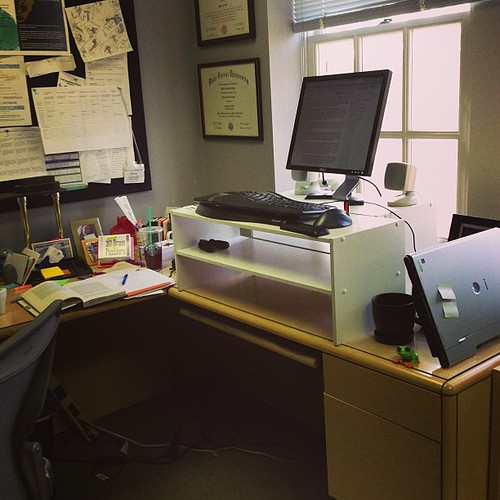
I measured the height of my elbows atop my desk surface while standing, and found a nearly yard-wide ClosetMaid shoe shelf at Target that would raise my ergonomic keyboard to that level and have plenty of room for my trackball on the side. A similar (narrower) shelf elevates my monitor, but not enough -- I really need to raise it another few inches to make it perfect.
Changes seem to beget more changes. When I alter my life in one place, I uncover nagging dissatisfactions with the way I've long arranged other things. I'm adapting to more walking, more standing, and devoting gym time to weights instead of cardio (while knowing I needed to do strength training, I've neglected it entirely for years because I was loath to spend any more time working out than I already did). The changes are dramatic, but don't require finding additional time in my day. I'm doing the same things I always have done -- getting my child to school and myself to work, tapping away at the computer, going to the gym three times a week -- but doing them differently, and carefully examining the data that emerges.
Exercise may be the most popular topic for resolutions, in our relatively sedentary land. I've been getting regular exercise for the past several years, but have been less and less enthusiastic about it. After injuring my knee last summer, I spent a few months away from jogging, and found myself equally dissatisfied with less high-impact ways of getting cardio, and filled with dread at the prospect of returning to running, which I find most satisfying at the moment it is over (and not a second before). Running's only attraction to me is that it enables me to get the most exercise in the least amount of time ... and I neither possessed nor wanted to devote any more time to the tedious process of staying fit.
At the same time, I was unhappy with the habit I had developed of driving Cady Gray to school 3/4 of a mile from our house, then driving to work, about a half mile from the house. It seemed quite the waste of mileage, gas, and stress about parking, when the distances were so eminently walkable. And so I decided that I would combine these two dissatisfactions and start walking to school with Cady Gray and walking to work whenever I could.
The plan worked admirably, putting me at work 15 or 20 minutes later than I used to arrive, but without an early morning class promptness was not of particular concern. And when I arrived, I had already walked more than two miles -- all before the day had even begun. The sense of accomplished engendered in me a desire to know just how much I was getting done. Am I managing to engage in enough activity during the rest of my day to make that 2.15 mile walk a significant part of my health maintenance regimen?
I needed more information. So I joined the ranks of the Quantified Selves by getting a FitBit One, a little device that hangs off my belt loop or clips to my waistband and records the steps I take, the mileage I cover, and the elevation I climb. I've learned that I manage to cover about 8 miles a day -- over 15,000 steps -- when I start off right by staying out of my car. And the desire to push that total as high as I can motivates me to walk across campus for lunch instead of grabbing what's closest. I've long climbed stairs whenever I could, regarding elevators as a unnecessary luxury, but now I welcome errands that take me out of the building because they mean getting two or three more flights climbed on my record.
While setting up this system, getting the devices registered and talking to each other, becoming excited about knowing more intimately how sedentary or active I am in a given day, I experienced a new dissatisfaction. I worked at the computer for hours at a time, sitting all the while. And at the edges of my perception lately, growing more visible and insistent, there is the research showing that too much sitting is bad for you, no matter how much exercise you get when you're up and about. Noel has been using a standing desk for several months now, alternating between its front-room location for the writing he does while listening to music, and the living room where he sits for his writing while watching film or TV. The more I became immersed in the ecosystem of personal tracking, the more it rankled that I was spending so much of my day perched on a chair.
I measured the height of my elbows atop my desk surface while standing, and found a nearly yard-wide ClosetMaid shoe shelf at Target that would raise my ergonomic keyboard to that level and have plenty of room for my trackball on the side. A similar (narrower) shelf elevates my monitor, but not enough -- I really need to raise it another few inches to make it perfect.
Changes seem to beget more changes. When I alter my life in one place, I uncover nagging dissatisfactions with the way I've long arranged other things. I'm adapting to more walking, more standing, and devoting gym time to weights instead of cardio (while knowing I needed to do strength training, I've neglected it entirely for years because I was loath to spend any more time working out than I already did). The changes are dramatic, but don't require finding additional time in my day. I'm doing the same things I always have done -- getting my child to school and myself to work, tapping away at the computer, going to the gym three times a week -- but doing them differently, and carefully examining the data that emerges.
Tuesday, December 4, 2012
Strix varia
Monday, November 5 was the day before Election Day. I was anxious as the last hours of the campaign ticked away. After spending part of the afternoon calling voters in North Carolina, I went out to the Jewel Moore Nature Reserve to run.
Thirty minutes of my usual slow jog, and I was exhausted. My iPhone app told me I was done, so I slowed to a walk and went a few more steps down the trail, out of the restored prairie and into the bordering wood. A circle of benches beckoned; I flopped down on my back, the Decemberists ringing in my ears, and let my arms dangle. Blood roared through my head, and I felt gravity tugging at my face like I was in a centrifuge. I lay there for a few minutes, utterly immobile, as the evening began to fall around me.
When I decided to get up, I did so slowly. Upright at last, I raised my head and took a step forward -- then froze. A gigantic owl was sitting in a tree not eight feet in front of me, maybe another eight feet above my head. Staring at me.

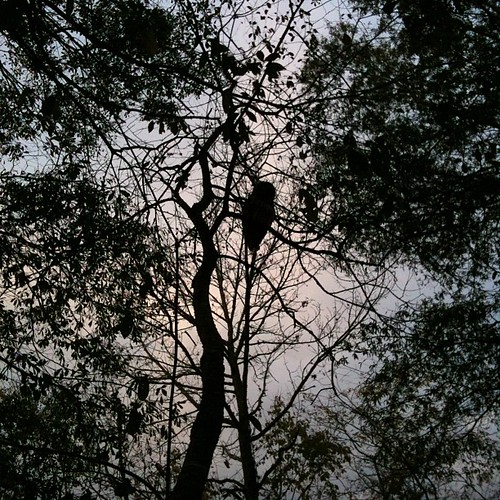
I didn't want to move, lest I break the spell. But the owl couldn't have been less rattled. It gazed at me, then swiveled its swivelly head to look out toward the prairie. Its sudden presence felt like a portent. I moved carefully around it for twenty full minutes, watching and periodically trying to get a cell phone picture -- nearly impossible in the gathering dark, against a silhouetting sky. This is the best I could do:
Until it left me of its own accord, I didn't feel I could leave the owl. It was the one who had the right to declare the encounter finished. And finally it spread its wings and flew a bit deeper into the trees, and I went home with my head spinning. To have such an experience on such a day. Surely it must mean something.
When I got home I told Cady Gray, my budding birder, all about it, and we went looking for pictures of Arkansas owls. A barred owl -- that's what it was, I realized. The owl commonly called a hoot owl.
I was thinking about that barred owl while walking through the nature reserve this past Friday, almost four weeks after that experience. "It was just about here," I recalled idly, and then -- I saw it again. This time on a low branch, fifteen feet down the trail, below my eyeline. Staring right at me again. And once again, I froze with my heart beating faster in my chest.
Was it the same one? From this angle, it looked a bit smaller than the almost two-foot length of my election eve owl. Maybe the coloring was a bit different, not quite as white around the face? I wasn't even certain it was another barred owl. While I was still wondering, it gathered itself, spread its wings, and flew right past me on its way to a higher branch overlooking the prairie. Involuntarily, I spoke aloud: "It's you!"
My walk abandoned, I followed the owl when it moved, in a completely unrushed fashion, to another tree after ten minutes or so. Then it seemed settled. Finally my time was up; dinner would be waiting for me at home. I had to back away from the owl's lead. I left it perched against the disappearing sundown in the western sky.
In the reflective, contemplative, self-assessing mood I've been occupying for the last month, the owl looms large. Birds represent freedom, owls in particular wisdom. I've thought about Athena and Harry Potter. I've turned over the long stretches of time I spent with this owl, searching for clues to its significance. The way it transcends its environment, refusing to be startled or spooked, moving its its own good time. The way it observes, turning its gaze on everything in all directions as it chooses. The fact that the barred owl is the only eastern U.S. owl with brown eyes rather than yellow ones.
I don't know if the owl has anything to teach me. But after two encounters in the past month, both up close and unbidden, it certainly has my attention.
Thirty minutes of my usual slow jog, and I was exhausted. My iPhone app told me I was done, so I slowed to a walk and went a few more steps down the trail, out of the restored prairie and into the bordering wood. A circle of benches beckoned; I flopped down on my back, the Decemberists ringing in my ears, and let my arms dangle. Blood roared through my head, and I felt gravity tugging at my face like I was in a centrifuge. I lay there for a few minutes, utterly immobile, as the evening began to fall around me.
When I decided to get up, I did so slowly. Upright at last, I raised my head and took a step forward -- then froze. A gigantic owl was sitting in a tree not eight feet in front of me, maybe another eight feet above my head. Staring at me.
I didn't want to move, lest I break the spell. But the owl couldn't have been less rattled. It gazed at me, then swiveled its swivelly head to look out toward the prairie. Its sudden presence felt like a portent. I moved carefully around it for twenty full minutes, watching and periodically trying to get a cell phone picture -- nearly impossible in the gathering dark, against a silhouetting sky. This is the best I could do:
Until it left me of its own accord, I didn't feel I could leave the owl. It was the one who had the right to declare the encounter finished. And finally it spread its wings and flew a bit deeper into the trees, and I went home with my head spinning. To have such an experience on such a day. Surely it must mean something.
When I got home I told Cady Gray, my budding birder, all about it, and we went looking for pictures of Arkansas owls. A barred owl -- that's what it was, I realized. The owl commonly called a hoot owl.
I was thinking about that barred owl while walking through the nature reserve this past Friday, almost four weeks after that experience. "It was just about here," I recalled idly, and then -- I saw it again. This time on a low branch, fifteen feet down the trail, below my eyeline. Staring right at me again. And once again, I froze with my heart beating faster in my chest.
Was it the same one? From this angle, it looked a bit smaller than the almost two-foot length of my election eve owl. Maybe the coloring was a bit different, not quite as white around the face? I wasn't even certain it was another barred owl. While I was still wondering, it gathered itself, spread its wings, and flew right past me on its way to a higher branch overlooking the prairie. Involuntarily, I spoke aloud: "It's you!"
My walk abandoned, I followed the owl when it moved, in a completely unrushed fashion, to another tree after ten minutes or so. Then it seemed settled. Finally my time was up; dinner would be waiting for me at home. I had to back away from the owl's lead. I left it perched against the disappearing sundown in the western sky.
In the reflective, contemplative, self-assessing mood I've been occupying for the last month, the owl looms large. Birds represent freedom, owls in particular wisdom. I've thought about Athena and Harry Potter. I've turned over the long stretches of time I spent with this owl, searching for clues to its significance. The way it transcends its environment, refusing to be startled or spooked, moving its its own good time. The way it observes, turning its gaze on everything in all directions as it chooses. The fact that the barred owl is the only eastern U.S. owl with brown eyes rather than yellow ones.
I don't know if the owl has anything to teach me. But after two encounters in the past month, both up close and unbidden, it certainly has my attention.
Saturday, August 18, 2012
Lying in them
Earlier this summer, I suddenly started making beds.
Not obsessively. But regularly. And for the first time in my adult life.
If I were seeing a therapist, we would probably already have had several long chats about this abrupt change in my behavior. Since I stopped living at home full time at age 18, right up until now, I have never voluntarily made a bed unless guests were coming over and a house tour was likely. I never saw the point. You wrestle the sheets and blankets into place, and then a few hours later you mess them up again. Just leave 'em messed up. All muss, no fuss. As long as nobody but you is going to see it, who cares?
And then, sometime in June, I woke up, got out of bed, got dressed, and decided for some reason to straighten the bottom sheets and smooth out the beautiful king-size quilt that Noel's mom made for us and that covers our bed. Or doesn't, because I never make the bed. Usually the quilt is flipped and skewed and tangled with the sheets. If I had to peg one reason I decided to make the bed that day, it would be because I wanted the quilt to look nice, the way it does after the cleaners have just been to the house and the beds have all been changed.
I didn't go whole hog. Didn't make sure everything was neatly tucked all the way around; just left the sheets hanging off the sides. No hospital corners. As I've just now realized writing this, I still have no dust ruffles on any of our beds to hide the bare box springs (another conventional homemaking practice I've never seen the point of), so the "made bed" is probably still a mess by most civilized standards. But the quilt was centered, and smooth. The pillows were stacked neatly if not decoratively at the head. It was a bed that looked different than one that had just been slept in. It was a bed that looked like it was waiting to be slept in later, instead of one that had just disgorged its occupants.
Then I did the same to the kids' beds. And the next day I did it again. And I didn't stop. Even when we went on vacation, staying in two places that didn't have daily maid service, I made the beds.
I liked it. Not the making of the beds, but the made beds that greeted me when I went in and out of the room throughout the day. And at least in the desultory way I went about it, the process took very little time or energy. I think I experienced a shift in perspective. Before, I saw making beds as something you did to finish a night's sleep, and I found it pointless because I was ready to move on. Now, I see making beds as something you do to start the day. So you can have a room that's ready to live in.
Cady Gray took to thanking me for her made bed shortly after I changed my habits. We talked about how nice it was to have that big piece of furniture neatened up, how welcoming that smooth coverlet is for lounging with a book as she loves to do. And I realized that making the kids' beds is an important broken windows strategy to help them keep their rooms neat and floors clear, as their dad likes them to do. And if they are able to do that, then all of us are far less stressed as we pass through our home without seeing messes that demand to be cleaned up or (worse) are too massive to tackle ad hoc.
My mother is probably laughing her head off right now as my dad reads her this account of my sudden change of behavior. It's not her fault I spent thirty years as a bed rebel. She did her best to get all of us into the habit. Like most people, I went my own way during college, and then I just took a lot longer to find my way back than others. A lot of folks revert to the basic civilized conventions quickly when they get a chance to control their environments. Others walk the walk, but feel guilty that they don't derive the right level of satisfaction from these domestic niceties, or that no matter how they try they won't measure up. I made my dissent into a habit and (mostly) refused to feel inadequate about it, except when it was exposed to others and I couldn't help resenting the judgment I imagined them passing.
And now I've joined the ranks of barely-minimum adequacy in the bed-making department, not nearly enough for Martha Stewart I'm sure, but a huge leap for me. It's not the result of some determined effort of self-improvement or long-procrastinated adulthood. Just a whim that's persisted so far, under summer conditions when there's little pressure to leave home in the morning in an all-fired hurry. We'll see if it survives once school starts next week. And we'll see if it's part of a pattern -- if it means anything more than my conscious mind grasps right now.
Not obsessively. But regularly. And for the first time in my adult life.
If I were seeing a therapist, we would probably already have had several long chats about this abrupt change in my behavior. Since I stopped living at home full time at age 18, right up until now, I have never voluntarily made a bed unless guests were coming over and a house tour was likely. I never saw the point. You wrestle the sheets and blankets into place, and then a few hours later you mess them up again. Just leave 'em messed up. All muss, no fuss. As long as nobody but you is going to see it, who cares?
And then, sometime in June, I woke up, got out of bed, got dressed, and decided for some reason to straighten the bottom sheets and smooth out the beautiful king-size quilt that Noel's mom made for us and that covers our bed. Or doesn't, because I never make the bed. Usually the quilt is flipped and skewed and tangled with the sheets. If I had to peg one reason I decided to make the bed that day, it would be because I wanted the quilt to look nice, the way it does after the cleaners have just been to the house and the beds have all been changed.
I didn't go whole hog. Didn't make sure everything was neatly tucked all the way around; just left the sheets hanging off the sides. No hospital corners. As I've just now realized writing this, I still have no dust ruffles on any of our beds to hide the bare box springs (another conventional homemaking practice I've never seen the point of), so the "made bed" is probably still a mess by most civilized standards. But the quilt was centered, and smooth. The pillows were stacked neatly if not decoratively at the head. It was a bed that looked different than one that had just been slept in. It was a bed that looked like it was waiting to be slept in later, instead of one that had just disgorged its occupants.
Then I did the same to the kids' beds. And the next day I did it again. And I didn't stop. Even when we went on vacation, staying in two places that didn't have daily maid service, I made the beds.
I liked it. Not the making of the beds, but the made beds that greeted me when I went in and out of the room throughout the day. And at least in the desultory way I went about it, the process took very little time or energy. I think I experienced a shift in perspective. Before, I saw making beds as something you did to finish a night's sleep, and I found it pointless because I was ready to move on. Now, I see making beds as something you do to start the day. So you can have a room that's ready to live in.
Cady Gray took to thanking me for her made bed shortly after I changed my habits. We talked about how nice it was to have that big piece of furniture neatened up, how welcoming that smooth coverlet is for lounging with a book as she loves to do. And I realized that making the kids' beds is an important broken windows strategy to help them keep their rooms neat and floors clear, as their dad likes them to do. And if they are able to do that, then all of us are far less stressed as we pass through our home without seeing messes that demand to be cleaned up or (worse) are too massive to tackle ad hoc.
My mother is probably laughing her head off right now as my dad reads her this account of my sudden change of behavior. It's not her fault I spent thirty years as a bed rebel. She did her best to get all of us into the habit. Like most people, I went my own way during college, and then I just took a lot longer to find my way back than others. A lot of folks revert to the basic civilized conventions quickly when they get a chance to control their environments. Others walk the walk, but feel guilty that they don't derive the right level of satisfaction from these domestic niceties, or that no matter how they try they won't measure up. I made my dissent into a habit and (mostly) refused to feel inadequate about it, except when it was exposed to others and I couldn't help resenting the judgment I imagined them passing.
And now I've joined the ranks of barely-minimum adequacy in the bed-making department, not nearly enough for Martha Stewart I'm sure, but a huge leap for me. It's not the result of some determined effort of self-improvement or long-procrastinated adulthood. Just a whim that's persisted so far, under summer conditions when there's little pressure to leave home in the morning in an all-fired hurry. We'll see if it survives once school starts next week. And we'll see if it's part of a pattern -- if it means anything more than my conscious mind grasps right now.
Saturday, March 31, 2012
Nothing but a number
When I was a kid, like any good middle child I measured my birthdays and age against that of my two brothers. Specifically against my older brother, who was born three and a half years before me. When his March 30 birthday rolled around, I know I had six months ahead where he would be four years older than me, in terms of the round yearly number we all use post-toddlerhood. Then in October, I would catch back up, and enjoy six months of being only three years his junior.
Yesterday my brother turned 50. That's a big one, and I've known it was headed my way for some time. The fact that Dwayne has hit it brings the reality of its approach home again. Right now he's four years older than me; in October, I'll close the gap again.
Another way to look at age is in terms of career. I got started pretty late, as many academics do, having taken my time wending my way through grad school. I landed my first and only university job in 1999, and I'm currently completing my thirteenth year of teaching. I'll be eligible to apply for full professor status after next year (my first couple of years of teaching were non-tenure track, so I lost a couple of rungs on the ladder). And then I'll be started the next phase of my career, probably looking around to see if my administrative experience might make me useful elsewhere, probably putting myself in position to succeed my current boss when he retires in a few years.
I've got maybe twenty years left in this business. More than I've got behind me. That's kind of the opposite of the age number staring me in the face.
This morning I ran my second 5K of 2012. I hope there will be a handful more before the year ends. When I say "ran," it's even more of an exaggeration than usual; not only was it my usual 12-minute-mile slow jog, but I also walked a lot more than I usually would find acceptable. You see, on Thursday afternoon I came down with the most sudden, violent fever I can remember. I was knitting with my students one minute, and the next I was feeling like crap and trying to get home before the shakes started in earnest. I shivered for an hour, ached for another, then took Motrin. And it was over. I waited for the next twenty-four hours for the other shoe to drop, for the gastrointestinal part of the virus to take hold or whatever, and it never did.
So I took it easy today, still cautious after that strange interlude. And I remember that even though this is the first time in my life that I've ever attempted to run 5Ks, meaning I'm about as healthy as I've ever been, I'm not getting any younger. I don't know how 50 is supposed to feel, and I'm pretty sure I don't feel it anyway, but I wonder how long I'll be able to ignore my age. No use asking Dwayne; he's a lifelong distance runner and still looks and acts like my default image of him, the athletic collegian.
What really makes me feel young is that I keep changing, I keep learning, and I keep reinventing myself. In that respect I really look forward to becoming a full professor and being liberated to look around and see what opportunities are out there for me. It's the kind of new stage in life that gets me energized. Sometimes the years you put into a career are better than a time machine that could take you back to the beginning.
Yesterday my brother turned 50. That's a big one, and I've known it was headed my way for some time. The fact that Dwayne has hit it brings the reality of its approach home again. Right now he's four years older than me; in October, I'll close the gap again.
Another way to look at age is in terms of career. I got started pretty late, as many academics do, having taken my time wending my way through grad school. I landed my first and only university job in 1999, and I'm currently completing my thirteenth year of teaching. I'll be eligible to apply for full professor status after next year (my first couple of years of teaching were non-tenure track, so I lost a couple of rungs on the ladder). And then I'll be started the next phase of my career, probably looking around to see if my administrative experience might make me useful elsewhere, probably putting myself in position to succeed my current boss when he retires in a few years.
I've got maybe twenty years left in this business. More than I've got behind me. That's kind of the opposite of the age number staring me in the face.
This morning I ran my second 5K of 2012. I hope there will be a handful more before the year ends. When I say "ran," it's even more of an exaggeration than usual; not only was it my usual 12-minute-mile slow jog, but I also walked a lot more than I usually would find acceptable. You see, on Thursday afternoon I came down with the most sudden, violent fever I can remember. I was knitting with my students one minute, and the next I was feeling like crap and trying to get home before the shakes started in earnest. I shivered for an hour, ached for another, then took Motrin. And it was over. I waited for the next twenty-four hours for the other shoe to drop, for the gastrointestinal part of the virus to take hold or whatever, and it never did.
So I took it easy today, still cautious after that strange interlude. And I remember that even though this is the first time in my life that I've ever attempted to run 5Ks, meaning I'm about as healthy as I've ever been, I'm not getting any younger. I don't know how 50 is supposed to feel, and I'm pretty sure I don't feel it anyway, but I wonder how long I'll be able to ignore my age. No use asking Dwayne; he's a lifelong distance runner and still looks and acts like my default image of him, the athletic collegian.
What really makes me feel young is that I keep changing, I keep learning, and I keep reinventing myself. In that respect I really look forward to becoming a full professor and being liberated to look around and see what opportunities are out there for me. It's the kind of new stage in life that gets me energized. Sometimes the years you put into a career are better than a time machine that could take you back to the beginning.
Saturday, March 10, 2012
A weekend away
For almost all of the last twelve years -- I don't think I've missed one since I moved to Arkansas -- I've been coming to Dallas on this weekend. It's the annual meeting of the Southwest Commission on Religious Studies, an umbrella organization that organizes a conference for the members of the American Academy of Religion, the Society of Biblical Literature, the American Schools of Oriental Research, and the Association for the Scientific Study of Religion in Texas and surrounding states.
Soon after I started attending, some of the organizers asked me to take leadership roles. I started as a chair of one of the program sessions, then served on the executive committee for the AAR's local branch, then agreed to become the AAR coordinator for the region. The six years of that job are almost up; next year will be my last in that position.
When I come to this meeting, I have a lot of jobs to do. Make decisions as a director of the Commission. Liaise between the AAR portion of the meeting and the meeting planner. Drum up attendance for the plenary. Give most of the reports at the AAR region's annual business meeting. And almost always, give a paper, moderate a session, sit on a panel.
This same weekend, my dad is going to a meeting that he's been attending for years. He's a member of the Kairos team that goes into a prison and spends three days with a group of inmates. The meeting involves months of preparation, like mine. It's packed with activities and a tight schedule, like mine. My dad has several leadership roles to enact, like I do. And there's a connection, too, with the premise of the meeting being religious. Mine is about the study of religion in an academic setting, and his is about practicing one religion's mandate to visit those in prison.
I'm sure readers will have their own opinion about which one is more in sync with their values and more salutary for society. As for me, well, we do good work here at the Southwest Commission on Religious Studies, but it's certainly neither as risky nor as courageous as the work of Kairos. I dare say that while our meeting may reach more people to advance their understanding in ways that improve their teaching of thousands of students, those people reached are already committed to that path, and so the advance is not revolutionary for most or all.
I dare say that the 40 inmates this Kairos weekend will reach are much more in need, and the effect on those men of being listened to and loved is potentially enormous, life-changing. College professors are used to being listened to. We have high social status. We are respected. The opposite is true, in all cases, for men in prison.
You might want to read about my dad's experience this weekend in his blog: http://walkinganewpath.blogspot.com. I am always humbled by what he relates. He may be the most self-critical blogger I read among the hundreds of feeds I follow. While serving others and seeking truth, he's always questioning his own motives and actions -- sometimes to a fault. I need to have more of that in my life, though. My confidence and ambition frequently lead me to believe that I'm a much better, more worthy person than anyone has a right to think themselves.
My dad has always been my role model. These days we often start from different premises in terms of our political and religious stances. The measure of our sincerity and effort surely is that sometimes we end up in the same place.
Those who are with Dad on his Kairos weekend don't have the same doctrine or politics as he does, either. Kairos is interdenominational, and folks participate from the liberal mainline churches, the nondenominational fellowships, the evangelicals and fundamentalists. When they read the Bible, some are reading God's dictation while others are reading human efforts to bear witness. But all are convinced that following the example of Jesus and Paul to pay special attention to society's outcasts is a good idea, good enough to take lots of time and effort and risk to undertake.
I'm convinced of it, too, and convicted. Here I am doing the work given me to do, and I'll do it with all my might, and I know it will make a difference and be appreciated. But how thankful I am that those rockier fields have found their laborers, too, and that I have some insight into their efforts through my dad.
Soon after I started attending, some of the organizers asked me to take leadership roles. I started as a chair of one of the program sessions, then served on the executive committee for the AAR's local branch, then agreed to become the AAR coordinator for the region. The six years of that job are almost up; next year will be my last in that position.
When I come to this meeting, I have a lot of jobs to do. Make decisions as a director of the Commission. Liaise between the AAR portion of the meeting and the meeting planner. Drum up attendance for the plenary. Give most of the reports at the AAR region's annual business meeting. And almost always, give a paper, moderate a session, sit on a panel.
This same weekend, my dad is going to a meeting that he's been attending for years. He's a member of the Kairos team that goes into a prison and spends three days with a group of inmates. The meeting involves months of preparation, like mine. It's packed with activities and a tight schedule, like mine. My dad has several leadership roles to enact, like I do. And there's a connection, too, with the premise of the meeting being religious. Mine is about the study of religion in an academic setting, and his is about practicing one religion's mandate to visit those in prison.
I'm sure readers will have their own opinion about which one is more in sync with their values and more salutary for society. As for me, well, we do good work here at the Southwest Commission on Religious Studies, but it's certainly neither as risky nor as courageous as the work of Kairos. I dare say that while our meeting may reach more people to advance their understanding in ways that improve their teaching of thousands of students, those people reached are already committed to that path, and so the advance is not revolutionary for most or all.
I dare say that the 40 inmates this Kairos weekend will reach are much more in need, and the effect on those men of being listened to and loved is potentially enormous, life-changing. College professors are used to being listened to. We have high social status. We are respected. The opposite is true, in all cases, for men in prison.
You might want to read about my dad's experience this weekend in his blog: http://walkinganewpath.blogspot.com. I am always humbled by what he relates. He may be the most self-critical blogger I read among the hundreds of feeds I follow. While serving others and seeking truth, he's always questioning his own motives and actions -- sometimes to a fault. I need to have more of that in my life, though. My confidence and ambition frequently lead me to believe that I'm a much better, more worthy person than anyone has a right to think themselves.
My dad has always been my role model. These days we often start from different premises in terms of our political and religious stances. The measure of our sincerity and effort surely is that sometimes we end up in the same place.
Those who are with Dad on his Kairos weekend don't have the same doctrine or politics as he does, either. Kairos is interdenominational, and folks participate from the liberal mainline churches, the nondenominational fellowships, the evangelicals and fundamentalists. When they read the Bible, some are reading God's dictation while others are reading human efforts to bear witness. But all are convinced that following the example of Jesus and Paul to pay special attention to society's outcasts is a good idea, good enough to take lots of time and effort and risk to undertake.
I'm convinced of it, too, and convicted. Here I am doing the work given me to do, and I'll do it with all my might, and I know it will make a difference and be appreciated. But how thankful I am that those rockier fields have found their laborers, too, and that I have some insight into their efforts through my dad.
Tuesday, October 25, 2011
In the details
Fall's arrival draws my eyes upwards to the shape of treetops against the deepening blue of the sky. And invariably I think of a day in art class in seventh or eighth grade, and a watercolor still life assignment. The subject was an arrangement of budding branches in a vase. I spent the first few class periods working on the shape of the vase and the precise curvature and proportion of the branches.
Then came the moment to turn to the minuscule reddish-pink flowers on the branches. And that's when I made a decision that I still think about to this day. I felt that no one could be expected to actually paint those tiny petals individually. I was sure I would not be blamed for merely suggesting the flowers, rather than specifying any detail.
So I washed a kind of general pink haze around those carefully delineated branches. And then I went on to wash some blue and green behind that as a sort of paint backdrop.
It was a terrible copout, and an even worse picture. I got a bad grade. I can still see how awful it looked -- like I'd just given up. Which is what I did.
Looking at those trees today, with each leaf of tens of thousands sharply evident against the sky as if pasted on by collage-style, I perceive that these details, at every scale, are a key to the meaning of life. And I see my knitting and crocheting work as a remedy for my former negligence. Stitch by stitch is how we have to go. There's no way to take a short-cut or fake your way to the end; every thing you do, good ideas and bad, careful decisions and careless, become details in the finished object. They might be details you treasure or ones you wish you could forget. Leaf by leaf, petal by petal, stitch by stitch -- the edges clear, the individuality unmistakeable, the whole constructed thereof.
Then came the moment to turn to the minuscule reddish-pink flowers on the branches. And that's when I made a decision that I still think about to this day. I felt that no one could be expected to actually paint those tiny petals individually. I was sure I would not be blamed for merely suggesting the flowers, rather than specifying any detail.
So I washed a kind of general pink haze around those carefully delineated branches. And then I went on to wash some blue and green behind that as a sort of paint backdrop.
It was a terrible copout, and an even worse picture. I got a bad grade. I can still see how awful it looked -- like I'd just given up. Which is what I did.
Looking at those trees today, with each leaf of tens of thousands sharply evident against the sky as if pasted on by collage-style, I perceive that these details, at every scale, are a key to the meaning of life. And I see my knitting and crocheting work as a remedy for my former negligence. Stitch by stitch is how we have to go. There's no way to take a short-cut or fake your way to the end; every thing you do, good ideas and bad, careful decisions and careless, become details in the finished object. They might be details you treasure or ones you wish you could forget. Leaf by leaf, petal by petal, stitch by stitch -- the edges clear, the individuality unmistakeable, the whole constructed thereof.
Tuesday, September 20, 2011
Eminent
I answered the phone at work today with my usual "This is Donna Bowman." "Is this the eminent professor and theologian Donna Bowman?" I heard, and midway through the sentence I started laughing out loud. That's the way my mentor and adviser at the University of Georgia, Dr. Will Power, always addresses me on the phone, and it couldn't be more charming.
Will wanted to ask about some new books in the field, hash over whether God should be viewed as a series of temporal occasions or as a single non-temporal instance (an evergreen discussion), and chat about mutual acquaintances. I was thrilled to hear him so full of life and energy, just as if twenty years hadn't passed since he taught my classes, or a couple of years since our last conversation. He's still teaching even though he could have retired with forty years' service four years ago, and if it keeps him that young, I say more power to him.
We have so many great tools for keeping in touch with old friends and colleagues now. And "in touch" is just the right metaphor; Facebook and other social networks let me observe them at an arm's length, making a closer move if I like but otherwise just watching the flow of what they choose to share.
But with members of an older generation, or those who for personal reasons have opted out of those sites, we have the joy that comes from regaining contact after extended silences. I couldn't be happier to find that my wonderful professor, who inspired me so much, is still thinking of me and still inspiring others. A moment of pure grace and joy.
Will wanted to ask about some new books in the field, hash over whether God should be viewed as a series of temporal occasions or as a single non-temporal instance (an evergreen discussion), and chat about mutual acquaintances. I was thrilled to hear him so full of life and energy, just as if twenty years hadn't passed since he taught my classes, or a couple of years since our last conversation. He's still teaching even though he could have retired with forty years' service four years ago, and if it keeps him that young, I say more power to him.
We have so many great tools for keeping in touch with old friends and colleagues now. And "in touch" is just the right metaphor; Facebook and other social networks let me observe them at an arm's length, making a closer move if I like but otherwise just watching the flow of what they choose to share.
But with members of an older generation, or those who for personal reasons have opted out of those sites, we have the joy that comes from regaining contact after extended silences. I couldn't be happier to find that my wonderful professor, who inspired me so much, is still thinking of me and still inspiring others. A moment of pure grace and joy.
Wednesday, August 3, 2011
Fools and their land are soon parted
I've never met any other family who owned the party game Wise and Otherwise. But it's become a legend in ours. In this game, someone reads out the first half of an old ethnic saying, viz., "There's an old Polish saying: If you knock three times with no answer ..." Then everybody writes down a more or less plausible conclusion to the saying, which is then combined with the real ending and read out for votes Dictionary-style.
The importance of this game to our family comes from a memorable occasion in which the saying to be completed was "Darkness conceals ..." My older brother's answer, "... the fool's shoddy workmanship," is a masterpiece of Wise and Otherwise misplay. Note the reliance on a proverbial construct, the fool; note, too, that the word "workmanship" is not only odd, but is judged incapable of standing on its own without the strangely archaic adjective "shoddy." Put it all together, and "Darkness conceals the fool's shoddy workmanship" has, improbably enough, become an actual saying in our household.
As the caretakers of the Wise and Otherwise game, we were implored by this reunion's organizers (my parents) to bring it along, and tonight we broke it out for an hour's hilarious play. You know a game is going well when the very first candidate read for our votes, "When the rats have enough food, there be nothing left in Mother Hubbard's cupboard" could not be completed without the poor reader cracking up. (Yep, that's a Dwayne classic too my mistake; it was my sister-in-law playing on his team, clearly affected by decades of close contact with the master, from the affected "there be" verb to the allusion to a nursery rhyme probably unknown in the country of this saying's origin.
Pretty soon, every time someone mentioned "fool," "land," "wisdom," or "piled high like the snows in winter," the room broke up. I don't know whether this game plays this well for all gatherings, but for our family, it's a guaranteed good time.
The importance of this game to our family comes from a memorable occasion in which the saying to be completed was "Darkness conceals ..." My older brother's answer, "... the fool's shoddy workmanship," is a masterpiece of Wise and Otherwise misplay. Note the reliance on a proverbial construct, the fool; note, too, that the word "workmanship" is not only odd, but is judged incapable of standing on its own without the strangely archaic adjective "shoddy." Put it all together, and "Darkness conceals the fool's shoddy workmanship" has, improbably enough, become an actual saying in our household.
As the caretakers of the Wise and Otherwise game, we were implored by this reunion's organizers (my parents) to bring it along, and tonight we broke it out for an hour's hilarious play. You know a game is going well when the very first candidate read for our votes, "When the rats have enough food, there be nothing left in Mother Hubbard's cupboard" could not be completed without the poor reader cracking up. (
Pretty soon, every time someone mentioned "fool," "land," "wisdom," or "piled high like the snows in winter," the room broke up. I don't know whether this game plays this well for all gatherings, but for our family, it's a guaranteed good time.
Tuesday, August 2, 2011
Rocky Top
I grew up in Tennessee. So did my brothers. So, for that matter, did my parents. They were actually born within a few days of each other at Erlanger Hospital in Chattanooga.
Tennessee will always be my home. Our home. But none of us lives there anymore.
Several years ago, when Archer was small, we all gathered in Chattanooga, our hometown. We stayed at a hotel and went to the aquarium and the carousel and the choo-choo. I even drove around the campus of my high school -- no one was there, it was summer. That's the only time I've been back since my folks moved away from Chattanooga while I was in grad school.
We're in Tennessee this week -- all the siblings and their families and the patriarch and matriarch. It's not any place in Tennessee that has special meaning to us, just a lovely resort near one of the massive lakes created by the TVA back in the last century, lakes we were taught in school to regard as wonders of human ingenuity and triumphs over nature. The distinguishing features of the place are that we're all able to reach it in a day's drive, there's lots to do for the kids, and we can all be accommodated together in gigantic suites with kitchens where each family takes turns cooking for the group.
Yet driving through this landscape will always bring it all back to me. I have an affection for the distinctive feel of each of the places I've lived -- eastern Tennessee, central North Carolina, central Georgia, central Virginia, and now central Arkansas. The air feels different, the vegetation smells different, the soil crumbles differently, the hills rise and fall in distinctive wrinkles. It's the close gaps and expansive plateaus of eastern Tennessee, though, that will always send me straight back into my childhood.
Tennessee will always be my home. Our home. But none of us lives there anymore.
Several years ago, when Archer was small, we all gathered in Chattanooga, our hometown. We stayed at a hotel and went to the aquarium and the carousel and the choo-choo. I even drove around the campus of my high school -- no one was there, it was summer. That's the only time I've been back since my folks moved away from Chattanooga while I was in grad school.
We're in Tennessee this week -- all the siblings and their families and the patriarch and matriarch. It's not any place in Tennessee that has special meaning to us, just a lovely resort near one of the massive lakes created by the TVA back in the last century, lakes we were taught in school to regard as wonders of human ingenuity and triumphs over nature. The distinguishing features of the place are that we're all able to reach it in a day's drive, there's lots to do for the kids, and we can all be accommodated together in gigantic suites with kitchens where each family takes turns cooking for the group.
Yet driving through this landscape will always bring it all back to me. I have an affection for the distinctive feel of each of the places I've lived -- eastern Tennessee, central North Carolina, central Georgia, central Virginia, and now central Arkansas. The air feels different, the vegetation smells different, the soil crumbles differently, the hills rise and fall in distinctive wrinkles. It's the close gaps and expansive plateaus of eastern Tennessee, though, that will always send me straight back into my childhood.
Saturday, July 2, 2011
Madeleine
We had lunch at Panera Bread today. Since it's Saturday -- an S day -- I got to contemplate choosing a dessert from their bakery section.
Usually in this situation I would find the chocolatey-est thing on the shelf. I have only a few sweet opportunities a week; I try not to waste them on anything non-chocolate.
But last time I took the kids to Panera Bread, Cady Gray picked out a thick, flower-shaped sugar cookie with bright yellow and pink sprinkles. It looked so cheery that I decided to try it today, much to Noel's surprise. I tucked it in my purse and brought it home; an hour or so later, I unwrapped it, broke off a piece, and popped it in my mouth.
Perhaps you've had this particular cookie. A quick Google search finds people in search of the recipe. All I can say is that it was something far greater than what I was expecting. Thick, buttery, not just sugary but also with the underlying rustic richness of shortbread, accented with the sharp, sweet hit of the sprinkles coated on the top.
I involuntarily exclaimed at its goodness, earning a longsuffering look from Noel (whose low-carb diet would recoil in horror from such a confection). It was an instant trip back in time, both to the thick homemade sugar cookies we helped bake for holidays, and to the shortbread biscuits that my Scottish grandmother always gave us when we visited her, dispensed from a tartan-covered package.
It's been a long time since I was brought up so short by a morsel of food. I felt like I had taken a bite of summer itself. A reminder of the power of taste, and a call to expand my dessert horizons every so often.
Usually in this situation I would find the chocolatey-est thing on the shelf. I have only a few sweet opportunities a week; I try not to waste them on anything non-chocolate.
But last time I took the kids to Panera Bread, Cady Gray picked out a thick, flower-shaped sugar cookie with bright yellow and pink sprinkles. It looked so cheery that I decided to try it today, much to Noel's surprise. I tucked it in my purse and brought it home; an hour or so later, I unwrapped it, broke off a piece, and popped it in my mouth.
Perhaps you've had this particular cookie. A quick Google search finds people in search of the recipe. All I can say is that it was something far greater than what I was expecting. Thick, buttery, not just sugary but also with the underlying rustic richness of shortbread, accented with the sharp, sweet hit of the sprinkles coated on the top.
I involuntarily exclaimed at its goodness, earning a longsuffering look from Noel (whose low-carb diet would recoil in horror from such a confection). It was an instant trip back in time, both to the thick homemade sugar cookies we helped bake for holidays, and to the shortbread biscuits that my Scottish grandmother always gave us when we visited her, dispensed from a tartan-covered package.
It's been a long time since I was brought up so short by a morsel of food. I felt like I had taken a bite of summer itself. A reminder of the power of taste, and a call to expand my dessert horizons every so often.
Thursday, June 16, 2011
Security

July 31, 2009
I walked into Archer's room yesterday and found Cady Gray holding a battered blue Magna Doodle. "Remember this, Mom?" she asked, holding it up. "Archer used to take this everywhere."
He sure did. And not just because he liked it -- because he needed it. Not that long ago, the most frequent sound heard in Archer's presence was the zip-thunk of the eraser bar being pulled back and forth. Archer kept track of things on that Magna Doodle. We didn't always know what he was keeping track of, but he had to do it. He scrawled scoreboards and charts and announcements and informational signs and highway numbers and who knows what all on there. Scribble, scribble -- ten or fifteen seconds -- zip-thunk, erase and do it again. All day long.
Magna Doodles don't last forever. The eraser bar gets hard to pull. The magnetic particles inside lose their potency somehow. The screen gets gray and accumulates dead pixels. And sometimes a boy accidentally leaves it in a restaurant somewhere, or can't locate it in his room. Such occasions were dire emergencies at our house. Archer would break down in tears and beg us to make it right. We usually had a spare one stashed somewhere, either a new one or an old discarded one. In extreme cases, these would not do; only the current Magna Doodle was acceptable. When it was time to buy a new one, we had to prep Archer that it was coming and why it was necessary, and he was usually fine with it. An ad hoc substitution -- "here, we have this new one to replace the one you can't find!" -- often led to howls of rejection and an escalation of the emergency.
"This is how you erase it," Cady Gray continued, demonstrating the technique. "Archer doesn't use this anymore." "I guess he doesn't need it," I told her.
"Hey Archer," I asked, as he entered the room. "Remember when you used to carry this MagnaDoodle all the time? You don't do that anymore, do you?"
He paused for a moment in the midst of getting whatever he had come for. "Yeah, I don't need it. I can just keep track of the points in my head now."
Wednesday, May 11, 2011
Makin' things with light
Thanks to a question on Cash Cab this evening, Noel and I amused our children briefly with a duet version of the Lite-Brite theme song: "Lite Brite! Makin' things with liiiiight ... What a sight, makin' things with Lite Brite!"
Lite Brite is one of those Generation X toys that people my age remember fondly. Some of them I never owned, but I can't deny that we owned a Lite Brite. I dutifully made all the the designs that came with it -- you may recall that they were printed on black paper which you inserted behind the pegboard, and when you put the peg in you actually punctured the paper.
You also got blank sheets of black paper on which you could make your own designs. I remember making title cards for the puppet shows that my brother and I put on for the family. And if I'm not mistaken, we managed to hold onto our Lite Brite long enough to lose some significant number of the colored pegs that came with it, necessitating the buying of a replacement pack.
Do you have any Lite Brite memories? Original Lite Brite or later-generation variants are both acceptable.
Lite Brite is one of those Generation X toys that people my age remember fondly. Some of them I never owned, but I can't deny that we owned a Lite Brite. I dutifully made all the the designs that came with it -- you may recall that they were printed on black paper which you inserted behind the pegboard, and when you put the peg in you actually punctured the paper.
You also got blank sheets of black paper on which you could make your own designs. I remember making title cards for the puppet shows that my brother and I put on for the family. And if I'm not mistaken, we managed to hold onto our Lite Brite long enough to lose some significant number of the colored pegs that came with it, necessitating the buying of a replacement pack.
Do you have any Lite Brite memories? Original Lite Brite or later-generation variants are both acceptable.
Wednesday, March 2, 2011
Catching up and moving forward
In the press of raising small children, getting tenured and promoted, and taking on various leadership positions in scholarly organizations, I let a lot of things slide. Last year I resolved to change my ways on some of those things. I scheduled long-neglected checkups, updated our insurance coverage, and arranged for some badly-needed home improvements.
Much still remains to be done. And my "be a better person" campaign (as I thought of it) would be pretty depressing if I focused on all the neglected things I failed to pick back up last year. I'm the kind of person that can let the mountain of needs keep me from accomplishing anything at all. I get overwhelmed and discouraged by the length of the to-do list, and it paralyzes me.
But it feels good to have a few of those items under my belt, especially the ones I felt guiltiest about. I think, however, that it's important not just to try to get back to even (and I'm a long way from it), but also to start new endeavors. Otherwise, the endless process of clawing towards basic respectability and responsibility would be too dispiriting. So I enjoy the feeling of moving forward, learning something new, advancing in areas I've identified as personally fulfilling.
For some people, being an adult means keeping the bills paid and the taxman away from the door. That's certainly part of it, but if it were all about plugging holes in the dike and shoveling back the encroaching sea, there'd be little to look forward to. I couldn't be happier that at the same time I'm trying to keep up with the treadmill, I'm also actually trying to get better -- not just from the low standard I've set with my failures, but from the level of skill and accomplishment I've reach to this point.
Much still remains to be done. And my "be a better person" campaign (as I thought of it) would be pretty depressing if I focused on all the neglected things I failed to pick back up last year. I'm the kind of person that can let the mountain of needs keep me from accomplishing anything at all. I get overwhelmed and discouraged by the length of the to-do list, and it paralyzes me.
But it feels good to have a few of those items under my belt, especially the ones I felt guiltiest about. I think, however, that it's important not just to try to get back to even (and I'm a long way from it), but also to start new endeavors. Otherwise, the endless process of clawing towards basic respectability and responsibility would be too dispiriting. So I enjoy the feeling of moving forward, learning something new, advancing in areas I've identified as personally fulfilling.
For some people, being an adult means keeping the bills paid and the taxman away from the door. That's certainly part of it, but if it were all about plugging holes in the dike and shoveling back the encroaching sea, there'd be little to look forward to. I couldn't be happier that at the same time I'm trying to keep up with the treadmill, I'm also actually trying to get better -- not just from the low standard I've set with my failures, but from the level of skill and accomplishment I've reach to this point.
Saturday, December 4, 2010
Beginning to look a lot like
We were invited to a holiday party tonight at the best decorated house in the neighborhood. That may sound like some kind of boast, but really, I think no one in our little rectangle of streets and cul-de-sacs would dispute the title. For Halloween they fill their large corner yard with ghoulish displays, and for Christmas the lights cover every inch of the property.
It's the first time we've been inside, though, and what a revelation -- Archer announced after his whirlwind tour that there were twenty-six trees of all shapes and sizes. Skinny hallway trees, full-sized color-themed trees, tabletop trees, even a rotating tree. And in between the trees were garlands, lighted villages (at least three huge sets), Santas, snowmen, trains, carolers, twinkles and merries on every available surface, horizontal or vertical.
The kids adored the spectacle and would have stayed for hours searching for the Christmas pickle and peanut our hosts told us were on one of the trees. The warmth and wonder of that house, inside and out, reminded me of a lifetime of decorating for Christmas. I can't imagine spending a tenth as much time or effort as the family that lives there, but I do remember well what it meant to my parents and their parents to pull down the Christmas boxes from the attic every year and lovingly place each element yet again.
My favorite Christmas decoration from my childhood was probably a white ceramic tree, about a foot tall, equipped with an incandescent light bulb inside. When we visited our paternal grandparents for the holidays, I always looked forward to the job of putting colored transparent pegs in the holes and watching them light up. Something about adding light to a Christmas decoration made it magical for me; I felt the same way about a set of ceramic carolers my mother had, who gathered around a lamp post with a soft white nightlight bulb shedding light on the scene.
What was your favorite holiday decoration as a kid?
It's the first time we've been inside, though, and what a revelation -- Archer announced after his whirlwind tour that there were twenty-six trees of all shapes and sizes. Skinny hallway trees, full-sized color-themed trees, tabletop trees, even a rotating tree. And in between the trees were garlands, lighted villages (at least three huge sets), Santas, snowmen, trains, carolers, twinkles and merries on every available surface, horizontal or vertical.
The kids adored the spectacle and would have stayed for hours searching for the Christmas pickle and peanut our hosts told us were on one of the trees. The warmth and wonder of that house, inside and out, reminded me of a lifetime of decorating for Christmas. I can't imagine spending a tenth as much time or effort as the family that lives there, but I do remember well what it meant to my parents and their parents to pull down the Christmas boxes from the attic every year and lovingly place each element yet again.
My favorite Christmas decoration from my childhood was probably a white ceramic tree, about a foot tall, equipped with an incandescent light bulb inside. When we visited our paternal grandparents for the holidays, I always looked forward to the job of putting colored transparent pegs in the holes and watching them light up. Something about adding light to a Christmas decoration made it magical for me; I felt the same way about a set of ceramic carolers my mother had, who gathered around a lamp post with a soft white nightlight bulb shedding light on the scene.
What was your favorite holiday decoration as a kid?
Wednesday, November 17, 2010
The show must go on
Tonight as I took Archer to his piano lesson in my university's music department, we passed through a lobby full of undergraduates in long dresses, heels, and incongruous winter jackets against the cold rain outside. They clumped in excited gaggles outside of the recital hall, a few breaking off every so often to run after some forgotten item or person. Soon they'd be herded into a rehearsal space to make final preparations for their choir concert.
After Archer's lesson, his teacher mentioned that the end of term recital would be coming up for him, too. He has three pieces to memorize. Immediately that brought back memories of last year's recital; it was a watershed moment for me, seeing how Archer could concentrate and perform under pressure.
And of course it reminds me of the many, many recitals in my childhood. There were choral performances galore, and those I loved. Piano recitals, not so much. The individual pressure was less to my liking; the nakedness of the performance and the complexity of the task intimidated me. I was more confident as a singer, less nervous about making mistakes -- certain, in fact, that I would not -- and had a lot more fun making music with my voice.
As an adult I'm more accustomed to individual performances, and more confident that I can pull off a success even when I'm going it alone. So now I'm nervous for the child I used to be. We've tried to raise kids who believe in their own abilities implicitly. I hope they take pleasure in stepping up to the plate and knocking it out of the park when they get their chance.
Monday, October 11, 2010
Lucky town
Tomorrow is my fourteenth wedding anniversary. On October 12, 1996, Noel and I got married, and remarkably our parents seemed happy about the event, despite our combined lack of marketable skills. We just knew we wanted to be together.
Now there are two bubbly, energetic kids bouncing around the house. Oh, there's a house, in a town where I have a job. There's a two car garage with two cars in it. There are all the trappings of settled life. It's not as luxurious as many, but in so many ways it feels like a damn sight more than I deserve.
On beautiful fall evenings, with the Japanese maples blazing with color and the sunset filtering in through the windshield, I like to think about the little miracle of my life as I drive through town. The careers that we have, just about exactly what we would have chosen if we had been designing our own jobs. The children -- so astoundingly bright, so wonderfully happy, so achingly beautiful.
None of that is forever, of course. It could all be taken away tomorrow. But what unmerited good fortune -- what grace -- to have enjoyed it even for a moment.
Now there are two bubbly, energetic kids bouncing around the house. Oh, there's a house, in a town where I have a job. There's a two car garage with two cars in it. There are all the trappings of settled life. It's not as luxurious as many, but in so many ways it feels like a damn sight more than I deserve.
On beautiful fall evenings, with the Japanese maples blazing with color and the sunset filtering in through the windshield, I like to think about the little miracle of my life as I drive through town. The careers that we have, just about exactly what we would have chosen if we had been designing our own jobs. The children -- so astoundingly bright, so wonderfully happy, so achingly beautiful.
None of that is forever, of course. It could all be taken away tomorrow. But what unmerited good fortune -- what grace -- to have enjoyed it even for a moment.
Subscribe to:
Posts (Atom)