Showing posts with label comics. Show all posts

Tuesday, May 10, 2016

Happiness is a warm pupper

I always appreciate the way that Noel tries to make Mother's Day both special for me, and not actively annoying to me. He gets the kids to pick out cards and little treats. He asks if I'd like him to make anything special for dinner, but if I don't have any ideas, he comes up with his own (delicious) ones. Otherwise he knows that I want what Frankie Heck wants: a Not-Mother's Day. No pressure, no pomp, and for God's sake, no brunch.

That's exactly what I had on Sunday, and darned if it wasn't one of the happiest days I've had (in the midst of a very happy season of a very happy year). I laughed and played games with the kids, I ate delicious food, I took a long walk with my podcasts, and I watched television with my husband. The exact definition of good times.

And the next day the A.V. Club published a list Noel and I put together of the most useful shorthand quotes from Charles Schulz's Peanuts, a comic that definitively shaped both of our childhoods and helped to bring us together. It was so wonderful to collaborate with him and to enjoy the reaction of those who shared it and commented on it.

School is out, and the living is easy. I'm working on a qualitative research task brought to me by some faculty in the physical therapy department, part of a paper about use of an outcomes assessment tool in students' clinical rotations. It needs to be done by the end of the week, so I'm working through it chunk by chunk. Once that's done, I'll start on my writing project for the summer -- a book for Fortress Press's Theology for the People series.

It's only week 2 of the summer, by even the stingiest accounting. There's much warmth and many pleasures to come.

Monday, May 2, 2016

A pop culture education

Most parents will tell you that part of anticipating a child coming into the family is looking forward to sharing one's culture. And pop culture is a lot of that. Noel was shaped by the records in his father's collection; I devoured the classic books on my parents' shelves. We were excited about introducing our children to the things we loved.

That ended up being on a slower timeframe than I think we had imagined. Yes, we shared some classic children's literature when they were young, but it took a while for CG to develop an interest in the television, music, and film that consumes her parents' lives. AA, meanwhile, has always gone his own way and developed his own obsessions; we worried, early on, that he would have nothing to talk about with his peers, but it turns out that Pokemon is a universal language (thankfully).

Another factor, though, is that it turns out the easiest way into popular culture's archival depths (aka the stuff that was meaningful to us when we were younger) is by way of current culture. And those entry points need to have some family appeal. They need to be things that we can watch or listen to with our child. CBS's Supergirl, for example; we made plans early on to include CG in our viewing of it, based on the creative people involved, its empowering messages, and the geek appeal factor. But once we're all hooked, when the show makes references to other parts of the DC universe (or even does a version of a classic story, like its retelling of Alan Moore's "For the Man Who Has Everything"), it's a simple matter to give those ancillary materials to CG and let her expand the connections.

We all treasure the moments when we bond with our children over shared culture. But those moments aren't really the heart and soul of a cultural education. As suggested by those records of Noel's dad and those books of my parents, the most important thing is to leave a lot of culture lying around, and wait for your kids to burrow their way in, by any route they choose. CG uses our Amazon Echo to stream music from our collection while she reads, and sometimes we can suggest other artists she might like. She developed her love of comic strips from the many collections with which we seeded her shelf. But as rich as our libraries might be, they'd be a prison if that's all she ever explored. She made her own way to manga and anime, and together she and Archer have ventured into gaming and design, areas their parents would never have been able to lead them.

And now they teach us, and amaze us. That's the part that we didn't know enough, years ago, to anticipate, and it's the part that now seems most miraculous.

Friday, October 23, 2015

These are the good old days

National attention has been focused for the last few decades on the effort to create meaningful standards for K-12 education. In recent years, Common Core standards have become a flashpoint for conflict. I see Facebook posts from friends both local and far-flung complaining that Common Core is forcing an unnatural and incomprehensible pedagogy on children, especially in math, frustrating kids and parents alike.


Parental complaints like this always reminds me of the Peanuts comics Charles Schulz drew in the 1960s about the so-called "New Math," which focused on set theory, concepts of equivalence, and number lines rather than memorizing arithmetic facts and computation methods. It's clear from the set of strips that Schulz understands the new math, and while he lets Sally channel the displeasure of a generation of angry parents, he doesn't side with her. Instead, he presents her as the voice of willful ignorance and stultifying lack of ambition.


Noel and I were talking yesterday about how we sometimes seem to have stumbled through a portal into an alternate educational dimension, with our kids. Their teachers are, almost to an individual, dedicated, energetic, creative, and loving. Their administrations stress college and career preparedness, and I see that emphasis in the teachers' classrooms. The assignments they give and the pedagogies they employ engage our highly intelligent children; nearly every day we hear from them about what they are learning, and the innovative ways the lessons have been brought home to them. Real-world applications have been presented and stressed; when I ask my kids how a certain abstract concept matters in life or careers, they are always ready with an answer.

Maybe we have just lucked out with the teachers and schools we've had. But I don't think so. Seems to me that, despite all the obstacles in their way (of which the greatest by far is legislative parsimony -- far more than unions or out-of-touch professional training, the favorite villains of conservative media in the state), most educators never stop trying to do their job well. I'm constantly amazed at what my kids are learning to do and how they're being challenged. I went to expensive college prep schools when I was their age, and in so many ways they are getting a better education that I did -- largely because teaching methods are so much more advanced, standards are clearer, assessments measure actual learning better, and enrichment opportunities are more plentiful and more challenging.

I'll always be grateful for the teachers and principals that are giving my kids this terrific foundation for advanced learning and lifelong curiosity. What they're being asked to do now -- and how they're rising to the opportunity -- bodes very well for what they'll be able to do five, ten, and twenty years down the road.

Tuesday, June 30, 2015

Shelfie

I woke up to an email from a student, asking for a list of ten or so books "that you have found essential in the formation of what we know as Donna." Having taken a few minutes to put together a briefly-annotated list, I thought I might as well share it here. Links are to the Goodreads page, so you can add whatever takes your fancy to your "to-read" shelf or click on through to buy from Amazon.

Paula Fredriksen, From Jesus to Christ -- a very readable account of the transformation of Jesus' message in the first few centuries of the common era, not just philosophically and religiously but also politically.

Scott McCloud, Understanding Comics -- an entire aesthetic and media theory in the guide of a comic book about how comic books work. Amazing.

Carlo Ginzburg, The Cheese and the Worms -- using records from the Inquisition, historian Ginzburg reconstructs the diversity of the intellectual enterprise from the side of both commoners and elites during the tumult of Reformation. A constant reminder that intellectual history isn't just the record of great thinkers, it's also the story of how ideas were received and transformed by the population, and how that transformation boomeranged back on the elites.

Erasmus, Enchiridion -- Erasmus is my favorite Reformation writer, and this is his great work on the life of faith. He's just such an amazing prose stylist, even in translation.

David Hume, The Natural History of Religion -- Hume demolishes the idea that religion began with pure revelation and has degraded to the conditions we see today, with wit and irony, in this brief little treatise. Essential to my understanding that every reality we encounter has an evolutionary history.

Elizabeth Moon, The Deed of Paksenarrion -- my favorite book, which I reread every couple of years, a fantasy trilogy about a soldier who becomes an instrument of the gods. You may find it very silly if fantasy isn't your thing, but it's undeniably the work of fiction that has most shaped me.

Shusako Endo, Silence -- For years Martin Scorsese has been trying to make a movie of this novel about Jesuit missionaries in 19th c. Japan. The most powerful portrayal I know of the sacrifice of Jesus.

Laurel Thatcher Ulrich, The Age of Homespun -- an examination of women's lives in colonial America through the objects they made. Reads like a detective story, uncovering something previously anonymous and subterranean.

Marilynne Robinson, Gilead -- A pastor reflects on life and faith and relationships as he nears his own death. Engages with all kinds of great thinkers, but never ceases to be an unfolding revelation of a novel.

Paul Collins, Not Even Wrong -- One of the great non-fiction writers tries to understand his autistic son by digging back into the prehistory of autism.

Tuesday, August 23, 2011

Total fun

Total Fun comic

I have pictures to share from the birthday party, but I can't resist posting this amazing comic that Archer brought home from school today. Click to see a bigger version on Flickr.

This is his account of the trip we took to Magic Springs in July. Just look at all the detail he recollects and includes. In the first panel (after the title), we're traveling on highway 65, there's a sign that says "Magic Springs 17 mi," and Archer is saying "Are we there yet?" The top right panel shows us parking, with Archer shouting "Yay!!" and a sign noting that it costs $10 to park (true fact).

In the middle row, we see Archer floating in a Wave Pool and saying "Woot!" The depth markings for the wave pool are indicated on the lefthand side -- 2 through 6 ft. The line through the middle is 4 ft and has a sign: "Non Swimmers STAY OFF THIS LINE." In the second panel, Archer is entering a wonderland of tall grids with a machine asking for "PASSWORD 776_". "Coooool!!" he exclaims. This represents the rows of lockers where we stashed our stuff for the day, whose automated locking system and endless numbers were a source of obvious delight.

Moving on to the only carnival game we played, BALL TOSS wasn't a success. Archer is throwing at a pyramid of milk bottles but doesn't get them knocked down. "Aww!" he exclaims, and his sister kindly empathizes: "Sorry!" In the last panel of the middle row, Archer is riding "Pirate Run -- Moderate Thrill" in the middle car and yelling "EEEE!!!!" (He's numbered the cars since we had many discussions about the relative merits of front and back positions.)

That's the setup for the big climax of this comic: The Arkansas Twister, whose sign is portrayed in the bottom left panel. "Warning: High Thrill" and "MUST BE 48 in", the sign proclaims, and in addition to fancy lettering on the ride's name, there's a drawing of a tornado. In the next panel Archer is going down a big hill with a speedometer reading of 54 mph and shouting "Weee!" And to close out the story, we ride back home on Interstate 30, leaving the exit for Magic Springs behind, and hear a voice from the car exclaiming, "That was FUN!"

I have to agree with Archer's teacher that this comic is AWESOME.

Friday, July 29, 2011

Oh, looks gooooood!

I don't care if they call him Captain Arkansas or Captain Americus Vespucci.  This can't be legal.

Malco Motors from James Spears on Vimeo.

Monday, September 27, 2010

Didja notice?

Like most American homes, ours has a bathroom well furnished with reading material. And for the last few months, every time I've gone in there, I've seen this comics collection cover:

worldsfinest

It's one of the DC Showcase volumes of Silver Age superhero comics. This one is the third volume of World's Finest stories -- World's Finest being the series that teamed up Superman and Batman.

I looked at that cover over and over for weeks. And then I began to idly wonder who the heroes were punching out. What was the context for this moment of triumphant mayhem? Was this just a generic image, or did it have a story?

One day I realized the truth. They are punching out their non-super alter egos. It's a little hard to tell, but the signifiers are there: Note the glasses flying from Clark Kent's face, Robin's youthful (and vaguely swarthy) opponent, and ... Bruce Wayne's shoes look expensive, sorta, don't they?

I assume there's a sensational issue from which this splash page was taken, in which some sort of ginned-up appearance of conflict between the costumed versions and the secret identities. What's interesting to me, though, is that every time I see the cover now, I go through a ten-second version of the realization that took me weeks the first time: Oh, that comic book again, hm, who are they punching, oh yeah, it's themselves!

How long would it have taken you to figure it out? Or did you know right away?

Monday, July 26, 2010

Catch 'em all

Parenting is nothing if not a constant stream of new situations. As your children grow up and develop new interests, hobbies, and personality traits, you find yourself in neverending research mode. What are the best books, websites, or activities to engage a child who has latched onto something particular in her environment? Most of us have no way to know from direct experience; the choices were all different during our upbringing, and even having an older child doesn't help much given the variety of interests available, especially if the genders are different.

I've asked you readers a variety of questions over the last few years about what books or hobbies Archer might enjoy given various obsessions he's developed. Now it's finally Cady Gray's turn. She's got an obsession of her very own: Pokemon.

It's a subset or offshoot of her love for comics. I've given her various manga, and the Pokemon Diamond and Pearl Adventure series seems to fire her up more than any other. She rattles off the Pokemon used in each story, describes their characteristics and attacks, and gets very concerned about irregular play. (She's started watching the TV show too, which is shown on Boomerang.) The key seems to be the collecting, categorizing, and sports aspects of the premise.

I'd like to help her branch out into other manga with related themes. That might help her form a bridge to manga with different premises. My research has gotten me excited about the Hikaru No Go series, which I think even Archer might like; and Cardcaptor Sakura seems like a natural fit for a Pokemon fan. But a lot of the websites I looked at turned up their noses at Pokemon and were eager to demonstrate to skeptics that most manga is nothing like it. My efforts to discover some logical next steps for a Pokemon lover weren't as fruitful as I would have thought given Pokemon's ubiquity in popular culture.

Some of you are big manga folk, I know. And some of the rest of you might have non-manga suggestions for where to take Cady Gray's Poke-love. If you have ideas, leave me a comment!

Wednesday, December 9, 2009

Four panels, no waiting

James Callan, movie critic and trivia master, tweeted about this list from School Library Journal of this year's best comics for kids.

Cady Gray has taken to comics in a big way. Noel stocks her bookshelves with phone-book-sized compilations of kid-friendly strips like Peanuts, Calvin & Hobbes, Little Lulu, Casper and all his friends. We pick up Archie digests for her every time we go to our local bookstore. And when we go into her room and see her lying on the floor with one, or reading one in bed, we get the warm fuzzies. If there's anything more nostalgic than remembering your own childhood love of comics, it's realizing that you can nurture the same passion in a new generation.

Both our kids have developed a deep appreciation for silliness and topsy-turvydom. It's natural in a certain age, I understand, but Archer seems to have acquired it simultaneously with Cady Gray -- or maybe he got it from Cady Gray. She frequently emerges from her room with a comic strip she wants to show us. "It's so funny!" she'll enthuse, then quote the speech balloons. "Get it?" she'll exclaim with delight, repeating the phrases over and over.

The best moment was when I found her in bed happily turning the pages of one of the Moomin anthologies. It's precisely the kind of anarchic craziness combined with determined good manners and decorum that I find irresistible. Do a favor for the kid in your life -- or the kid in your heart -- and pick them up. And if you have any comics recommendations for Cady Gray, share them in the comments.

Saturday, August 29, 2009

Selected work

For the last few weeks, there's been a tote bag in our backseat with about fifteen of those Fawcett-Crest Peanuts paperbacks inside. Cady Gray likes to read them while we're driving, or anywhere she ends up at loose ends (like during church).

Those particular books come from Noel's childhood library, but my brothers and I had our own storehouse of them as kids. I remember vividly picking them off of rotating racks at any truck stop or souvenir stand we happened upon during family vacations.

Then as now, the provenance of the strips inside was somewhat confounding. Each paperback bore on its cover a cryptic phrase like "Selected strips from You're A Good Egg, Charlie Brown and Good Grief, Snoopy!"

Clearly there were collections that preceded the one I held in my hand. My book was some kind of recombination of previous books. But the books mentioned were not around, and it was impossible to tell if they were originals, or if they themselves were selected from some prior iteration.

Every time I see that phrasing on the cover of whatever comics collection Cady Gray is reading, I wonder whether there's a Patient Zero of those Fawcett-Crest Peanuts paperbacks. Or is it simply turtles all the way down?

Sunday, July 19, 2009

Big church

A couple of months back, Archer decided that he was more interested in keeping track of the liturgy than in the activities provided for children during Sunday morning services. At the same time, Cady Gray proclaimed that she didn't like children's church and wanted to stay with us.

So for several weeks they've been sitting through the regular church service -- what I used to call "big church" when I was a kid. Archer enjoys tracking the activities on the program, moving from hymnal to prayer book to printed inserts, numbering and recording the time each one begins and providing whispered commentary to us on the duration of prayers and the estimated time the service might take.

Cady Gray reads comic books. In a development that has warmed both her of parents' hearts, she's embraced Peanuts and Archie and just about every other bit of sequential art we've tucked into her bookshelf for her to find: Cul de Sac, Richie Rich, Calvin & Hobbes, Mutts, Little Lulu, even an old Doonesbury collection that got mixed in there by mistake.

As she sits crosslegged in the pew, intent on the Fawcett collection of Snoopy strips passed down from her dad, I feel an intense tug of memory. How many of those double-sided Peanuts collections -- the ones where there was one book starting at one end, and another upside down starting from the other -- did I check out of the church library and devour during services?

I think Mom and Dad were more forgiving of comics reading during Sunday and Wednesday evenings than Sunday mornings; at the most important worship of the week, I usually had to content myself with studying the underutilized Old Testament books or contemplating the mesmerizing curves of those hip line drawings in my Good News Bible. But I memorized the output of Charles Schulz from those readings and rereadings -- during church, in the back of the station wagon during long trips, anytime one of those paperbacks was within reach.

And perhaps it won't be taken amiss if I suggest that it's possible I learned almost as much about what matters in the world from Charlie Brown and Linus as from the sermons I was supposed to be listening to.

Saturday, June 13, 2009

Happiness is ...

... cookies-and-cream truffles.
... pressing the foot pedal of a working vintage sewing machine.
... buying yarn.
... a new straw hat.
... a four-year-old's smile.
... turning the pages of an unexpectedly good book.
... a new volume of Little Orphan Annie.
... Jeff Smith for kids.
... cinnamon rolls for dinner.
... Mom's potato salad.
... accomplishments and milestones.
... dinner with your husband.
... permission to cast on.
... looking forward.

Monday, July 28, 2008

Panel by panel

Eric asks for some ideas about comics to check out. His basic parameters: burned out on the most prominent superheroes, interested in alternative stuff, likes insider digs at geek culture, maybe not susceptible to the more audacious Alan Moore aesthetic.

Few of my suggestions are going to come as any surprise to those who've been following comics closely for the last decade. But here are some of my favorites for the one-time fan who's ready to dive back into the pool:

Chris Ware, Jimmy Corrigan, The Smartest Kid On Earth. Nothing in Eric's list of likes and dislikes really tells me whether he'll respond to Ware's architectural, nostalgic, melancholy sensibility. However, Ware is probably my favorite living cartoonist, and a genuine bona-fide certified dyed-in-the-wool genius -- one of those once-in-a-generation near-freaks. Nothing like starting at the top!

Kurt Busiek, Astro City. Even if you think you don't want any more superheroes, Busiek's bright, grounded reimagination of the genre has an invigorating spirit. Of all the superfolk-through-the-eyes-of-ordinary-folk experiments, this may be the most thoroughly entertaining and moving.

Dan Clowes, Caricature. "Caricature" is a story that rewards almost endless scrutiny, and Clowes' famous misanthropy perhaps reaches its artistic zenith in this collection -- just on the edge of disintegrating into postmodernism.

Craig Thompson, Blankets. Marrying the standard bittersweetness-of-adolescence autobiographical trope to outstanding draftsmanship and a deeply-felt religious angle, this massive graphic novel is compulsively readable.

Michel Rebagliati, Paul Has A Summer Job. Or any of the "Paul" books, beautiful and highly artistic pieces of storytelling with themes that sneak up on you -- about the awkward interlude between adulthood and real responsibility.

Guy Delisle, Pyongyang: A Journey In North Korea. A stunning travelogue by a gifted observer who spends time in the mysterious dictatorship supervising outsourced animators.

Rick Geary, The Fatal Bullet. Or any of his "Treasury of Victorian Murder" series (now shifting into the twentieth century with the upcoming volume on the Lindbergh baby). Geary's talents as an illustrator meet his perfect capacity for representing a romanticized past with a jaundiced eye, devoid of sentimentality, in this dissection of the assassination of President Garfield.

Frank King, Walt And Skeezix. Simply the most sublime experience reading comics I've had in the last five years. Nothing less than a celebration of life and humanity in the back alleys of the Roaring Twenties' gentler rural incarnation.

Saturday, July 12, 2008

Gee whiskers

The inspirationally gigantic Complete Little Orphan Annie, Volume 1 is sitting on our bedside table, and Noel and I have both made it through the first three story arcs, digesting them in marathon edge-of-our-seats sessions spanning several months of the strip at a time. Although it's hardly as gentle or character-driven (not to mention as gag-filled and fantastical) as my beloved Gasoline Alley, it shares a remarkably clear and unpretentious style.

What's amazing about these artifacts from eighty years ago is how easy it is to get caught up in Annie's drama. Annie is a boondocks saint, an orphan who is alternately misunderstood and exploited by adults, a hard-case street urchin who prefers to stick up for everyone else rather than herself. And yet her story, so melodramatic in outline (snooty rich lady hates kids but flaunts her "charity" work with Annie; middle-class shopkeeper takes Annie in to help in her shop six days a week and returns her to the "home" on Sundays to save feeding her; beleaguered farmers love her like a daughter but are on the verge of losing her along with their land), is presented almost documentary-style. Drawn at the height of the silent film era, almost none of the close-ups, exaggerations, and flowery tropes of the cinema make it into Harold Gray's panels.

There's a ethical treatise in Gray's worldview. Good-hearted people can be found in any class -- working, middle, even war profiteers. The pure of heart can recognize each other intuitively, but if they are inexperienced in the ways of the world, they tend to believe the best of all the louts and mercenaries and criminals and scam artists that surround them, clinging to their illusions until they've been fleeced. What's needed are street-smart individuals with hearts of gold, who have no problem socking the baddies in the jaw and giving a hand to the poor unfortunates who need it most. Annie does her part at ground level, but she's at the mercy of an adult society that sees her as a problem and not an asset. Daddy Warbucks is much more powerful, with his money and his willingness to brawl with lowlifes who don't understand reason -- but he's at the mercy of the business world that gives him the money. He's always disappearing for months at a time to attend to overseas munitions interests, during which Annie tries to hang on to three squares and stay ahead of the dogcatcher.

The parts of society that wouldn't become visible in most media until the Great Depression -- debt-riddled landowners, tramps and hobos, homeless waifs -- are already at the center of Gray's strips in the mid-1920's. It's a fascinating sociological artifact. But more than that, it's a cracking story with frequently lyrical writing and effortless emotional pull. I can't wait to dive back in.

Thursday, March 20, 2008

Quaffing root beer with Bill Mauldin

When I was a kid, I read and reread fifty-cent Fawcett paperback collections of Peanuts cartoons until they fell apart in my hands. My seven-year-old self didn't understand the cultural references that Schulz occasionally threw into the strip. I didn't know who Andrew Wyeth was, or Willie McCovey. But their mysterious specificity spoke deeply to me. It never occurred to me to wonder who they were. They were perfect as complete ciphers. To this day, nothing delights me more than unexplained jargon in entertainment -- highly particularized references that entirely fail to refer, a world where everyone understands the code except me.


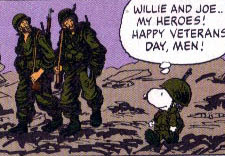
One of those Peanuts references from my youth was Bill Mauldin, someone whom Snoopy was perpetually on the way to meet for a root beer. When I became interested in comics history, I developed a vague sense of who Bill Mauldin was -- a cartoonist whose iconic soldier characters had become emblematic of infantry life. But it wasn't until I read Todd DePastino's passionate biography of Mauldin, a youngster who became an unlikely voice of his generation, that I appreciated the complexities of the place he holds in history: a foot soldier who fled combat but guiltily applied himself to documenting its grim reality, a celebrity whose Depression-era boyhood left him unable to deal with wealth and success, an angry crusader whose scathing cartoons about Communist witch-hunting and Southern racial oppression were routinely eviscerated by many of the newspapers who belonged to his syndicate.

Fantagraphics is producing a collection of Bill Mauldin cartoons to coincide with W.W. Norton's publication of the biography. (My review of Bill Mauldin: A Life Up Front appeared today on the A.V. Club site.) Together, they're an essential reminder of the complicated stories of the war and its aftermath, and a portrait of an unlikely hero who made himself such by rejecting heroic myths wholesale.

Wednesday, October 24, 2007

Nostalgia

I had a busy day planned -- a review to write, student work to catch up on, an important chat to be had with my boss -- and I left the house this morning in some trepidation that wet weather would ruin Cady Gray's field trip to the pumpkin patch. As I hustled across the street that separates our neighborhood from the campus, marveling at the periwinkle blue of the clearing sky, I realized that everything was going to be fine. I was wearing handknit socks.

That sense of retro robustness has characterized the last few days, actually, as I dived into the third Gasoline Alley collection from Drawn and Quarterly. I fell in love with Frank King's original strip when the sublimely beautiful first volume came out a couple of years ago. And ever since, I've been trying to figure out what it is about this 1920s comic strip that has such a hold over me.
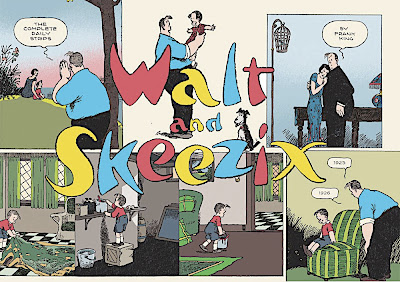


Walt and Skeezix: The Complete Daily Strips, 1925-1926 sees the alley bunch (a group of men who own garages and are always puttering around automobiles) go in together on a seaside hotel investment scheme; Skeezix, now four or five years old, in danger of once again being snatched by the haughty opera star Mme. Octave; and most notably, our hero Walt finally getting up enough pluck to propose to Phyllis Blossom. It's Walt who carries the emotional load of the comic. A broadly drawn fat man with a tiny pin head and an open-book face, he's transparently anxious, joyful, and wistful by turns as he takes care of the orphan Skeezix who was left on his doorstep as a baby. Skeezik's trusting, uncomplicated expressions -- often communicated through the limp arch of his little body slung over Walt's broad shoulder -- offer a poignant counterpart to Walt's clumsy but well-meaning efforts at parenting.

The result is about as far from our stereotype of simplistic, crude, overstylized, or self-consciously artistic early strips as can be imagined. Gasoline Alley occupies a crucial niche in the history of the powerful, compact comic strip that would peak in the 1960s with Peanuts.

More than a historical curiosity, though, these visions of men, women, children, technology, money, and relationships from the twenties tug at my heart and imagination. I worry about Walt, enjoy Skeezik's altogether boyish play, fume a little at the way Phyllis plays with Walt's affections, and get frustrated at the secrets she and Mme. Octave keep from Walt and reader alike. Even the supporting cast, much more like the broad types that we expect to populate strips of the time, have wormed their way into my affection; Avery, the skinflint who nevertheless falls for every crazy snake oil salesman who walks down the alley, makes me laugh out loud. In five cumulatively absurd panels, King can send him halfway around the county to get ten cents he's owed, spending ten dollars in the process.

I'm sure that it's no accident I fell in love with Gasoline Alley when my own children were small. But there's also the timing of the publishing projects that are bringing these pieces of history into the twenty-first century. There is something larger than me and my personal obsessions to Gasoline Alley's hold on my affections. It's emblematic of an appreciation of the past's complexity -- not just our debt to it in the creative accomplishments it made possible, but also the unique value and integrity of the moment itself. It's a kind of miracle, a quirk of historical eras, that we can connect to the world of eighty years ago through these pen and ink lines.

I assume that we're living near the end of our historical epoch, the Industrial Age, the Technological Age, the Age of the Internal Combustion Engine. At some point the paradigm will change -- and both Walt's 1925 alley and our 2007 subdivision will seem equally as far away to the denizens of the next world as the American Revolution and the Civil War, those bookends of American pastoralism, seem equally far away to us.

Monday, August 6, 2007

Connect the dots

  • This and this came in the mail today, destined to be worn by a couple of birthday children at their Legends of the Hidden Temple party. I can confidently predict that the two of them are going to flip out.

  • Over the weekend I gorged myself on my favorite Matt Groening production ever: the Will and Abe Life In Hell strips. Noel just reviewed the recent collection -- Will And Abe's Guide To The Universe -- in the latest wildly popular edition of the biweekly "Comics Panel" on the A.V. Club. Although I read Life In Hell fitfully during its heyday in the eighties and early nineties (basically whenever I picked up a copy of Creative Loafing), I didn't see most of the Will and Abe strips until I read the collections some time later. Will and Abe are Matt's sons, two years apart, and periodically he would record his conversations with them or have them explain some cultural phenomenon like bullies or cartoons. They came thickest and fastest around 1993-1994, when Will was six and Abe was four. Abe wears a cape (pretending to be Dracula), and Will doesn't like being drawn as a bunny. There's something about the surreal coherence of their confident assessment of everything in their world that is inimitable. Tellingly, I loved these strips long before I became a parent; I think their humor and perspective achieve something close to universality.

  • Speaking of comics, it's comics week on the A.V. Club, and that means comics content! Despite the protests of dozens of readers that the newspaper comic strip is a dead medium, worthy of absolutely no digital ink being spilled discussing it, Noel, Tasha and I put together an inventory of memorable comic strip deaths -- inspired, of course, by the impending demise of Funky Winkerbean's Jessica, from cancer. I wrote the entries on Mary Gold (the first death of a major comic strip character, in The Gumps circa 1929), Mort (in Ruby Park), Daddy Warbucks (in Little Orphan Annie, of course, although he was "resurrected" once his arch-enemy FDR left the scene), and the Anonymous Corpse frequently seen in Kudzu funeral strips.

  • For my money, the not-to-be-surpassed highlight of comics week is Noel's interview with Achewood mastermind Chris Onstad, probably pound for pound the funniest person on the internet. Noel links to a selection of Achewood greatest hits, including his personal favorite "SaniTaco," so be sure to follow all the clickables.

Thursday, July 19, 2007

Speaking of stringing words together ...

  • Here's a peek into the high-profile, high-stakes, high-pressure life of a Hollywood reporter (or a guy who occasionally writes for the Hollywood Reporter). Today was the first day of Emmy season, with the nominees announced early this morning in Los Angeles. Under contract for a couple of pieces in the Emmy preview issue, Noel was on the starting blocks as soon as he got out of bed. He has today and tomorrow, basically, to contact as many writers, directors, producers, publicists, and other assorted television personnel related to the nominees and get quotes to fill out his two pieces (one on writers and one on directors). They're due first thing next week. So he's been glued to the phone since the kids left the house. I dropped by around 11 to see if he could go to lunch with Archer and me, but he said Walter Hill was supposed to call soon. We can all relax when enough phone calls have been fielded and brief interviews conducted to produce enough quotes to string together for the pieces ... we hope by Saturday. If Noel's still sweating out that last call from J.J. Abrams on Monday morning, things might be a little tense around here.

  • Every time I go down the stairs on my wait out the south side of my building (I'm a dedicated stair-taker), I'm confronted by a large poster for the University's Writing Center (don't click on that link, the site is a mass of broken html). Here's the text: "Problems with your papers? You won't after seeing us." A "Good As Gold" to the first commenter, professional grammarian or otherwise, to point out the excruciating mistake therein.

  • If you're tired of waiting for me to post one of my occasional roundups of A.V. Club writing, good news! You can apparently subscribe to a feed of articles tagged with my byline. (Or Noel's, if that's the way you roll. You're an autonomous agent, man.) For those of you with commitment issues, I'll keep updating you via blog. Not much to report from the last month -- the Lost in the Stars writeup in this "Surprisingly Good Tribute Albums" inventory, a review of Tim Willocks' blood-and-thunder crusader novel The Religion, and new today, a review of the Potemkin book I mentioned in the "closest book meme" post.

  • And in "things you should be reading" news, the second biweekly* installment of the A.V. Club's Comics Panel is an endless feast. The sheer number of graphic novels, single issues, and collections both prestige and mass-market covered by the team of Keith, Tasha, and Noel is awe-inspiring, but the variety is just as impressive. From DC's line of girl-comix to the newsprint Atom collection to a Top Shelf coming-of-age animal allegory to Rick Geary's compulsively readable Victorian true-crime tales to a critical take on the comics medium ... the column made me want to sweep off my bedside bookstack with a dramatic flourish and restack from the bottom up with comics, comics, comics.
*Every time I use the prefixes "semi-" or "bi-" with reference to time periods, I have to recite to myself: "semi means half, bi means two." I have occasional arguments with people who insist on using them with the reverse meaning, but my own inability to intuit the distinction without conscious rehearsal shows how difficult it is to get it right.