A movie nerd discussion group in which I've lurked for many, many years has started a conversation about changing formats. The intermittently active community interacts through the venerable medium of the listserv, also known as an e-mail list, a Yahoo! Group, and so forth. You're all familiar with them, I'm sure. To post a message, you send an e-mail to the group address, and the listserv program e-mails it to everyone in the group individually.
Way back in the early part of this decade, I gave a conference presentation about the relative merits of listservs ("push" technologies, so-called because the information is pushed into the e-mail inboxes of each user) and courseware sites ("pull" technologies, which rely on the inherent attractiveness or value of the information contained therein to draw users onto the site).
The advantages of listservs primarily lie in their convenience. The conversations come directly to you via e-mail, and you don't have to make any special effort to follow along. If you want to participate, it's as simple as replying to the e-mail.
But there are some hidden pitfalls. Members may post messages that others consider uninteresting or annoying -- and without leaving the group, there's no way to stop them from cluttering the inbox. Active conversations often get "out of sync," with members posting replies meant specifically for one or a few users, while cross-talk goes on under the same subject heading unrelated to that exchange. Although posting is easy, posting etiquette -- discouraging top-posts, judicious quoting, what counts as appropriate listserv fodder -- is correspondingly difficult to enforce.
Enter the forum, or bulletin board -- an online destination where discussions are threaded, recorded, and most importantly, ordered. Unlike the afterthought archives page of a listserv -- how could you expect anything else from a push technology? -- the pull technology of a forum means that the unit of conversation is the thread, not the post (or the e-mail). They're searchable, they're flexible, they're constructive at their best and contained at their worst, and several conversations can go on at once with people checking in only on those that interest them.
But they're inconvenient, because people have to change their behavior to use them. They have to go to the forum; they have to seek out the conversation. Now there are ways to get activity pushed to you -- most forums allow you to subscribe to an area or a thread to get notified of new posts; even better is a daily digest of new and most active threads, e-mailed to all users. But it's not the same as every message from every member of the group just dropping onto your desktop.
I happen to think that the benefits of the latter outweigh the convenience of the former. Yet I'm under no illusions about the drawbacks. I'm in favor of the move, especially since the group has been pretty dead for a long time. On a forum, the group will change. For better, for worse, who can say -- but it will be different because the communication medium will be different, just as a telephone conversation has different rhythms and nuances than a meeting in a diner.
Monday, August 31, 2009


Sunday, August 30, 2009
After the boys of summer are gone
Today's post about the serendipity of a hat is at Toxophily.
Thanks to our friend Ali's invitation, we went down to Dickey-Stephens Park for the last afternoon game of the season. It was a glorious afternoon. Here are two children at a baseball game on the last weekend of August -- one keeping score, one mugging for the camera.


Thanks to our friend Ali's invitation, we went down to Dickey-Stephens Park for the last afternoon game of the season. It was a glorious afternoon. Here are two children at a baseball game on the last weekend of August -- one keeping score, one mugging for the camera.
Saturday, August 29, 2009
Selected work
For the last few weeks, there's been a tote bag in our backseat with about fifteen of those Fawcett-Crest Peanuts paperbacks inside. Cady Gray likes to read them while we're driving, or anywhere she ends up at loose ends (like during church).
Those particular books come from Noel's childhood library, but my brothers and I had our own storehouse of them as kids. I remember vividly picking them off of rotating racks at any truck stop or souvenir stand we happened upon during family vacations.
Then as now, the provenance of the strips inside was somewhat confounding. Each paperback bore on its cover a cryptic phrase like "Selected strips from You're A Good Egg, Charlie Brown and Good Grief, Snoopy!"
Clearly there were collections that preceded the one I held in my hand. My book was some kind of recombination of previous books. But the books mentioned were not around, and it was impossible to tell if they were originals, or if they themselves were selected from some prior iteration.
Every time I see that phrasing on the cover of whatever comics collection Cady Gray is reading, I wonder whether there's a Patient Zero of those Fawcett-Crest Peanuts paperbacks. Or is it simply turtles all the way down?
Those particular books come from Noel's childhood library, but my brothers and I had our own storehouse of them as kids. I remember vividly picking them off of rotating racks at any truck stop or souvenir stand we happened upon during family vacations.
Then as now, the provenance of the strips inside was somewhat confounding. Each paperback bore on its cover a cryptic phrase like "Selected strips from You're A Good Egg, Charlie Brown and Good Grief, Snoopy!"
Clearly there were collections that preceded the one I held in my hand. My book was some kind of recombination of previous books. But the books mentioned were not around, and it was impossible to tell if they were originals, or if they themselves were selected from some prior iteration.
Every time I see that phrasing on the cover of whatever comics collection Cady Gray is reading, I wonder whether there's a Patient Zero of those Fawcett-Crest Peanuts paperbacks. Or is it simply turtles all the way down?
Friday, August 28, 2009
Thickskinned
When you're in charge of things, you have to do two things that make other people upset with you. You have to make decisions, and you have to take responsibility for screw-ups.
I got in trouble in the latter way this morning. A person in my unit was the victim of a serious screw-up. Ultimately I and my fellow administrators were responsible, and when I got the call this morning from this justifiably very upset person, I didn't hesitate at all to abase myself and accept full blame.
These unpleasant moments are going to come up for anyone in my position every once in a while. The question is how you are going to respond. Are you going to take the failure personally and feel the paralyzing fear that comes from knowing you've made a big mistake?
I know that feeling really well. Like most of my students, I've gotten where I am today by pleasing people. Therefore the most devastating feeling I regularly experience is when people are unhappy with me. It's a queasy feeling in my gut, a dizzy sensation in my head, an anxiety that keeps me up at night.
If you're in a position where you're bound to tick people off, you can't be incapacitated by this feeling every couple of weeks (or days). So you have to learn how to take responsibility for problems without taking them personally, as it were. Not that you don't resolve to do better, not that you don't try to make up for the error, not that you don't sincerely regret the problem and sympathize with those affected. But at some level, you have to externalize the consequences. The outcome must be manifested in remedial action, not in personal stress and recriminations.
It's hard not to wonder if my ability to avoid stomach-churning and nail-biting over this signals that my heart is hardening. From my point of view, having spent my life at the mercy of others' opinions, a smidge more control over my own self-esteem doesn't sound so bad. As long as the others whom I wrong don't notice a difference in what I actually do about it, as opposed to how I feel about it.
I got in trouble in the latter way this morning. A person in my unit was the victim of a serious screw-up. Ultimately I and my fellow administrators were responsible, and when I got the call this morning from this justifiably very upset person, I didn't hesitate at all to abase myself and accept full blame.
These unpleasant moments are going to come up for anyone in my position every once in a while. The question is how you are going to respond. Are you going to take the failure personally and feel the paralyzing fear that comes from knowing you've made a big mistake?
I know that feeling really well. Like most of my students, I've gotten where I am today by pleasing people. Therefore the most devastating feeling I regularly experience is when people are unhappy with me. It's a queasy feeling in my gut, a dizzy sensation in my head, an anxiety that keeps me up at night.
If you're in a position where you're bound to tick people off, you can't be incapacitated by this feeling every couple of weeks (or days). So you have to learn how to take responsibility for problems without taking them personally, as it were. Not that you don't resolve to do better, not that you don't try to make up for the error, not that you don't sincerely regret the problem and sympathize with those affected. But at some level, you have to externalize the consequences. The outcome must be manifested in remedial action, not in personal stress and recriminations.
It's hard not to wonder if my ability to avoid stomach-churning and nail-biting over this signals that my heart is hardening. From my point of view, having spent my life at the mercy of others' opinions, a smidge more control over my own self-esteem doesn't sound so bad. As long as the others whom I wrong don't notice a difference in what I actually do about it, as opposed to how I feel about it.
Thursday, August 27, 2009
Name something
I'm looking forward to all the interesting work Archer will bring home as a third grader. It's always fascinating when the assignments provide a peek into his mental processes. Here's an early example -- a worksheet that asks him to fill in the blanks.
Name Something
- Name something funny. silly glasses
- Name something green. A green folder
- Name something shiny. A gold coin
- Name something pretty. A tiera
- Name something big. A piano
- Name something furry. A cat
- Name something mysterious. A magnefieing glass
- Name something purple. A plum
- Name something curly. A spring
- Name something slow. A snail
- Name something salty. Salt
- Name something sweet. Candy
- Name something strong. A weightlifter
- Name something yellow. A banana
- Name something wild. A lion
Wednesday, August 26, 2009
Well children
We took the kids in for their double-barrelled yearly check-ups today, complete with a bunch o' shots (three for Cady Gray, two for Archer), a hearing and vision check for Cady Gray, and of course, a lot of waiting around in a small exam room.
Like almost everyone, I'll bet, I have vivid memories of my pediatrician's office from childhood. The smell is what I remember best -- rubber and paper, like if the downtown library was next to a tire factory. I can remember some individual visits, even, like the one where my younger brother got tested for all the allergies in the world, all over his back. And the ones where the big trigger needle came out instead of the syringe. And the one when my dad brought me from the farm where I'd complained of cramps, and we were told that I was probably getting my first period.
It's strange to realize that my children will have vivid memories of the clinic they've been going to for years, this new building with no discernible smell (to me) and no salient features (to me). Someday they'll be able to recall the Greatest Story Ever Told lying on top of the book basket, or the red-upholstered stool on smooth-gliding wheels, or the portrait of a Pekingese by the nurse practitioner hanging on the wall.
What do you remember about your childhood checkups?
Like almost everyone, I'll bet, I have vivid memories of my pediatrician's office from childhood. The smell is what I remember best -- rubber and paper, like if the downtown library was next to a tire factory. I can remember some individual visits, even, like the one where my younger brother got tested for all the allergies in the world, all over his back. And the ones where the big trigger needle came out instead of the syringe. And the one when my dad brought me from the farm where I'd complained of cramps, and we were told that I was probably getting my first period.
It's strange to realize that my children will have vivid memories of the clinic they've been going to for years, this new building with no discernible smell (to me) and no salient features (to me). Someday they'll be able to recall the Greatest Story Ever Told lying on top of the book basket, or the red-upholstered stool on smooth-gliding wheels, or the portrait of a Pekingese by the nurse practitioner hanging on the wall.
What do you remember about your childhood checkups?
Tuesday, August 25, 2009
Someone's eager to listen
Today's post about finding the right way to use beautiful yarn is at Toxophily.

And today is my second child's fifth birthday. I'm a biased observer, naturally, but in my estimation, her beauty is matched by her intelligence and sweetness. Happy birthday, my love.
And today is my second child's fifth birthday. I'm a biased observer, naturally, but in my estimation, her beauty is matched by her intelligence and sweetness. Happy birthday, my love.
Monday, August 24, 2009
Back to school sale
I depend on the semiannual Rhea Lana consignment sale to outfit my kids. And thankfully, the sale was moved up closer to the beginning of school this year. So this afternoon I completed my work and headed out to the dying shopping center on the edge of town, where the sale has commandeered five storefronts for the week.
If you're going to try to get ninety percent of your kids' fall-winter clothing in one swell foop, strategy is essential. Shopping carts are scarce, if present at all, and you can only carry around six or ten outfits before your carryin' arm gets tired and you lose your will to flip through the racks. So smart shoppers bring a laundry basket to fill. I've even seen some being dragged around with jumpropes or clothesline, the better to move quickly without having to lean over and lift from the knees.
Naturally it helps if you know what size your children are, generally speaking. However, if you rarely shop at actual stores, you don't get that regular checkup on the key numbers. So there's some guesswork and projection involved.
Cady Gray was comfortable in size 5 tops last winter, but she was still wearing some size four pants and leggings with plenty of length to spare. So I shopped exclusively on the size 6 racks for her today; the shirts and sweaters will fit this year, and the pants next year -- no problem since she still has plenty of size 5 pants that I bought at last year's sale. Archer is rail-thin, making the ratio of length to waist circumference a problem. He made it through last year with size 6 pants, which were pretty short by the time it got to be shorts weather. Eyeballing the size 7 and 8 pants, I was of the opinion that size 8 pants were ridiculously long. I was a little worried that size 7's would be vulnerable to a height spurt, but if I got them with enough elastic in the waist, they should be presentable for long enough.
As for styles, I have definite opinions. I stay away from pink and purple in the girls' section as much as possible, and I like to keep it simple -- long-sleeve tees that can be layered, not a lot of frou-frou. For Archer, it's all about stripes. I love a boy in a striped tee shirt; it's just ... boyish in a way that makes me happy.
If I can get out the door with seven to ten shirts, four or five pants, a jacket and sweater, and a pair of pajamas for each child, I consider it a Rhea Lane sale well shopped. PJs get harder to find the older they get, but for everything else, I scored -- and I only broke my "nothing over five dollars" rule for a couple of special items. Now to put bricks on the kids heads and try to keep them the same size until March or so!
If you're going to try to get ninety percent of your kids' fall-winter clothing in one swell foop, strategy is essential. Shopping carts are scarce, if present at all, and you can only carry around six or ten outfits before your carryin' arm gets tired and you lose your will to flip through the racks. So smart shoppers bring a laundry basket to fill. I've even seen some being dragged around with jumpropes or clothesline, the better to move quickly without having to lean over and lift from the knees.
Naturally it helps if you know what size your children are, generally speaking. However, if you rarely shop at actual stores, you don't get that regular checkup on the key numbers. So there's some guesswork and projection involved.
Cady Gray was comfortable in size 5 tops last winter, but she was still wearing some size four pants and leggings with plenty of length to spare. So I shopped exclusively on the size 6 racks for her today; the shirts and sweaters will fit this year, and the pants next year -- no problem since she still has plenty of size 5 pants that I bought at last year's sale. Archer is rail-thin, making the ratio of length to waist circumference a problem. He made it through last year with size 6 pants, which were pretty short by the time it got to be shorts weather. Eyeballing the size 7 and 8 pants, I was of the opinion that size 8 pants were ridiculously long. I was a little worried that size 7's would be vulnerable to a height spurt, but if I got them with enough elastic in the waist, they should be presentable for long enough.
As for styles, I have definite opinions. I stay away from pink and purple in the girls' section as much as possible, and I like to keep it simple -- long-sleeve tees that can be layered, not a lot of frou-frou. For Archer, it's all about stripes. I love a boy in a striped tee shirt; it's just ... boyish in a way that makes me happy.
If I can get out the door with seven to ten shirts, four or five pants, a jacket and sweater, and a pair of pajamas for each child, I consider it a Rhea Lane sale well shopped. PJs get harder to find the older they get, but for everything else, I scored -- and I only broke my "nothing over five dollars" rule for a couple of special items. Now to put bricks on the kids heads and try to keep them the same size until March or so!
Sunday, August 23, 2009
Helping us all to remember what we came here for
Today's post about birthday knitting and the resulting joy is at Toxophily.
The weekend has been every bit as wonderful as I thought it would be, with amazing coolish August weather as the icing on the Mario Brothers birthday cake. Here's one more picture of the party, showing Cady Gray's girlish and appropriately Japanese glee at everyone singing "Happy Birthday" to her:

The weekend has been every bit as wonderful as I thought it would be, with amazing coolish August weather as the icing on the Mario Brothers birthday cake. Here's one more picture of the party, showing Cady Gray's girlish and appropriately Japanese glee at everyone singing "Happy Birthday" to her:
Saturday, August 22, 2009
Five eight

This morning, our newly eight-year-old son and our almost five-year-old daughter shared a birthday party at the park. Then this afternoon, they opened presents from the family. Herewith, a photoessay.

The kids, um, had a lot of energy.

Thanks to timely and generous artwork provided by the incomparable Lydia (who was paid in birthday cake), the boys pinned mustaches on Mario ...

... and the girls pinned crowns on Princess Peach. (Yeah, I know it's a gender stereotype. A liberated dad at the party told me it was okay.)

Pizza and juice boxes for all!

Take a look at this awesome Mario-themed cake provided by our local bakery, Ed's!

Cady Gray is quite overcome by the singing of "Happy Birthday" to her.

Archer just wants cake.

What's this weird glop of decompasing food on the playground?

Maybe everybody should take a look at it.

Back at home, electronic games were found under layers of wrapping paper.

Granny Lou and Papa sent real Capezio ballet shoes!

Mom knit hats based on beloved trademarked characters.
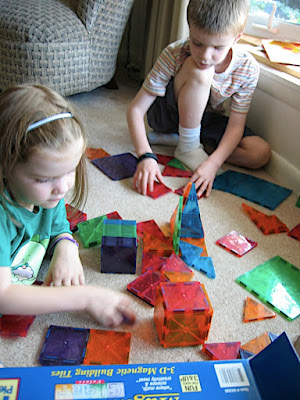
After all the excitement, a quiet afternoon building with our new magnetic shape blocks is exactly what we needed.

Level ups for everyone!
Friday, August 21, 2009
Celebration weekened
There's something really special about this weekend. It seems the stars have aligned to produce a near-perfect confluence of enjoyment. Let's count the factors:
- Birthday party! The kids will have their shared birthday party tomorrow morning. Subfactors: (a) It's a slacker party at a local public park with a game exchange instead of present-giving. (b) Tomorrow is going to be the nicest day of summer in weeks, with temperatures in the low eighties and plenty of sunshine.
- Tarantino! His new film has generated plenty of heated disagreement, which makes me eager to see it for myself.
- No class! Since classes have started, I feel a great sense of freedom on the weekend when school is not in session. Yet since classes have just started, I don't have any work to do to prepare for next week. Win-win!
Thursday, August 20, 2009
New beginnings
I taught my first class of the year today, and it was one that was especially fraught with danger. For the second time in two years I'm teaching outside my department -- this time in the Department of Philosophy and Religious Studies.
Happily the students in my seminar on process theology were very kind. They nodded with understanding as I went over the syllabus, even the requirements which are probably less common in their classes than in the ones I usually teach, like shared notetaking, podcasting, and blogging. They contributed energetically to the brief discussion after we got done with the logistics. I left feeling like the class had a chance of working.
While we were taking a stroll around the neighborhood after dinner, Noel asked me whether I hoped to open eyes or change lives with this class. I really don't want to present the students with any kind of crisis, I answered. If the class has any goals for what I want the students to be (as opposed to what I want them to know or do), it's simply this. I want them to appreciate the honest struggle of some thoughtful religious people to find ways to be faithful in the twenty-first century -- ways to integrate understandings of the world that they can't easily deny with a belief in the transcendent that they have no desire to abandon.
There are a variety of attitudes toward religion in the class; that I can see from my informal first day survey. I have a student who leans toward Hinduism, another that leans toward Buddhism. I have two who cited interests in Christian apologetics, plus a couple of Catholics. There are a few students who didn't mention any religious belief, and one who stated that he's an atheist.
I think all those students will need to take some kind of journey to empathize with the impulses, desires, and needs that lead some religious thinkers to embrace process thought. It's hard to tell on the first day if they want to go there. But at least the friendly faces and open discussion give me hope that my goals aren't completely unrealistic. And at least we all know where we stand; it remains to be seen if we want to move.
Happily the students in my seminar on process theology were very kind. They nodded with understanding as I went over the syllabus, even the requirements which are probably less common in their classes than in the ones I usually teach, like shared notetaking, podcasting, and blogging. They contributed energetically to the brief discussion after we got done with the logistics. I left feeling like the class had a chance of working.
While we were taking a stroll around the neighborhood after dinner, Noel asked me whether I hoped to open eyes or change lives with this class. I really don't want to present the students with any kind of crisis, I answered. If the class has any goals for what I want the students to be (as opposed to what I want them to know or do), it's simply this. I want them to appreciate the honest struggle of some thoughtful religious people to find ways to be faithful in the twenty-first century -- ways to integrate understandings of the world that they can't easily deny with a belief in the transcendent that they have no desire to abandon.
There are a variety of attitudes toward religion in the class; that I can see from my informal first day survey. I have a student who leans toward Hinduism, another that leans toward Buddhism. I have two who cited interests in Christian apologetics, plus a couple of Catholics. There are a few students who didn't mention any religious belief, and one who stated that he's an atheist.
I think all those students will need to take some kind of journey to empathize with the impulses, desires, and needs that lead some religious thinkers to embrace process thought. It's hard to tell on the first day if they want to go there. But at least the friendly faces and open discussion give me hope that my goals aren't completely unrealistic. And at least we all know where we stand; it remains to be seen if we want to move.
Wednesday, August 19, 2009
Personal messages
Today is Archer's eighth birthday -- and the first day of school for both him and Cady Gray, whose birthday is next Tuesday. Last week I took them separately to buy birthday presents for each other, and it wasn't hard to steer them to an aisle where they could not only locate something perfectly suited for their sibling, but also something that might be useful for, oh, the first day of school, let's say.

Yesterday I collared each of them in turn to sign the birthday cards they picked out. Their approaches to the task were as perfectly matched as the gifts they selected.
Cady Gray's effort to communicate the rationale behind her choice of card:

... and Archer's provision of an opportunity to quantify the experience (note that Cady Gray happily played along):

Yesterday I collared each of them in turn to sign the birthday cards they picked out. Their approaches to the task were as perfectly matched as the gifts they selected.
Cady Gray's effort to communicate the rationale behind her choice of card:
... and Archer's provision of an opportunity to quantify the experience (note that Cady Gray happily played along):
Tuesday, August 18, 2009
Summer's last light
Tomorrow my last child enters the tender embrace of the school system. Tonight, she's still a little girl playing school with her brother on a summer's night.
Here's a selection from their summer activities, put together by their dad. Enjoy!
Here's a selection from their summer activities, put together by their dad. Enjoy!
Monday, August 17, 2009
Logistics
I have a love-hate relationship with instructions. Well do I remember the elementary school worksheet that told me in no uncertain terms to read all the directions before beginning. Naturally I was too impatient for that, and so I dived right in doing math problems and coloring all the O's orange and underlining all the threes ... only to find that the last instruction was to disregard all previous instructions. Oops.
The early days of any school year are all about instructions. Today we had our initial meeting with the new freshmen, in which they were provided with a bewildering sheaf of papers and asked to remember and not fail to do a long laundry list of things. And then our kids went to their elementary school and heard a similar spiel from their new teachers while acquiring similarly varied folders full of forms to be returned and procedures to be followed.
I spend a lot of time getting my classes organized so they'll run smoothly throughout the semester, so naturally I find myself giving exactly these kind of talks on a regular basis. And every year I listen to myself and hate what I hear. Sure, these are things that people need to know. But a rambling lecture -- heck, even an organized lecture -- on logistical details makes even the most dedicated listener weary, confused, and disengaged. Trying to emphasize ten tips and five rules and seven policies results inevitably in zero items actually being heard, understood, and retained.
So having heard two of these talks today -- both lasting about 20-30 minutes, both involving shuffling large stacks of paper and muttering "did I cover everything ... oh yes, very important!" -- I'm already thinking about how to do things differently on the first days of my classes coming up shortly. What's the best first day of class you ever had -- or ever led? How do you handle all the logistical details that come with wrangling a group into the same procedures without turning the members' brains to mush?
The early days of any school year are all about instructions. Today we had our initial meeting with the new freshmen, in which they were provided with a bewildering sheaf of papers and asked to remember and not fail to do a long laundry list of things. And then our kids went to their elementary school and heard a similar spiel from their new teachers while acquiring similarly varied folders full of forms to be returned and procedures to be followed.
I spend a lot of time getting my classes organized so they'll run smoothly throughout the semester, so naturally I find myself giving exactly these kind of talks on a regular basis. And every year I listen to myself and hate what I hear. Sure, these are things that people need to know. But a rambling lecture -- heck, even an organized lecture -- on logistical details makes even the most dedicated listener weary, confused, and disengaged. Trying to emphasize ten tips and five rules and seven policies results inevitably in zero items actually being heard, understood, and retained.
So having heard two of these talks today -- both lasting about 20-30 minutes, both involving shuffling large stacks of paper and muttering "did I cover everything ... oh yes, very important!" -- I'm already thinking about how to do things differently on the first days of my classes coming up shortly. What's the best first day of class you ever had -- or ever led? How do you handle all the logistical details that come with wrangling a group into the same procedures without turning the members' brains to mush?
Sunday, August 16, 2009
Care package
I spent a couple of hours at midday meeting freshmen and their families, unloading their trucks and U-Hauls, and carrying their Rubbermaid containers and futon covers up to the top floors of the dormitory. It was in the nineties today, and every once in a while the loading zone at the front door emptied out and gave the students and me a chance to check our cell phones, suck down some water, and stand in the shade for a minute or two.
During one of those breaks I pulled out the scarf I'm making for the Orphan Foundation of America's Red Scarf project and knit a few rows. One of the student orientation staff made a joke about not needing a scarf today, which gave me a chance to mention why I was making one.
It seemed so appropriate to be knitting for college students with no parents while I was greeting parents who were dropping their children off at college for the first time. I love the Red Scarf Project because it gives me a chance to send the same kind of warmth that I enjoy lavishing on my students to former foster children attending college all over the country.
If you knit or crochet, consider making a scarf in any unisex color and pattern for this wonderful program. Starting September 1, you can send up to five scarves to the OFA, along with gift cards or the like, and they'll distribute the care packages next Valentine's Day to the thousands of young adults they serve.
If you're not a knitter or crocheter, you can contribute to the effort, too. Just donate via this PayPal link. The Orphan Foundation of America gets four stars, Charity Navigator's highest rating, and 91 cents out of every dollar donated goes straight to the beneficiaries. I promise it'll make you feel nearly as good as wearing a cozy handknit scarf on a frosty day.
During one of those breaks I pulled out the scarf I'm making for the Orphan Foundation of America's Red Scarf project and knit a few rows. One of the student orientation staff made a joke about not needing a scarf today, which gave me a chance to mention why I was making one.
It seemed so appropriate to be knitting for college students with no parents while I was greeting parents who were dropping their children off at college for the first time. I love the Red Scarf Project because it gives me a chance to send the same kind of warmth that I enjoy lavishing on my students to former foster children attending college all over the country.
If you knit or crochet, consider making a scarf in any unisex color and pattern for this wonderful program. Starting September 1, you can send up to five scarves to the OFA, along with gift cards or the like, and they'll distribute the care packages next Valentine's Day to the thousands of young adults they serve.
If you're not a knitter or crocheter, you can contribute to the effort, too. Just donate via this PayPal link. The Orphan Foundation of America gets four stars, Charity Navigator's highest rating, and 91 cents out of every dollar donated goes straight to the beneficiaries. I promise it'll make you feel nearly as good as wearing a cozy handknit scarf on a frosty day.
Saturday, August 15, 2009
Immersive
NPR did a story this morning about a new serial killer novel that comes with a packet of items -- driver's license, death certificates, etc. -- along with phone numbers and websites where you can interact with the characters.
It reminded me of one of the first places I spent a lot of time on the web -- The Spot. It was purported to be a kind of reality show on the web, with a bunch of beautiful people living in a house and posting journal entries and photos with all kinds of relationship gossip. I couldn't browse graphical sites from my Charlottesville apartment, but I had access to Netscape on my workplace computer. Several times a day I'd check in, looking for new content in the characters' diaries.
Even though the faux-real touches of projects like this are gimmicky, they have the potential to draw you in. One reason I'm so looking forward to seeing District 9 tonight is that it's framed in that documentary style. I find that approach makes me more alert, scanning for information and feeling like whatever I've caught is something I really possess, not something that was fed to me. It's a structure that involves me, exactly as it's designed to do.
It reminded me of one of the first places I spent a lot of time on the web -- The Spot. It was purported to be a kind of reality show on the web, with a bunch of beautiful people living in a house and posting journal entries and photos with all kinds of relationship gossip. I couldn't browse graphical sites from my Charlottesville apartment, but I had access to Netscape on my workplace computer. Several times a day I'd check in, looking for new content in the characters' diaries.
Even though the faux-real touches of projects like this are gimmicky, they have the potential to draw you in. One reason I'm so looking forward to seeing District 9 tonight is that it's framed in that documentary style. I find that approach makes me more alert, scanning for information and feeling like whatever I've caught is something I really possess, not something that was fed to me. It's a structure that involves me, exactly as it's designed to do.
Friday, August 14, 2009
Everything's coming up Millhouse
I joked to Noel tonight that I was in the midst of the Two Days of Donna. Today I acquired a new wall in my office ... just a few inches from an existing wall, but insulated and blocking a door that had let through a lot of sound from the adjoining room. It's going to be painted a deep shade of red -- an accent wall in my battleship-gray room, just like on the HGTV design shows!
And after a three month wait and lots of shipping back and forth to the Lenovo factories deep in Red China, I have a brand new tablet to replace my beloved (but four-year-old) X60. There's nothing I like better than setting up a new piece of equipment; I can spend hour upon hour tweaking the parameters, customizing the colors and menus, researching extensions and accessories. I lost myself in that process for the whole afternoon.
And if that weren't enough, Noel has a crazy plan to take the kids to Little Rock tomorrow, let them run wild through a toy store, stuff them full of pizza and bombard their senses with video games. That means I get to stay home and do whatever I want. Maybe for two, three hours! Then later that evening, Noel and I are going out to dinner and a movie. I really don't know what I've done to deserve such largesse.
Next week, the deluge: I'll help move freshmen into the dorms on Sunday, attend three meetings (one in full academic regalia) on Monday, and then it's just more meetings and frantic preparation before classes begin on Thursday. It's the perfect time for knitting, reading, thinking, and drawing a deep, contemplative breath. I plan to do them all tomorrow.
And after a three month wait and lots of shipping back and forth to the Lenovo factories deep in Red China, I have a brand new tablet to replace my beloved (but four-year-old) X60. There's nothing I like better than setting up a new piece of equipment; I can spend hour upon hour tweaking the parameters, customizing the colors and menus, researching extensions and accessories. I lost myself in that process for the whole afternoon.
And if that weren't enough, Noel has a crazy plan to take the kids to Little Rock tomorrow, let them run wild through a toy store, stuff them full of pizza and bombard their senses with video games. That means I get to stay home and do whatever I want. Maybe for two, three hours! Then later that evening, Noel and I are going out to dinner and a movie. I really don't know what I've done to deserve such largesse.
Next week, the deluge: I'll help move freshmen into the dorms on Sunday, attend three meetings (one in full academic regalia) on Monday, and then it's just more meetings and frantic preparation before classes begin on Thursday. It's the perfect time for knitting, reading, thinking, and drawing a deep, contemplative breath. I plan to do them all tomorrow.
Thursday, August 13, 2009
In readiness
I've spent the last few weeks in mourning for the dying summer, savoring every last moment of peace and quiet on campus, gazing at my uncluttered calendar, and generally dreading the day when it would all end.
Today as I was walking home after a three-hour workshop and a two-and-a-half hour meeting, I caught up with a group of Honors students who are on campus a few days early to undergo training as residential mentors. Now I flatter myself that I'm a well-liked professor and that students are comfortable around me. (Students past and present, now's your time to disabuse me of my illusions.)
Falling into a conversation with the eight or nine students was effortless. And when I broke off from the group because their route and mine diverged, I was surprised to find myself energized. I felt as if I'd been plugged into the wall after sitting on standby.
Maybe the students coming back and my life getting more hectic has an upside, I realized. Am I fully alive when they aren't around?
Today as I was walking home after a three-hour workshop and a two-and-a-half hour meeting, I caught up with a group of Honors students who are on campus a few days early to undergo training as residential mentors. Now I flatter myself that I'm a well-liked professor and that students are comfortable around me. (Students past and present, now's your time to disabuse me of my illusions.)
Falling into a conversation with the eight or nine students was effortless. And when I broke off from the group because their route and mine diverged, I was surprised to find myself energized. I felt as if I'd been plugged into the wall after sitting on standby.
Maybe the students coming back and my life getting more hectic has an upside, I realized. Am I fully alive when they aren't around?
Wednesday, August 12, 2009
Basic training
A couple of weeks ago the instructional resource center at my university sent out an announcement for "course design camp." People who were teaching a course for the first time, or reworking an existing course, were invited to come to a half-day workshop on the subject.
In my ten years of university teaching, I've designed lots of courses. If I had to do a quick count, it would be thirty to forty, counting major redesigns of courses with nominally the same topic. You'd think I'd consider myself something of a veteran, if not an expert.
But I signed up for the camp, because I find course design to be difficult work. I'd like to know about other approaches than the one I built for myself out of trial and error. Maybe there are better ways to accomplish some of the goals I set for myself in putting together my courses. It's tough for me because over time I've come to believe that just about all the values and processes of the course need to be carefully structured ahead of time; anything without very specific delineation in the syllabus and grading structure tends not to be successful in the implementation. I've gone from being a go-with-the-flow course designer to being a meticulous demiurge -- if not micromanager -- making sure everything is in place and robust, every contingency accounted for, every potential question answered, before I walk into class on the first day.
All that construction work is pretty intense, although it tends to be creative and rewarding. I guess I just wonder if there are other ways of going about it. I also wonder if my approach might prove to be the norm on this campus or an outlier, and I'm curious to see what methods my fellow workshop participants bring to the table. In the final analysis, I just find it irresistible to get a peek into other people's course design approaches, both informed and ad hoc, and see both what I might learn and where I currently stand.
In my ten years of university teaching, I've designed lots of courses. If I had to do a quick count, it would be thirty to forty, counting major redesigns of courses with nominally the same topic. You'd think I'd consider myself something of a veteran, if not an expert.
But I signed up for the camp, because I find course design to be difficult work. I'd like to know about other approaches than the one I built for myself out of trial and error. Maybe there are better ways to accomplish some of the goals I set for myself in putting together my courses. It's tough for me because over time I've come to believe that just about all the values and processes of the course need to be carefully structured ahead of time; anything without very specific delineation in the syllabus and grading structure tends not to be successful in the implementation. I've gone from being a go-with-the-flow course designer to being a meticulous demiurge -- if not micromanager -- making sure everything is in place and robust, every contingency accounted for, every potential question answered, before I walk into class on the first day.
All that construction work is pretty intense, although it tends to be creative and rewarding. I guess I just wonder if there are other ways of going about it. I also wonder if my approach might prove to be the norm on this campus or an outlier, and I'm curious to see what methods my fellow workshop participants bring to the table. In the final analysis, I just find it irresistible to get a peek into other people's course design approaches, both informed and ad hoc, and see both what I might learn and where I currently stand.
Subscribe to:
Posts (Atom)