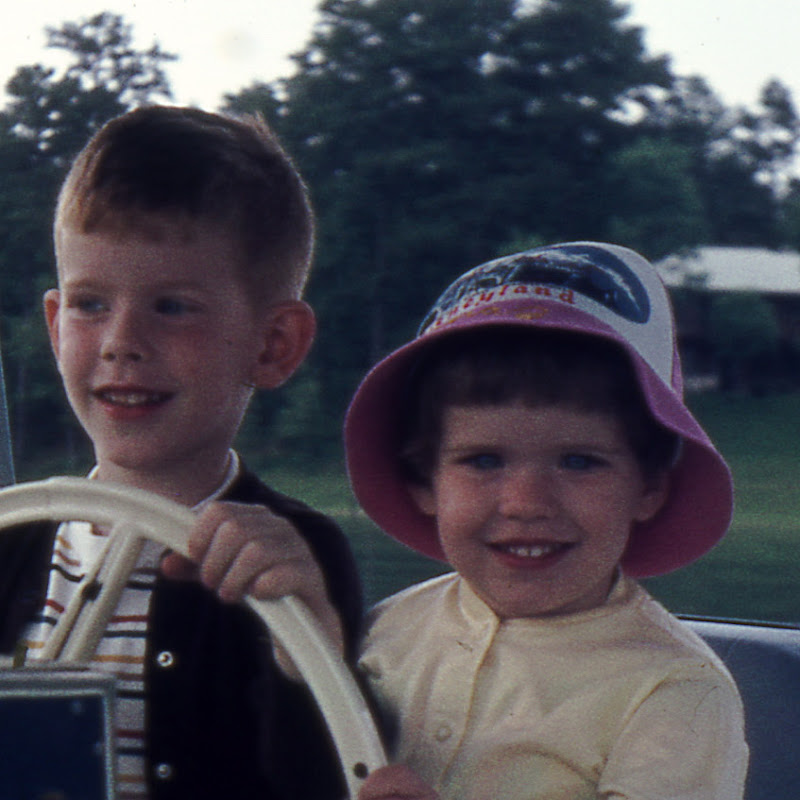
I heard a story on NPR driving home this afternoon about what songs our dads were listening to when they were our age. I haven't asked my dad what his favorite might have been in his forties, but judging from my memory of long commutes listening to Luther Masingill on WDEF -- master of the news, traffic, and MOR pop format -- it was probably Anne Murray's "You Needed Me."
My dad loved the adult contemporary female singers -- all the better if they had a country streak (though I never knew him to listen to country music per se). Olivia Newton-John hit a chord, as I recall; Barbara Mandrell was one of his idols. When he and mom went to Vegas for a convention and he got to see Mandrell in concert, he seemed genuinely thrilled. (Naturally as a teetotaller and non-gambler, the shows were the main attraction of Sin City, and he forgave them if they went a little blue.)
I've written before, but probably can never write enough, about how important my dad has been in my life. He taught me optimism and loyalty, two principles that form the bedrock of the approach I try to take to my life. He and I don't see eye to eye on many matters of ideology, but he's always been sincere in his beliefs, never an opportunist or a reactionary, and that I deeply admire. Reading his devotional blog, I recognize his honest search for truth, although we start from quite different premises.
And the way that our world views overlap like the halves of a stereoscopic image, slightly different angles that add up to the same fundamental values, describes the music we listened to as well. I grew to love the version of pop that my dad responded to, even though my teenage ears yearned at the time for something harsher, younger, and (I thought) more authentic. It was at least secular, concerned with feelings I recognized as the hallmarks of adulthood (love in all its manifestations and results, good and bad); it was a closer cousin to the pop and rock my friends and older siblings sent my way than the hymns on the local Moody Bible Institute affiliate favored by my mother. Sharing it even without comment felt like a point of agreement.
It was always that way with my dad. What we shared was more important than what separated us, and listening ears were always open. Happy Father's Day, Dad.
Friday, June 17, 2011


Thursday, June 16, 2011
Security

July 31, 2009
I walked into Archer's room yesterday and found Cady Gray holding a battered blue Magna Doodle. "Remember this, Mom?" she asked, holding it up. "Archer used to take this everywhere."
He sure did. And not just because he liked it -- because he needed it. Not that long ago, the most frequent sound heard in Archer's presence was the zip-thunk of the eraser bar being pulled back and forth. Archer kept track of things on that Magna Doodle. We didn't always know what he was keeping track of, but he had to do it. He scrawled scoreboards and charts and announcements and informational signs and highway numbers and who knows what all on there. Scribble, scribble -- ten or fifteen seconds -- zip-thunk, erase and do it again. All day long.
Magna Doodles don't last forever. The eraser bar gets hard to pull. The magnetic particles inside lose their potency somehow. The screen gets gray and accumulates dead pixels. And sometimes a boy accidentally leaves it in a restaurant somewhere, or can't locate it in his room. Such occasions were dire emergencies at our house. Archer would break down in tears and beg us to make it right. We usually had a spare one stashed somewhere, either a new one or an old discarded one. In extreme cases, these would not do; only the current Magna Doodle was acceptable. When it was time to buy a new one, we had to prep Archer that it was coming and why it was necessary, and he was usually fine with it. An ad hoc substitution -- "here, we have this new one to replace the one you can't find!" -- often led to howls of rejection and an escalation of the emergency.
"This is how you erase it," Cady Gray continued, demonstrating the technique. "Archer doesn't use this anymore." "I guess he doesn't need it," I told her.
"Hey Archer," I asked, as he entered the room. "Remember when you used to carry this MagnaDoodle all the time? You don't do that anymore, do you?"
He paused for a moment in the midst of getting whatever he had come for. "Yeah, I don't need it. I can just keep track of the points in my head now."
Wednesday, June 15, 2011
New and nearly new
I've been hanging on by a thread at work for the last few months with a crippled laptop. My beloved Lenovo tablet has been plagued by a problem with the screen, which flips around to turn the machine from a laptop to a tablet. Three times I had a problem where the screen only rotated with difficulty, followed by a failure of the display. The first two times I took it to IT, they sent it away, and it came back with a new motherboard. The third time we were ordering replacement computers for several faculty members, so rather than continue the cycle I decided to upgrade to the new model.
A laptop without a working screen is, in effect, a desktop, since it has to be hooked up to a monitor to be useful. So anytime I've needed mobile computing in the last half of the semester, I had to remember to bring my Macbook Air from home.
Today I got the replacement tablet, and boy is it sweet, what with a screen that lights up and displays information, and the ability to lift it out of its dock and carry it about whilst it still functions as a computer. One more step in getting my electronics environment back in working order.
While Noel and the kids are gone over the weekend, I'm hoping to set things up so the kids can have a computer of their own. For that to happen, I have to take old technology and make it new again. Not only does the computer need to be brought into the second decade of the twenty-first century, but I have to set up an old wireless access point to work with our more up-to-date network. It will be like recreating the configuration we had in 2003 and gluing it onto the side of the whiz-bang 2011 version.
If it works (which is by no means assured), the whole thing will be new to the kids; they'll be thrilled. I'll be thrilled, I admit. I love taking the old and making it new again -- it validates my packrat ways, since a sane person would have displosed of this eight-year-old computer and wireless pod long ago.
A laptop without a working screen is, in effect, a desktop, since it has to be hooked up to a monitor to be useful. So anytime I've needed mobile computing in the last half of the semester, I had to remember to bring my Macbook Air from home.
Today I got the replacement tablet, and boy is it sweet, what with a screen that lights up and displays information, and the ability to lift it out of its dock and carry it about whilst it still functions as a computer. One more step in getting my electronics environment back in working order.
While Noel and the kids are gone over the weekend, I'm hoping to set things up so the kids can have a computer of their own. For that to happen, I have to take old technology and make it new again. Not only does the computer need to be brought into the second decade of the twenty-first century, but I have to set up an old wireless access point to work with our more up-to-date network. It will be like recreating the configuration we had in 2003 and gluing it onto the side of the whiz-bang 2011 version.
If it works (which is by no means assured), the whole thing will be new to the kids; they'll be thrilled. I'll be thrilled, I admit. I love taking the old and making it new again -- it validates my packrat ways, since a sane person would have displosed of this eight-year-old computer and wireless pod long ago.
Tuesday, June 14, 2011
Celebrations
This time of year comes with so much to celebrate. My oldest nephew graduated from high school and will study and run track in Maine this fall. Father's Day is this weekend. And birthdays of friends and family continue apace.
August, as is well known, is the only month without a major holiday. For us, though, it's the biggest month of the year, with both kids' birthdays occurring in the same week. July has Independence Day, which is a big deal for some families, but usually passes quietly for us with maybe a picnic, and the scary fireworks safely confined to the TV.
I mention celebration only because I'll be passing the run-up to Father's Day in an unusual situation -- as a single, childless woman. Noel and the kids are going to visit the Tennessee grandparents on Thursday, coming back on Sunday. I'm looking forward to having the time and space to work on some projects around the house, like reconfiguring our computer set-up to be centered in Archer's room, getting rid of the huge desk where it currently sits, and clearing out the space for my planned crafting center.
When they get back it will be Father's Day, and I'll only have a few hours to make the day special. Getting the kids to make cute cards or breakfast in bed is out -- they won't be here. A nice present (that Noel knows about) is underway but won't be ready in time for his return. It will be special for me to see him and the kids again after a few days apart. Maybe enough of a gift would be to take the kids off his hands and leave him to enjoy a special dinner in solitude.
August, as is well known, is the only month without a major holiday. For us, though, it's the biggest month of the year, with both kids' birthdays occurring in the same week. July has Independence Day, which is a big deal for some families, but usually passes quietly for us with maybe a picnic, and the scary fireworks safely confined to the TV.
I mention celebration only because I'll be passing the run-up to Father's Day in an unusual situation -- as a single, childless woman. Noel and the kids are going to visit the Tennessee grandparents on Thursday, coming back on Sunday. I'm looking forward to having the time and space to work on some projects around the house, like reconfiguring our computer set-up to be centered in Archer's room, getting rid of the huge desk where it currently sits, and clearing out the space for my planned crafting center.
When they get back it will be Father's Day, and I'll only have a few hours to make the day special. Getting the kids to make cute cards or breakfast in bed is out -- they won't be here. A nice present (that Noel knows about) is underway but won't be ready in time for his return. It will be special for me to see him and the kids again after a few days apart. Maybe enough of a gift would be to take the kids off his hands and leave him to enjoy a special dinner in solitude.
Monday, June 13, 2011
Information cascade
When it rains it pours, and when there's a drought you can't buy a break. Noel and I have been without laptops since the middle of last week. Mine got to the repair shop today, which was expected -- I sent it ground and decided to live with the slow pace. Noel was hoping to have his back the same day, but ended up having to leave it over the weekend and retrieve it today.
We were muddling through, dealing with things that don't work so well (posting to the AV Club content management system, chiefly), until I screwed up our network connection in a misguided affort to refurbish an old computer. We had a tense couple of hours of no internet at all while I tried to either put things back the way they should be, or create a new configuration that would work.
Then this morning Noel stopped receiving e-mail, and when I tried to send him something I got back a "user quota exceeded" error. Turns out our local ISP isn't too generous with the amount of e-mails it will let you keep on its server; the 500 or so that Noel had gotten over the last several days was too much for them. When he was able to get his laptop back and actually take the e-mails off the server, everything got back to normal.
It always seems to be that way -- when you're down, the universe kicks you, and when you're trying to work around less than optimal circumstances, your window gets narrower and narrower.
But in a good sign for thinking and acting sensibly about networks, online community guru and personal hero of mine Derek Powazek has started a new project to counter skeptical, doomsaying, or downbeat assessments of the internet and our interactions through it. Amusingly, it was inspied by a particularly off-the-mark tweet by a respected commentator. I like where Derek is going with this -- especially as foreshadowed by his Declaration of Principles. Follow his progress on this tumblr, and enjoy the counter-narrative that's so badly needed.
We were muddling through, dealing with things that don't work so well (posting to the AV Club content management system, chiefly), until I screwed up our network connection in a misguided affort to refurbish an old computer. We had a tense couple of hours of no internet at all while I tried to either put things back the way they should be, or create a new configuration that would work.
Then this morning Noel stopped receiving e-mail, and when I tried to send him something I got back a "user quota exceeded" error. Turns out our local ISP isn't too generous with the amount of e-mails it will let you keep on its server; the 500 or so that Noel had gotten over the last several days was too much for them. When he was able to get his laptop back and actually take the e-mails off the server, everything got back to normal.
It always seems to be that way -- when you're down, the universe kicks you, and when you're trying to work around less than optimal circumstances, your window gets narrower and narrower.
But in a good sign for thinking and acting sensibly about networks, online community guru and personal hero of mine Derek Powazek has started a new project to counter skeptical, doomsaying, or downbeat assessments of the internet and our interactions through it. Amusingly, it was inspied by a particularly off-the-mark tweet by a respected commentator. I like where Derek is going with this -- especially as foreshadowed by his Declaration of Principles. Follow his progress on this tumblr, and enjoy the counter-narrative that's so badly needed.
Sunday, June 12, 2011
A year on
Our kids are turning seven and ten this August. I guess they all feel like big ones, but these are huge, surely, by any stretch of the imagination. One goes from an age that people associate with kindergarten to the middle years of childhood -- on her way to tween-dom. The other is heading to double digits, with adolescence in his sights.
It's going to be big in another way, too. Cady Gray has learned to ride a two-wheeler on a beat-up freecycled bike, and now that she's getting independent with it, she needs a real bike of her own. So that's on the list for August. I'd like to get Archer a bigger Snap Circuits set. Cady Gray is ready for Narnia books and maybe even Harry Potter. I've already got a couple of new chess books in the closet for her brother's bookshelf.
What else should mark these momentous birthdays? Do you have gifts that have gone over well with kids like mine, or at similar ages? I'd love to get even more ideas.
It's going to be big in another way, too. Cady Gray has learned to ride a two-wheeler on a beat-up freecycled bike, and now that she's getting independent with it, she needs a real bike of her own. So that's on the list for August. I'd like to get Archer a bigger Snap Circuits set. Cady Gray is ready for Narnia books and maybe even Harry Potter. I've already got a couple of new chess books in the closet for her brother's bookshelf.
What else should mark these momentous birthdays? Do you have gifts that have gone over well with kids like mine, or at similar ages? I'd love to get even more ideas.
Saturday, June 11, 2011
Sharing time
A few links of recent interest:
- As our kids begin to use the internet more, we wonder whether we've given them enough guidance to keep them safe and help them use good judgment. This online curriculum on digital literacy looks like it might improve their understanding of online communication, which I think is more important than a collection of rules.
- After my freshmen focused on spontaneity, altruism, and community pride in their service project last semester, I'm intrigued by this study of heroism. I wonder whether it might spark ideas among a future group of students about what conditions lead to individuals doing extraordinary things.
- How about this craft to do with your kids this summer? Klutz has a new book with everything you need to make bouquets of papercraft flowers. And Craftzine posted a free rose project from it to whet your appetite. I think Cady Gray would love to try this with me.
- As our kids begin to use the internet more, we wonder whether we've given them enough guidance to keep them safe and help them use good judgment. This online curriculum on digital literacy looks like it might improve their understanding of online communication, which I think is more important than a collection of rules.
- After my freshmen focused on spontaneity, altruism, and community pride in their service project last semester, I'm intrigued by this study of heroism. I wonder whether it might spark ideas among a future group of students about what conditions lead to individuals doing extraordinary things.
- How about this craft to do with your kids this summer? Klutz has a new book with everything you need to make bouquets of papercraft flowers. And Craftzine posted a free rose project from it to whet your appetite. I think Cady Gray would love to try this with me.
Friday, June 10, 2011
Solo entertainment
When you're a couple with kids, seeing the latest movie or show takes on a whole new complexity. You have to find someone to stay with the kids to make your night out possible, adding planning and expense to the equation. This makes non-home-based entertainment a rarer proposition than for your single or childless friends.
Of course, you have another option -- you could choose to go out separately, making the childcare question moot. That's easy enough when only one member of the couple is interested in the show. When both are, though, there's a feeling that you ought to wait to see it together, both in terms of economy and solidarity.
We were hoping to get a sitter this weekend to go see Super 8, but haven't been able to find one. And Noel and the kids are going to be out of town next weekend. So he decided to go out on his own to see the movie tonight (and run a couple of other errands), since I would have plenty of time while he's gone to see it on my own.
That makes perfect sense, and while I wish we were going to be able to experience it together and discuss it afterwards -- it's one of our more anticipated films of the summer -- that means depriving him of the chance to see it for the next couple of weeks.
Noel deserves a night out; he's not only been working hard but also dealing with the sudden addition of two full-time summer-vacation kid charges to the household for the last two days. And I'll get the time back in spades when he takes them to Nashville next week -- not that an evening at home with them is hard work, since they are hard at play together in their rooms by 6:30 pm. Still, even though it's eminently reasonable to split up the moviegoing, it feels like a regression to a pre-married or pre-kids era, or a temporary pause in the agreed-upon arrangements. With such unspoken consensus about our mutual time, we have forged habits that are surprisingly rigid even when they do not serve any perceptible interest.
Of course, you have another option -- you could choose to go out separately, making the childcare question moot. That's easy enough when only one member of the couple is interested in the show. When both are, though, there's a feeling that you ought to wait to see it together, both in terms of economy and solidarity.
We were hoping to get a sitter this weekend to go see Super 8, but haven't been able to find one. And Noel and the kids are going to be out of town next weekend. So he decided to go out on his own to see the movie tonight (and run a couple of other errands), since I would have plenty of time while he's gone to see it on my own.
That makes perfect sense, and while I wish we were going to be able to experience it together and discuss it afterwards -- it's one of our more anticipated films of the summer -- that means depriving him of the chance to see it for the next couple of weeks.
Noel deserves a night out; he's not only been working hard but also dealing with the sudden addition of two full-time summer-vacation kid charges to the household for the last two days. And I'll get the time back in spades when he takes them to Nashville next week -- not that an evening at home with them is hard work, since they are hard at play together in their rooms by 6:30 pm. Still, even though it's eminently reasonable to split up the moviegoing, it feels like a regression to a pre-married or pre-kids era, or a temporary pause in the agreed-upon arrangements. With such unspoken consensus about our mutual time, we have forged habits that are surprisingly rigid even when they do not serve any perceptible interest.
Thursday, June 9, 2011
The magic box
I took my iPad to places it's never been before today. Hooked up to a projector, paging through Keynote slides, playing movie clips. Those are things I know how to do on a computer, and that familiarity has bred comfort. I'm confident that I can get the desktop extended or mirrored on the projection screen, that I can bring up the items I want to display, that I can switch between media.
But not until I did all those things on my iPad did I realize how much harder I had to work to do those things on a computer. With the monitor duplicated or extended, you have to work hard at showing the audience only what you want them to see, not the logistics behind the scenes. Take movie clips; I normally do this by bookmarking scenes on DVDs, switching the DVDs out one by one, letting the DVD load, selecting the bookmark, and all the while finding a way to cover the projector or get this all done on the monitor screen so that my audience isn't distracted by watching all this activity.
The iPad doesn't allow video out except for Keynote presentations and playing videos. That's a bug for some uses, but a definite feature for the way I used it today. The audience sees only what you intend to present -- not the desktop, not the application around it, not menus, not cursors It allows you to perform, not operate a computer in public. When the clip is over or the presentation ends, the iPad stops projecting. No more seeing "End of slideshow, click to exit" or the Powerpoint navigation view -- sights we've all come to expect, yet which nevertheless remain suboptimal, jarring, unprofessional.
I spent 100% less time keeping track of my technology -- to start and stop it at the right time, to navigate to what I wanted, to push buttons and keep the flow of the session moving at the same time -- and 100% more time focusing on my audience. That's the iPad magic that it's hard to show in a commercial, harder to explain, since it relies on recognizing a problem that most of us elide as unavoidable and therefore forgivable. Sometimes it takes a different approach, a different tool, to make you aware of how many compromises and work-arounds you were enduring before.
But not until I did all those things on my iPad did I realize how much harder I had to work to do those things on a computer. With the monitor duplicated or extended, you have to work hard at showing the audience only what you want them to see, not the logistics behind the scenes. Take movie clips; I normally do this by bookmarking scenes on DVDs, switching the DVDs out one by one, letting the DVD load, selecting the bookmark, and all the while finding a way to cover the projector or get this all done on the monitor screen so that my audience isn't distracted by watching all this activity.
The iPad doesn't allow video out except for Keynote presentations and playing videos. That's a bug for some uses, but a definite feature for the way I used it today. The audience sees only what you intend to present -- not the desktop, not the application around it, not menus, not cursors It allows you to perform, not operate a computer in public. When the clip is over or the presentation ends, the iPad stops projecting. No more seeing "End of slideshow, click to exit" or the Powerpoint navigation view -- sights we've all come to expect, yet which nevertheless remain suboptimal, jarring, unprofessional.
I spent 100% less time keeping track of my technology -- to start and stop it at the right time, to navigate to what I wanted, to push buttons and keep the flow of the session moving at the same time -- and 100% more time focusing on my audience. That's the iPad magic that it's hard to show in a commercial, harder to explain, since it relies on recognizing a problem that most of us elide as unavoidable and therefore forgivable. Sometimes it takes a different approach, a different tool, to make you aware of how many compromises and work-arounds you were enduring before.
Wednesday, June 8, 2011
Safety first
A few days ago, Ravelry announced that its user database had been breached. The hackers got encrypted passwords that they could potentially (given enough time, computing power, and determination) decode the passwords. Ravelry's owners and programmers forced everyone to change their Ravelry passwords, and advised them to change passwords as well on any other site where they might have used the same password.
I've written about internet security before, but I'm certainly no fanatic about it. Like most frequent users of online services, however, I've gradually become aware that the practices that seemed just fine when the 'net was young and one's user accounts were in the single digits are now profoundly unhealthy. In particular, the problem of the "usual password" has become acute.
I have a usual password. I'll bet you do, too. It's something meaningful only to me. I stick a number or two on the end sometimes (usually only if the site forces me to have a password of a certain length). Whenever I'm creating an account to buy one thing, or to get access to something free, or to try out a service, I use it. Usually I give a fleeting thought to whether my profile contains sensitive information, but only in the cases of banks and insurance and such do I feel the need to be extra careful and have a unique password.
Ravelry was one of those places where I used the standard password. It was just yarn and projects and chat, after all -- no credit cards or social security numbers. But the break-in revealed how foolish it is to use a site-by-site judgment. If a hacker can get that password in one place, he can crack all the places where you've used it. That goes double if, like many of us, you have a standard username that you use all over the internet (it just so happens that my Rav username is unique).
Once you start thinking about the amount of information that might be found when you put all those sites together, it's overwhelming. My cavalier attitude toward keeping my financials "extra safe" with unique passwords isn't enough.
Thank goodness I've been a user of LastPass for some time now -- that has enabled me to have unique random passwords for a lot of my sites. But I ran their security check program after the Rav break-in and was stunned to find that I had dozens of sites with my standard password. Dozens. The list went on and on.
As of yesterday, I changed every single one to a random string, stored in LastPass. I kept my e-mail login meaningful only to me, using a phrase with substitutions and transpositions; I want to be able to store that one in my biological memory bank, since it's what I'll need to access the "forget password" processes of all the other sites if I can't get to my LastPass vault for some reason.
I've been lucky rather than secure. I'm still not inconveniencing myself unduly with the 2-factor authentication schemes and the like that are available, but at least I've gotten myself to the point that I should have reached several years ago. Without password management tools, though, keeping track of strong, unique passwords for every login would be inconceivable. With such software, it becomes simply a matter of overcoming inertia and complacency to do what's right.
I've written about internet security before, but I'm certainly no fanatic about it. Like most frequent users of online services, however, I've gradually become aware that the practices that seemed just fine when the 'net was young and one's user accounts were in the single digits are now profoundly unhealthy. In particular, the problem of the "usual password" has become acute.
I have a usual password. I'll bet you do, too. It's something meaningful only to me. I stick a number or two on the end sometimes (usually only if the site forces me to have a password of a certain length). Whenever I'm creating an account to buy one thing, or to get access to something free, or to try out a service, I use it. Usually I give a fleeting thought to whether my profile contains sensitive information, but only in the cases of banks and insurance and such do I feel the need to be extra careful and have a unique password.
Ravelry was one of those places where I used the standard password. It was just yarn and projects and chat, after all -- no credit cards or social security numbers. But the break-in revealed how foolish it is to use a site-by-site judgment. If a hacker can get that password in one place, he can crack all the places where you've used it. That goes double if, like many of us, you have a standard username that you use all over the internet (it just so happens that my Rav username is unique).
Once you start thinking about the amount of information that might be found when you put all those sites together, it's overwhelming. My cavalier attitude toward keeping my financials "extra safe" with unique passwords isn't enough.
Thank goodness I've been a user of LastPass for some time now -- that has enabled me to have unique random passwords for a lot of my sites. But I ran their security check program after the Rav break-in and was stunned to find that I had dozens of sites with my standard password. Dozens. The list went on and on.
As of yesterday, I changed every single one to a random string, stored in LastPass. I kept my e-mail login meaningful only to me, using a phrase with substitutions and transpositions; I want to be able to store that one in my biological memory bank, since it's what I'll need to access the "forget password" processes of all the other sites if I can't get to my LastPass vault for some reason.
I've been lucky rather than secure. I'm still not inconveniencing myself unduly with the 2-factor authentication schemes and the like that are available, but at least I've gotten myself to the point that I should have reached several years ago. Without password management tools, though, keeping track of strong, unique passwords for every login would be inconceivable. With such software, it becomes simply a matter of overcoming inertia and complacency to do what's right.
Tuesday, June 7, 2011
It's really here
I'm always fascinated by the rhythms of life in higher education. I don't have my summers off, like my colleagues who are on nine-month contracts, but things do change in the summer. The schedule is empty, the office is empty, and everything slows way down.
When you have kids, the slight mismatch between their academic year and yours creates interesting eddies in the flow. I've been done with classes since the first week of May, and with major office work since mid-May. But Archer and Cady Gray's last day of school wasn't until today. That means there were three weeks where I was on summer time, as it were, but with the added luxury of having the kids occupied during the day.
That's the interval where one probably ought to really focus on getting important stuff done. But it's also the moment when you most need a breather after a full year of work and (for me, this year) a very hectic and unusually intense spring semester.
I have made good use of these weeks -- better than usual, anyway. Plenty of writing, progress on research. And as administrative tasks have come up, I've been able to respond quickly. There are several long-term tasks for the summer still ahead of me -- some big (sketching out my major conference presentations for the fall), some smaller (overhauling the syllabus for my handcrafting class to reflect lessons learned from the first iteration), and some ongoing and collaborative (producing an annual report for the academic year just past, designing a curriculum workshop to be presented after the national honors conference in October, coming up with a strategy for creating an Honors Handbook).
Now that the kids are officially on summer vacation, though, there's one more thing on my plate -- helping out with kid care whenever I can to allow Noel to get his work done. The respite while the Conway School District was taking care of that for us is over. Summer may still be a more relaxed time work-wise, but we still have to face the reality that there are going to be two kids underfoot in somebody's office until day camps start ... at the end of June.
When you have kids, the slight mismatch between their academic year and yours creates interesting eddies in the flow. I've been done with classes since the first week of May, and with major office work since mid-May. But Archer and Cady Gray's last day of school wasn't until today. That means there were three weeks where I was on summer time, as it were, but with the added luxury of having the kids occupied during the day.
That's the interval where one probably ought to really focus on getting important stuff done. But it's also the moment when you most need a breather after a full year of work and (for me, this year) a very hectic and unusually intense spring semester.
I have made good use of these weeks -- better than usual, anyway. Plenty of writing, progress on research. And as administrative tasks have come up, I've been able to respond quickly. There are several long-term tasks for the summer still ahead of me -- some big (sketching out my major conference presentations for the fall), some smaller (overhauling the syllabus for my handcrafting class to reflect lessons learned from the first iteration), and some ongoing and collaborative (producing an annual report for the academic year just past, designing a curriculum workshop to be presented after the national honors conference in October, coming up with a strategy for creating an Honors Handbook).
Now that the kids are officially on summer vacation, though, there's one more thing on my plate -- helping out with kid care whenever I can to allow Noel to get his work done. The respite while the Conway School District was taking care of that for us is over. Summer may still be a more relaxed time work-wise, but we still have to face the reality that there are going to be two kids underfoot in somebody's office until day camps start ... at the end of June.
Monday, June 6, 2011
Computer free
As we all know, you can fill your house with computers, as many as you like, and they will all fail at once. We have two main computers at home, my Air and Noel's iBook. Both have failures that require them to go to the shop this week. The Air left today to have a broken hinge replaced; Noel will be calling about his battery-bulge problem tomorrow.
And of course, the moment they all fail is one of the several times a year when you have some public presentation to make that isn't a simple matter to transfer to another device. I have a Keynote presentation I give to incoming freshmen at our summer orientation session, which takes place this Thursday. I could export it to a Powerpoint and use a Windows laptop to present it -- if my Windows laptop weren't essentially a desktop right now, with a dead screen requiring it to be hooked up to an external monitor to be useful. That works in a pinch for a presentation, but it's not optimal to have to glance behind you at the screen to know what you're projecting.
Before sending off the Air, I put the presentation on my iPad (through the GoodReader file transfer and PDF reader app), and today, with some trepidation, I downloaded the iPad version of Keynote to see if I could do the presentation directly from the device. The presentation needed some serious updating for this year, too, and so I began working through the process of editing it. My trepidation turned gradually to delight. Placing elements on the slides, adding transitions and orchestrating movement, even grabbing screenshots from other apps (PDFs, webpages) and inserting them into the show was far more intuitive than using a mouse and screen interface. I especially appreciated the ease of zooming in on anything the iPad can display, taking a screenshot, inserting the image from the iPad's photo library, resizing and masking it to show just the part I need, and adding annotations and highlights.
The experience was exhilarating. I ended up going much farther in improving the presentation, replacing outdated images to more closely match what the families will be looking at on their handouts, and making the flow more intuitive. Next time I'm skipping the laptop and going straight to the iPad to make my presentation -- and I can't wait to experimenting with hooking the device up to the projector and controlling it via touch.
And of course, the moment they all fail is one of the several times a year when you have some public presentation to make that isn't a simple matter to transfer to another device. I have a Keynote presentation I give to incoming freshmen at our summer orientation session, which takes place this Thursday. I could export it to a Powerpoint and use a Windows laptop to present it -- if my Windows laptop weren't essentially a desktop right now, with a dead screen requiring it to be hooked up to an external monitor to be useful. That works in a pinch for a presentation, but it's not optimal to have to glance behind you at the screen to know what you're projecting.
Before sending off the Air, I put the presentation on my iPad (through the GoodReader file transfer and PDF reader app), and today, with some trepidation, I downloaded the iPad version of Keynote to see if I could do the presentation directly from the device. The presentation needed some serious updating for this year, too, and so I began working through the process of editing it. My trepidation turned gradually to delight. Placing elements on the slides, adding transitions and orchestrating movement, even grabbing screenshots from other apps (PDFs, webpages) and inserting them into the show was far more intuitive than using a mouse and screen interface. I especially appreciated the ease of zooming in on anything the iPad can display, taking a screenshot, inserting the image from the iPad's photo library, resizing and masking it to show just the part I need, and adding annotations and highlights.
The experience was exhilarating. I ended up going much farther in improving the presentation, replacing outdated images to more closely match what the families will be looking at on their handouts, and making the flow more intuitive. Next time I'm skipping the laptop and going straight to the iPad to make my presentation -- and I can't wait to experimenting with hooking the device up to the projector and controlling it via touch.
Sunday, June 5, 2011
Collecting bottles and thrown-away cans
Today's post about the instant gratification of a summer hat is at Toxophily.

I've actually got a bunch of finished objects from the past month or more. This one is too summer-perfect (and its owner too breathtakingly beautiful) to wait.
I've actually got a bunch of finished objects from the past month or more. This one is too summer-perfect (and its owner too breathtakingly beautiful) to wait.
Saturday, June 4, 2011
Daily reading
You'll find a lot of folks out there decrying the dumb stuff to be found on the internet. Absolutely -- like everything, 90% of the internet is crap.
But what people miss when they talk about the idiocy of Twitter or blogs or whatever is that you get to choose what you read therein. You could send a Martian into any bookstore and they'd conclude that books are mostly awful, because awful dominates in terms of sheer volume -- self-help, diet, celebrity, cash-ins, etc. We don't think of books as a sewage pit because we know we don't pick a random sampling to read, but make informed choices based on what we want to read. And within the range of things we might want to read are more wonderful books than we could consume in a lifetime, even though that range constitutes only a small sliver of the pie chart of books the market produces.
If, like me, you experience in the internet mostly through a feed reader, the internet looks very different than it does to the doomsayers. I subscribe to interesting sources through Google Reader, then flip through the hundreds of documents it serves up daily for me using the fantastic iPad app Reeder. In thirty minutes I can discover two essays I want to use in class, useful advice, cogent perspective on current affairs, inspiring and sobering personal stories, and a good laugh. If I see something I think deserves wider attention, I hit a button to share it with folks who have chosen to follow me; similarly, many of the items I read are those my friends have passed along by hitting that same button.
Seen through my screen, the internet is a place that enriches, informs, and entertains me every day. I choose to filter out the crap. You do, too, every time you watch something you've DVR'd rather than flipping channels, every time you go to your favorite author's shelf in the library, every time you refrain from sweeping everything from the grocery store endcap display into your cart. More choices always means a gross proliferation of crap, but that's not the important factor on which to focus -- instead, it's that we develop better tools for keeping our personal consumption nourishing, and watch the miniscule sliver of the pie that we want grow along with the part we're happily ignoring.
But what people miss when they talk about the idiocy of Twitter or blogs or whatever is that you get to choose what you read therein. You could send a Martian into any bookstore and they'd conclude that books are mostly awful, because awful dominates in terms of sheer volume -- self-help, diet, celebrity, cash-ins, etc. We don't think of books as a sewage pit because we know we don't pick a random sampling to read, but make informed choices based on what we want to read. And within the range of things we might want to read are more wonderful books than we could consume in a lifetime, even though that range constitutes only a small sliver of the pie chart of books the market produces.
If, like me, you experience in the internet mostly through a feed reader, the internet looks very different than it does to the doomsayers. I subscribe to interesting sources through Google Reader, then flip through the hundreds of documents it serves up daily for me using the fantastic iPad app Reeder. In thirty minutes I can discover two essays I want to use in class, useful advice, cogent perspective on current affairs, inspiring and sobering personal stories, and a good laugh. If I see something I think deserves wider attention, I hit a button to share it with folks who have chosen to follow me; similarly, many of the items I read are those my friends have passed along by hitting that same button.
Seen through my screen, the internet is a place that enriches, informs, and entertains me every day. I choose to filter out the crap. You do, too, every time you watch something you've DVR'd rather than flipping channels, every time you go to your favorite author's shelf in the library, every time you refrain from sweeping everything from the grocery store endcap display into your cart. More choices always means a gross proliferation of crap, but that's not the important factor on which to focus -- instead, it's that we develop better tools for keeping our personal consumption nourishing, and watch the miniscule sliver of the pie that we want grow along with the part we're happily ignoring.
Friday, June 3, 2011
We are the champions
Today Archer competed in his first Quiz Bowl tournament with others in his fourth grade Pinnacle group. They've had some practice in class, but live competition is always different. My hope was simply that he would answer some questions, contribute to his team, and win at least one game before the elimination rounds in the afternoon.
Schools did not field teams. Instead, students were assigned to teams once they got to the tournament. Archer ended up on a team of students he didn't know, like everyone else in the tournament. Two brackets were formed with eight teams each, made up of five students who competed four at a time.
The competition had been rescheduled from last week because the high school students and teachers who act as judges, timers, and coaches were unavailable on the original date. The usual perils of a volunteer-run operation pertained -- folks had varying levels of ability and professionalism. Lengthy second-round games caused all the remaining rounds to be cut by half. Noel, who spent the whole day at the tournament, experienced some of the frustration of the sports parent anxious that the game be administered fairly. But of course we appreciate the efforts of everyone to make it a great day for the contestants.
And what a day it was for Archer! His teammates named him captain of Team Kangaroo (Noel told me that when the question of who should be captain was raised, everybody pointed at Archer). His team dominated the early rounds that determined seeding for the elimination portion, resulting in a number 1 seed. Only one of his team's games was still competitive entering the last round (that one was won on the last question); all the others were decided before the last round began due to Team Kangeroo's insurmountable lead. Archer was the king of math computation questions, but also rolled through categories on baseball team names and forming plurals. Best of all, as captain he was very good at asking his teammates for their input during the non-buzzer rounds. In the end his team won their bracket and got to stand on the dais while "We Are The Champions" played. Archer grinned, waved, and pumped his fist like he was on top of the world.
We were thrilled that he experienced such success the first time playing outside of his school. One of the high schoolers serving as coach for another team remarked to Noel that Archer would be a monster player in a few years. I can certainly see how that might be the case. He has some strengths already under his belt; doing well will motivate him to seek expertise in other areas.
It was interesting and a little heartbreaking to see him among the other kids, so clearly different and out of place among their conversations and horseplay, spinning and humming to himself, having to make an effort to stay focused and moderate his impulses, prefacing his answers with "I think the answer is ..." and "I'm just going to say ..." instead of blurting out words or phrases like his teammates. But what can happen with a competition like this is that he can gain the respect of others for a special skill, and others might want him included in what they do because of it. That's the start to a connection, a social group. As long as something like that exists for him, he will continue to grow in the areas where he experiences the biggest challenges. And there will be the potential for friends, for kids who will assist and protect him in the jungles of the school system, something that gives me hope.
Schools did not field teams. Instead, students were assigned to teams once they got to the tournament. Archer ended up on a team of students he didn't know, like everyone else in the tournament. Two brackets were formed with eight teams each, made up of five students who competed four at a time.
The competition had been rescheduled from last week because the high school students and teachers who act as judges, timers, and coaches were unavailable on the original date. The usual perils of a volunteer-run operation pertained -- folks had varying levels of ability and professionalism. Lengthy second-round games caused all the remaining rounds to be cut by half. Noel, who spent the whole day at the tournament, experienced some of the frustration of the sports parent anxious that the game be administered fairly. But of course we appreciate the efforts of everyone to make it a great day for the contestants.
And what a day it was for Archer! His teammates named him captain of Team Kangaroo (Noel told me that when the question of who should be captain was raised, everybody pointed at Archer). His team dominated the early rounds that determined seeding for the elimination portion, resulting in a number 1 seed. Only one of his team's games was still competitive entering the last round (that one was won on the last question); all the others were decided before the last round began due to Team Kangeroo's insurmountable lead. Archer was the king of math computation questions, but also rolled through categories on baseball team names and forming plurals. Best of all, as captain he was very good at asking his teammates for their input during the non-buzzer rounds. In the end his team won their bracket and got to stand on the dais while "We Are The Champions" played. Archer grinned, waved, and pumped his fist like he was on top of the world.
We were thrilled that he experienced such success the first time playing outside of his school. One of the high schoolers serving as coach for another team remarked to Noel that Archer would be a monster player in a few years. I can certainly see how that might be the case. He has some strengths already under his belt; doing well will motivate him to seek expertise in other areas.
It was interesting and a little heartbreaking to see him among the other kids, so clearly different and out of place among their conversations and horseplay, spinning and humming to himself, having to make an effort to stay focused and moderate his impulses, prefacing his answers with "I think the answer is ..." and "I'm just going to say ..." instead of blurting out words or phrases like his teammates. But what can happen with a competition like this is that he can gain the respect of others for a special skill, and others might want him included in what they do because of it. That's the start to a connection, a social group. As long as something like that exists for him, he will continue to grow in the areas where he experiences the biggest challenges. And there will be the potential for friends, for kids who will assist and protect him in the jungles of the school system, something that gives me hope.
Thursday, June 2, 2011
Fixer upper
Last summer we finally did something about our ramshackle, deteriorating landscaping in the front yard, putting up a new retaining wall and installing some grass. Given how much needed to be done, the operation, modest as it was, exhausted our available resources and made a big difference right away.
Now we're ready to think about phase 2, installing some beds and features and reshaping the existing borders. Another big operation, but summer is the time for such things.
It's also the time to make sure everything we use regularly -- like cars and computers -- is in good working order. Naturally, when you start looking, you find things that need to be fixed. After I wrote a week ago about needing a new MacBook Air sometime soon, the notoriously unreliable screen hinge cracked on me this morning (with an audible "snap"). And Noel, who's been having trouble with his iBook's trackpad, suddenly discovered the cause today -- a bulging battery, something we've never seen before but that has been a problem in various models for several years. Noel's computer is still covered by AppleCare, and mine should be covered by a recall of these hinge assemblies that Apple announced earlier this year, but we'll see if we end up being out any money.
Summer is also the time of long car trips -- the most miles we put on our cars every year, given that we don't have commutes to speak of. Both cars need checkups to make sure they're fully road-worthy. And finally, following Noel's good example, I need to get on with a new general practitioner and have a full physical. I'm back with my gynecologist and I've been in good health, but with aging knocking on my door I need to be ready.
There are a lot of things in our lives and property that need work. We can't do all of them. But isn't it nice that the summer is here, with its open calendar and vacation days, so that we can do some of them, making steady progress toward our responsibilities and our future.
Now we're ready to think about phase 2, installing some beds and features and reshaping the existing borders. Another big operation, but summer is the time for such things.
It's also the time to make sure everything we use regularly -- like cars and computers -- is in good working order. Naturally, when you start looking, you find things that need to be fixed. After I wrote a week ago about needing a new MacBook Air sometime soon, the notoriously unreliable screen hinge cracked on me this morning (with an audible "snap"). And Noel, who's been having trouble with his iBook's trackpad, suddenly discovered the cause today -- a bulging battery, something we've never seen before but that has been a problem in various models for several years. Noel's computer is still covered by AppleCare, and mine should be covered by a recall of these hinge assemblies that Apple announced earlier this year, but we'll see if we end up being out any money.
Summer is also the time of long car trips -- the most miles we put on our cars every year, given that we don't have commutes to speak of. Both cars need checkups to make sure they're fully road-worthy. And finally, following Noel's good example, I need to get on with a new general practitioner and have a full physical. I'm back with my gynecologist and I've been in good health, but with aging knocking on my door I need to be ready.
There are a lot of things in our lives and property that need work. We can't do all of them. But isn't it nice that the summer is here, with its open calendar and vacation days, so that we can do some of them, making steady progress toward our responsibilities and our future.
Wednesday, June 1, 2011
Farewell, fourth grade
There are only a few days left in Archer's fourth-grade year -- and therefore in his whole elementary school career. Next year he heads off to middle school (a foreign concept to me; my elementary education went through sixth grade, at which point we immediately went into junior high).
I asked a few weeks ago for ideas for teacher gifts. What I decided on were bookmarks I could make out of leftover sock yarn, and little crochet baskets suitable to sit on a desk and corral post-its, stickers, and the like.
I gave all the special subject teachers (art, music, PE) gifts at Christmastime. So I think I'll be sending these gifts to the administrators -- principal, assistant principal, etc. -- as well as the classroom teachers.
Time is running out. Tomorrow Archer will get at least one award in the end-of-year ceremony (a note was sent home alerting us). Soon he will be done with this school that has served us so well for five full years, headed out into a new adventure. I know my little gifts are inadequate to express how much we owe to the school and its personnel. But I hope they will be accepted in the spirit of our gratitude.
I asked a few weeks ago for ideas for teacher gifts. What I decided on were bookmarks I could make out of leftover sock yarn, and little crochet baskets suitable to sit on a desk and corral post-its, stickers, and the like.
I gave all the special subject teachers (art, music, PE) gifts at Christmastime. So I think I'll be sending these gifts to the administrators -- principal, assistant principal, etc. -- as well as the classroom teachers.
Time is running out. Tomorrow Archer will get at least one award in the end-of-year ceremony (a note was sent home alerting us). Soon he will be done with this school that has served us so well for five full years, headed out into a new adventure. I know my little gifts are inadequate to express how much we owe to the school and its personnel. But I hope they will be accepted in the spirit of our gratitude.
Tuesday, May 31, 2011
One more time we're gonna celebrate
As the clock started edging closer to 10 am, I got more and more nervous. You only get one shot at this, and I was hoping I hadn't muffed it. What if no one read, or commented? What if everyone read and hated it? What if I'd made a terrible error or missed something obvious?
When you write for a site with a million viewers a month, even if you are one of dozens and contribute only occasionally to obscure parts of the site, there can be a lot riding on your work. Triple that when you are reviving a feature that has become important to a loyal group of readers. When it's time for that first post, you can't help but experience some anxiety. What happens today might determine whether people come back next week. It might determine whether people remember the feature with fondness and give the site credit for its excellence, or whether they consider it a joke or a lost opportunity, or whether it fades quickly back into the morass of the internet.
Today the first post for the last summer of TV Club Classic reappraisals of NewsRadio, my favorite television show of all time and a true cult classic, appeared at 10 am Central time precisely. And to my great relief, for the rest of the day the comments rolled steadily in, both from readers who have been following along since the summer of 2008 when I began writing about it and from those just discovering that somebody out there is talking about NewsRadio.
One of the magical things that can happen in Web 2.0 is the creation of an unintentional community. People gather around something they care about, sometimes in an unlikely place that wasn't exactly built for their obsession, like the comments section of a publication. Norms and mores develop, enforced by the community. Vigorous discussion is encouraged, but questioning of core values may be squelched. The location, shifting forward in time week by week and season by season as the host publication marches on with its mission, becomes like an online meetup, an event that community members look forward to for its own sake. Friendships and antagonisms develop, members gain and lose reputation, personalities manifest themselves in greater detail, and a kind of gratitude for the little miracle of this accidental gathering can hover around it like a halo.
There are times when we can take possession of something -- treasure it, value it, make it ours by virtue of the fact that no one has laid claim to it. I think some of the folks in these scattered TV Club communities feel that way about not only their shows, but the discussion to which they return week in and week out. It's even stronger when the show has been neglected, or has lain fallow for a while, or isn't currently in the mainstream of the cultural conversation, but it can happen on a show as overexposed and obsessively, ubiquitously analyzed as Lost, where Noel's recaps gained a devoted and idiosyncratic cult following of their own.
This last season of NewsRadio is divisive; some feel it's a sad downhill slide, some feel it's underrated. I don't know if folks will keep showing up for the next three months to talk about it. But I'm glad they came back for this first post, if only to say goodbye once again to Phil Hartman. In a way, I know that I don't have to do much for this to happen -- just provide the space and a few conversation starters. I aim to do much more, of course. But the pressure isn't what I made it out to be. The community of commenters isn't responding to me but to each other -- to what they've built, and what meaning it bestows on each of us who claim it.
When you write for a site with a million viewers a month, even if you are one of dozens and contribute only occasionally to obscure parts of the site, there can be a lot riding on your work. Triple that when you are reviving a feature that has become important to a loyal group of readers. When it's time for that first post, you can't help but experience some anxiety. What happens today might determine whether people come back next week. It might determine whether people remember the feature with fondness and give the site credit for its excellence, or whether they consider it a joke or a lost opportunity, or whether it fades quickly back into the morass of the internet.
Today the first post for the last summer of TV Club Classic reappraisals of NewsRadio, my favorite television show of all time and a true cult classic, appeared at 10 am Central time precisely. And to my great relief, for the rest of the day the comments rolled steadily in, both from readers who have been following along since the summer of 2008 when I began writing about it and from those just discovering that somebody out there is talking about NewsRadio.
One of the magical things that can happen in Web 2.0 is the creation of an unintentional community. People gather around something they care about, sometimes in an unlikely place that wasn't exactly built for their obsession, like the comments section of a publication. Norms and mores develop, enforced by the community. Vigorous discussion is encouraged, but questioning of core values may be squelched. The location, shifting forward in time week by week and season by season as the host publication marches on with its mission, becomes like an online meetup, an event that community members look forward to for its own sake. Friendships and antagonisms develop, members gain and lose reputation, personalities manifest themselves in greater detail, and a kind of gratitude for the little miracle of this accidental gathering can hover around it like a halo.
There are times when we can take possession of something -- treasure it, value it, make it ours by virtue of the fact that no one has laid claim to it. I think some of the folks in these scattered TV Club communities feel that way about not only their shows, but the discussion to which they return week in and week out. It's even stronger when the show has been neglected, or has lain fallow for a while, or isn't currently in the mainstream of the cultural conversation, but it can happen on a show as overexposed and obsessively, ubiquitously analyzed as Lost, where Noel's recaps gained a devoted and idiosyncratic cult following of their own.
This last season of NewsRadio is divisive; some feel it's a sad downhill slide, some feel it's underrated. I don't know if folks will keep showing up for the next three months to talk about it. But I'm glad they came back for this first post, if only to say goodbye once again to Phil Hartman. In a way, I know that I don't have to do much for this to happen -- just provide the space and a few conversation starters. I aim to do much more, of course. But the pressure isn't what I made it out to be. The community of commenters isn't responding to me but to each other -- to what they've built, and what meaning it bestows on each of us who claim it.
Monday, May 30, 2011
Remembering
In my youth -- as I suspect it was for most of my readers -- Memorial Day was a holiday that had drifted from its roots. Yes, it was always more prominent in the South, given that the Decoration Day tradition originated there. And I remember the large (and beautiful) national cemetery in Chattanooga being covered with flags on this weekend. I have dim recollections of a military parade, too.
But in the seventies, the armed services were definitely an ambiguous subject throughout the American culture. Not so for kids coming of age in the first decade of the twenty-first century. Supporting and honoring the troops has become an activity closely associated with civic virtue, promoted by all segments of the media and never questioned in public.
My family doesn't have a strong military background or tradition, unlike many of the students I teach. My father was in the reserves, and my mother's brothers served in World War II; I'm sure my grandfathers and on back had military experiences that I don't remember hearing about. But other than a few souvenirs and stories, soldiering never entered my upbringing. By contrast, it's rare for my students to have a family without a conscious, active, and meaningful association with a branch of the service, base life, and one of the present or recent deployment zones around the world.
Many commenters have noted today that the distinction between Memorial Day and Veterans Day seems to have been lost. It's a natural result of the pro-military attitude of the times. We take every opportunity to praise those currently serving, and any day with patriotic meaning becomes another chance.to place them front and center. We do remember the sacrifice of those serving on Memorial Day, but the sentiment is not sharply distinguished between the living and the dead. Perhaps that distinction no longer serves our culture well in an era with lengthy wars and occupations, when the line between the absent and the present is thin and raw.
Sunday, May 29, 2011
The way it oughta be
On Memorial Day weekend, you should get together with friends. I'm glad we have friends who are generous enough to invite us over.
You should have a special cold beverage to sip while you chat.
Your kids should make a secret clubhouse somewhere in the backyard.
There should be grilled meats and baked beans and fresh herbs.
The sun should shine and the heat should remind you that summer is here.
Kids should run in and out of the house to get lemonade refills and always forget to close the door behind them.
By that standard, we just had a perfect Memorial Day afternoon. Thanks, friends.
You should have a special cold beverage to sip while you chat.
Your kids should make a secret clubhouse somewhere in the backyard.
There should be grilled meats and baked beans and fresh herbs.
The sun should shine and the heat should remind you that summer is here.
Kids should run in and out of the house to get lemonade refills and always forget to close the door behind them.
By that standard, we just had a perfect Memorial Day afternoon. Thanks, friends.
Saturday, May 28, 2011
Turning a profit
The paper raised an interesting question a few days ago about my university. In 2003, under the previous administration, UCA built a retirement community about a block away from campus and a half-mile from my house. At the time we were told that this was a growing trend among universities. Now it has been revealed that the debt incurred to build the 100-bed facility was over $8 million, of which (after a 2006 refinancing), more than $7 million is still outstanding.
Since 2007 the facility has turned a profit -- sometimes small, sometimes large -- but the very idea of a public university operating a business that seeks to turn a profit and competes with private entities doesn't sit well with some in the legislature, who have made inquiries about the propriety of the arrangement.
The article provided details about businesses serving the public affiliated with other universities in the state, from the hotel and restaurant associated with the University of Arkansas's hospitality degree programs, to a retirement home on land leased by the University of Arkansas at Monticello. The relationships between the businesses and the universities vary, with UCA's facility being owned by the school and exempt from taxes, while Fayetteville's restaurant and hotel get tax breaks for their involvement in training students, and the Monticello home is not owned by the university and gets no exemption.
Lawmakers are uneasy about a university using its privileged position as a public trust to gain a competitive advantage against area businesses. UCA has responded that it's "common" for public universities to run golf courses, detail clinics, bookstores, hospitals, and other operations that cater to ordinary consumers.
What's your experience with auxiliary businesses being operated for a profit by public universities? Do you see any problem with such arrangements? Does it matter whether the business serves as a training ground or provides opportunities to students? Does this constitute an unfair advantage over the competition?
Since 2007 the facility has turned a profit -- sometimes small, sometimes large -- but the very idea of a public university operating a business that seeks to turn a profit and competes with private entities doesn't sit well with some in the legislature, who have made inquiries about the propriety of the arrangement.
The article provided details about businesses serving the public affiliated with other universities in the state, from the hotel and restaurant associated with the University of Arkansas's hospitality degree programs, to a retirement home on land leased by the University of Arkansas at Monticello. The relationships between the businesses and the universities vary, with UCA's facility being owned by the school and exempt from taxes, while Fayetteville's restaurant and hotel get tax breaks for their involvement in training students, and the Monticello home is not owned by the university and gets no exemption.
Lawmakers are uneasy about a university using its privileged position as a public trust to gain a competitive advantage against area businesses. UCA has responded that it's "common" for public universities to run golf courses, detail clinics, bookstores, hospitals, and other operations that cater to ordinary consumers.
What's your experience with auxiliary businesses being operated for a profit by public universities? Do you see any problem with such arrangements? Does it matter whether the business serves as a training ground or provides opportunities to students? Does this constitute an unfair advantage over the competition?
Friday, May 27, 2011
Final voyage
Summer at the A.V. Club means TV Club Classic. During the year we focus on covering current shows week to week, but in the summer when new episodes are thinner on the ground, many of us turn to writing about shows from the past, reconsidering them in light of history or sometimes experiencing them for the first time.
I've been writing about NewsRadio since June 2008, taking on two seasons that first summer, then a single season every summer thereafter. It's been one of my all-time favorite shows since the mid-nineties when it started airing, and has attained a cult following since then as one of the most underappreciated comedies the television medium has ever produced. The response to its reconsideration in TV Club Classic has been most gratifying.
And now we're at the final season. That would be bittersweet enough, but it's also a post-tragedy season for the show; in between the last episode of Season 4 and the first of Season 5, Phil Hartman -- a mainstay of the cast, and the man behind one of its most popular characters -- was murdered. Jon Lovitz joined the cast in the wake of this loss. A lot of fans of the show find this final season problematic. They feel like it's not the same without Hartman, that Lovitz didn't fit in, that the show lost its way and should have ended on an earlier high note, that the whole thing is just too sad to contemplate.
So my job of writing about this season is difficult. I haven't seen this season since it aired, and don't have vivid memories of much of it. I hope that I'll be able to argue that the season is better than its reputation, but until I get farther into it, I can't be sure.
It's also an opportunity to approach the show in a different way, though. Over the past few years the critical reputation of the show has grown tremendously, and my job has become a dissection of why it is brilliant. That's a gratifying role, and readers have been very complimentary, by and large, of my performance. But it might be interesting to make an argument whose outcome isn't already a matter of cultural consensus.
I have the best readers in the business -- they really know their stuff. And they may disagree with my assessment of this season, as has sporadically happened with episodes with controversial reputations. I'm looking forward to working through this season with them; maybe we'll both discover something we didn't know before. That would be a great ending to four years and five seasons that have already changed the way I approach watching and writing about television.
I've been writing about NewsRadio since June 2008, taking on two seasons that first summer, then a single season every summer thereafter. It's been one of my all-time favorite shows since the mid-nineties when it started airing, and has attained a cult following since then as one of the most underappreciated comedies the television medium has ever produced. The response to its reconsideration in TV Club Classic has been most gratifying.
And now we're at the final season. That would be bittersweet enough, but it's also a post-tragedy season for the show; in between the last episode of Season 4 and the first of Season 5, Phil Hartman -- a mainstay of the cast, and the man behind one of its most popular characters -- was murdered. Jon Lovitz joined the cast in the wake of this loss. A lot of fans of the show find this final season problematic. They feel like it's not the same without Hartman, that Lovitz didn't fit in, that the show lost its way and should have ended on an earlier high note, that the whole thing is just too sad to contemplate.
So my job of writing about this season is difficult. I haven't seen this season since it aired, and don't have vivid memories of much of it. I hope that I'll be able to argue that the season is better than its reputation, but until I get farther into it, I can't be sure.
It's also an opportunity to approach the show in a different way, though. Over the past few years the critical reputation of the show has grown tremendously, and my job has become a dissection of why it is brilliant. That's a gratifying role, and readers have been very complimentary, by and large, of my performance. But it might be interesting to make an argument whose outcome isn't already a matter of cultural consensus.
I have the best readers in the business -- they really know their stuff. And they may disagree with my assessment of this season, as has sporadically happened with episodes with controversial reputations. I'm looking forward to working through this season with them; maybe we'll both discover something we didn't know before. That would be a great ending to four years and five seasons that have already changed the way I approach watching and writing about television.
Thursday, May 26, 2011
The British are different from us ...
I followed a link from a tweet this morning to the blog Tabloid Watch, and spent the next twenty minutes browsing the posts to my increasing disbelief. My awareness of British tabloid journalism and its cutthroat business model of sensationalism, celebrity gossip, and pandering to xenophobia and nativism has always been vague at best. Reading about how many papers print screaming headlines that are intentionally misleading at best, outright bald-faced lies at worst, though, blew my mind.
The story that brought me to the site was this correction from the Daily Mail, which hilariously claimed that its story "Babies who are born at 23 weeks should be left to die, says NHS chief" was printed "in good faith. When in fact, the National Health Service consultant in question said no such thing.
But the stories that exercised my outrage throughout the day were the repeated claims that the European Union was about to clap liberty-loving Englishmen in shackles. Proposals to merge England and France! Banning plastic bags! Forcing government offices to fly the EU flag! All examples of the tyranny of the the EU and all designed to foment outrage in the readership. Only problem is that none of these things are true, as readers would find if they read far enough down in the stories, past the histrionic quotes from rightwing activist groups and self-appointed watchdogs, and if they can negotiate complexities of meaning beyond "EU diktat" and "EU plot exposed."
I understand that the British press is given more leeway in the civil code to print material that turns out to be false -- that it is much more difficult there to win a lawsuit for libel or slander. But something is very wrong if papers can't be held accountable for intentionally telling lies in a breakneck race to the bottom.
The story that brought me to the site was this correction from the Daily Mail, which hilariously claimed that its story "Babies who are born at 23 weeks should be left to die, says NHS chief" was printed "in good faith. When in fact, the National Health Service consultant in question said no such thing.
But the stories that exercised my outrage throughout the day were the repeated claims that the European Union was about to clap liberty-loving Englishmen in shackles. Proposals to merge England and France! Banning plastic bags! Forcing government offices to fly the EU flag! All examples of the tyranny of the the EU and all designed to foment outrage in the readership. Only problem is that none of these things are true, as readers would find if they read far enough down in the stories, past the histrionic quotes from rightwing activist groups and self-appointed watchdogs, and if they can negotiate complexities of meaning beyond "EU diktat" and "EU plot exposed."
I understand that the British press is given more leeway in the civil code to print material that turns out to be false -- that it is much more difficult there to win a lawsuit for libel or slander. But something is very wrong if papers can't be held accountable for intentionally telling lies in a breakneck race to the bottom.
Wednesday, May 25, 2011
What's beyond severe?
Another day, another outbreak of tornadoes all over the general region where we live. Last night they tracked to our northwest; today the reports pinpointed their development right in our general vicinity. As the high-risk forecast extended over a larger area throughout the morning, I asked Noel to bring the kids to my office after picking them up from school so we could wait out the threat in a safer structure.
He arrived right after the first storm of the day formed just to our southeast and came through in a hurry. Bearing some bags of food (in case we needed to stay past dinnertime, Noel put together a version of our soup-and-wraps supper that could be made in the office kitchen) and everything Noel needed to keep working for the next few hours, the family made its way back upstairs to watch the radar and wait. Moments earlier the first tornado warning of the day had been issued for a storm that was tracking ten or fifteen miles south of us. Turns out we were almost exactly on the line of storm genesis, which was moving east along with the storms it was spawning.
It didn't take long before the whole burgeoning complex was erupting to our east. Soon the map filled with thunderstorm and tornado warning polygons stretching along I-30 and up to the northeast. But we were in the clear. The system had passed us by only moments before producing any severe weather.
We waited an extra 45 minutes just to be sure there wouldn't be any more storms firing in our area, then headed home with our food in tow to make dinner in our own kitchen. From north to south, Missouri to Louisiana, the line of dangerous weather all the forecasts were warning about continues to march east. This time we were lucky enough to be out of the zone where a safe place was necessary. Others not so fortunate are, I hope, in a place where they can preserve life and limb. This extraordinary tornado season should have alerted all of us that even though we can't steer a storm away from our property, we can be prepared to minimize our dangers.
Everyone in this region is ready for tornado time to be over. The destruction has been horrific, unprecedented, dispiriting, and relentless. Let's hope we don't see another year like this for another generation.
He arrived right after the first storm of the day formed just to our southeast and came through in a hurry. Bearing some bags of food (in case we needed to stay past dinnertime, Noel put together a version of our soup-and-wraps supper that could be made in the office kitchen) and everything Noel needed to keep working for the next few hours, the family made its way back upstairs to watch the radar and wait. Moments earlier the first tornado warning of the day had been issued for a storm that was tracking ten or fifteen miles south of us. Turns out we were almost exactly on the line of storm genesis, which was moving east along with the storms it was spawning.
It didn't take long before the whole burgeoning complex was erupting to our east. Soon the map filled with thunderstorm and tornado warning polygons stretching along I-30 and up to the northeast. But we were in the clear. The system had passed us by only moments before producing any severe weather.
We waited an extra 45 minutes just to be sure there wouldn't be any more storms firing in our area, then headed home with our food in tow to make dinner in our own kitchen. From north to south, Missouri to Louisiana, the line of dangerous weather all the forecasts were warning about continues to march east. This time we were lucky enough to be out of the zone where a safe place was necessary. Others not so fortunate are, I hope, in a place where they can preserve life and limb. This extraordinary tornado season should have alerted all of us that even though we can't steer a storm away from our property, we can be prepared to minimize our dangers.
Everyone in this region is ready for tornado time to be over. The destruction has been horrific, unprecedented, dispiriting, and relentless. Let's hope we don't see another year like this for another generation.
Tuesday, May 24, 2011
Upgrade
I love my MacBook Air. To everyone who asks, I rave that it's my favorite of all the computers I've owned. Sleek, light, ultraportrable, yet a workhorse with a full-sized keyboard and screen and plenty of memory for my cloud-computing tendencies.
The original knock on the Air, back when it was introduced, was the lack of a disc media drive. I bought an external drive with the machine, but I can count on one hand the number of times I've used it in three years. It makes no sense to carry a heavy drive every day when you might need it once a month to install software -- and with downloadable software the new norm, that's a level of use that few people will ever reach.
My original Air is a little more than three years old now. It's served me well. But it's showing signs of age -- increasing slowness, the spinning beach ball, a lot of force-quitting needed. I'm inclined to think it could be rehabilitated, slimmed down, retrofitted for a different purpose, and live another several years. My few tentative steps in that direction have made some difference, but I still have trouble playing video and keeping high-demand applications (like Twitter clients) open.
And Apple has introduced the next generation Air, which features a solid-state hard drive standard. It was an option on the first generation, but I didn't get it. I prefer iPad-style flash memory storage -- no moving parts to wear out.
It may not be the right time to replace my Air in terms of getting a closeout deal of some kind. And I don't have any urgent need for a new machine for any particular projects or functions upcoming. (Well, except for my movie-clip-laden orientation talk to the new freshmen in early June.) But every time I have to shut down and restart to get my applications to run smoothly, or sit through long delays between mouse clicks registering, I start dreaming about a new dream machine -- and feel a little guilty about the love I'm leaving behind.
The original knock on the Air, back when it was introduced, was the lack of a disc media drive. I bought an external drive with the machine, but I can count on one hand the number of times I've used it in three years. It makes no sense to carry a heavy drive every day when you might need it once a month to install software -- and with downloadable software the new norm, that's a level of use that few people will ever reach.
My original Air is a little more than three years old now. It's served me well. But it's showing signs of age -- increasing slowness, the spinning beach ball, a lot of force-quitting needed. I'm inclined to think it could be rehabilitated, slimmed down, retrofitted for a different purpose, and live another several years. My few tentative steps in that direction have made some difference, but I still have trouble playing video and keeping high-demand applications (like Twitter clients) open.
And Apple has introduced the next generation Air, which features a solid-state hard drive standard. It was an option on the first generation, but I didn't get it. I prefer iPad-style flash memory storage -- no moving parts to wear out.
It may not be the right time to replace my Air in terms of getting a closeout deal of some kind. And I don't have any urgent need for a new machine for any particular projects or functions upcoming. (Well, except for my movie-clip-laden orientation talk to the new freshmen in early June.) But every time I have to shut down and restart to get my applications to run smoothly, or sit through long delays between mouse clicks registering, I start dreaming about a new dream machine -- and feel a little guilty about the love I'm leaving behind.
Monday, May 23, 2011
In the crowd
So much ink has been spilled about how the internet affects us. Y'all know how I feel -- I think the opportunities afforded by online connection far outweigh the problems or potential losses involved. One area that is not sufficiently appreciated, in my view, is the creation of crowds.
I think people understand (although may not bring to consciousness often enough) that the internet overcomes isolation and helps people find support groups. Where you live, there might be no one else with your particular problem -- or no one willing to talk about it. Online, you can find hundreds -- or hundreds of thousands. Knowing you are not alone is one of the most powerful steps toward dealing in a healthy way with your challenges, whatever they may be.
But just as important, affecting just many people, is another crowd-creating phenomenon -- that of inspiration and empowerment. I've written before about the experience of going online and finding that the activity you want to learn isn't beyond your abilities, because you can find example after example of people doing it -- people just like you.
That experience lasts well beyond the novice stage, the hurdle of learning and becoming proficient at your chosen activity. It remains startling to me, many years on, just how big that crowd can be. Today is Sew, Mama, Sew's Giveaway Day, a blogosphere-wide holiday for handcrafters. Hundreds of blogs all over the world are participating; the link above is only one of three master lists of giveaways. That may not sound impressive until you realize that almost every one of those sites are focused on providing resources for others to participate in the craft. They host tutorials, provide patterns, and demonstrate the possibilities of the activity. For every site in the list, there are dozens -- hundreds -- sometimes thousands of followers making things of their own.
And lest you forget that, sometimes those followers appear in a crowd, all together, all at once, their work providing vivid proof that the world is full of more people making and creating and forging their own creative, beautiful environments than you usually let yourself imagine. Flickr pools collecting multiple versions of a certain design, or all the things people have made out of a certain material, or variations on a motif theme. Hundreds. Thousands. Just in this little corner of all the things you could make, or all the materials you could use.
The internet has this power to aggregate. And the potential of aggregation is its forceful demonstration of what is possible. I can no longer pretend that everyone thinks this is hard, that everyone has trouble doing it, that it is a lost art. In fact, I'm actively annoyed now when people talk to me about my knitting and imply that no one does this anymore. Open your eyes! I want to say. There are millions of people knitting, there are thousands of people making and selling yarn and designing patterns. How can you miss this? How has it not crossed your consciousness? Are you blind?
I want to say to them: Look, I am here to prove to you that you could do this, if you chose. But you could tell yourself, I suppose, that I'm specially talented -- different from you. If so, please have a look at the hundreds of thousands like me who not only do this but go to the trouble of posting on the internet what they have done. Imagine that for each of them there are a handful or a roomful or a town-full of people doing it who do not bother to post about it on the internet -- the invisible fellow travelers. Now do you see that you have no excuse?
Go and look. Then do. You may become an exception in your workplace, in your neighborhood, in your suburb. But you are not an endangered species in the world. You are part of a massive movement. People fear that the message of the internet is observe, comment, be above it all, be a parasite. I disagree. Open the right door -- the right million doors -- and the message is: Do. As we are doing.
I think people understand (although may not bring to consciousness often enough) that the internet overcomes isolation and helps people find support groups. Where you live, there might be no one else with your particular problem -- or no one willing to talk about it. Online, you can find hundreds -- or hundreds of thousands. Knowing you are not alone is one of the most powerful steps toward dealing in a healthy way with your challenges, whatever they may be.
But just as important, affecting just many people, is another crowd-creating phenomenon -- that of inspiration and empowerment. I've written before about the experience of going online and finding that the activity you want to learn isn't beyond your abilities, because you can find example after example of people doing it -- people just like you.
That experience lasts well beyond the novice stage, the hurdle of learning and becoming proficient at your chosen activity. It remains startling to me, many years on, just how big that crowd can be. Today is Sew, Mama, Sew's Giveaway Day, a blogosphere-wide holiday for handcrafters. Hundreds of blogs all over the world are participating; the link above is only one of three master lists of giveaways. That may not sound impressive until you realize that almost every one of those sites are focused on providing resources for others to participate in the craft. They host tutorials, provide patterns, and demonstrate the possibilities of the activity. For every site in the list, there are dozens -- hundreds -- sometimes thousands of followers making things of their own.
And lest you forget that, sometimes those followers appear in a crowd, all together, all at once, their work providing vivid proof that the world is full of more people making and creating and forging their own creative, beautiful environments than you usually let yourself imagine. Flickr pools collecting multiple versions of a certain design, or all the things people have made out of a certain material, or variations on a motif theme. Hundreds. Thousands. Just in this little corner of all the things you could make, or all the materials you could use.
The internet has this power to aggregate. And the potential of aggregation is its forceful demonstration of what is possible. I can no longer pretend that everyone thinks this is hard, that everyone has trouble doing it, that it is a lost art. In fact, I'm actively annoyed now when people talk to me about my knitting and imply that no one does this anymore. Open your eyes! I want to say. There are millions of people knitting, there are thousands of people making and selling yarn and designing patterns. How can you miss this? How has it not crossed your consciousness? Are you blind?
I want to say to them: Look, I am here to prove to you that you could do this, if you chose. But you could tell yourself, I suppose, that I'm specially talented -- different from you. If so, please have a look at the hundreds of thousands like me who not only do this but go to the trouble of posting on the internet what they have done. Imagine that for each of them there are a handful or a roomful or a town-full of people doing it who do not bother to post about it on the internet -- the invisible fellow travelers. Now do you see that you have no excuse?
Go and look. Then do. You may become an exception in your workplace, in your neighborhood, in your suburb. But you are not an endangered species in the world. You are part of a massive movement. People fear that the message of the internet is observe, comment, be above it all, be a parasite. I disagree. Open the right door -- the right million doors -- and the message is: Do. As we are doing.
Sunday, May 22, 2011
Connecting
I'm going to be in Boston for a conference in the fall of 2012. Looking forward to the visit. But I don't have to wait to connect with some folks in the city. I'm going to do that tomorrow via Skype, thanks to an alert and nimble teacher who asked me to visit his class.
Steven Berbeco teaches history and Arabic at the Charlestown School (his Arabic classes were featured on NPR's Day to Day back in 2006). When he decided to show his kids Walter Salles' film Central Station as part of a unit on Brazil, he went to the web to find some texts to supplement their viewing. He found my 2001 article "Faith and the Absent Savior in Central Station," and thought it was accessible enough to give to his kids -- less as a way to enrich the information about Brazil than as an example of analytic academic writing. In that vein he's asked me to Skype into two classes early Monday morning to chat with the students about how I approached the movie and generated an argument about its meaning.
I have to get up an hour earlier than usual to make the date -- Berbeco's first class meets at 7:30 am Eastern time, and I'm going to join them at 7:00 am my time, thirty minutes later. But it's a happy obligation. I'm impressed with their teacher's initiative and energy, and excited that I can be present in their class across the miles.
Steven Berbeco teaches history and Arabic at the Charlestown School (his Arabic classes were featured on NPR's Day to Day back in 2006). When he decided to show his kids Walter Salles' film Central Station as part of a unit on Brazil, he went to the web to find some texts to supplement their viewing. He found my 2001 article "Faith and the Absent Savior in Central Station," and thought it was accessible enough to give to his kids -- less as a way to enrich the information about Brazil than as an example of analytic academic writing. In that vein he's asked me to Skype into two classes early Monday morning to chat with the students about how I approached the movie and generated an argument about its meaning.
I have to get up an hour earlier than usual to make the date -- Berbeco's first class meets at 7:30 am Eastern time, and I'm going to join them at 7:00 am my time, thirty minutes later. But it's a happy obligation. I'm impressed with their teacher's initiative and energy, and excited that I can be present in their class across the miles.
Saturday, May 21, 2011
Storage
In the summer, when the pace is slower, our thoughts turn to problems long set aside. One of the perennials in our house is storage. We have a lot of certain things -- a lot of DVDs, a lot of CDs, a lot of yarn, a lot of books, a lot of games. And we're always ruminating on the best way to get them all put where they belong, where they won't get in the way but will be available when we need them.
And by "a lot," I don't mean what other people might call a lot. For many of my students, a hundred DVDs is a lot; for most of our friends, 300 or 500 would certainly qualify. We have thousands, with more being added every day. In five short years of knitting, I've accumulated hundreds of skeins of yarn. And despite our best efforts, we are not getting rid of books faster than they are coming in the door.
Several major efforts are underway to reassert our superiority over these things, these media and materials in their multiple units. New wooden bookcases for the kids -- to supplement and/or replace cheap particleboard ones that they've long since outgrown. A new three-drawer Cam-Am media cabinet to give us some growing room on top of the four drawers we've long since outgrown.
And for me --at least in my current scheming, to be realized in a month or so -- an Expedit storage wall, with a desk and maybe some other bits and bobs, to become my new craft and sewing area.
I like having places where things belong, even if you couldn't tell it from the way my stuff usually is. Nothing gives me more satisfaction than a major reorganization project. I'm hoping this summer will be full of them.
Friday, May 20, 2011
Earning it
I've done my share of work this week. I dealt with some complicated situations regarding student scholarship and retention status -- ones that required more thought and careful wordsmithing of communications due to factors like medical conditions and incomplete grades. I wrote and circulated a new set of letters designed to provide official notification of scholarship awards and renewals. I proofread the copy-edited manuscripts of half the chapters in my forthcoming co-edited book (with my co-editor slated to proof the rest). I attended some long meetings, wrote a piece for a former student's webzine, and of course posted a couple of TV writeups. I even helped a colleague with her knitting questions.
But as I was working on one of the final tasks of my to-do list, revising a set of lengthy e-mails containing summer assignments for students enrolled in my handcrafting seminar this fall (they are customized to the various skill levels already present in the class, as determined by a survey I had them all fill out), the college secretary knocked on my door. She said our boss had given her permission to go home early. I checked my watch -- 1:30 pm. My boss had popped in an hour earlier to say he was taking a half-day vacation. When I looked out my office door, I saw that I was the only one left in the office.
It didn't seem right to abandon my revision project in midstream just because the building was emptying (helped along by the gloomy skies and occasional heavy rain outside). So I carried on for another hour. Really, though, I was wondering if I had earned an early start to my weekend. Even though I'd accomplished quite a bit during the week, I'd also enjoyed the summer's much more leisurely pace in its first full week. I took two mornings off-campus to work on research, completing an intensive self-education in qualitative fieldwork methods. And I spent a couple of late afternoons on my running, ducking out a few minutes early to get in a couple of miles before heading home for dinner.
When I finally did leave, fully two hours before official closing time, it was a strangely joyless moment. I actually lingered, packing up my things, rather than racing for the car and freedom. Normally I enjoy the Friday afternoon start to my weekend wholeheartedly, celebrating the sharp distinction between the difficult, time-consuming obligations of my work and the relaxing pursuits of my leisure time. It's one of the lessons that needs reiteration throughout life, lest one imagine that a life comprised solely of avocations would be equally as fulfilling: without contrast, that singular joy is dampened.
But as I was working on one of the final tasks of my to-do list, revising a set of lengthy e-mails containing summer assignments for students enrolled in my handcrafting seminar this fall (they are customized to the various skill levels already present in the class, as determined by a survey I had them all fill out), the college secretary knocked on my door. She said our boss had given her permission to go home early. I checked my watch -- 1:30 pm. My boss had popped in an hour earlier to say he was taking a half-day vacation. When I looked out my office door, I saw that I was the only one left in the office.
It didn't seem right to abandon my revision project in midstream just because the building was emptying (helped along by the gloomy skies and occasional heavy rain outside). So I carried on for another hour. Really, though, I was wondering if I had earned an early start to my weekend. Even though I'd accomplished quite a bit during the week, I'd also enjoyed the summer's much more leisurely pace in its first full week. I took two mornings off-campus to work on research, completing an intensive self-education in qualitative fieldwork methods. And I spent a couple of late afternoons on my running, ducking out a few minutes early to get in a couple of miles before heading home for dinner.
When I finally did leave, fully two hours before official closing time, it was a strangely joyless moment. I actually lingered, packing up my things, rather than racing for the car and freedom. Normally I enjoy the Friday afternoon start to my weekend wholeheartedly, celebrating the sharp distinction between the difficult, time-consuming obligations of my work and the relaxing pursuits of my leisure time. It's one of the lessons that needs reiteration throughout life, lest one imagine that a life comprised solely of avocations would be equally as fulfilling: without contrast, that singular joy is dampened.
Thursday, May 19, 2011
Raptured
I've been shying away from expressing opinions in this blog that might not be shared by some of the folks I know read it -- especially political and religious opinions. As a result, I don't weigh in on many of the issues that are the major topics of discussion in the culture around me, and I certainly don't bring my theological perspective to bear, even when the topic is religiously charged.
It's been a surprise to me to find, while moving the posts in my old blog to a new location, that expressing exactly such opinions used to be my common practice. In fact, I'll go so far as to say that having a place to have my say on these subjects was one of the main reasons I started blogging.
I find myself rejecting many potential writing topics because I know my opinion on them is strong but not necessarily congruent with some segment of my audience. I'd like to modify that practice -- not in order to offend people, but in order to think through some subjects where I might quite naturally be entitled to an opinion.
So in that spirit, it is incumbent on me to mention that the devotees of a powerful fringe radio network have become convinced by their leader that the rapture is going to happen at around 6 pm on May 21, two days from now. Interestingly, Harold Camping (the originator of this prediction) asserts that this 6 pm scheduling isn't Jerusalem time or Greenwich Mean Time, but local time -- that is, believers will be caught up in the air (as Paul first suggested) when the clock strikes 6 in their time zone, and the rapture will ripple around the world hour by hour. That's a new one on me.
Mainstream Christian thinkers and scholars have already given many reasons for doubting Camping's timetable, based on the naive, relatively recent, and checkered pedigree of premillennial dispensationalism. Anybody with some historical knowledge should already be skeptical, since such definitive and dated assurances have been made many times previously and have always failed.
I grew up in a church where the Rapture was a fervent article of faith, and a near-future historical event that we all looked forward to. We saw it in films, heard about it in revivals, sang songs about it around the campfire. But I came to realize, during my university education in religious studies, that the Rapture is not a prophecy of an end-times event that can be pinpointed in the Bible, but instead is a piece of a larger theory created by assembling a complex puzzle from verses scattered all over scripture -- including verses that quite clearly were not intended by their authors or understood by their original audiences to be prophecies of the end times.
So not only am I confident the Rapture isn't happening on May 21, I'm confident the Rapture isn't happening at all, ever. Even if I were a biblical literalist, I wouldn't believe in the Rapture as it's preached and in the system in which it was invented and remains embedded -- as a removal of believers from the earth prior to the rise of the Antichrist and the time of tribulation. Because that's a combination of Paul's statement that the dead in Christ will rise first and believers will meet Christ in the air when Jesus comes again -- that is, as the sequence of events in a single happening called the second coming -- and the Revelation narrative with its seven-year periods and various Satanic figures and awful plagues. There's nothing obvious or literal about combining those two parts of Scripture, written by different people for different reasons in completely different political and religious circumstances at least fifty years apart (notably, one before the destruction of the Jerusalem temple and one after). The fact that many people regard this combination as natural and obvious is a testimony to how thoroughly this century-old system of interpretation has infiltrated parts of the evangelical world.
Wouldn't it be nice if we didn't have to deal with our long-term problems or care about the future of the world's oppressed and poor because the world was going to end? If the countdown to the new heaven and the new earth relieved us of our responsibilities to each other? I know that thoughtful Rapture believers would never advocate such a perspective. But I also know that the end of the world and Judgment Day, if asserted as actual near-future historical events, are bound to relativize the value of all our other mandates and efforts.
So I encourage everyone to pay their bills and leave their 401(k)s alone and get the oil changed in their cars. We'll all still be here May 22, and on the day after the next predicted end of the world, and basically until the world is done with us -- not when God decides to pull the plug.
It's been a surprise to me to find, while moving the posts in my old blog to a new location, that expressing exactly such opinions used to be my common practice. In fact, I'll go so far as to say that having a place to have my say on these subjects was one of the main reasons I started blogging.
I find myself rejecting many potential writing topics because I know my opinion on them is strong but not necessarily congruent with some segment of my audience. I'd like to modify that practice -- not in order to offend people, but in order to think through some subjects where I might quite naturally be entitled to an opinion.
So in that spirit, it is incumbent on me to mention that the devotees of a powerful fringe radio network have become convinced by their leader that the rapture is going to happen at around 6 pm on May 21, two days from now. Interestingly, Harold Camping (the originator of this prediction) asserts that this 6 pm scheduling isn't Jerusalem time or Greenwich Mean Time, but local time -- that is, believers will be caught up in the air (as Paul first suggested) when the clock strikes 6 in their time zone, and the rapture will ripple around the world hour by hour. That's a new one on me.
Mainstream Christian thinkers and scholars have already given many reasons for doubting Camping's timetable, based on the naive, relatively recent, and checkered pedigree of premillennial dispensationalism. Anybody with some historical knowledge should already be skeptical, since such definitive and dated assurances have been made many times previously and have always failed.
I grew up in a church where the Rapture was a fervent article of faith, and a near-future historical event that we all looked forward to. We saw it in films, heard about it in revivals, sang songs about it around the campfire. But I came to realize, during my university education in religious studies, that the Rapture is not a prophecy of an end-times event that can be pinpointed in the Bible, but instead is a piece of a larger theory created by assembling a complex puzzle from verses scattered all over scripture -- including verses that quite clearly were not intended by their authors or understood by their original audiences to be prophecies of the end times.
So not only am I confident the Rapture isn't happening on May 21, I'm confident the Rapture isn't happening at all, ever. Even if I were a biblical literalist, I wouldn't believe in the Rapture as it's preached and in the system in which it was invented and remains embedded -- as a removal of believers from the earth prior to the rise of the Antichrist and the time of tribulation. Because that's a combination of Paul's statement that the dead in Christ will rise first and believers will meet Christ in the air when Jesus comes again -- that is, as the sequence of events in a single happening called the second coming -- and the Revelation narrative with its seven-year periods and various Satanic figures and awful plagues. There's nothing obvious or literal about combining those two parts of Scripture, written by different people for different reasons in completely different political and religious circumstances at least fifty years apart (notably, one before the destruction of the Jerusalem temple and one after). The fact that many people regard this combination as natural and obvious is a testimony to how thoroughly this century-old system of interpretation has infiltrated parts of the evangelical world.
Wouldn't it be nice if we didn't have to deal with our long-term problems or care about the future of the world's oppressed and poor because the world was going to end? If the countdown to the new heaven and the new earth relieved us of our responsibilities to each other? I know that thoughtful Rapture believers would never advocate such a perspective. But I also know that the end of the world and Judgment Day, if asserted as actual near-future historical events, are bound to relativize the value of all our other mandates and efforts.
So I encourage everyone to pay their bills and leave their 401(k)s alone and get the oil changed in their cars. We'll all still be here May 22, and on the day after the next predicted end of the world, and basically until the world is done with us -- not when God decides to pull the plug.
Wednesday, May 18, 2011
From K-Tel!

I never thought I would juxtapose the terms "K-Tel" and "knitting," but there they are in my hand -- two sticks of light blue plastic with red collars on both ends and a needle-eye at their points. A colleague getting back into knitting and crochet brought them to me during a tutoring session today. She had inherited them along with rolls and bags of other miscellaneous tools from a great-aunt, and wondered if I knew what they were.
After a little research, I found that the little blue sticks were a 1960's example of a phenomenon that persists into the modern day -- inventions that purport to make crafting easier, combine two crafts, or create a brand new one. From cro-tatting to latch-hooking, these innovations rely on entrepreneurial promotion to lure in crafters either dissatisfied with their current options or interested in picking up a new technique. Some (like latch-hooking) stuck, and some (like K-Tel knitting) did not.
The K-Tel Knitter promised (in this commercial) to produce knit and crochet fabric in a revolutionary way. But from instructions posted by Marnie MacLean, the instrument really just mimics crochet without the hooking. Instead, the K-Tel Knitter stick pushes a loop through each stitch, where you grab it with your fingers and hold it while the Knitter is pulled out.
Looks like this gadget was made in ample quantities -- they're not hard to find on eBay, and if you have a basket of crafting tools inherited from the baby-boom generation, you might have one, too. Doubtful that it will convince any of us to give up our trusty hooks, but if it really took this baby-blue stick to make that awesome poncho in the commercial, I might be tempted.
Tuesday, May 17, 2011
Apple for the teacher
Around the time final exams were happening at my university, I startled awake late one night with a sinking thought: I hadn't figured out what to give the kids' teachers at the end of their school year. Just moments later I realized that they still had more than a month left before summer break, plenty of time for me to figure it out. I relaxed and went back to sleep.
A couple of weeks later, the question is now more pressing -- especially if I want to make something for the teachers. It's Archer's last year at this school, and I'd like to do something small for his special activity teachers, cafeteria monitor, therapist, and principal, in addition to his classroom teacher. Cady Gray's teacher is a young and stylish woman for whom I'd like to make a hip hat or scarf. I can't make those for everyone else, though, or I'll run out of time and ideas.
For Christmas, they all got crochet cup cozies with Starbucks gift cards. I'm not sure about a similarly small and quick end of year idea, though. Apple cozies are a possibility -- they're teacher-appropriate and very adorable and unusual, but I worry that they are not all that useful.
Do you have any go-to teacher gifts in your repertoire? If you were a teacher receiving a handmade gift, what would you wish for?
A couple of weeks later, the question is now more pressing -- especially if I want to make something for the teachers. It's Archer's last year at this school, and I'd like to do something small for his special activity teachers, cafeteria monitor, therapist, and principal, in addition to his classroom teacher. Cady Gray's teacher is a young and stylish woman for whom I'd like to make a hip hat or scarf. I can't make those for everyone else, though, or I'll run out of time and ideas.
For Christmas, they all got crochet cup cozies with Starbucks gift cards. I'm not sure about a similarly small and quick end of year idea, though. Apple cozies are a possibility -- they're teacher-appropriate and very adorable and unusual, but I worry that they are not all that useful.
Do you have any go-to teacher gifts in your repertoire? If you were a teacher receiving a handmade gift, what would you wish for?
Monday, May 16, 2011
On assignment
One of the categories I'm supposed to list for my year-end faculty activity report is "community service for which your professional training is essential." The idea is to show what you do outside of your job that enriches the lives of others through the kind of expertise you bring to the inside of your job.
I always think about that phrase "for which your professional training is essential" when I'm asked to contribute a piece to an online magazine or speak to a Sunday school class. Those invitations come with a fair amount of regularity, probably due to a combination of the expertise I have to contribute and the avocations and extracurricular interests for which I'm known.
Consider the latest few examples -- two pieces for the recently-launched site Jesus, Jazz, Buddhism and one that will be appearing at the end of the week on Arkansas: Abroad. The topics I was asked to cover were movies (The King's Speech in particular), the internet (and its relation to a philosophy of the material world in particular), and religious tolerance (stemming from a visit by the Dalai Lama to the area), all from the perspective of a theologian. That list extends to the sites of my research interests, draws upon non-theological expertise I've developed, and stakes a position in an area where anyone in my field would be expected to be able to speak cogently.
I like being asked to write these pieces, although they're not always easy. It seems to me that academics ought to contribute to the public conversation in areas where our training has led us to think deeply. The most rewarding part, though, is being able to make connections between the skills I've developed in various aspects of my work and the kinds of cultural conversations in which a broad array of people want to be involved.
I always think about that phrase "for which your professional training is essential" when I'm asked to contribute a piece to an online magazine or speak to a Sunday school class. Those invitations come with a fair amount of regularity, probably due to a combination of the expertise I have to contribute and the avocations and extracurricular interests for which I'm known.
Consider the latest few examples -- two pieces for the recently-launched site Jesus, Jazz, Buddhism and one that will be appearing at the end of the week on Arkansas: Abroad. The topics I was asked to cover were movies (The King's Speech in particular), the internet (and its relation to a philosophy of the material world in particular), and religious tolerance (stemming from a visit by the Dalai Lama to the area), all from the perspective of a theologian. That list extends to the sites of my research interests, draws upon non-theological expertise I've developed, and stakes a position in an area where anyone in my field would be expected to be able to speak cogently.
I like being asked to write these pieces, although they're not always easy. It seems to me that academics ought to contribute to the public conversation in areas where our training has led us to think deeply. The most rewarding part, though, is being able to make connections between the skills I've developed in various aspects of my work and the kinds of cultural conversations in which a broad array of people want to be involved.
Sunday, May 15, 2011
Weepies
Noel and I are going out for a rare dinner-and-a-movie tonight, which will be followed when we get home by late Survivor finale and school lunch packing. So I'll very quickly note that both of us spent part of the day wiping tears from our eyes -- me because of this story about an unlikely long-distance connection forged by a tornado disaster, from the Washington Post (reprinted in our local paper), and Noel because of the documentary Louder Than A Bomb, which caught him off guard with its portrait of a high school experience rarely caught on film these days, but whose kids in solidarity through a shared activity and talent was quite familiar to him. What have you read or seen recently that has similarly moved you?
Saturday, May 14, 2011
And the rain comes down in the midst of spring
Today's post about the perfect Mother's Day gift -- time to sew -- is at Toxophily.

During the most hectic days of the last two months, it felt like I might never get back to making things with cloth and thread and string and hooks and needles again. Mother's Day and the arrival of summer marks a return to creating. I hope it lasts the whole summer through.
During the most hectic days of the last two months, it felt like I might never get back to making things with cloth and thread and string and hooks and needles again. Mother's Day and the arrival of summer marks a return to creating. I hope it lasts the whole summer through.
Friday, May 13, 2011
Quick hits
Reposting my old blog site on Tumblr has made me realize that I used to do a lot more short or bullet-point-style entries. These days I feel like I'm not really writing unless I'm writing a multi-paragraph essay. It's nice to give myself permission to just touch on a few brief topics instead.
- At Cady Gray's recital last night, both my kids were delighted -- delighted! -- that an older student performed a song from Super Mario World, the "Air Platform" theme. I wouldn't have recognized the music from the rather abstract beginning, but once it segued into a rollicking ragtime beat, I caught some familiar notes. We ended up humming it all the way home.
- What's the difference between a subscription and an automatic home delivery service? I guess a subscription implies some discount off the cover price of a magazine -- that's all I can figure. Interweave Press publishes a magazine called Knitscene that has been coming out about twice or three times a year on an irregular schedule, and people who like the magazine have been asking about subscriptions for years. No subscription, but there's a "consumer auto-ship program" you can sign up for (a fee of $0.99 applies, then your credit card is charged each time a new issue is released and it's mailed to you for free). As one of those Knitscene fans who has to go looking at the local bookstore every time I know a new one has come out, I'm signing up, but I still don't understand why we can't just subscribe to it and be done.
- Come later this summer, the Craft Wisely class blog will start coming to life as students enrolled in the class for the fall 2011 semester begin posting about their summer crafting and learning. If you haven't followed that blog or subscribed to the feed in your favorite reader, take a second and do it now, won't you?
One keyboard, four hands
A lengthy Blogger outage kept me from posting last night, but here's what I was going to offer: Video documentation of our kids' piano recitals. They both did fantastic and are eager to continue learning. Best of all: post-recital treats!
Wednesday, May 11, 2011
Makin' things with light
Thanks to a question on Cash Cab this evening, Noel and I amused our children briefly with a duet version of the Lite-Brite theme song: "Lite Brite! Makin' things with liiiiight ... What a sight, makin' things with Lite Brite!"
Lite Brite is one of those Generation X toys that people my age remember fondly. Some of them I never owned, but I can't deny that we owned a Lite Brite. I dutifully made all the the designs that came with it -- you may recall that they were printed on black paper which you inserted behind the pegboard, and when you put the peg in you actually punctured the paper.
You also got blank sheets of black paper on which you could make your own designs. I remember making title cards for the puppet shows that my brother and I put on for the family. And if I'm not mistaken, we managed to hold onto our Lite Brite long enough to lose some significant number of the colored pegs that came with it, necessitating the buying of a replacement pack.
Do you have any Lite Brite memories? Original Lite Brite or later-generation variants are both acceptable.
Lite Brite is one of those Generation X toys that people my age remember fondly. Some of them I never owned, but I can't deny that we owned a Lite Brite. I dutifully made all the the designs that came with it -- you may recall that they were printed on black paper which you inserted behind the pegboard, and when you put the peg in you actually punctured the paper.
You also got blank sheets of black paper on which you could make your own designs. I remember making title cards for the puppet shows that my brother and I put on for the family. And if I'm not mistaken, we managed to hold onto our Lite Brite long enough to lose some significant number of the colored pegs that came with it, necessitating the buying of a replacement pack.
Do you have any Lite Brite memories? Original Lite Brite or later-generation variants are both acceptable.
Tuesday, May 10, 2011
Trade-offs
Being an administrator means facing the reality that not all good things can be simultaneously accomplished. Almost every improvement somebody proposes involves a cost elsewhere.
Nowhere is this more evident than in the always-contentious realms of time and power. In order to exercise control over a process, or have input into it, or manage it in a hands-on manner, you have to give up some of your time -- by going to meetings, reviewing documents, doing interviews, etc.
Sometimes a process will be criticized for not allowing enough people to have input, or for being controlled by the few. The only solution to that criticism is to widen the scope of input and control. But that means asking the critics to devote time and effort to the process, in amounts comparable to those that the few were previously investing. And the things a faculty member tends to guard most closely are his time and autonomy. Becoming a part of a larger process means having less of both. It's the price one pays for gaining power over the process.
So people who are asking for more of a say need to be prepared to give up something else they value to get it. It's a trade-off. And there's no right answer. What you choose depends on how much you value each side, and which you want to prioritize. It's up to you to decide if the cure is worse than the disease -- if more work on behalf of the group and less on your own projects is worth it for the change you want to see happen.
And at that point, an administrator's job is to present you with the choice, not to make it for you. An administrator's job is to make sure everyone knows what the administrator sees every day: Every yes contains a corresponding no.
Nowhere is this more evident than in the always-contentious realms of time and power. In order to exercise control over a process, or have input into it, or manage it in a hands-on manner, you have to give up some of your time -- by going to meetings, reviewing documents, doing interviews, etc.
Sometimes a process will be criticized for not allowing enough people to have input, or for being controlled by the few. The only solution to that criticism is to widen the scope of input and control. But that means asking the critics to devote time and effort to the process, in amounts comparable to those that the few were previously investing. And the things a faculty member tends to guard most closely are his time and autonomy. Becoming a part of a larger process means having less of both. It's the price one pays for gaining power over the process.
So people who are asking for more of a say need to be prepared to give up something else they value to get it. It's a trade-off. And there's no right answer. What you choose depends on how much you value each side, and which you want to prioritize. It's up to you to decide if the cure is worse than the disease -- if more work on behalf of the group and less on your own projects is worth it for the change you want to see happen.
And at that point, an administrator's job is to present you with the choice, not to make it for you. An administrator's job is to make sure everyone knows what the administrator sees every day: Every yes contains a corresponding no.
Monday, May 9, 2011
Step away from the dead trees
I've been a New Yorker subscriber for years. I love the magazine. But in the last couple of years, I've grown dissatisfied with the way it reaches me -- namely, in print.
It comes every week, this physical object of paper and ink. They pile up on the kitchen counter, the bedside table, the recycling bin. They add to the poundage of pages silently glaring at me, waiting for me to lug them somewhere and read them.
That's not how I read anymore. I can access all the stories in the magazine on the computer because I'm a subscriber. They're everywhere I might want to read them. Why do they still insist on sending me the printed magazine through the mail?
I've been wishing for an online-only subscription for quite a while now. And my prayers have finally been answered. The New Yorker announced an iPad subscription today, replacing the previous model where you had to buy individual issues on the iPad app. You can get a combined print-iPad subscriptions, or -- just for me -- iPad only. Ahhhh ... that's what I wanted.
Let me be clear -- I don't want the printed magazine to disappear as an option for everyone. I prefer to have the choice, though, to pay for New Yorker content without having to receive physical objects in the mail. And I'll bet there's more like me out there.
It comes every week, this physical object of paper and ink. They pile up on the kitchen counter, the bedside table, the recycling bin. They add to the poundage of pages silently glaring at me, waiting for me to lug them somewhere and read them.
That's not how I read anymore. I can access all the stories in the magazine on the computer because I'm a subscriber. They're everywhere I might want to read them. Why do they still insist on sending me the printed magazine through the mail?
I've been wishing for an online-only subscription for quite a while now. And my prayers have finally been answered. The New Yorker announced an iPad subscription today, replacing the previous model where you had to buy individual issues on the iPad app. You can get a combined print-iPad subscriptions, or -- just for me -- iPad only. Ahhhh ... that's what I wanted.
Let me be clear -- I don't want the printed magazine to disappear as an option for everyone. I prefer to have the choice, though, to pay for New Yorker content without having to receive physical objects in the mail. And I'll bet there's more like me out there.
Sunday, May 8, 2011
Personal day
Who could ask for more on Mother's Day? I crocheted with my daughter, sipped my favorite beverage, spent quality time with my sewing machine, watched a vintage Tupperware promotional film, and got this card from my son (also addressed to his Granny Lou, who took the original while I kept these scans):

Happy Mother's Day
and have a lot of
love in your heart
You have 999 hearts and 999 fire-flowers and 8 stars
Great

Donna and Granny Lou, you are awesome ... both of you.
Donna, great knitting and
Granny Lou, great Uno
playing! Excellent!
Happy Mother's Day
and have a lot of
love in your heart
You have 999 hearts and 999 fire-flowers and 8 stars
Great
Donna and Granny Lou, you are awesome ... both of you.
Donna, great knitting and
Granny Lou, great Uno
playing! Excellent!
Saturday, May 7, 2011
Detour
For the first time anyone can remember, Interstate 40 in Arkansas is closed due to flooding. The White River has reached heights not seen since the 1930's, long before the levee systems were completed. A temporary gauge installed at the 1-40 crossing shows water reaching the top of the guard rail in the median strip -- meaning that the roadway is under a few feet of water.
My mom and dad were on their way up to see us from their home in coastal Georgia when the interstate was closed, and decided to come on ahead from their halfway stop in Alexander, Alabama. It took them 11 hours, a few of which were spent stopped or crawling on the detour that thousands of trucks were taking, more than 100 miles out of their way.
Although the river seems to be cresting in the central part of the state, it will take quite a while for things to get back to normal. Granny Lou and Papa were originally planning to attend church with us tomorrow and leave after lunch, making their leisurely way back south, but given the uncertainty of travel on the back roads and detours they'll now have to take, their departure has been moved up to early morning. I wish they could stay until the road opens up and things are more settled, but they have appointments and more trips coming up, and we can't predict how long the flooding will disrupt travel.
It's been a very short stay -- only two full days and part of an evening -- especially when you consider it took two full days to get here and might take as long going back. You wouldn't ask any one to go through that willingly. Yet the kids have adored having them here, keeping them hopping with games of all kinds, along with bike-riding and other outdoor activities on the loveliest weekend of the spring so far.
A day in the car dodging floodwaters and studying maps isn't my idea of the perfect Mother's Day. I hope Granny Lou can accept the two days of grandchild love she got while here in exchange.
My mom and dad were on their way up to see us from their home in coastal Georgia when the interstate was closed, and decided to come on ahead from their halfway stop in Alexander, Alabama. It took them 11 hours, a few of which were spent stopped or crawling on the detour that thousands of trucks were taking, more than 100 miles out of their way.
Although the river seems to be cresting in the central part of the state, it will take quite a while for things to get back to normal. Granny Lou and Papa were originally planning to attend church with us tomorrow and leave after lunch, making their leisurely way back south, but given the uncertainty of travel on the back roads and detours they'll now have to take, their departure has been moved up to early morning. I wish they could stay until the road opens up and things are more settled, but they have appointments and more trips coming up, and we can't predict how long the flooding will disrupt travel.
It's been a very short stay -- only two full days and part of an evening -- especially when you consider it took two full days to get here and might take as long going back. You wouldn't ask any one to go through that willingly. Yet the kids have adored having them here, keeping them hopping with games of all kinds, along with bike-riding and other outdoor activities on the loveliest weekend of the spring so far.
A day in the car dodging floodwaters and studying maps isn't my idea of the perfect Mother's Day. I hope Granny Lou can accept the two days of grandchild love she got while here in exchange.
Friday, May 6, 2011
Lingering
For the first time in a decade (as I remember), I won't be attending commencement tomorrow. The arrangements have been changed so that students graduating with honors no longer march separately; instead they will cross the stage according to their colleges. So my services are no longer required to lead them. Although I volunteered to take one stint on the podium, giving my boss a break, but he turned me down.
Maybe that's why, even after a senior banquet of rather epic length, celebrating 86 graduates and launching a fundraising campaign, I stuck around until nearly the last person had left the room. I used to have one last chance to shake every graduate's hand and say a final congratulations. But this year, tonight was that last chance.
With graduating classes this size, there are dozens of students I don't know well, and some I don't know at all. Yet what always touches and humbles me is that it's not just the students I've worked with closely, or even the ones who've taken my classes, who thank me at these events. Somehow they grant me shared credit for what's been good in their experiences, and go out of their way to tell me so.
Just yesterday, a young lady I didn't recognize sat down beside me at the coffee shop where I was working. "You don't remember me," she said, "but I was an Honors College graduate a few years ago." She was right, to my shame -- I didn't know her. She'd never taken one of my classes. I recognized her name when she said it, but not her face. "Anyway, I just wanted to tell you how much the Honors College meant to me," she continued. "It was a great experience. Thank you."
How fortunate am I, to be associated with something that allows me such unearned and reflected gratitude. I benefit from the work of my colleagues. I hope they have the same experiences when one of those students I taught or mentored approaches them.
Maybe that's why, even after a senior banquet of rather epic length, celebrating 86 graduates and launching a fundraising campaign, I stuck around until nearly the last person had left the room. I used to have one last chance to shake every graduate's hand and say a final congratulations. But this year, tonight was that last chance.
With graduating classes this size, there are dozens of students I don't know well, and some I don't know at all. Yet what always touches and humbles me is that it's not just the students I've worked with closely, or even the ones who've taken my classes, who thank me at these events. Somehow they grant me shared credit for what's been good in their experiences, and go out of their way to tell me so.
Just yesterday, a young lady I didn't recognize sat down beside me at the coffee shop where I was working. "You don't remember me," she said, "but I was an Honors College graduate a few years ago." She was right, to my shame -- I didn't know her. She'd never taken one of my classes. I recognized her name when she said it, but not her face. "Anyway, I just wanted to tell you how much the Honors College meant to me," she continued. "It was a great experience. Thank you."
How fortunate am I, to be associated with something that allows me such unearned and reflected gratitude. I benefit from the work of my colleagues. I hope they have the same experiences when one of those students I taught or mentored approaches them.
Thursday, May 5, 2011
How do we find out?
For the next stage of my research project, I'm reading about qualitative research methods. There's something very common-sense about the notion that we can't find out anything about the process of meaning-making and interpretation except by participating, observing, and flexibly adapting one's investigation as the picture emerges.
But the literature on this methodology reveals why it must be carefully justified. The human being is both the object of study (in other words, the objects are in themselves subjects) and the tool being used in the study (the researcher is also a human being). This confuses the careful delineation of object, observer, and instrument that might be considered basic to the scientific method.
What's clear, though, is that the inquirer's self-insertion into the process of inquiry is the only way to discover previously unseen aspects of the problem at hand. Some questions about human experience can't be completely specified before observation begins. Instead, the shape of the question and answer alike emerge as the investigation proceeds.
One way to think about this process would be as the uncovering of the unarticulated or as-yet unformed meanings. Many qualitative researchers are hoping to find out what their subjects don't fully know -- the structures that underlie their conscious meanings. That's certainly true of my project. It's not that I want to put myself in a superior position to my subjects; it's that I want to have a broader view based on seeing them in all their variation and similarity, and a deeper view based on a dual role as participant and observer.
To me, there is nothing more powerful in scholarship than bringing what is implicit -- present as a structure for thinking, but unthought in itself -- into full view. Being able to think through something that before simply limited or channelled thought is the most powerful consequence of being educated. If we're lucky, we get this training and practice at the same time we get the more common form of education, which is turning what starts as explicit into an implicit way of being. This is what happens in disciplinary training, as we take structures that are presented as fully conscious chunks of content and process, and transform them by constant use into a set of lenses through which the world appears shaped already into disciplinarily-convenient forms and categories.
When the two forms of learning -- implicit to explicit, and explicit to implicit -- inform each other in a single inquiry, we are in the most profound realm of interdisciplinarity. That's what I'm hoping to emphasize in my project, although I've thought less about the latter, discipline-specific contribution. Now that the chiasmus is formulated, though, perhaps an appreciation of that side will emerge more clearly.
But the literature on this methodology reveals why it must be carefully justified. The human being is both the object of study (in other words, the objects are in themselves subjects) and the tool being used in the study (the researcher is also a human being). This confuses the careful delineation of object, observer, and instrument that might be considered basic to the scientific method.
What's clear, though, is that the inquirer's self-insertion into the process of inquiry is the only way to discover previously unseen aspects of the problem at hand. Some questions about human experience can't be completely specified before observation begins. Instead, the shape of the question and answer alike emerge as the investigation proceeds.
One way to think about this process would be as the uncovering of the unarticulated or as-yet unformed meanings. Many qualitative researchers are hoping to find out what their subjects don't fully know -- the structures that underlie their conscious meanings. That's certainly true of my project. It's not that I want to put myself in a superior position to my subjects; it's that I want to have a broader view based on seeing them in all their variation and similarity, and a deeper view based on a dual role as participant and observer.
To me, there is nothing more powerful in scholarship than bringing what is implicit -- present as a structure for thinking, but unthought in itself -- into full view. Being able to think through something that before simply limited or channelled thought is the most powerful consequence of being educated. If we're lucky, we get this training and practice at the same time we get the more common form of education, which is turning what starts as explicit into an implicit way of being. This is what happens in disciplinary training, as we take structures that are presented as fully conscious chunks of content and process, and transform them by constant use into a set of lenses through which the world appears shaped already into disciplinarily-convenient forms and categories.
When the two forms of learning -- implicit to explicit, and explicit to implicit -- inform each other in a single inquiry, we are in the most profound realm of interdisciplinarity. That's what I'm hoping to emphasize in my project, although I've thought less about the latter, discipline-specific contribution. Now that the chiasmus is formulated, though, perhaps an appreciation of that side will emerge more clearly.
Wednesday, May 4, 2011
Endings
Every semester a couple of my courses come to an end. The group of students that was collected for the purpose of the class, the ones that met together twice or three times a week, break apart for good. It's a momentous thing -- more momentous, in its way, than the beginning of a course, which is something I tend to prepare for rather obsessively.
Yet I always find myself at a loss when classes come to an end. Part of the problem is that traditionally, a course ends with a final exam. That's a fine moment of closure, but its nature is that of evaluation and judgment. So when we do a final exam as the last course activity, students are under stress, still focused on themselves and their grades. It's not conducive to reflection or celebration.
And I think that when we are all about to go our separate ways, ending a relationship that necessarily became rather intimate as we talked about ideas and worked through difficult texts together, reflection and celebration are in order. Yet I rarely manage to live up to that ideal the way I typically get certain values enacted into day 1 -- values and practices that will define what the class is about. Shouldn't there be the same kind of closure, the one that sends us out into the world with something resonant, or at least expresses thanks for what we managed to do together?
I never plan anything elaborate for this moment of ending; I usually wing it. Sometimes I ask if anybody else wants to say anything. It's awkward. The grades aren't in, and the student evaluations might not be in either. There are unresolved issues in the course. We may not know what we think of it, all told, but I hate to think of the last few minutes where we sit face to face passing without the chance to say goodbye. If anybody has any good ways of closing a course, I'd love to hear abou them.
Yet I always find myself at a loss when classes come to an end. Part of the problem is that traditionally, a course ends with a final exam. That's a fine moment of closure, but its nature is that of evaluation and judgment. So when we do a final exam as the last course activity, students are under stress, still focused on themselves and their grades. It's not conducive to reflection or celebration.
And I think that when we are all about to go our separate ways, ending a relationship that necessarily became rather intimate as we talked about ideas and worked through difficult texts together, reflection and celebration are in order. Yet I rarely manage to live up to that ideal the way I typically get certain values enacted into day 1 -- values and practices that will define what the class is about. Shouldn't there be the same kind of closure, the one that sends us out into the world with something resonant, or at least expresses thanks for what we managed to do together?
I never plan anything elaborate for this moment of ending; I usually wing it. Sometimes I ask if anybody else wants to say anything. It's awkward. The grades aren't in, and the student evaluations might not be in either. There are unresolved issues in the course. We may not know what we think of it, all told, but I hate to think of the last few minutes where we sit face to face passing without the chance to say goodbye. If anybody has any good ways of closing a course, I'd love to hear abou them.
Tuesday, May 3, 2011
Gearing down
Tomorrow is one of only two really busy days for me this week; I have a meeting at Archer's school, a final exam-cum-potluck at midday, and a final party in the evening. Friday is senior thesis and banquet day, an always lengthy slog made more stressful this year by the Board of Trustees meeting at which the Green Bear Project petitions will be presented.
After that, the semester is really, truly over. Well, except for submitting grades and doing various marathon clean-up meetings next week. But that's very different from the kind of busy-ness that pervades my normal life.
What surprises me is how tired I am. Maybe it's just finally coming down after being on high weather alert for the past two weeks. Maybe it's getting neither enough exercise nor sleep. Maybe it's just having a long unbroken day spent staring at a computer screen grading student work, a soporific exercise if carried on for more than an hour at a pop. Maybe I'm coming down with something.
I feel like I could go to bed right now and sleep for a week. I know students feel this way around this time of the semester, but their lives are typically far less balanced than mine. Perhaps my weariness is a sign that I've lost the balance myself. Fortunately I have three good months to work on getting it back.
After that, the semester is really, truly over. Well, except for submitting grades and doing various marathon clean-up meetings next week. But that's very different from the kind of busy-ness that pervades my normal life.
What surprises me is how tired I am. Maybe it's just finally coming down after being on high weather alert for the past two weeks. Maybe it's getting neither enough exercise nor sleep. Maybe it's just having a long unbroken day spent staring at a computer screen grading student work, a soporific exercise if carried on for more than an hour at a pop. Maybe I'm coming down with something.
I feel like I could go to bed right now and sleep for a week. I know students feel this way around this time of the semester, but their lives are typically far less balanced than mine. Perhaps my weariness is a sign that I've lost the balance myself. Fortunately I have three good months to work on getting it back.
Monday, May 2, 2011
Reorganization
Some people clean in the spring. For us, it's the approach of summer that gets us thinking about making more space for ourselves.
Noel has spent the last couple of weekends sorting through the kids' accumulated toys and books, rearranging, culling, and changing the storage arrangements. He's been nice enough to take it on by himself, and in response I've been thinking about some of the larger plans we have.
The old iBook we use as a print server has become the kids' default computer. Lately when I've been back there while they're using it, I've noticed that it's emitting a whine that seems to be lower and lower in pitch. I think it's that the DVD drive is slowing down, but there's no denying that the computer is probably on its last legs.
What I'd like to do is resurrect our old iMac G4 desktop. Toward the end of its useful life, it was having serious operating system issues, but before we retired it I made sure to get a complete wipe and reinstall. If I remember correctly, that's where I left it. If we can get it working, I'll put it in Archer's room, where he already has a computer desk. I spent some time today researching what version of the OS would be best to install. Summer means that I can dig out all those old install CDs and get that all set up.
And once that computer is in place and we can clean out the massive computer desk in our room, we can think about that corner of our room, which I would like very much to fill with yarn and craft supplies. That means more research, searching for inspiration about storage and display.
Summer is the time to linger over projects, because you're not having to do a million things at once. Suddenly chores become possibilities, and transformation seems doable.
Noel has spent the last couple of weekends sorting through the kids' accumulated toys and books, rearranging, culling, and changing the storage arrangements. He's been nice enough to take it on by himself, and in response I've been thinking about some of the larger plans we have.
The old iBook we use as a print server has become the kids' default computer. Lately when I've been back there while they're using it, I've noticed that it's emitting a whine that seems to be lower and lower in pitch. I think it's that the DVD drive is slowing down, but there's no denying that the computer is probably on its last legs.
What I'd like to do is resurrect our old iMac G4 desktop. Toward the end of its useful life, it was having serious operating system issues, but before we retired it I made sure to get a complete wipe and reinstall. If I remember correctly, that's where I left it. If we can get it working, I'll put it in Archer's room, where he already has a computer desk. I spent some time today researching what version of the OS would be best to install. Summer means that I can dig out all those old install CDs and get that all set up.
And once that computer is in place and we can clean out the massive computer desk in our room, we can think about that corner of our room, which I would like very much to fill with yarn and craft supplies. That means more research, searching for inspiration about storage and display.
Summer is the time to linger over projects, because you're not having to do a million things at once. Suddenly chores become possibilities, and transformation seems doable.
Sunday, May 1, 2011
On the front lines
We have had apocalyptic weather forecasts this week. My awareness of it is heightened by the #arwx hasthag on Twitter and the availability of moment-by-moment weather news via mobile apps. But even if I were only watching the Weather Channel, I would know that this wasn't business as usual; the usual "a few storms may be severe" phrases have been regularly replaced by "strong to severe ... may contain heavy rain, large hail and tornadoes" and "flooding in likely in flood-prone areas." Today the National Weather Service issued its third PDS -- "particularly dangerous situation" -- alert of the week for my region: one for tornados on Tuesday night, one for flash flooding during that same storm system, and then another one for flash flooding tonight.
Tonight finds us at the apex of an epic three-day rain event that's seen almost six inches fall just south of us, with more on the way. We've gotten a couple of inches so far, mostly in one big go early this afternoon that nearly swamped our street. Then, thankfully, a respite of several hours, but the next round is on our doorstep. The problem is that we had heavy rain Monday through Wednesday as well; our ground is saturated and the waterways are full.
So once again, I'm on high alert. Noel is no doubt a little tired of me packing the car with sleeping bags and changes of clothes, in case we need to head to safety quickly. It makes me feel better, though, to have a plan. The water rises quickly and relentlessly at the little intersection where our house is located -- the lowest point on the block, and the location of the storm drain that collects from both directions. If it ever got near our front door, the depth on the street where our driveway meets it would be up to the windows on our car. During Monday's heavy rain event, the water came about halfway up our driveway, and two cars stalled in the street right in front of us, with water halfway up the doors.
Tonight's storms will be here within the hour, and I'll be watching the street until the heaviest rain has passed, however long it . If we have to go, we'll cut across our neighbor's yard to a slightly higher part of the street, and try to get to my office again. More rain is in the forecast for tomorrow, but the downpours should be over, and it's the downpours that pose the biggest threat.
If I thought we were stuck here with the water rising, I'd be very nervous. But knowing that we can get out if we need to, water in the house (if it comes) shouldn't be devastating. If there's one thing this week has taught us, it's that we can let go of our possessions a lot easier than we might have imagined, taking care of our lives, safety, and health first -- and solely, if it comes to that.
Tonight finds us at the apex of an epic three-day rain event that's seen almost six inches fall just south of us, with more on the way. We've gotten a couple of inches so far, mostly in one big go early this afternoon that nearly swamped our street. Then, thankfully, a respite of several hours, but the next round is on our doorstep. The problem is that we had heavy rain Monday through Wednesday as well; our ground is saturated and the waterways are full.
So once again, I'm on high alert. Noel is no doubt a little tired of me packing the car with sleeping bags and changes of clothes, in case we need to head to safety quickly. It makes me feel better, though, to have a plan. The water rises quickly and relentlessly at the little intersection where our house is located -- the lowest point on the block, and the location of the storm drain that collects from both directions. If it ever got near our front door, the depth on the street where our driveway meets it would be up to the windows on our car. During Monday's heavy rain event, the water came about halfway up our driveway, and two cars stalled in the street right in front of us, with water halfway up the doors.
Tonight's storms will be here within the hour, and I'll be watching the street until the heaviest rain has passed, however long it . If we have to go, we'll cut across our neighbor's yard to a slightly higher part of the street, and try to get to my office again. More rain is in the forecast for tomorrow, but the downpours should be over, and it's the downpours that pose the biggest threat.
If I thought we were stuck here with the water rising, I'd be very nervous. But knowing that we can get out if we need to, water in the house (if it comes) shouldn't be devastating. If there's one thing this week has taught us, it's that we can let go of our possessions a lot easier than we might have imagined, taking care of our lives, safety, and health first -- and solely, if it comes to that.
Subscribe to:
Posts (Atom)