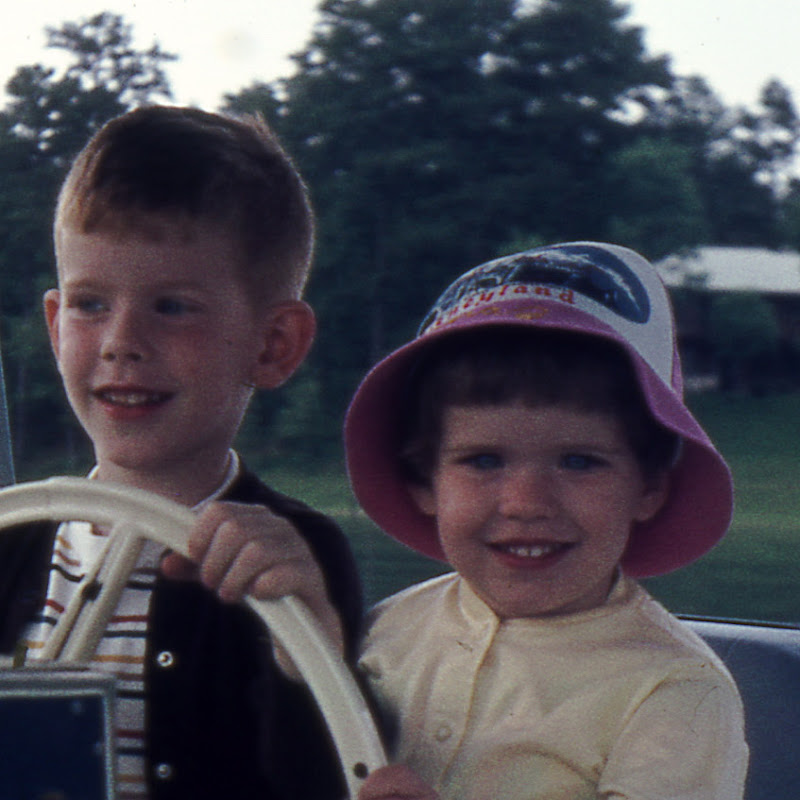
It may seem that not much changed here at UTC Headquarters during NaBloPoMo. I posted every day, just like I always do. There were stories about stuff the kids said and did. I blathered on about teaching and technology and process theology. I documented my travel and succumbed to the occasional meme.
But I was aware that some of those visiting me were also NaBloPoMoing, and I felt a kind of responsibility born of that kinship. I stole some of their ideas, they stole some of mine. I watched with interest as they struggled with the challenge of daily posting, and figured out for themselves how the process differs from their previous experience of blogging. I don't know if any of them will continue, as I did after my first NaBloPoMo in 2006, but I imagine many have discovered something new about themselves or their writing or their blogs, as I did (and still do).
There's still a big honkin' piece of unfinished business for the month, and that's the cache of unanswered questions. I admit -- many of those questions were daunting. I took a look at them each evening when I came home without a blog topic, and usually they seemed beyond my energy, time, or ability to think of something enlightening to say. (Behold the disadvantage of blogging after a full day's work; unless I had worked up a passion about some potential post during the day, often my highest ambition for the day's post was to get it written, up, and over with.)
But I appreciate my readers too much to let those questions wither away and die after their NaBloPoMo. So I hereby pledge to answer every single question, even the really hard ones, before 2007 is over.
But not tonight. Too tired, and too ready to get the weekend underway with TV on the DVR and learning to cable without a needle for holiday knitting. And so NaBloPoMo ends as it began.
Instead, let me ask you a question: If you did NaBloPoMo, what did you learn about yourself, your writing, or your blog -- if anything?
Friday, November 30, 2007


Thursday, November 29, 2007
Warning: big words

I use Google Docs as my word processor for most writing I do. Occasionally when I'm checking my word count, I also glance at the reading level scores that are provided along with all the other statistics about my document. They're consistently in the 13-16 grade range -- college level.
These scores calculate characters per word, words per sentence, syllables per word, and similar measures. In the Flesch-Kincaid Reading Ease formula, for example, easy-to-read texts score in the nineties and difficult texts score in the twenties. Reader's Digest has a readability index of about 62, according to the Wikipedia page on the Flesch-Kincaid method. The Harvard Law Review usually tests in the low 30's. My latest book review for the A.V. Club scored 30.69.
Now I assume that I'm writing for people with a college education. But does that mean that I shouldn't try to write on a more accessible level? Part of it is my preferred style of long sentences that accumulate detail, examples, appositives, and lists snowball-fashion as they roll to their conclusions. Part of it is my penchant for shoving together words and phrases to make new descriptors out of old parts.
I don't think my usual style is just academic obscurantism. There is a conventional rhythm to academic writing that I can switch on and off depending on what kind of text I'm working on, and I admit to enjoying the precision and sophistication of that language at its best. But there are complicated ideas that can only be properly qualified and correlated in terminology that's far from ordinary speech.
I can write more simply when needed. The Flesch reading ease scores of the answers I provide for "Ask The A.V. Club" are in the 60's; those are more casual and less compressed pieces of writing than my reviews. Toxophily scores as "junior high school" on the same test linked above; I write more conversationally in that setting and about that subject.
Do your readability scores differ by topic, audience, or setting? Do you think that, like some government agencies, we should all try to write for an eighth-grade reader?
Wednesday, November 28, 2007
Camera obscura
New post at Toxophily: sky-blue socks!
This morning I had my trusty Canon Powershot S400 in my purse, and I took it out when I got to work and turned it on. This is what I saw on the screen:

Or something like that anyway, only pinker and blobbier. Well, nuts. I love this camera, purchased in March 2004. I guess you can't expect these gadgets to last forever. Let me just check Google to see if there's any hope of repair ...
Hey, FixYa.com has a post from somebody with a pink streaky display, and the response says that it's a CCD failure (the imaging chip inside the camera), and that Canon has a service bulletin promising a fix whether in or out of warranty. Let me just call that 800 number. Computer answers, I navigate to the repair area and tell them my product. The computer transfers me to "our Virginia call center" (a pointed jab at overseas outsourcing), and then I'm told that "all our representatives are busy." Par for the course.
But wait! The computer is telling me that if I punch in my number and say my name, they'll call me back in "9 to 15 minutes" when it's my turn. OK, I'll give that a shot. Back to work, and ten minutes later, Larry in Virginia has called me up and is joking about the pink blobs being a new feature to spark my creativity. Clearly he's not being paid by the call, since he carefully explains the whole return process to me and takes my information.
A while later, I get an e-mail from Canon Customer Care with an attachment -- already filled out with the serial number and shipping address I gave Larry -- for me to print out and put in the box with my camera. Hot on its heels came an e-mail from UPS with a link to my prepaid shipping label for printing and affixing to my package.
That's right -- not only are they fixing my three-and-a-half year old camera for free, but they're paying for the shipping there and back. Combine that with the terrific experience I had with the telephone service, and my day went from "oh no, my camera's dead!" to "wow, I'm getting a free repair!" in no time flat.
Canon, say hello to your customer for life.
This morning I had my trusty Canon Powershot S400 in my purse, and I took it out when I got to work and turned it on. This is what I saw on the screen:
Or something like that anyway, only pinker and blobbier. Well, nuts. I love this camera, purchased in March 2004. I guess you can't expect these gadgets to last forever. Let me just check Google to see if there's any hope of repair ...
Hey, FixYa.com has a post from somebody with a pink streaky display, and the response says that it's a CCD failure (the imaging chip inside the camera), and that Canon has a service bulletin promising a fix whether in or out of warranty. Let me just call that 800 number. Computer answers, I navigate to the repair area and tell them my product. The computer transfers me to "our Virginia call center" (a pointed jab at overseas outsourcing), and then I'm told that "all our representatives are busy." Par for the course.
But wait! The computer is telling me that if I punch in my number and say my name, they'll call me back in "9 to 15 minutes" when it's my turn. OK, I'll give that a shot. Back to work, and ten minutes later, Larry in Virginia has called me up and is joking about the pink blobs being a new feature to spark my creativity. Clearly he's not being paid by the call, since he carefully explains the whole return process to me and takes my information.
A while later, I get an e-mail from Canon Customer Care with an attachment -- already filled out with the serial number and shipping address I gave Larry -- for me to print out and put in the box with my camera. Hot on its heels came an e-mail from UPS with a link to my prepaid shipping label for printing and affixing to my package.
That's right -- not only are they fixing my three-and-a-half year old camera for free, but they're paying for the shipping there and back. Combine that with the terrific experience I had with the telephone service, and my day went from "oh no, my camera's dead!" to "wow, I'm getting a free repair!" in no time flat.
Canon, say hello to your customer for life.
Tuesday, November 27, 2007
Ever since Diderot
Noel discovered some months back that he had a giant man-crush on Ken Jennings, the all-time Jeopardy! champion. Ken's blog, Confessions of a Trivial Mind, reveals something quite different from the trivia geek or socially-stunted dork one might expect would be the type to win 74 Jeopardy! games in a row. Number one: Terrific, writer. Number two: A passion for film, and astoundingly astute taste in same. Number three: Opinions about the broader culture that show good sense, rather than its much-vaunted populist cousin, "common sense."
I can love Ken Jennings in a much more heterosexual way than my hubby, albeit for the same reasons. And every time I catch up with his blog, he gives me another reason to fall head over heels. Take this post on Wikipedia, prompted by a sensationalist story from Pennsylvania about a few secondary and higher-ed faculty members who discourage use of the collaborative encyclopedia.
Few topics in academic circles raise my hackles more than Wikipedia. My colleagues almost without exception have a knee-jerk reaction to mention of the site: mouths turn down, tongues cluck, eyebrows raise. We're all supposed to commiserate with each other about the sorry state of the world where any yahoo can edit a compendium of knowledge, and where our students are too stupid (or too lazy) to realize (or care) that it's all a pack of lies.
I can rarely stop myself from butting into any conversation anyway -- being a know-it-all is one of my many character flaws -- but I take it as a personal mission never to let negative stereotypes about Wikipedia go unchallenged. "Actually," I pipe up, "a 2005 study by the journal Nature found that Wikipedia was almost as accurate as the Encyclopedia Brittanica. And of course it's much more up to date, not to mention including much more information about topics in popular culture and current events."
Heads generally turn. "But anyone can change it," someone usually points out. "You don't have to be an expert to write an article in Wikipedia, or change one that's already there. There are no editors, no oversight. Nobody should be using it as a source."
"True, anyone can edit it, and there aren't official arbiters of content," I respond. "But an unofficial group of people, many of whom are experts and nearly all of whom are committed to the project for the common good, maintain the site and weed out bad or unverified information. The vast majority of edits on the site are done by a tiny percentage of those using it. It's simply not true that everyone who stops by sprays graffiti all over the site -- in fact, only a few do, and others almost always come along and clean it up."
"But I do agree with you about one thing. Nobody should be using it as a source -- nobody should be citing its articles in a research paper. It's just like any other encyclopedia -- a starting point for research, not a stopping point. Would you let your students cite the Encyclopedia Brittanica in a research paper?" I ask. My colleagues usually shake their heads begrudgingly. "Exactly," I say. "There's no reason to single out Wikipedia as a bad source; in fact, it does what it's designed to do perfectly well, like all its encyclopedia cousins, and better than some. And that's to give a reasonable overview of the subject, a quick source for dates or lists, and a bibliography one can follow for more in-depth and specialized information."
I've had some version of this conversation -- usually a less one-sided, more contentious one -- at least a dozen times in the past year, at gatherings of faculty in my institution, at workshops and conferences, at dinners, on planes. Not once have I encountered as reasonable, as open-minded, or as sensible a perspective in my conversation partners as the one Ken provides in this blog entry. I wish I could make it required reading for everyone in education.
I ranted recently about how little my fellow academics trust people in general, and Web 2.0 in particular. Hey, why bother getting a Ph.D. if Joe Podunk's thoughts on any given subject are going to be given as much weight as yours? But that's a caricature of collaborative technologies that harness the wisdom of crowds. It's not survival of the most popular, or validation of every vandalistic impulse found in the human id. It's not even democracy. It's the aggregation of expertise far beyond the traditional academic realm -- without excluding that realm. (Wikipedia entries on academic subjects typically cite the standard works in the field, and are often informally moderated by folks with the pertinent degree.)
And of course, our irrational hatred of Wikipedia has everything to do with elitism. We all use it, after all -- but we don't think our students are smart enough to use it, too. We think their poor credulous minds will be unable to distinguish between good uses of the tool and using it to murder Shakespeare or butcher the law of relativity. Let me ask this: Whose fault is it if our students can't figure out what tool to use for what purpose? Whose fault is it if they don't know how to tell a credible piece of information from crankery? We'd rather ban power tools than risk our apprentices nicking their fingers, and so we create for them an artificial world where everybody does research as if it were still 1975. And we think that training with hand saws and drill bits is preparing them for a job as a twenty-first century carpenter.
How did I know how many Jeopardy! games Ken Jennings won? You guess.
I can love Ken Jennings in a much more heterosexual way than my hubby, albeit for the same reasons. And every time I catch up with his blog, he gives me another reason to fall head over heels. Take this post on Wikipedia, prompted by a sensationalist story from Pennsylvania about a few secondary and higher-ed faculty members who discourage use of the collaborative encyclopedia.
Few topics in academic circles raise my hackles more than Wikipedia. My colleagues almost without exception have a knee-jerk reaction to mention of the site: mouths turn down, tongues cluck, eyebrows raise. We're all supposed to commiserate with each other about the sorry state of the world where any yahoo can edit a compendium of knowledge, and where our students are too stupid (or too lazy) to realize (or care) that it's all a pack of lies.
I can rarely stop myself from butting into any conversation anyway -- being a know-it-all is one of my many character flaws -- but I take it as a personal mission never to let negative stereotypes about Wikipedia go unchallenged. "Actually," I pipe up, "a 2005 study by the journal Nature found that Wikipedia was almost as accurate as the Encyclopedia Brittanica. And of course it's much more up to date, not to mention including much more information about topics in popular culture and current events."
Heads generally turn. "But anyone can change it," someone usually points out. "You don't have to be an expert to write an article in Wikipedia, or change one that's already there. There are no editors, no oversight. Nobody should be using it as a source."
"True, anyone can edit it, and there aren't official arbiters of content," I respond. "But an unofficial group of people, many of whom are experts and nearly all of whom are committed to the project for the common good, maintain the site and weed out bad or unverified information. The vast majority of edits on the site are done by a tiny percentage of those using it. It's simply not true that everyone who stops by sprays graffiti all over the site -- in fact, only a few do, and others almost always come along and clean it up."
"But I do agree with you about one thing. Nobody should be using it as a source -- nobody should be citing its articles in a research paper. It's just like any other encyclopedia -- a starting point for research, not a stopping point. Would you let your students cite the Encyclopedia Brittanica in a research paper?" I ask. My colleagues usually shake their heads begrudgingly. "Exactly," I say. "There's no reason to single out Wikipedia as a bad source; in fact, it does what it's designed to do perfectly well, like all its encyclopedia cousins, and better than some. And that's to give a reasonable overview of the subject, a quick source for dates or lists, and a bibliography one can follow for more in-depth and specialized information."
I've had some version of this conversation -- usually a less one-sided, more contentious one -- at least a dozen times in the past year, at gatherings of faculty in my institution, at workshops and conferences, at dinners, on planes. Not once have I encountered as reasonable, as open-minded, or as sensible a perspective in my conversation partners as the one Ken provides in this blog entry. I wish I could make it required reading for everyone in education.
I ranted recently about how little my fellow academics trust people in general, and Web 2.0 in particular. Hey, why bother getting a Ph.D. if Joe Podunk's thoughts on any given subject are going to be given as much weight as yours? But that's a caricature of collaborative technologies that harness the wisdom of crowds. It's not survival of the most popular, or validation of every vandalistic impulse found in the human id. It's not even democracy. It's the aggregation of expertise far beyond the traditional academic realm -- without excluding that realm. (Wikipedia entries on academic subjects typically cite the standard works in the field, and are often informally moderated by folks with the pertinent degree.)
And of course, our irrational hatred of Wikipedia has everything to do with elitism. We all use it, after all -- but we don't think our students are smart enough to use it, too. We think their poor credulous minds will be unable to distinguish between good uses of the tool and using it to murder Shakespeare or butcher the law of relativity. Let me ask this: Whose fault is it if our students can't figure out what tool to use for what purpose? Whose fault is it if they don't know how to tell a credible piece of information from crankery? We'd rather ban power tools than risk our apprentices nicking their fingers, and so we create for them an artificial world where everybody does research as if it were still 1975. And we think that training with hand saws and drill bits is preparing them for a job as a twenty-first century carpenter.
How did I know how many Jeopardy! games Ken Jennings won? You guess.
Monday, November 26, 2007
The secret life of telephones
All my blog energy this evening, following a vestry meeting that lasted more than three hours, went into my How I Met Your Mother blog on the T.V. Club. So here's an Archer story that happened during my trip to San Diego, as told in an e-mail by Noel:
Archer came out of his room just now to retrieve his bucket of good-of-gold stickers, and found that I'd placed the phone inside the bucket and that a good-as-gold was stuck to the phone.
Archer: (smiling wryly) You already got a good-as-gold stuck on the phone.
Me: Do phones deserve a good-as-gold?
Archer: (firmly, still smiling) No!
Me: But what if a phone does a really good job paying attention in art class?
Archer: (smile fading, pointing at me) Phones help you call. They do not get good-as-golds.
Sunday, November 25, 2007
Leftover heaven
I spent my teenage years at one of Chattanooga's exclusive prep schools. And I spent the greater proportion of those years somewhat overweight. The connection between those two facts was the school cafeteria, a daily dose of culinary delights that bore little resemblance to the steam trays and lunchrooms most high schoolers remember. The chef churned out unlimited quantities of classic Southern cooking that did a number on my waistline for six years. Whenever I need to convey to someone how different this experience was from the norm, I tell them about the trays of fresh-baked chocolate-chip cookies that would be brought out midway through the lunch period, steaming hot, and left on the dessert tables for us to grab as many as we wanted. That and the icebox chocolate cream pies.
But my very favorite dish at the GPS cafeteria was the turkey divan. At the time I had no idea what made this broccoli, turkey, and white sauce dish so transcendent. It was served in small bowls, and one bowl was never enough for me -- I would wait until the line had disappeared toward the end of the period and go back for seconds and thirds. Something in the gratined finishing of the dish, the slightly crispy texture of the top and the unidentifiable tangy bite of the sauce, bespoke love and pure pleasure to me.
God bless my fellow Bruiser and best bud Doc Thelma. She posted the recipe, Noel made it with some of the remains of my brined turkey tonight, and I enjoyed not just my portion but most of Cady Gray's as well. The secret ingredient? A hint of curry in that white sauce. It was exactly as I remembered it, and only required a warm Toll House cookie to complete my personal flashback to 1982.
Doc, if you can unearth the construction of that Bright School graham-cracker-and-chocolate frosting dessert that I loved at age seven, I believe I can die happy.
But my very favorite dish at the GPS cafeteria was the turkey divan. At the time I had no idea what made this broccoli, turkey, and white sauce dish so transcendent. It was served in small bowls, and one bowl was never enough for me -- I would wait until the line had disappeared toward the end of the period and go back for seconds and thirds. Something in the gratined finishing of the dish, the slightly crispy texture of the top and the unidentifiable tangy bite of the sauce, bespoke love and pure pleasure to me.
God bless my fellow Bruiser and best bud Doc Thelma. She posted the recipe, Noel made it with some of the remains of my brined turkey tonight, and I enjoyed not just my portion but most of Cady Gray's as well. The secret ingredient? A hint of curry in that white sauce. It was exactly as I remembered it, and only required a warm Toll House cookie to complete my personal flashback to 1982.
Doc, if you can unearth the construction of that Bright School graham-cracker-and-chocolate frosting dessert that I loved at age seven, I believe I can die happy.
Saturday, November 24, 2007
How do you knooooow?
Noel and I took advantage of the presence of Grandma Libby and Grandpa Alex to go out for dinner and a movie tonight, a break from the non-stop childcare Noel's been enduring since last Saturday and my own travel-related disconnects. We went to see Enchanted, which gave me the 1.5 steps extra beyond the Disney-princess-in-the-real-world premise I was looking for, allowing me to ignore the ridiculous CGI overkill of the ending and the all-thought-stopped-at-the-premise framework that came wrapped around the entertaining parts. Most importantly, it gives me an excuse to answer Eric's question:
How did you and Noel meet?
Well, I was in Athens, Georgia, getting my master's degree and indulging some minor rock-and-roll dreams. Noel was getting his B.A. in journalism and writing for the Red and Black. Both of us helped program the university's extensive film series. I don't remember the exact moment we met, but I was an avid reader of his back-page Friday column of entertainment picks, and he was a frequent audience member at my band's shows.
It wasn't until mere weeks before Noel's graduation that we socialized together for the first time -- and that was a party with a group, not a date. I totally flubbed what should have been our first date by never following up on my suggestion that we go see Casablanca together, thus ruining a great story we could have told in future years. Instead, I've got this unwieldy tale of shared interests, gradual friendship, and a romance that didn't blossom until we started exchanging letters after Noel moved back to Nashville.
What I'd really like is a rewritten "how we met" story that will entertain our children and grandchildren, and look good in the notice of our golden wedding anniversary celebration in the newspaper of the future (whatever that may be). My mom tells us how my dad used to hitchhike from Knoxville to Chattanooga every weekend. I don't think that the time Noel drove up to Charlottesville in an ice storm and wrecked his brand new car really has the same romantic ring.
So I'm soliciting your help, internet. Can you refashion any elements of our rather prosaic real-life tale into an enhanced version 2.0? And if not, do you at least have another question for me -- one that maybe will have a more entertaining answer? (Not your fault, Eric -- you had no way of knowing.)
How did you and Noel meet?
Well, I was in Athens, Georgia, getting my master's degree and indulging some minor rock-and-roll dreams. Noel was getting his B.A. in journalism and writing for the Red and Black. Both of us helped program the university's extensive film series. I don't remember the exact moment we met, but I was an avid reader of his back-page Friday column of entertainment picks, and he was a frequent audience member at my band's shows.
It wasn't until mere weeks before Noel's graduation that we socialized together for the first time -- and that was a party with a group, not a date. I totally flubbed what should have been our first date by never following up on my suggestion that we go see Casablanca together, thus ruining a great story we could have told in future years. Instead, I've got this unwieldy tale of shared interests, gradual friendship, and a romance that didn't blossom until we started exchanging letters after Noel moved back to Nashville.
What I'd really like is a rewritten "how we met" story that will entertain our children and grandchildren, and look good in the notice of our golden wedding anniversary celebration in the newspaper of the future (whatever that may be). My mom tells us how my dad used to hitchhike from Knoxville to Chattanooga every weekend. I don't think that the time Noel drove up to Charlottesville in an ice storm and wrecked his brand new car really has the same romantic ring.
So I'm soliciting your help, internet. Can you refashion any elements of our rather prosaic real-life tale into an enhanced version 2.0? And if not, do you at least have another question for me -- one that maybe will have a more entertaining answer? (Not your fault, Eric -- you had no way of knowing.)
Friday, November 23, 2007
Only 33 shopping days left
The Christmas shopping season officially began today, complete with wall-to-wall coverage on the news networks and a bunch of sale announcement e-mails landing in my inbox. Time for my annual confrontation with my shopping demons.
I have shopping problems. My desire to buy, give, and own the perfect stylish gifts collides with my crippling buyer's remorse. This leads to a lot more window shopping, second-guessing, making and forgetting brilliant plans, and basically trying to cram a lifetime of meaning into one purchase.
This year I'm making two gifts for the basic family units, which means that I only have 18/21 of the anxiety of a normal year. What I'd like to do is commit to an overall strategy -- like buying handmade, or buying fair trade -- and stick to it for every gift I buy. But every time I try that, there's somebody that I just can't fit in, and then the whole thing is blown and I'm back to flitting here and rushing there with no boundaries to give my shopping some shape and direction.
Maybe I need to tap the wisdom of those who have a better relationship with the consumer society and the Christmas imperative. What method do you use to get your shopping done without losing your mind or feeling completely inadequate to the task?
I have shopping problems. My desire to buy, give, and own the perfect stylish gifts collides with my crippling buyer's remorse. This leads to a lot more window shopping, second-guessing, making and forgetting brilliant plans, and basically trying to cram a lifetime of meaning into one purchase.
This year I'm making two gifts for the basic family units, which means that I only have 18/21 of the anxiety of a normal year. What I'd like to do is commit to an overall strategy -- like buying handmade, or buying fair trade -- and stick to it for every gift I buy. But every time I try that, there's somebody that I just can't fit in, and then the whole thing is blown and I'm back to flitting here and rushing there with no boundaries to give my shopping some shape and direction.
Maybe I need to tap the wisdom of those who have a better relationship with the consumer society and the Christmas imperative. What method do you use to get your shopping done without losing your mind or feeling completely inadequate to the task?
Thursday, November 22, 2007
Give thanks
This holiday I give thanks for:
- The fact that I am not a day-after-Thanksgiving shopper. 4 am this year, the crazy loons.
- Ravelry. And Jess and Casey.
- Alton Brown's brined turkey recipe.
- 7 pm bedtimes for the kids.
- Clarity.
- Google (for Reader, Docs, Notebook, etc., etc.)
- Sandy.
- Kids who grow up even though you think you never want them to change, blossoming into unforeseen vistas of personality.
- Noel's lucrative freelance gigs.
- Rumors of a Mac tablet.
- Moleskine journals.
- Screener season.
- BookMooch.
- Noro Kureyon.
- Koigu Painters Palette Premium Merino.
- The A.V. Club T.V. Club.
- Ken Jennings and his blog.
- The Criterion Collection edition of Days of Heaven.
- TiVo. Someday we'll have you back in our lives full time, we promise.
- Handknit socks. There's no such thing as a bad day when you're wearing handknit socks.
- My readers. I don't know why you show up day after day, but I'm glad you do.
Wednesday, November 21, 2007
Process and progress
Emmett asks:
I wonder if you've worked at reading "Process and Reality" for its own sake, as a book that has its own, extra-theological purpose?
Did you feel it necessary to understand process philosophy as a whole, or did you abstract from it what was immediately relevant to theology?
The book to which he's referring is Alfred North Whitehead's magnum opus, a massive and famously dense systematic metaphysics. It's by far the least readable of Whitehead's works, which are for the most part quite accessible. In most of his books, Whitehead tended to write essays and chapters in response to particular problems, linking them together gradually to make a limited number of theoretical points, but staying connected to the examples and situations that prompted the exploration.
But in PR, as Whitehead scholars call it, almost nothing is connected to reality as we know it. The prose is dense with jargon -- actual occasion, prehension, nexus, eternal object, consequent nature. There are no examples. Every so often Whitehead will give a short discourse on other philosophers treated related ideas, but mostly it's chapter after chapter of philosophical heavy lifting comparable to Kant for sheer opacity.
Emmett, PR isn't for reading. It's for reference. Ideas that Whitehead tries out in Science And The Modern World or Adventures Of Ideas get constructed robustly in PR, defined and polished and placed in the matrix of all the other ideas. But the only way to find out why those ideas got created at all is to be introduced to them in the less speculative, more grounded works.
I tend to read the first and last chapters of PR straight through. The rest I work like a jigsaw puzzle, moving the pieces around and ignoring the ones that aren't part of the picture I'm currently working on. Or maybe like a textbook, studying the word lists and doing the exercises to try to get the one point that matters right at the moment.
In answer to your other question, I think it's a mistake to try to extract from PR only the theological content (which is concentrated in the last chapter and mentioned briefly in a few other places in the text). Understanding process philosophy as a whole is important, although I don't claim to have mastered it; nevertheless, I continue to try because I don't want to sin against Whitehead by failing to understand him as he presents himself, rather than as I might want to make him useful for my projects.
There are many -- perhaps most -- who are better at reading and using PR. But since you're asking me, I'd say you need a guide, for sure. I was first led through PR by my mentor Will Power, at the University of Georgia; then more systematically by the late Langdon Gilkey, at the University of Virginia. While I had already struggled through much of it myself in both cases, knowledgeable teachers gave me context that allowed me to situate the metaphysical solution in relation to the problems it was designed to solve. Everything makes more sense when it is nested in a network of relationships -- an observation Whitehead would certainly appreciate.
Thanks for the question, Emmett -- hope you came back to read it. For the rest of you, please forgive this brief foray into the more technical and less generally relevant (or interesting) aspects of my academic specialty. You're welcome to cleanse your palette by submitting a question of your own!
I wonder if you've worked at reading "Process and Reality" for its own sake, as a book that has its own, extra-theological purpose?
Did you feel it necessary to understand process philosophy as a whole, or did you abstract from it what was immediately relevant to theology?
The book to which he's referring is Alfred North Whitehead's magnum opus, a massive and famously dense systematic metaphysics. It's by far the least readable of Whitehead's works, which are for the most part quite accessible. In most of his books, Whitehead tended to write essays and chapters in response to particular problems, linking them together gradually to make a limited number of theoretical points, but staying connected to the examples and situations that prompted the exploration.
But in PR, as Whitehead scholars call it, almost nothing is connected to reality as we know it. The prose is dense with jargon -- actual occasion, prehension, nexus, eternal object, consequent nature. There are no examples. Every so often Whitehead will give a short discourse on other philosophers treated related ideas, but mostly it's chapter after chapter of philosophical heavy lifting comparable to Kant for sheer opacity.
Emmett, PR isn't for reading. It's for reference. Ideas that Whitehead tries out in Science And The Modern World or Adventures Of Ideas get constructed robustly in PR, defined and polished and placed in the matrix of all the other ideas. But the only way to find out why those ideas got created at all is to be introduced to them in the less speculative, more grounded works.
I tend to read the first and last chapters of PR straight through. The rest I work like a jigsaw puzzle, moving the pieces around and ignoring the ones that aren't part of the picture I'm currently working on. Or maybe like a textbook, studying the word lists and doing the exercises to try to get the one point that matters right at the moment.
In answer to your other question, I think it's a mistake to try to extract from PR only the theological content (which is concentrated in the last chapter and mentioned briefly in a few other places in the text). Understanding process philosophy as a whole is important, although I don't claim to have mastered it; nevertheless, I continue to try because I don't want to sin against Whitehead by failing to understand him as he presents himself, rather than as I might want to make him useful for my projects.
There are many -- perhaps most -- who are better at reading and using PR. But since you're asking me, I'd say you need a guide, for sure. I was first led through PR by my mentor Will Power, at the University of Georgia; then more systematically by the late Langdon Gilkey, at the University of Virginia. While I had already struggled through much of it myself in both cases, knowledgeable teachers gave me context that allowed me to situate the metaphysical solution in relation to the problems it was designed to solve. Everything makes more sense when it is nested in a network of relationships -- an observation Whitehead would certainly appreciate.
Thanks for the question, Emmett -- hope you came back to read it. For the rest of you, please forgive this brief foray into the more technical and less generally relevant (or interesting) aspects of my academic specialty. You're welcome to cleanse your palette by submitting a question of your own!
Tuesday, November 20, 2007
Home meme
After just fourteen hours of pre-Thanksgiving air travel, I'm home. Good opportunity to wimp out and do a meme.
I was tagged for the ABC meme by Doc Thelma. The rules:
List a word that describes you for every letter of the alphabet. Offer as much or as little explanation as you wish. Please keep the words positive and feel free to get creative.
A: Arminian
B: Barthian (can I use a theological term for every letter, do you think?)
C: Corrector (like Ted)
D: Disorganized
E: Eloquent (occasionally)
F: Fair (I sunburn at the drop of an SPF)
G: Groovin' (on a Sunday afternoon)
H: Homebody
I: Imaginative (well, I like to think I am)
J: Jorges (my mother's maiden name)
K: Knitter
L: Laundress (I do the clothes washing in the family)
M: Mac-owning, Mac-loving
N: Nosy
O: Optically challenged
P: Poetic
Q: Questioning
R: Raveler
S: Safety-conscious
T: Technophile
U: Uncertain
V: Voracious eater
W: Whiteheadian
X: eXtravagance-averse
Y: Youthful
Z: Zappos-coveting
I tag anybody who's almost out of ideas as NaBloPoMo limps to an end!
I was tagged for the ABC meme by Doc Thelma. The rules:
List a word that describes you for every letter of the alphabet. Offer as much or as little explanation as you wish. Please keep the words positive and feel free to get creative.
A: Arminian
B: Barthian (can I use a theological term for every letter, do you think?)
C: Corrector (like Ted)
D: Disorganized
E: Eloquent (occasionally)
F: Fair (I sunburn at the drop of an SPF)
G: Groovin' (on a Sunday afternoon)
H: Homebody
I: Imaginative (well, I like to think I am)
J: Jorges (my mother's maiden name)
K: Knitter
L: Laundress (I do the clothes washing in the family)
M: Mac-owning, Mac-loving
N: Nosy
O: Optically challenged
P: Poetic
Q: Questioning
R: Raveler
S: Safety-conscious
T: Technophile
U: Uncertain
V: Voracious eater
W: Whiteheadian
X: eXtravagance-averse
Y: Youthful
Z: Zappos-coveting
I tag anybody who's almost out of ideas as NaBloPoMo limps to an end!
Monday, November 19, 2007
Sacred treasure
I stood in a hushed, darkened gallery, the voice of a female singer chanting faintly in Middle Eastern rhythms seeping down from speakers in the ceiling. Before me were four dark, oval pieces of leather, about three inches high, suspended between plates of glass in a tilted display case. Tiny Aramaic characters were inscribed on the fragments, although they could barely be discerned against the age-darkened hide. It was as if the tips of four giant fingers had pushed against the window between our worlds.
The pieces of leather were parts of the Targum of Job, an Aramaic translation of the biblical book of Job that was one of hundreds of texts found in clay storage jars buried in caves near the Dead Sea. The Dead Sea Scrolls (or, as scholars call them, the Qumran texts) were written, collected, and stored by a Jewish sect readying itself for the Messianic age, which was imminent. The members expected two Messiahs -- a king and a priest -- and they developed an elaborate community rule that classified adherents in terms of the stages of purification they had reached. One of their major activities, it seems, was gathering and copying sacred texts. Some were parts of what became the Hebrew Bible; some were later relegated to apocryphal or secondary status; some were specific to the Qumran group; and some were completely lost to history after the Roman conquest of Jerusalem in 70 C.E.
Of all the upheavals and quantum leaps in the study of Judaism and Christianity, the discovery of the Dead Sea Scrolls by a shepherd in 1947 ranks as one of the greatest, if not the greatest. At a single stroke the age of the oldest manuscripts of the Hebrew Bible was pushed back several centuries. Even more significantly, for the first time there was copious material evidence about the existence, way of life, and beliefs of a Jewish sect expecting the Messiah(s), at odds with the official Judaism of its time (Qumranites held that the Temple was defiled, and maintained pure rituals until the true Temple cult could be restored), and contemporaneous with the Jesus movement. Suddenly, instead of appearing in 30 C.E. as a unique and unprecedented revelation, the texts and ideas of the early church about Jesus could be seen in a context of intense disputes and sectarian schisms in turn-of-the-era Judaism. Suddenly, the scribes who copied Jewish texts emerged with stunning human personality: the one who wrote flowing, beautiful paleo-Hebrew, the one who left an erasure mark on the Job Targum fragment after a mistake, the one who inadvertently left out a word in the books of Samuel and had to squeeze it in above the line.
As I peered down into the case containing the fragments of Samuel, I was overwhelmed with emotion. I thought back to the Codex Sinaiticus that I witnessed in Washington, D.C. last year. These fragile letters were messages from a mysterious, alien ancient past to our time -- unintended messages, but a communication nonetheless. They force us to see our religious and scriptural commitments in relation to the beliefs and practices, no less (and probably much more) intense, thorough, and devout than our own, of people to whom these documents meant something related but quite strange and skewed from what they have come to mean to us. To be in their presence is to feel the compass shift, to realize that it may be our canon, interpretation, and eschatology that is off true -- or that the whole notion of one unerring tradition persisting into our time may be unlikely to the point of absurdity.
The pieces of leather were parts of the Targum of Job, an Aramaic translation of the biblical book of Job that was one of hundreds of texts found in clay storage jars buried in caves near the Dead Sea. The Dead Sea Scrolls (or, as scholars call them, the Qumran texts) were written, collected, and stored by a Jewish sect readying itself for the Messianic age, which was imminent. The members expected two Messiahs -- a king and a priest -- and they developed an elaborate community rule that classified adherents in terms of the stages of purification they had reached. One of their major activities, it seems, was gathering and copying sacred texts. Some were parts of what became the Hebrew Bible; some were later relegated to apocryphal or secondary status; some were specific to the Qumran group; and some were completely lost to history after the Roman conquest of Jerusalem in 70 C.E.
Of all the upheavals and quantum leaps in the study of Judaism and Christianity, the discovery of the Dead Sea Scrolls by a shepherd in 1947 ranks as one of the greatest, if not the greatest. At a single stroke the age of the oldest manuscripts of the Hebrew Bible was pushed back several centuries. Even more significantly, for the first time there was copious material evidence about the existence, way of life, and beliefs of a Jewish sect expecting the Messiah(s), at odds with the official Judaism of its time (Qumranites held that the Temple was defiled, and maintained pure rituals until the true Temple cult could be restored), and contemporaneous with the Jesus movement. Suddenly, instead of appearing in 30 C.E. as a unique and unprecedented revelation, the texts and ideas of the early church about Jesus could be seen in a context of intense disputes and sectarian schisms in turn-of-the-era Judaism. Suddenly, the scribes who copied Jewish texts emerged with stunning human personality: the one who wrote flowing, beautiful paleo-Hebrew, the one who left an erasure mark on the Job Targum fragment after a mistake, the one who inadvertently left out a word in the books of Samuel and had to squeeze it in above the line.
As I peered down into the case containing the fragments of Samuel, I was overwhelmed with emotion. I thought back to the Codex Sinaiticus that I witnessed in Washington, D.C. last year. These fragile letters were messages from a mysterious, alien ancient past to our time -- unintended messages, but a communication nonetheless. They force us to see our religious and scriptural commitments in relation to the beliefs and practices, no less (and probably much more) intense, thorough, and devout than our own, of people to whom these documents meant something related but quite strange and skewed from what they have come to mean to us. To be in their presence is to feel the compass shift, to realize that it may be our canon, interpretation, and eschatology that is off true -- or that the whole notion of one unerring tradition persisting into our time may be unlikely to the point of absurdity.
Sunday, November 18, 2007
The Villani Heuristic
I got through my session and paper presentation this morning with only the usual technical anxieties, and it was well received (all my laugh lines got laughs). Then it was playtime.
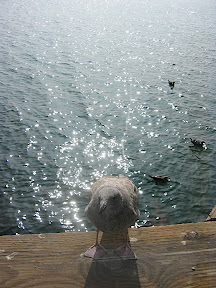
This is the gull that eyed me sourly as I ate my crab cakes on the pier.

A kite demonstration on the Embarcadero.

The Port of San Diego was sponsoring a family day, complete with patio seating and board games.

Adam Villani and his charming bride Jen swept me away for a whirlwind tour of the greater San Diego metropolitan area. After fish tacos, we went over to the Hotel del Coronado, where The Stunt Man was filmed.

Those tiny dots are surfers off the shore at La Jolla.

For our second food stop, we went to Hodad's in Ocean Beach for classic diner fare.

Here's the mouthwatering burger I enjoyed.
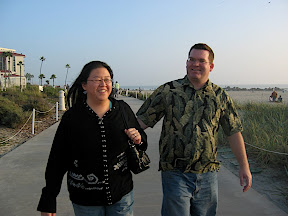
Thanks for the enlightening day and indulgent companionship, Adam and Jen!
This is the gull that eyed me sourly as I ate my crab cakes on the pier.
A kite demonstration on the Embarcadero.
The Port of San Diego was sponsoring a family day, complete with patio seating and board games.
Adam Villani and his charming bride Jen swept me away for a whirlwind tour of the greater San Diego metropolitan area. After fish tacos, we went over to the Hotel del Coronado, where The Stunt Man was filmed.
Those tiny dots are surfers off the shore at La Jolla.
For our second food stop, we went to Hodad's in Ocean Beach for classic diner fare.
Here's the mouthwatering burger I enjoyed.
Thanks for the enlightening day and indulgent companionship, Adam and Jen!
Saturday, November 17, 2007
It's official
Three days is the most I can go without experiencing debilitating Children Missing Syndrome.* Oh, I missed the kids off and on Thursday and Friday -- when I saw little tots playing in the park or ordering off the Lil' Sailors menu at the local fish house. But today the same sights made me want to double over in pain. As if they were punishing me at my lowest possible moment, Cady Gray and Archer were too distracted to talk to Mommy on the phone when I called just after their dinner -- all I got were a few non sequiturs and an unceremonious handing the phone back to Dad.
Three more days to go.
Here's what happened today:
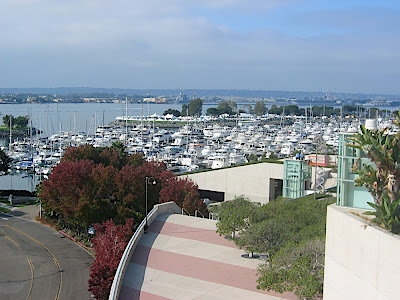
It was another gorgeous morning.

I had a great Italian lunch al fresco in the Gaslamp District.
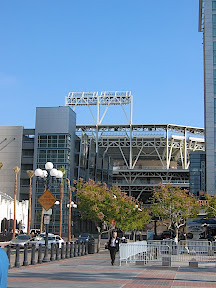
Petco Park was about a block away.
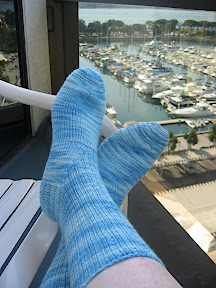
I finished a pair of socks.
Tomorrow: I invade the Society for Biblical Literature. Also: The real truth about Adam Villani, Gentleman.
*Not to be confused with Missing Children Syndrome, which requires immediately intervention by the authorities.
Three more days to go.
Here's what happened today:
It was another gorgeous morning.
I had a great Italian lunch al fresco in the Gaslamp District.
Petco Park was about a block away.
I finished a pair of socks.
Tomorrow: I invade the Society for Biblical Literature. Also: The real truth about Adam Villani, Gentleman.
*Not to be confused with Missing Children Syndrome, which requires immediately intervention by the authorities.
Friday, November 16, 2007
Dominance
A couple of years ago, I read Malcolm Gladwell's profile of Cesar Milan, star of HBO's The Dog Whisperer. Tonight I flipped to HBO on the hotel TV (we don't get any pay channels at home) and there was Cesar. It was the first time I'd seen the show -- and I was instantly hooked. I could watch all night. It's something about the wonderment exhibited by the dog owners, suddenly seeking their Sheltie riding in the car without barking incessantly, or their pit bull mix lying next to a rabbit without trying to kill it. And it's Cesar himself -- his unstudied presence on camera, his complete confidence and control over the conversation. He's like one of those horrible TV psychics, but without the act. He doesn't come off like a showman at all, but he's doing the same thing -- controlling the scenario completely, framing it how he wants it framed.
I always do this on trips -- gorge myself on a marathon of some show I never watch, approaching the end of an hour in the anxiety that they're not going to give me another one. More! More! More!
Today's post is over at Toxophily, where there are pictures of socks and shoes in San Diego.
I always do this on trips -- gorge myself on a marathon of some show I never watch, approaching the end of an hour in the anxiety that they're not going to give me another one. More! More! More!
Today's post is over at Toxophily, where there are pictures of socks and shoes in San Diego.
Thursday, November 15, 2007
On the dock of the bay
Turns out my stress didn't end when I got to the airport this morning -- the travel agency did not actually book my itinerary, so I had no e-ticket waiting for me when I got there, which was an unpleasant surprise. (The way travel gets done at my university is that the department secretary works out an itinerary with the travel agency and gives them the university's "ghost" credit card number to reserve it, simultaneously starting a purchase order and requisition up through the approval process. Once the requisition has been approved by the highest office in line, then the university travel office is supposed to contact the travel agency and actually pay them, thereby finally booking the ticket officially. Somewhere along the way somebody missed a step.)
So I paid about $1500 for a $500 round-trip ticket to San Diego this morning, which made me mad. (On the positive side, I got the exact same itinerary that had been reserved two months ago -- all four flights. Kind of amazing, really.) The second flight today was delayed by an hour because the plane had been diverted two legs earlier for an inflight medical emergency, landing in St. Louis before going on to Austin where it was originally headed.
But you know what? This made it all better:

A cozy room at the Marriott Hotel and Marina ...
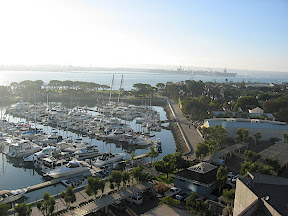
... with a balcony view.
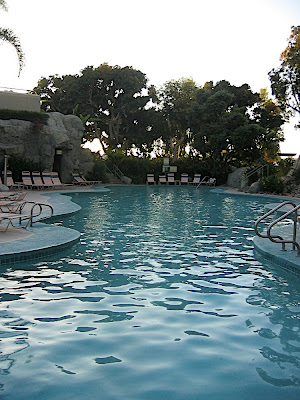
It was 78 degrees, so I went for a swim.

When I floated on my back, this is what I saw.

The restorative powers of a sunset walk along the bay ...

... cannot be overestimated.
So I paid about $1500 for a $500 round-trip ticket to San Diego this morning, which made me mad. (On the positive side, I got the exact same itinerary that had been reserved two months ago -- all four flights. Kind of amazing, really.) The second flight today was delayed by an hour because the plane had been diverted two legs earlier for an inflight medical emergency, landing in St. Louis before going on to Austin where it was originally headed.
But you know what? This made it all better:
A cozy room at the Marriott Hotel and Marina ...
... with a balcony view.
It was 78 degrees, so I went for a swim.
When I floated on my back, this is what I saw.
The restorative powers of a sunset walk along the bay ...
... cannot be overestimated.
Wednesday, November 14, 2007
In the air again
Last night I dreamed that I got up nice and early, drove to the airport in plenty of time to make my 10 am flight, and was strolling toward security when I suddenly realized: I had forgotten to pack my suitcase. I had put my pashmina in it, but nothing else. So there I was approaching the security line and thinking: It's okay, I'll just buy everything when I get there. But I have nothing! I realized. No shoes, no underwear, nothing. I can't go to California with absolutely nothing. I don't have the time or money to buy a whole wardrobe for five days. I have to go back home and get clothes, even though it's going to make it really hard to make the flight.
So I went back out to the parking lot, but my car didn't seem to be where I had left it. I'm walking around in the parking lot looking for my car, getting more and more frantic as I realize there's no way this is going to work out. And I wake up.
This dream has a simple meaning. I'm going to San Diego in the morning, and I'm anxious about it. Will I leave in time, will I remember everything, what will go wrong? Traveling stress-free, for me, is getting all that anxiety out in the open ahead of time. That makes me over-prepare and triple-check everything. When I actually leave, so the theory goes, I have no worries because I've got a big built-in safety net.
Well, not exactly. But I'm usually able to let go of my need to control everything once I get to the airport. After that, it's all out of my hands, and I'm just along for the ride. In this case, I'm along for the ride to the American Academy of Religion annual meeting, preceded by the day-long Board of Directors meeting (my first), highlighted by a presentation to the Society of Biblical Literature on recent portrayals of biblical women on film, and culminating in a visit to the Dead Sea Scrolls at the San Diego Natural History Museum. If I prepare correctly and keep the stress under control, it's going to be an excellent trip.
Tomorrow I'll return to your questions, so if you've got any more, fire away. See you on the West Coast.
So I went back out to the parking lot, but my car didn't seem to be where I had left it. I'm walking around in the parking lot looking for my car, getting more and more frantic as I realize there's no way this is going to work out. And I wake up.
This dream has a simple meaning. I'm going to San Diego in the morning, and I'm anxious about it. Will I leave in time, will I remember everything, what will go wrong? Traveling stress-free, for me, is getting all that anxiety out in the open ahead of time. That makes me over-prepare and triple-check everything. When I actually leave, so the theory goes, I have no worries because I've got a big built-in safety net.
Well, not exactly. But I'm usually able to let go of my need to control everything once I get to the airport. After that, it's all out of my hands, and I'm just along for the ride. In this case, I'm along for the ride to the American Academy of Religion annual meeting, preceded by the day-long Board of Directors meeting (my first), highlighted by a presentation to the Society of Biblical Literature on recent portrayals of biblical women on film, and culminating in a visit to the Dead Sea Scrolls at the San Diego Natural History Museum. If I prepare correctly and keep the stress under control, it's going to be an excellent trip.
Tomorrow I'll return to your questions, so if you've got any more, fire away. See you on the West Coast.
Tuesday, November 13, 2007
On doing and teaching
Rick asks:
for an aspiring teacher, would you please offer your thoughts on the statement: "those who can't do, teach."
Happy to. Unfortunately, it's sometimes true. But to my mind, if you're not doing, you have no business teaching.
I think the saying is usually applied to people who can't cut it in the real world, and so retreat to the supposedly safe world of academia, where they don't have to produce anything but can criticize their students' efforts to do so. The premise is that the competition in the world of business or work is too hot for these mediocre folks to handle, and that by teaching they are able to avoid these challenges.
I'm sure such teachers exist. But, at least at the university level, I've become convinced that they are the exception, and that whenever possible they should not be given teaching positions.
What does "doing" mean at the university level? It means performing to an audience of your peers the skills you are teaching to your students. In most cases, that's publishing and presenting at scholarly conferences. You are submitting your work for extramural evaluation, and in doing so, you are being judged in the same way you judge your students. If your work is not up to the standard to be accepted for publication by peer-refereed journals, or to be accepted at a conference prestigious enough to be selective, perhaps you are not skilled or knowledgeable enough to teach -- at least, that is the premise of these requirements for faculty promotion and tenure.
But beyond the results of these evaluations of quality, it's important to realize that the collaborative nature of the scholarly enterprise must be performed by the teacher, not just taught as an obligation to students. Students are expected to submit their work to be evaluated, the idea being that they will benefit and learn from getting feedback, from being accountable to someone other than themselves. A university teacher who is not a scholar -- who is not submitting his work to be evaluated, who is not demonstrating in performance a belief that he needs to get feedback for his own benefit and learning, who does not want to be accountable to the community of those in the same field -- is trying to make his students play by rules he does not want applied to himself.
My thinking about university teaching has increasingly moved in the direction of performance and extramural accountability. I want my students writing blogs so that they are responsible to a vast, unknown audience outside the classroom. I want them writing together, depending on each other, and having their work made public, to get them out of their isolated heads and their belief in their own heroic powers to create or fail to create alone. And I don't want to ask them to do anything I'm not doing myself -- blogging, collaborative writing, making my work public to an audience of my peers and beyond. I don't do those things because I have mastered them (with the implication that those who are learning should not be expected to do those things as an apprentice). I do them because they keep me accountable to others, enable me to move beyond what I could do alone, check my ideas and methods against those that are standard in my field, and contribute to the ongoing conversation in the areas where I presume to transmit ideas and methods to the next generation.
Some parts of the university have made performance and extramural evaluation into standard processes for undergraduates -- but they are the parts that are less traditional and most threatening to the old university ideal: business, the arts, athletics. I'm a believer in those traditional academic methods and subject matter, but I also recognize that their insularity can provide non-performing teachers with immunity from being discovered as those who "can't do." The performance of scholarship becomes a kind of game to students and faculty alike -- a hoop that has to be jumped through but isn't integral to the job, an assignment rather than an identity. The increasing reliance on non-tenure-track and adjunct faculty, those who are not expected to publish and present (perform and be evaluated outside one's own institution), threatens to make these processes seem auxiliary to teaching, separate from it, disposable or optional.
In reality, they are crucial, and students who are not taught by someone undergoing them are experiencing hypocrisy at best, and being shortchanged at worst.
for an aspiring teacher, would you please offer your thoughts on the statement: "those who can't do, teach."
Happy to. Unfortunately, it's sometimes true. But to my mind, if you're not doing, you have no business teaching.
I think the saying is usually applied to people who can't cut it in the real world, and so retreat to the supposedly safe world of academia, where they don't have to produce anything but can criticize their students' efforts to do so. The premise is that the competition in the world of business or work is too hot for these mediocre folks to handle, and that by teaching they are able to avoid these challenges.
I'm sure such teachers exist. But, at least at the university level, I've become convinced that they are the exception, and that whenever possible they should not be given teaching positions.
What does "doing" mean at the university level? It means performing to an audience of your peers the skills you are teaching to your students. In most cases, that's publishing and presenting at scholarly conferences. You are submitting your work for extramural evaluation, and in doing so, you are being judged in the same way you judge your students. If your work is not up to the standard to be accepted for publication by peer-refereed journals, or to be accepted at a conference prestigious enough to be selective, perhaps you are not skilled or knowledgeable enough to teach -- at least, that is the premise of these requirements for faculty promotion and tenure.
But beyond the results of these evaluations of quality, it's important to realize that the collaborative nature of the scholarly enterprise must be performed by the teacher, not just taught as an obligation to students. Students are expected to submit their work to be evaluated, the idea being that they will benefit and learn from getting feedback, from being accountable to someone other than themselves. A university teacher who is not a scholar -- who is not submitting his work to be evaluated, who is not demonstrating in performance a belief that he needs to get feedback for his own benefit and learning, who does not want to be accountable to the community of those in the same field -- is trying to make his students play by rules he does not want applied to himself.
My thinking about university teaching has increasingly moved in the direction of performance and extramural accountability. I want my students writing blogs so that they are responsible to a vast, unknown audience outside the classroom. I want them writing together, depending on each other, and having their work made public, to get them out of their isolated heads and their belief in their own heroic powers to create or fail to create alone. And I don't want to ask them to do anything I'm not doing myself -- blogging, collaborative writing, making my work public to an audience of my peers and beyond. I don't do those things because I have mastered them (with the implication that those who are learning should not be expected to do those things as an apprentice). I do them because they keep me accountable to others, enable me to move beyond what I could do alone, check my ideas and methods against those that are standard in my field, and contribute to the ongoing conversation in the areas where I presume to transmit ideas and methods to the next generation.
Some parts of the university have made performance and extramural evaluation into standard processes for undergraduates -- but they are the parts that are less traditional and most threatening to the old university ideal: business, the arts, athletics. I'm a believer in those traditional academic methods and subject matter, but I also recognize that their insularity can provide non-performing teachers with immunity from being discovered as those who "can't do." The performance of scholarship becomes a kind of game to students and faculty alike -- a hoop that has to be jumped through but isn't integral to the job, an assignment rather than an identity. The increasing reliance on non-tenure-track and adjunct faculty, those who are not expected to publish and present (perform and be evaluated outside one's own institution), threatens to make these processes seem auxiliary to teaching, separate from it, disposable or optional.
In reality, they are crucial, and students who are not taught by someone undergoing them are experiencing hypocrisy at best, and being shortchanged at worst.
Monday, November 12, 2007
Reading to write
Stevie asks:
I have a soft spot for epic, heroic fantasy, and I'm not sure why. After all, as a teenager I was into hard science fiction -- the harder the better. (One of the books I read to tatters during those years was Robert L. Forward's Dragon's Egg, about tiny flat sentient creatures living on the surface of a neutron star who careen through full lives so quickly that it would be almost impossible for a human observer to recognize their intelligence.) I read LotR and Piers Anthony and so forth during this time -- one of my high school friends was more into fantasy than I was, and I piggy-backed off of her -- but it was the plausible and technological future worlds that held my interest.
In college I used to ride my bike about five miles from campus to a used book store, where I engaged in the reverse-pyramid scheme of used paperbacks -- buy 'em for half price, sell 'em back for 2 for 1 credit, meaning that every book I bought could be traded in for one quarter of a future book. I don't know why I picked up Sheepfarmer's Daughter on one of my trips -- maybe it was because it was the first volume of a trilogy. (I tend to overrate getting in on the ground floor.) To the best of my recollection I wasn't reading any fantasy at the time -- even my SF phase was largely behind me. (Actually, somewhat to my shame, I was reading a lot of Regency period romance novels, a genre I still find irresistible.)
What can I say? From the very first pages, I met a heroine who was almost exactly what I needed. She craved adventure and chafed under structure, before she learned to appreciate it. She was always on the verge of being misunderstood, but fair-minded and thoughtful superiors managed to give her what she needed. She was favored of destiny, but could not think of herself as particularly good or accomplished. She made impossible choices, and struggled to bring good out of evil. She approached the world with what she knew how to do best, and hoped with all her heart that it would meet the challenge.
I wanted to be Paksenarrion. I still do. Her trilogy, collected as The Deed of Paksenarrion, is my favorite book. I return to it every year to remind myself how to be a hero, and why it doesn't require any extra measure of self-knowledge or self-confidence or moral uprightness. Paks helps me to believe that there's enough in me, when combined with what's good on earth and in heaven, to do what needs to be done.
I know it's not a very prestigious or literary choice for my favorite book. Believe me, when I pick it up on a yearly basis -- or teach it to students, occasionally -- I approach it with trepidation. What if I open it up and find that my admiration has been misplaced, that it's trash and poorly written and clumsily plotted and unbelievably characterized? But every year it is just as beautiful -- as human, as suspenseful, as inspiring, as nuanced -- and students have fallen in love with it, too, validating my affection.
I wish I could plow through the conference paper I'm writing, the final exams I'm planning, the syllabi I'm constructing, the journal articles and encyclopedia articles that are waiting for my attention, in a 72-hour Red Bull-fueled marathon of work. And then do nothing but read about Paksenarrion during my trip to San Diego. A sojourn with this soldier would rejuvenate me, as it always does, for the missions I undertake in my own journey through life.
What's your favorite book that isn't about theology?I like that you assume that my favorite books are all about theology. After all, I know accountants would just curl up with the tax code if they weren't forced away from it by family members worried about their mental health. No, I kid theology because I love theology, but it's not always my preferred leisure reading. (Although just this past month I devoured James Kugel's How To Read The Bible at every spare moment as if it were a page-turning mystery.)
I have a soft spot for epic, heroic fantasy, and I'm not sure why. After all, as a teenager I was into hard science fiction -- the harder the better. (One of the books I read to tatters during those years was Robert L. Forward's Dragon's Egg, about tiny flat sentient creatures living on the surface of a neutron star who careen through full lives so quickly that it would be almost impossible for a human observer to recognize their intelligence.) I read LotR and Piers Anthony and so forth during this time -- one of my high school friends was more into fantasy than I was, and I piggy-backed off of her -- but it was the plausible and technological future worlds that held my interest.
In college I used to ride my bike about five miles from campus to a used book store, where I engaged in the reverse-pyramid scheme of used paperbacks -- buy 'em for half price, sell 'em back for 2 for 1 credit, meaning that every book I bought could be traded in for one quarter of a future book. I don't know why I picked up Sheepfarmer's Daughter on one of my trips -- maybe it was because it was the first volume of a trilogy. (I tend to overrate getting in on the ground floor.) To the best of my recollection I wasn't reading any fantasy at the time -- even my SF phase was largely behind me. (Actually, somewhat to my shame, I was reading a lot of Regency period romance novels, a genre I still find irresistible.)
What can I say? From the very first pages, I met a heroine who was almost exactly what I needed. She craved adventure and chafed under structure, before she learned to appreciate it. She was always on the verge of being misunderstood, but fair-minded and thoughtful superiors managed to give her what she needed. She was favored of destiny, but could not think of herself as particularly good or accomplished. She made impossible choices, and struggled to bring good out of evil. She approached the world with what she knew how to do best, and hoped with all her heart that it would meet the challenge.
I wanted to be Paksenarrion. I still do. Her trilogy, collected as The Deed of Paksenarrion, is my favorite book. I return to it every year to remind myself how to be a hero, and why it doesn't require any extra measure of self-knowledge or self-confidence or moral uprightness. Paks helps me to believe that there's enough in me, when combined with what's good on earth and in heaven, to do what needs to be done.
I know it's not a very prestigious or literary choice for my favorite book. Believe me, when I pick it up on a yearly basis -- or teach it to students, occasionally -- I approach it with trepidation. What if I open it up and find that my admiration has been misplaced, that it's trash and poorly written and clumsily plotted and unbelievably characterized? But every year it is just as beautiful -- as human, as suspenseful, as inspiring, as nuanced -- and students have fallen in love with it, too, validating my affection.
I wish I could plow through the conference paper I'm writing, the final exams I'm planning, the syllabi I'm constructing, the journal articles and encyclopedia articles that are waiting for my attention, in a 72-hour Red Bull-fueled marathon of work. And then do nothing but read about Paksenarrion during my trip to San Diego. A sojourn with this soldier would rejuvenate me, as it always does, for the missions I undertake in my own journey through life.
Sunday, November 11, 2007
Algebra
We pause in our regularly scheduled NaBloPoMo reader question column for a check on Archer's mathematical progress.
I do not have a mental facility for algebra -- I pretty much always have to work it out on paper. So in most of the examples below, I didn't know ahead of time what the answers were -- I just checked Archer's answers after he provided them.
This morning, Archer asked about the final score of the UCA game last night (they shoot off a cannon in the stadium every time the home team scores, and since that's only about a seven-minute walk from our house, he spends the evening being constantly reminded about the game). I looked it up online and found that it was UCA 35, Stephen Austin 23.
"What combination of touchdowns, extra points, and field goals did we make to get 35?" I asked.
"Five touchdowns," he answered. "How many extra points?" "Five. A touchdown and extra point is 6+1," he said.
"Now what combination of touchdowns, extra points, and field goals made 23?" I challenged.
"Two touchdowns," he said.
"How many extra points?" "Two."
"How many field goals?" Triumphantly: "Three."
I added it up: 14 + 9 = 23. Yep.
While I was working it out, Archer was making up his own scores, and one of them was 62. I asked him if he could figure out how many of each kind of score went into that.
"You could do ten touchdowns with no extra points and one field goal, but that would be 63," he tried. "Maybe we could go down to nine touchdowns with no extra points and two field goals, but that's 63 too."
"Try some touchdowns with extra points," I suggested. (Even with my atrophied math skills, I knew that getting some single-points in there to allow for something other than multiples of three was the key to the answer.
"If we go down to eight touchdowns with extra points, that's 56 points, and then three field goals makes 62!" he reckoned.
Okay, now for the test. I went to ESPN.com to find another real score he could work on. The first one on the ticker was Louisiana Tech 10, LSU 58.
"How do you make 10 out of touchdowns, extra points, and field goals?" I asked.
"One touchdown, one extra point, one field goal," he answered promptly.
"How about 58?"
He thought for just a moment. "Seven touchdowns with extra points, one touchdown with no extra point, and one field goal."
I think he's grasped the concept.
I do not have a mental facility for algebra -- I pretty much always have to work it out on paper. So in most of the examples below, I didn't know ahead of time what the answers were -- I just checked Archer's answers after he provided them.
This morning, Archer asked about the final score of the UCA game last night (they shoot off a cannon in the stadium every time the home team scores, and since that's only about a seven-minute walk from our house, he spends the evening being constantly reminded about the game). I looked it up online and found that it was UCA 35, Stephen Austin 23.
"What combination of touchdowns, extra points, and field goals did we make to get 35?" I asked.
"Five touchdowns," he answered. "How many extra points?" "Five. A touchdown and extra point is 6+1," he said.
"Now what combination of touchdowns, extra points, and field goals made 23?" I challenged.
"Two touchdowns," he said.
"How many extra points?" "Two."
"How many field goals?" Triumphantly: "Three."
I added it up: 14 + 9 = 23. Yep.
While I was working it out, Archer was making up his own scores, and one of them was 62. I asked him if he could figure out how many of each kind of score went into that.
"You could do ten touchdowns with no extra points and one field goal, but that would be 63," he tried. "Maybe we could go down to nine touchdowns with no extra points and two field goals, but that's 63 too."
"Try some touchdowns with extra points," I suggested. (Even with my atrophied math skills, I knew that getting some single-points in there to allow for something other than multiples of three was the key to the answer.
"If we go down to eight touchdowns with extra points, that's 56 points, and then three field goals makes 62!" he reckoned.
Okay, now for the test. I went to ESPN.com to find another real score he could work on. The first one on the ticker was Louisiana Tech 10, LSU 58.
"How do you make 10 out of touchdowns, extra points, and field goals?" I asked.
"One touchdown, one extra point, one field goal," he answered promptly.
"How about 58?"
He thought for just a moment. "Seven touchdowns with extra points, one touchdown with no extra point, and one field goal."
I think he's grasped the concept.
Subscribe to:
Posts (Atom)