I'm just back from the presentation to the incoming Honors students, and we had an excellent (if inconclusive) conversation about how to assess film quality. I'm too bushed to write much about it, but I just want to note that the strongest reaction was to "The Start Of Something New" from High School Musical -- and it was a huge groan as soon as it came on the screen, followed by a chorus of "no" to my question "is this good?" after it was over.
I remember what it was like to be 18 -- liking the right things and disliking the right things was a matter of life and death. It was almost impossible to have taste of your own. You borrowed your taste from other people -- at that age, from peers that you looked up to. And clearly, despising Zach Efron and Disney tweener culture is de rigeur among those who have recently left the target demographic. I'm not denying that people genuinely dislike High School Musical, but I sincerely doubt that the unanimity and public vehemence of the reaction spring entirely from individuals making their own independent judgments.
More and more, I want to push students to look for quality in unexpected places. I know it's embarrassing for academics to mount serious classes on popular culture -- "The Semiotics of Madonna" and all that. But if academia does nothing but reinforce the ironclad distinctions between high and low culture that are so real to students at their age, then we haven't helped them develop taste at all -- we've simply become the new place from which they borrow.
If a student made a good argument for the quality of something I've dismissed -- Adam Sandler movies, Alan Jackson songs, Rob Liefeld comics -- I'd consider that the definitive proof that the message had gotten through. But at this age, all you can do is plant the idea that the line between what's worth experiencing and what's not might not be as bright as they thought -- that the imperative to expand one's taste goes in both directions, higher and lower.
And then you get to work helping them to appreciate what's already widely accepted as having quality, which is the main line of work for a couple of years, at least. These smart, ambitious students at least accept the premise that there's something to high culture, that they should know about it and be able to analyze it, that it's not all an elitist conspiracy to keep people from having any fun. That makes it easier. (Well -- at least until they become sophomores.) I think it might be possible to get back to the idea of embracing the disreputable in their final semesters, and I'd dearly love them to go out into the world with that spirit. I hope that when they write their seminal defense of the music of Britney Spears, they send me a copy.
Thursday, June 12, 2008


Wednesday, June 11, 2008
Divisive
Apparently with Cory Doctorow, you either love him or you hate him.
Or maybe you don't know who he is (raise your hands out there). If you don't read Boing Boing, one of the biggest multi-author blogs on the web, or if you don't follow science fiction, you may never have run across him.
But for those who do, he inspires wildly disparate reactions. Mention him on the internet in a positive light, and watch the vitriol come out of the woodwork. Whole blogs are powered by animus toward his love of Disneyana, his dedicated self-promotion, his steampunk obsession, his copyfighting free-information advocacy. My good friend Adam Villani, on the whole a positive, easy-going guy, has been known to devote posts to how mad Cory makes him.
Today the A.V. Club ran Tasha's long interview with Doctorow (not related to E.L. Doctorow as far as the Ragtime author knows, by the way), and in an effort to pre-emptively calm the storm, Tasha posted about how pleasant and knowledgable he was, and how much she liked his latest book Little Brother (although she's been lukewarm on some of his past novels). Her comment probably deflected some of the more hateful insults, but nevertheless the discussion became a referendum on Cory's "internet persona" and writing talent (or lack thereof).
For the record, while I find Doctorow's particular hobbyhorses occasionally tiresome, I share his optimism about technology sparking creativity and revitalizing traditional media, and his dread of government and corporate co-option of technology for surveillance and unreasonable search-and-seizure. I'm not a Disney or steampunk fanatic, but I enjoy some of the links he highlights on Boing Boing related to those topics -- and those I don't are easily skipped over.
Likewise, Boing Boing helpfully thumbtacks the cover art to Cory's books onto every post he makes about his readings or con appearances or the like, and I skim right by them in Google Reader with hardly a break in my consumption of Boing Boing's other "wonderful things."
I understand why he rubs a lot of people the wrong way, I think. He's an enthusiast and he's highly visible, and unlike his fellow Boing Boingers he seems to encase every link he throws up in a Jello mold of his own personality. That kind of idiosyncratic filter can make him come off as a person who is mystified by other interests and dissenting views. But he's never bothered me. And after reading his interview -- which probably represents him better than the brief screenbytes in which his "internet persona" is commonly displayed -- I find him a far more congenial thinker than I had previously imagined, even with all our shared perspectives. It certainly makes me want to read Little Brother.
Or maybe you don't know who he is (raise your hands out there). If you don't read Boing Boing, one of the biggest multi-author blogs on the web, or if you don't follow science fiction, you may never have run across him.
But for those who do, he inspires wildly disparate reactions. Mention him on the internet in a positive light, and watch the vitriol come out of the woodwork. Whole blogs are powered by animus toward his love of Disneyana, his dedicated self-promotion, his steampunk obsession, his copyfighting free-information advocacy. My good friend Adam Villani, on the whole a positive, easy-going guy, has been known to devote posts to how mad Cory makes him.
Today the A.V. Club ran Tasha's long interview with Doctorow (not related to E.L. Doctorow as far as the Ragtime author knows, by the way), and in an effort to pre-emptively calm the storm, Tasha posted about how pleasant and knowledgable he was, and how much she liked his latest book Little Brother (although she's been lukewarm on some of his past novels). Her comment probably deflected some of the more hateful insults, but nevertheless the discussion became a referendum on Cory's "internet persona" and writing talent (or lack thereof).
For the record, while I find Doctorow's particular hobbyhorses occasionally tiresome, I share his optimism about technology sparking creativity and revitalizing traditional media, and his dread of government and corporate co-option of technology for surveillance and unreasonable search-and-seizure. I'm not a Disney or steampunk fanatic, but I enjoy some of the links he highlights on Boing Boing related to those topics -- and those I don't are easily skipped over.
Likewise, Boing Boing helpfully thumbtacks the cover art to Cory's books onto every post he makes about his readings or con appearances or the like, and I skim right by them in Google Reader with hardly a break in my consumption of Boing Boing's other "wonderful things."
I understand why he rubs a lot of people the wrong way, I think. He's an enthusiast and he's highly visible, and unlike his fellow Boing Boingers he seems to encase every link he throws up in a Jello mold of his own personality. That kind of idiosyncratic filter can make him come off as a person who is mystified by other interests and dissenting views. But he's never bothered me. And after reading his interview -- which probably represents him better than the brief screenbytes in which his "internet persona" is commonly displayed -- I find him a far more congenial thinker than I had previously imagined, even with all our shared perspectives. It certainly makes me want to read Little Brother.
Tuesday, June 10, 2008
My media summer
I posted my first "TV Club Classic" Newsradio blog this morning, and the response is extremely gratifying. Writing for the TV Club is somewhat nervewracking. There's more exposure than for book reviews (which are the lowest-rated items on the site, probably). People have fierce opinions about television -- it's a true mass medium, and everybody's a critic. I feel a lot of pressure to say something interesting and something funny to kick off the conversation.
On the other hand, in some ways it doesn't matter what I write. A lot of commenters pay little or no attention to the actual post -- it just provides a space for them to write about what they want to write about. And that trend became clear in the TV Club very quickly, such that many of the more popular blogs (like Noel's massive Lost blog) became the centers of communities with their own energy, obsessions, and interrelationships. One can only be grateful that these people have chosen to gather with you, week after week, to do whatever it is they want to do.
On the Newsradio blog, people are gleefully posting their favorite lines and bits from the show and arguing about the merits of various episodes and characters ... all of which might be construed as getting ahead of ourselves, or stealing the thunder from future blog posts. But as much as I'd like to be the one to remind the group about that hilarious moment or hideous costume, I have to remember that I still have a privileged position, and when the time comes, it's what I choose to highlight that will carry the initial weight, at least.
For now it's just exciting that the first installment has gotten 200 comments in seven hours. Those are good numbers for a pilot, so to speak. Now my job is to carry the momentum forward -- and no matter who reads or who doesn't read or why they come, I still feel the responsibility of creating a place where they will continue to come.
On the other hand, in some ways it doesn't matter what I write. A lot of commenters pay little or no attention to the actual post -- it just provides a space for them to write about what they want to write about. And that trend became clear in the TV Club very quickly, such that many of the more popular blogs (like Noel's massive Lost blog) became the centers of communities with their own energy, obsessions, and interrelationships. One can only be grateful that these people have chosen to gather with you, week after week, to do whatever it is they want to do.
On the Newsradio blog, people are gleefully posting their favorite lines and bits from the show and arguing about the merits of various episodes and characters ... all of which might be construed as getting ahead of ourselves, or stealing the thunder from future blog posts. But as much as I'd like to be the one to remind the group about that hilarious moment or hideous costume, I have to remember that I still have a privileged position, and when the time comes, it's what I choose to highlight that will carry the initial weight, at least.
For now it's just exciting that the first installment has gotten 200 comments in seven hours. Those are good numbers for a pilot, so to speak. Now my job is to carry the momentum forward -- and no matter who reads or who doesn't read or why they come, I still feel the responsibility of creating a place where they will continue to come.
Monday, June 9, 2008
AssumptionBusters
Later this week, eighty of our incoming Honors students are coming to campus for summer orientation and registration. We always do some kind of academic presentation for them on the first evening. For the last few years, I've talked about movies -- specifically, about making judgments about the quality of movies.
I ask them: What makes a movie good? They invariably come back with criteria about plot and character. Realistic stories, characters you can relate to, believable dialogue. Then I start hitting 'em with clips from movies that don't fit those criteria -- musicals, mostly. I ask if they're good, and those who think they are have to explain how they can be good despite their lack of realism, outsized characters, and stylized dialogue. Gradually I lead them away from human stories altogether, ending up with animation, art films, and the avant-garde. All the while, we keep asking the question: is this good? And we try to figure out along the way what we would need to know to fully answer that question -- about genre, about the filmmakers' histories, about references or allusions the film makes to other pieces of culture or films, about the intentions behind the movie. The aim is to complicate the notion of quality in popular culture, and to show how deep and wide the field can be, rewarding lifetimes of study and humbling our snap judgments.
I've used a pretty stable rotation of film clips for this interactive presentation: Moulin Rouge (to illustrate high stylization and mashup culture), High School Musical (reexamining the disreputable), Singin' In The Rain (the elements of traditional style), Dancer In The Dark (the effect of untraditional methods), Lagaan (how does the wider culture affect the presentation?), Fantasia 2000 (the "Pines of Rome" sequence -- mingling abstraction with character), Gerry (breaking almost all the rules about story and character, not to mention editing and music), Eye Myth (the Brakhage short -- almost completely abstract).
I might add Sweeney Todd this year, since we have a copy -- right after Singin' In The Rain, to talk about the Broadway pedigree of the film musical form and how changes in that parent genre affect how to understand current film.
But I'm always looking for ways to update this presentation and make it new, fresh, and interesting. So movie nerds (and other gentle readers), I ask you: If it were your job to bust up these teenagers' assumptions about hallmarks of film quality, what movies would you be tempted to show?
I ask them: What makes a movie good? They invariably come back with criteria about plot and character. Realistic stories, characters you can relate to, believable dialogue. Then I start hitting 'em with clips from movies that don't fit those criteria -- musicals, mostly. I ask if they're good, and those who think they are have to explain how they can be good despite their lack of realism, outsized characters, and stylized dialogue. Gradually I lead them away from human stories altogether, ending up with animation, art films, and the avant-garde. All the while, we keep asking the question: is this good? And we try to figure out along the way what we would need to know to fully answer that question -- about genre, about the filmmakers' histories, about references or allusions the film makes to other pieces of culture or films, about the intentions behind the movie. The aim is to complicate the notion of quality in popular culture, and to show how deep and wide the field can be, rewarding lifetimes of study and humbling our snap judgments.
I've used a pretty stable rotation of film clips for this interactive presentation: Moulin Rouge (to illustrate high stylization and mashup culture), High School Musical (reexamining the disreputable), Singin' In The Rain (the elements of traditional style), Dancer In The Dark (the effect of untraditional methods), Lagaan (how does the wider culture affect the presentation?), Fantasia 2000 (the "Pines of Rome" sequence -- mingling abstraction with character), Gerry (breaking almost all the rules about story and character, not to mention editing and music), Eye Myth (the Brakhage short -- almost completely abstract).
I might add Sweeney Todd this year, since we have a copy -- right after Singin' In The Rain, to talk about the Broadway pedigree of the film musical form and how changes in that parent genre affect how to understand current film.
But I'm always looking for ways to update this presentation and make it new, fresh, and interesting. So movie nerds (and other gentle readers), I ask you: If it were your job to bust up these teenagers' assumptions about hallmarks of film quality, what movies would you be tempted to show?
Sunday, June 8, 2008
Despised and rejected
The remarkable thing about the Bible is that over and over again, it tells the story of how God chose people completely upside-down from how their societies viewed them. The childless man becomes the ancestor of two great nations. The youngest son prevails over his brothers. The shepherd boy, so insignificant as to be left out in the fields when the prophet summoned the clan, becomes the king. The exiled remnant become the foundation of new prosperity. The crazy hermit is closer to the truth than the mighty warrior. Prostitutes and collaborators get to sup with God's chosen one, while the righteous and the rich are ignored.
According to the Bible, then, who are God's chosen people -- who are the elect? It seems to me that there's a consistent strain in the Biblical narratives that says that the elect are those despised by their societies. The elect are the people that the comfortable, well-off, well-positioned, upper middle class of any particular community don't want to associate with. (For it's precisely the middle class, you know, who are most concerned about who they associate with -- they have the most to gain by playing the game of class and morality correctly, and the most to lose by hanging with the wrong crowd.) The Bible says that to find out whom God values, look to see whom people value -- and then go to the other end of the spectrum.
I'm that middle class person. I've got a comfortable life, a good education, a high-status job. I've been outwardly blessed with a devoted husband, beautiful children, the respect of my peers, good friends and a good living.
It's pretty clear to me that according to the Bible, I'm not God's elect.
That's important because all of us look for God in the signs and signifiers of our societies. Who is it that has God's favor? Who should we follow here on earth? Where is the image of God most clearly to be seen?
Throughout history, human beings have always looked for God in the mainstream of their societies -- in mainstream morality, majority values, high-status lifestyles. But the Bible says that God deliberately chooses to be found as far away from that as possible.
My temptation is to look for God inside myself. Where in my life is God working? What am I doing that Jesus would do?
But the Bible says that my neighborhood, my class, my upbringing, my values, my religion are not where God is likely to be found. "Inasmuch as you have done it to the least of these my brothers, you have done it to me." According to the Bible, I'll find God amongst the people I shun, in the lifestyles my society disparages, in the classes and age groups and values that threaten people like me, and against which people like me spend so much of our energy working and lobbying and bringing ballot initiatives and proposing zoning ordinances.
The least of these. We middle-class Christians work hard to put ourselves into that category by talking about the blackness of our sin and the wonder of grace. But the Bible talks about the least of these in pretty concrete, publicly-available terms -- economic power, job status, demographic desirability, affiliation with favored or patriotic groups, religious majority, moral purity in practice.
I'm not the least -- not in America, not in Arkansas, not in Conway. I'm not the most, either, but I'm a lot closer to that end. If I'm looking for God, and I'm taking the Bible seriously, I'd better be looking in the neighborhoods where people like me don't go.
According to the Bible, then, who are God's chosen people -- who are the elect? It seems to me that there's a consistent strain in the Biblical narratives that says that the elect are those despised by their societies. The elect are the people that the comfortable, well-off, well-positioned, upper middle class of any particular community don't want to associate with. (For it's precisely the middle class, you know, who are most concerned about who they associate with -- they have the most to gain by playing the game of class and morality correctly, and the most to lose by hanging with the wrong crowd.) The Bible says that to find out whom God values, look to see whom people value -- and then go to the other end of the spectrum.
I'm that middle class person. I've got a comfortable life, a good education, a high-status job. I've been outwardly blessed with a devoted husband, beautiful children, the respect of my peers, good friends and a good living.
It's pretty clear to me that according to the Bible, I'm not God's elect.
That's important because all of us look for God in the signs and signifiers of our societies. Who is it that has God's favor? Who should we follow here on earth? Where is the image of God most clearly to be seen?
Throughout history, human beings have always looked for God in the mainstream of their societies -- in mainstream morality, majority values, high-status lifestyles. But the Bible says that God deliberately chooses to be found as far away from that as possible.
My temptation is to look for God inside myself. Where in my life is God working? What am I doing that Jesus would do?
But the Bible says that my neighborhood, my class, my upbringing, my values, my religion are not where God is likely to be found. "Inasmuch as you have done it to the least of these my brothers, you have done it to me." According to the Bible, I'll find God amongst the people I shun, in the lifestyles my society disparages, in the classes and age groups and values that threaten people like me, and against which people like me spend so much of our energy working and lobbying and bringing ballot initiatives and proposing zoning ordinances.
The least of these. We middle-class Christians work hard to put ourselves into that category by talking about the blackness of our sin and the wonder of grace. But the Bible talks about the least of these in pretty concrete, publicly-available terms -- economic power, job status, demographic desirability, affiliation with favored or patriotic groups, religious majority, moral purity in practice.
I'm not the least -- not in America, not in Arkansas, not in Conway. I'm not the most, either, but I'm a lot closer to that end. If I'm looking for God, and I'm taking the Bible seriously, I'd better be looking in the neighborhoods where people like me don't go.
Saturday, June 7, 2008
And down the stretch they come
I was a typical horse-crazy teenager once upon a time. When Affirmed and Alydar battled it out over the course of the three Triple Crown races and Affirmed came out victorious, I was twelve years old. The Triple Crown and the tennis Grand Slam events were probably the most closely watched sporting contests in our house.
Now my kids have developed a keen interest in racing of all kinds -- mostly for the opportunity to have a rooting interest in one competitor, and for Archer, the chance to keep track of the running order at all times. While the race is being run, there's much shouting, cheering, and as Archer puts it, "pretending to be a horse race."
For this year's Belmont shocker, Cady Gray picked number 6 to be her horse -- and then ended up with the longshot winner. Archer picked number 3, but was happy to be the track announcer for Cady Gray's win. Noel picked Denis of Cork and got the place. I went with the sure thing, Big Brown, and like everyone else, I was stunned at the result.
Given Archer's fascination with the numerical aspects of all kinds of sports, we experimented with watching the Indy 500 and the French Open this year. Sports are governed by sequence -- cause and effect, periods of play, batting order, game-set-match -- and Archer bombards us with questions until he gets that sequence straight in his head. Although horseracing affords him an opportunity to watch the numbers of the competitors change order, it doesn't have the intricate scores-within-scores-within-scores of tennis, or the complex pitch count and base progression of baseball. Looking through his eyes, I can see the appeal of both the simple sport of racing and the intricate path to victory involved in something like tennis. In recounting when things happens and how a certain outcome was reached, Archer is "storytelling" in his own way, and it's clear that it gives him great satisfaction.
Now my kids have developed a keen interest in racing of all kinds -- mostly for the opportunity to have a rooting interest in one competitor, and for Archer, the chance to keep track of the running order at all times. While the race is being run, there's much shouting, cheering, and as Archer puts it, "pretending to be a horse race."
For this year's Belmont shocker, Cady Gray picked number 6 to be her horse -- and then ended up with the longshot winner. Archer picked number 3, but was happy to be the track announcer for Cady Gray's win. Noel picked Denis of Cork and got the place. I went with the sure thing, Big Brown, and like everyone else, I was stunned at the result.
Given Archer's fascination with the numerical aspects of all kinds of sports, we experimented with watching the Indy 500 and the French Open this year. Sports are governed by sequence -- cause and effect, periods of play, batting order, game-set-match -- and Archer bombards us with questions until he gets that sequence straight in his head. Although horseracing affords him an opportunity to watch the numbers of the competitors change order, it doesn't have the intricate scores-within-scores-within-scores of tennis, or the complex pitch count and base progression of baseball. Looking through his eyes, I can see the appeal of both the simple sport of racing and the intricate path to victory involved in something like tennis. In recounting when things happens and how a certain outcome was reached, Archer is "storytelling" in his own way, and it's clear that it gives him great satisfaction.
Friday, June 6, 2008
Digerating in the flatness
Item! We almost have a new bathroom floor. Installers from Home Depot laid tile and grouted in the kids' bathroom yesterday and today. (They used the wrong kind of mud under the tile, and Noel says that he has rarely heard such swearing as when the supervisor found out. Due to the mistake, they had to let it dry for an entire day before they could come back and do the grout.) We have to clean it and seal it tomorrow, and then the plumbers will come and reinstall the toilet on Monday.
Item! Archer is developing a new interest in traffic signals. He spends every car trip talking about how many lights are on each signal, and what that means for what each light represents, and what the lights facing the cars going the other directions are doing. I can see the fascination -- it's a pattern wherein one can deduce what one can't observe directly, and the pattern changes in coordination with other parts of the pattern.
Item! The subject line is what Cady Gray said she was doing while spinning around on Noel's office chair. She called the chair adjustment lever her "digerater" and pumped it a few times before returning to her spinning. I think my first album is going to be called Digerating in the Flatness.
Item! I've finally achieved my dream job: watching one of my all-time favorite sitcoms every week. I'll be covering Newsradio this summer for "TV Club Classic," the A.V. Club feature that fills time between seasons by revisiting past shows episode by episode. Noel has the premiere spot -- he's watching Buffy for the first time, and has brought his legions of Lost-blog followers along for the ride. I'm also hoping to check out a few current summer shows, and maybe even blog their entire runs. Secret Life of an American Teenager, here I come!
Item! Archer is developing a new interest in traffic signals. He spends every car trip talking about how many lights are on each signal, and what that means for what each light represents, and what the lights facing the cars going the other directions are doing. I can see the fascination -- it's a pattern wherein one can deduce what one can't observe directly, and the pattern changes in coordination with other parts of the pattern.
Item! The subject line is what Cady Gray said she was doing while spinning around on Noel's office chair. She called the chair adjustment lever her "digerater" and pumped it a few times before returning to her spinning. I think my first album is going to be called Digerating in the Flatness.
Item! I've finally achieved my dream job: watching one of my all-time favorite sitcoms every week. I'll be covering Newsradio this summer for "TV Club Classic," the A.V. Club feature that fills time between seasons by revisiting past shows episode by episode. Noel has the premiere spot -- he's watching Buffy for the first time, and has brought his legions of Lost-blog followers along for the ride. I'm also hoping to check out a few current summer shows, and maybe even blog their entire runs. Secret Life of an American Teenager, here I come!
Thursday, June 5, 2008
Who's on first
Lately when I play games with Archer and Cady Gray, I've been doing the old "guess how many fingers I've got behind my back" routine to decide who goes first. In actuality, I rig the game to make sure that Cady Gray always wins, because she crumples into a weeping, quivering mass if she doesn't get to go first. It's the appearance of fairness that keeps Archer satisfied with the outcome.
Tonight Cady Gray announced that she wanted to play "twiddlywinks" with me. "Do you want to go first?" I asked.
"No," she announced, "the person who guesses the number closest to the number behind my back gets to go first."
I was amused. "OK, I'll guess four."
"I'll guess ... ten," she said. Then she pulled her hands out from behind her back. "It was ten! I'll go first."
Fast forward to the next game.
CG: Guess the number to go first.
Me: OK, this time I'll guess nine.
CG: I'll guess ten.
(pulls closed fists from behind back, laboriously raises nine fingers)
CG: The number was nine!
(I smile at her magnanimous gesture of fairness, but --)
CG: I go first. Again.
Tonight Cady Gray announced that she wanted to play "twiddlywinks" with me. "Do you want to go first?" I asked.
"No," she announced, "the person who guesses the number closest to the number behind my back gets to go first."
I was amused. "OK, I'll guess four."
"I'll guess ... ten," she said. Then she pulled her hands out from behind her back. "It was ten! I'll go first."
Fast forward to the next game.
CG: Guess the number to go first.
Me: OK, this time I'll guess nine.
CG: I'll guess ten.
(pulls closed fists from behind back, laboriously raises nine fingers)
CG: The number was nine!
(I smile at her magnanimous gesture of fairness, but --)
CG: I go first. Again.
Wednesday, June 4, 2008
Carry my water
In keeping with my "step down from soda" plan, I'm just about ready to ditch my flavored waters in favor of straight aqua. And that means I'm ready to say goodbye to evil bottled water with its enormous price markup and nefarious waste of petroleum and landfill clutter.
Part of the joy of making a lifestyle change is shopping for the accessories. Following a lead from Cool Tools, I'm considering a Sigg aluminum water bottle instead of the plastic kind you can pick up at your local big-box. Pros: no toxins leaching from the plastic, stylish, able to hold juices and carbonated drinks as well. Cons: well, it's pricey for a water bottle, but not so much for a positive life alteration.
Before I buy, I thought I'd solicit suggestions from you, the UTC reader. Do you carry a water bottle? What lessons do you have for me, and what products and practices would you suggest?
Part of the joy of making a lifestyle change is shopping for the accessories. Following a lead from Cool Tools, I'm considering a Sigg aluminum water bottle instead of the plastic kind you can pick up at your local big-box. Pros: no toxins leaching from the plastic, stylish, able to hold juices and carbonated drinks as well. Cons: well, it's pricey for a water bottle, but not so much for a positive life alteration.
Before I buy, I thought I'd solicit suggestions from you, the UTC reader. Do you carry a water bottle? What lessons do you have for me, and what products and practices would you suggest?
Tuesday, June 3, 2008
Mysterious messages from another planet
First grade is over, and Archer has brought home all his notebooks and folders and stray pieces of work. Here's a selection of the strange and sometimes profound thoughts he recorded in his journal (in between pages packed with scores, weather reports, and numbers that appear random to us but probably have hidden meaning):
- He is him and she is her. My time travel takes some time off my timer. A journal is my tool. I'm halfway there. This is my story. The End.
- Directions Yesterday. Number 32 - Get books. Number 715 - put up books. Line up - no talking.
- My dad tells what I'm thankful for on Thanksgiving. I'm thankful for church.
- Q: Why should the pigeon NOT drive the bus? [upside down] A: Because he is an animal.
- Let's go Camping! (1 of 2) There once were campers. I am also a camper. I'm that in Conway, Arkansas 72034. I go camping in my room at 7:30oo PM. 'Cause i'm
- Camp Song [musical notation] I will re-jest I'm free! and I am safe!
- PE Rules. 1. Have fun!!! 2. Be quiet. 3. Say 'Yes.' 4. Use kind words and actions. 5. Wear tennis shoes for PE. 6. Stop -- 'And Stop.'
- Hayden, go change your card. Macy, go bring me a ticket. Sending ... Sent sucessfully.
- The 10 Sides. 10 Sides are at 9 others. 8 are good. 7 are bad. 6 are small. 5 are big. 4 ARE WILD. 3 are tiny. 2 plus 1 equals 3.
- Apple Computers work at 3 p.m. They last working for 900 hours. they aren't at 7 p.m.
- Our feet. 90% free. Our hands. 10% free!
Monday, June 2, 2008
Squint to see
I first found out that I was nearsighted in fourth grade. My assigned seat was in the second-to-last row of the class, and I was constantly peering at the fuzzy words on the board and getting up for a better look.
When I got my first pair of glasses, I couldn't believe that normal people walked around every day seeing the world like this. I didn't have the analogy back then, of course, but it was exactly like the difference between HDTV and the normal broadcast standard. Everything was so clearly delineated, as if outlined with sharp boundaries. The distinction in the environment was a shock to me. Things separated themselves from each other with lines of light and color completely alien to the watercolor washes and impressionistic blurs I had always lived with.
In the eighth grade I got contact lenses, and became perversely proud of how poor my vision was. My relatively good right eye was 20/100. My almost useless left eye was off the chart; the eye doctor's report didn't even use numbers for it. "Four fingers," it said, indicating that I could distinguish four fingers held up against the light, even though I couldn't make out any of the letters or numbers.
Things haven't gotten much worse in the ensuing decades. I went to the doctor today and got a slight uptick in my prescription. The one consolation of nearsightedness is that it delays the onset of presbyoptera, apparently; I've yet to experience problems at reading distance. But for the rest of my life I'll be completely dependent on these little concavities of plastic, and the various cases and solutions that keep them wearable.
I'll always be grateful for that moment of clarity when I saw the world for the first time the way people with normal sight see it every day. Even though I've spent nearly every waking hour since with lenses that give me that experience, that distinctiveness still feels artificial to me -- as if someone is projecting a sharper, hyperfocused version of the world upon my brain.
When I got my first pair of glasses, I couldn't believe that normal people walked around every day seeing the world like this. I didn't have the analogy back then, of course, but it was exactly like the difference between HDTV and the normal broadcast standard. Everything was so clearly delineated, as if outlined with sharp boundaries. The distinction in the environment was a shock to me. Things separated themselves from each other with lines of light and color completely alien to the watercolor washes and impressionistic blurs I had always lived with.
In the eighth grade I got contact lenses, and became perversely proud of how poor my vision was. My relatively good right eye was 20/100. My almost useless left eye was off the chart; the eye doctor's report didn't even use numbers for it. "Four fingers," it said, indicating that I could distinguish four fingers held up against the light, even though I couldn't make out any of the letters or numbers.
Things haven't gotten much worse in the ensuing decades. I went to the doctor today and got a slight uptick in my prescription. The one consolation of nearsightedness is that it delays the onset of presbyoptera, apparently; I've yet to experience problems at reading distance. But for the rest of my life I'll be completely dependent on these little concavities of plastic, and the various cases and solutions that keep them wearable.
I'll always be grateful for that moment of clarity when I saw the world for the first time the way people with normal sight see it every day. Even though I've spent nearly every waking hour since with lenses that give me that experience, that distinctiveness still feels artificial to me -- as if someone is projecting a sharper, hyperfocused version of the world upon my brain.
Sunday, June 1, 2008
She's got the hat
Today's post, about yarn pots, is at Toxophily.
ObKidContent: Cady Gray "graduated" from one of her many preschools on Friday night. She was given a mortarboard crafted out of felt, complete with tassel, in which to receive her certificate.

The sad thing? She thinks that now that she's got the headgear, she can come to graduation with me at the end of every semester.
ObKidContent: Cady Gray "graduated" from one of her many preschools on Friday night. She was given a mortarboard crafted out of felt, complete with tassel, in which to receive her certificate.
The sad thing? She thinks that now that she's got the headgear, she can come to graduation with me at the end of every semester.
Saturday, May 31, 2008
What kids want
Yesterday one of the characters on Cyberchase was using a click-counter, and Archer fixated on it: "I need a four-digit counter, Dad." After some internet research, we determined that you can get them in sporting-goods departments (as pitch counters) or at office stores (presumably to count entries into events or retail situations). So we took a trip to Office Depot to pick one up for him. ("This is my Pyramid Tally counter, it has four digits.")
While there, of course, we had to get Cady Gray something too. She found something from Crayola that I've never seen before: Color Surge markers and paper. Now, I'm a longtime fan of Crayola markers and crayons; I've been buying Color Wonder books, markers, and paints since Archer was a baby. So we took the Color Surge set home and opened it up.
It comes with a stencil sheet and eight "classic" colors. The paper is thick and specially treated on both sides; it interacts with the ink in the markers to produce a fluorescent effect. Here's the side where Cady Gray colored in the stencils:

The scan doesn't do it justice, but that middle squiggle that looks white is actually yellow. The fluorescent white is actually one of my favorite things in the set, though.
And here's where she wrote her name in outlined letters and then colored them in, on the other side:
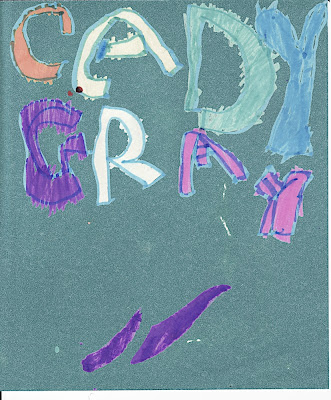
It really is an impressive effect -- the colors pop off the page, super-bright against the dark background. Lots of art products in the past several years have emphasized colors against black or dark, but this is one of the most versatile I've seen.
There's a big pad of the special paper and eight markers in the set, which we got for about $9. Cady Gray loves it, and I like both seeing her enjoy it and what she's making with it. Two thumbs up!
While there, of course, we had to get Cady Gray something too. She found something from Crayola that I've never seen before: Color Surge markers and paper. Now, I'm a longtime fan of Crayola markers and crayons; I've been buying Color Wonder books, markers, and paints since Archer was a baby. So we took the Color Surge set home and opened it up.
It comes with a stencil sheet and eight "classic" colors. The paper is thick and specially treated on both sides; it interacts with the ink in the markers to produce a fluorescent effect. Here's the side where Cady Gray colored in the stencils:
The scan doesn't do it justice, but that middle squiggle that looks white is actually yellow. The fluorescent white is actually one of my favorite things in the set, though.
And here's where she wrote her name in outlined letters and then colored them in, on the other side:
It really is an impressive effect -- the colors pop off the page, super-bright against the dark background. Lots of art products in the past several years have emphasized colors against black or dark, but this is one of the most versatile I've seen.
There's a big pad of the special paper and eight markers in the set, which we got for about $9. Cady Gray loves it, and I like both seeing her enjoy it and what she's making with it. Two thumbs up!
Friday, May 30, 2008
Writing for Godot
I've spent the week working on several writing projects that collectively define a large portion of the compositional spectrum for me. They require such different skills and processes that they almost seem like completely different activities.
First up, a book review for the A.V. Club. (Link is to a sample -- the actual one I wrote hasn't run yet). Here the word count is paramount: 400 words, no more and not many less. In that space I have to introduce the topic, put the book and author in context, summarize the book's content, and explain my aesthetic judgment about the book's quality. The strict word count and fairly rigid coverage requirements mean that I almost always fall into a three-paragraph formula that's as comfortable as an old shoe, but also often feels like repeating myself. It's nice to write a different kind of review for a different format, as I did with this same-length-but-no-paragraphs review of Fantagraphics' Bill Mauldin collection for Comics Panel (scroll down close to the bottom).
Next, an encyclopedia article. I've written several of these in the past couple of years, and I've discovered that they are easier and more fun if the topic is fairly narrow. It's a heck of a lot more enjoyable to summarize the life and work of one person, for example, than to try to figure out what an encyclopedia entry on "Southern Religion and Film" should be like. There aren't any guidelines for the content of the latter, which makes writing it something of a nail-biter. (What am I leaving out? What am I forgetting? What am I not giving its due? What piece will be obviously, glaringly absent or wrong to all readers, except, somehow, me?) The assigned task for encyclopedias is to be comprehensive while still expressing a moderate point of view. The more abstract the topic, the more difficult that is. So I did my best on this one to provide a loose typology of connections between Southern religion and film, but had to give up on the idea of comprehensiveness, especially in 1250 words.
Third, proofreading a journal article that's about to be published. This is where I get to sit back, read something I wrote six months ago, and be astonished at my own genius. Well, maybe not genius, but whenever I read something I wrote in the past, I'm usually surprised by how good I think it is. The process of writing usually blinds me to the overall point or impact, so that when I see it later and can hear the click-click-click of the tumblers falling into place to unlock the argument, I'm really rather impressed with myself. Maybe I can do this after all, I think. An academic journal article is actually looser and more personal than either of the previous two genres of writing. I can use the first person, extended analogies, and a greater length to make more complex points. Sure, there's a particular academic tone that's expected for this rarefied audience, but the freedom to construct a multi-layered edifice and make several related points means that I usually breeze through this writing more quickly and naturally than anything else other than personal reflection.
Last, composing a few sections of a student handbook we're putting together. Now we're on the extremely restrictive end of the spectrum. The assigned task is to be completely comprehensive and completely clear. The text must address as many conceivable issues and situations as practical, and it must articulate specific policies that govern those issues and situations. This is hard, hard work. Just writing a first draft, I am reworking every sentence multiple times to find the most thorough, well-defined, and precise way to communicate. It's an interesting challenge -- not unlike encyclopedia writing in its goal of comprehensiveness, but with the subtraction of any point of view, and the addition of nigh-unlimited space to achieve complete coverage. I don't think I'm cut out to be a technical writer, but it makes for a refreshing and instructive change ... occasionally. (I'll leave the demarcation of steps and definitions to Archer, whose mania for order and penchant for reading instruction manuals for fun make me think this might be a career option for him.)
First up, a book review for the A.V. Club. (Link is to a sample -- the actual one I wrote hasn't run yet). Here the word count is paramount: 400 words, no more and not many less. In that space I have to introduce the topic, put the book and author in context, summarize the book's content, and explain my aesthetic judgment about the book's quality. The strict word count and fairly rigid coverage requirements mean that I almost always fall into a three-paragraph formula that's as comfortable as an old shoe, but also often feels like repeating myself. It's nice to write a different kind of review for a different format, as I did with this same-length-but-no-paragraphs review of Fantagraphics' Bill Mauldin collection for Comics Panel (scroll down close to the bottom).
Next, an encyclopedia article. I've written several of these in the past couple of years, and I've discovered that they are easier and more fun if the topic is fairly narrow. It's a heck of a lot more enjoyable to summarize the life and work of one person, for example, than to try to figure out what an encyclopedia entry on "Southern Religion and Film" should be like. There aren't any guidelines for the content of the latter, which makes writing it something of a nail-biter. (What am I leaving out? What am I forgetting? What am I not giving its due? What piece will be obviously, glaringly absent or wrong to all readers, except, somehow, me?) The assigned task for encyclopedias is to be comprehensive while still expressing a moderate point of view. The more abstract the topic, the more difficult that is. So I did my best on this one to provide a loose typology of connections between Southern religion and film, but had to give up on the idea of comprehensiveness, especially in 1250 words.
Third, proofreading a journal article that's about to be published. This is where I get to sit back, read something I wrote six months ago, and be astonished at my own genius. Well, maybe not genius, but whenever I read something I wrote in the past, I'm usually surprised by how good I think it is. The process of writing usually blinds me to the overall point or impact, so that when I see it later and can hear the click-click-click of the tumblers falling into place to unlock the argument, I'm really rather impressed with myself. Maybe I can do this after all, I think. An academic journal article is actually looser and more personal than either of the previous two genres of writing. I can use the first person, extended analogies, and a greater length to make more complex points. Sure, there's a particular academic tone that's expected for this rarefied audience, but the freedom to construct a multi-layered edifice and make several related points means that I usually breeze through this writing more quickly and naturally than anything else other than personal reflection.
Last, composing a few sections of a student handbook we're putting together. Now we're on the extremely restrictive end of the spectrum. The assigned task is to be completely comprehensive and completely clear. The text must address as many conceivable issues and situations as practical, and it must articulate specific policies that govern those issues and situations. This is hard, hard work. Just writing a first draft, I am reworking every sentence multiple times to find the most thorough, well-defined, and precise way to communicate. It's an interesting challenge -- not unlike encyclopedia writing in its goal of comprehensiveness, but with the subtraction of any point of view, and the addition of nigh-unlimited space to achieve complete coverage. I don't think I'm cut out to be a technical writer, but it makes for a refreshing and instructive change ... occasionally. (I'll leave the demarcation of steps and definitions to Archer, whose mania for order and penchant for reading instruction manuals for fun make me think this might be a career option for him.)
Thursday, May 29, 2008
What the heck is going on in their heads?
A playlet found in Archer's room this morning, written on the back of a used-up sticker sheet:
Jackie: Inez is sleeping
Inez: Who's waking me up?
Matt: It was us.
Inez: Jackie?
[Matt is unidentifiable symbol that looks like a flag bearing a tripod and the letters CMJ followed by a pencil]
Matt: Who is that?!
All: HACKER?!
Jackie: Inez WAS sleeping!
Creech and Jewels: Stop that bad behavior, Hacker!
***
A conversation with Cady Gray tonight around bedtime:
Cady Gray: Mom, you can have one of these [little blank magnets from a Hangman game]. They're model sticks!
Mom: What are they?
CG: Model sticks. You can have one!
Mom: Thank you! What do they do?
CG: They don't do anything. They're model sticks!
Jackie: Inez is sleeping
Inez: Who's waking me up?
Matt: It was us.
Inez: Jackie?
[Matt is unidentifiable symbol that looks like a flag bearing a tripod and the letters CMJ followed by a pencil]
Matt: Who is that?!
All: HACKER?!
Jackie: Inez WAS sleeping!
Creech and Jewels: Stop that bad behavior, Hacker!
***
A conversation with Cady Gray tonight around bedtime:
Cady Gray: Mom, you can have one of these [little blank magnets from a Hangman game]. They're model sticks!
Mom: What are they?
CG: Model sticks. You can have one!
Mom: Thank you! What do they do?
CG: They don't do anything. They're model sticks!
Wednesday, May 28, 2008
How the Web Changed Knitting (and knitting changed the world)
The explosive growth of the crafting community in the last half-decade has reshaped the public face of leisure time and creativity. Suddenly it is impossible to be unaware that millions of people are making -- and inventing, and designing, and customizing -- their own clothes, art, computers, clocks, bags, jewelry, books, food, vehicles, and anything else you can think of.
My own participation in the knitting community leads me to think about how Web 2.0 has catalyzed this revolution, and then provided a platform from which the revolution changes the physical world. Consider:
My own participation in the knitting community leads me to think about how Web 2.0 has catalyzed this revolution, and then provided a platform from which the revolution changes the physical world. Consider:
- The predominant way knitting information was distributed pre-2000 was through books and magazines -- traditional print media. Magazines could be bought on newsstands, purchased at LYSes (local yarn stores), or received via subscription. Books were heavily dependent on knitting magazines, in which they are advertised and reviewed, and with which they often shared a publisher. The only way to measure the size of the knitting community was through sales of these physical objects.
- Online knitting "magazines" started to appear in the early 2000's. These sites solicited design submissions from the general public, and published them for free (supported by advertising). These sources of free patterns, presented with editorial and quality control, quickly became overwhelmingly popular among a young, "wired" group of knitters that had not been previously recognized as a large segment of the knitting population.
- At the same time, internet knitting businesses came into existence, selling yarn, supplies, designs, and traditional knitting media. Some of these businesses were internet extensions of brick-and-mortar shops and LYSes; but a new breed of internet-only, mail-order-only knitting businesses emerged in the early 2000s. All these businesses formed a natural pool of advertisers for the online knitting magazines.
- The availability of designs and supplies online freed knitters from their LYSes and other b&m craft stores in their local areas. This made it possible for more people in more places to become knitters -- all the materials could be mail-ordered or accessed online. The online businesses grew and offered larger selections. Two of the largest internet-only businesses started their own yarn labels, offering highly affordable yarn in a range of popular natural fibers and weights. LYSes with online stores made it possible for any buyer to get high-quality brand name yarns. Getting knitting supplies online increasingly involved no compromise in terms of availability, selection, quality, or price. In fact, the range of materials available from online businesses quickly exceeded that in even the most well-stocked b&m outlet.
- Online knitting communities began as Usenet groups and listservs, evolved into bulletin boards, and then into forums and boards conceived as adjuncts to the online magazines and stores. These communities not only allowed knitters to share information and built brand loyalty, but they also made the scale of the on- and offline knitting community visible in a staggering way. Ravelry.com, the first custom-built knitting online community, signed up 100,000 subscribers in its first eight months, and continues to attract 500 new members a day while still in its beta period. Its elegant design and integration of community tools with personal organization and social networking functions attracted the notice of web design and usability writers, and its sheer scale earned mention in the mainstream media's "hey, what's with all the knitters all of a sudden?" stories.
- One result of this web-catalyzed growth is that new knitters and previously-offline knitters are more quickly and thoroughly integrated into the knitting community than had ever been possible before. Help, suggestions, advice, and inspiration is available 24 hours a day. The eternal question "what do I knit next?" now has a universe of answers only limited by one's remaining lifespan, and any conceivable material is available to order online. It seems logical to conclude that more people are being motivated to try knitting because of this visibility and availability, and that a smaller percentage of those novices end up being unable to sustain their interest because of lack of support, paucity of supply, or lack of information. In other words, the Web 2.0 platform for the community means that the community grows in a more rapid and sustainable fashion.
- Another, perhaps less intuitive result is that traditional media are made more viable, not less, by this online growth. Patterns in magazines and books are now "advertised" by being included in the online pattern library of Ravelry; those who are attracted to them seek out the magazine or book that includes them. Every new print-media release generates online discussion that exposes more community members to the ink-on-paper content. Designers and books have fan groups and knit-alongs devoted to them. And of course, magazines and books are advertised directly by their publishers on these websites, sold through online knitting businesses, and reviewed by podcasters and bloggers. The penetration of traditional media into the much larger and much more diverse knitting community that has been revealed and nurtured by Web 2.0 applications is far more thorough than could have been achieved previously.
- And finally, the boomerang effect of all this online activity is the creation of real objects: knitted items from scarves to sweaters to DNA models to laptop covers. Fifteen years ago, most would have considered handmade objects to be endangered artifacts in an increasingly digital world. Instead, there are more of these handcrafted items in the world today than there would have been without the internet, and likely many more per capita than there were in any pre-internet boom period -- I'd estimate by a factor of ten to fifty or more. Of course real people have employment with real money in online-dependent businesses that make and ship real products, and real books have been written and bought and read because the internet made some knitbloggers stars, and so on in all the usual ways that the online world catalyzes real-world activity. But this is an example of Web 2.0 unleashing the power of the individual to create and therefore modify his particular environment. In larger terms, the proliferation of creative examples means that "designer" and "inventor" are no longer labels reserved for the few -- everyone can be a "maker." This movement has empowered thousands upon thousands to create and invent, then to share their knowledge with others which in turn sets off a new round of creation and invention. Informal social pressure creates a kind of healthy online competition to present and photograph one's work beautifully, and to document the process of making thoroughly and helpfully. This builds and enriches the resources to which the community can refer for help or inspiration.
- As a result, the world at large becomes newly aware that the "good old days" of craft, creativity, care, and the handmade are far from gone (as anti-digital forces used to take pleasure in lamenting). In fact, they are experiencing a renaissance and robust growth such as never has been seen before -- a proliferation of expertise, skill, and creativity that would never have been possible before the Internet.
- The one question mark in this story of mutual advancement and rising-tide-lifting-all-boats is the fate of the LYS. When supplies are available more readily and more cheaply and in greater variety online, what chance do these small businesses have? Many have prospered by offering their wares for sale online. Many have rethought their business model, offering a bookstore/coffeehouse atmosphere for socializing and classes for person-to-person learning. Many emphasize the personal touch -- expertise, advice, and services not available through an internet business. These are all strategies that have helped some categories of b&m retail survive and even thrive in the internet age. It remains to be seen whether the business model of the local yarn store will be viable longterm in the new environment. One positive sign is that the informal word-of-mouth network that has always been the best (and cheapest) form of advertising for retailers works better than ever now over the internet; knitbloggers frequently extol the LYSes they patronize or visit on their travels, spreading the word about the business and even creating "destinations" out of some famous LYses.
Tuesday, May 27, 2008
I was a stand-up tomato
A fair number of my readers are not movie nerds, so perhaps it will not be complete redundancy or overkill to devote today's post to Sydney Pollack, the director and actor who died yesterday at the age of 73. I cannot think of him without thinking of the way Akira Kurosawa said his name when announcing the 1986 Best Picture Oscar: "Sydney ... Pollawack."
Like many of his generation (Altman and Lumet come to mind), Pollack came to movies through television, especially the prestige anthology series from TV's golden age. His best years in movies were the late sixties (They Shoot Horses, Don't They?) and seventies (Three Days Of The Condor). The skills he honed there working with actors (aided by his own experience as an actor, a role to which he kept returning throughout his career) made him a favorite of many stars of the period, and got him jobs on high-profile projects like Out Of Africa, the film for which he won his two Oscars (as director and producer).
No doubt the movie for which he is best loved is Tootsie, a certified canonical masterpiece in the pantheon of filmed comedy. It's often a surprise to casual movie watchers that this gimmicky picture from the early eighties is hailed by serious cinephiles as one of the best American films of all time. But few comedies from any period can beat its self-referential wit (Dustin Hoffman, a Method actor whose obsessive preparation made him notoriously difficult to work with, plays a Method actor who can't get a job because he's so difficult to work with), its fleet dialogue and perfect comic timing, and its spot-on casting (Bill Murray as Hoffman's deadpan roommate gives a particularly priceless performance).
Many of the Pollack tributes and obituaries in the media today reference the director's cameo as Hoffman's agent in Tootsie, and rightly so -- it's his best film and one of the best scenes.
Like many of his generation (Altman and Lumet come to mind), Pollack came to movies through television, especially the prestige anthology series from TV's golden age. His best years in movies were the late sixties (They Shoot Horses, Don't They?) and seventies (Three Days Of The Condor). The skills he honed there working with actors (aided by his own experience as an actor, a role to which he kept returning throughout his career) made him a favorite of many stars of the period, and got him jobs on high-profile projects like Out Of Africa, the film for which he won his two Oscars (as director and producer).
No doubt the movie for which he is best loved is Tootsie, a certified canonical masterpiece in the pantheon of filmed comedy. It's often a surprise to casual movie watchers that this gimmicky picture from the early eighties is hailed by serious cinephiles as one of the best American films of all time. But few comedies from any period can beat its self-referential wit (Dustin Hoffman, a Method actor whose obsessive preparation made him notoriously difficult to work with, plays a Method actor who can't get a job because he's so difficult to work with), its fleet dialogue and perfect comic timing, and its spot-on casting (Bill Murray as Hoffman's deadpan roommate gives a particularly priceless performance).
Many of the Pollack tributes and obituaries in the media today reference the director's cameo as Hoffman's agent in Tootsie, and rightly so -- it's his best film and one of the best scenes.
Michael: Terry Bishop's doing Iceman. You promised to send me up for that. You told me I'd get a reading for that. Aren't you my agent?
George: Stuart Pressman wants a name.
Michael: Terry Bishop is a name?
George: Michael Dorsey is a name when you want to send a steak back. Wait, wait, wait!
Michael: You always do this to me.
George: It was a rotten thing to say. Let me start again. Terry Bishop is on a soap. Millions watch him every day.
Michael: That qualifies him to ruin Iceman? I can act circles around him. I played that part in Minneapolis.
George: lf he wants a name, that's his affair. People are in this business to make money.
Michael: I'm in it to make money too.
George: Really? The Harlem Theatre for the Blind? The People's Workshop at Syracuse?
Michael: Wait a minute. I did nine plays up at Syracuse. I got great reviews from the critics. Not that that's why I did it.
George: God forbid you should lose your standing as a cult failure.
Michael: You think I'm a failure?
George: I will not get sucked into this conversation. I will not.
Michael: I sent you my roommate's play to read. It had a great part in it for me
George: Where do you come off sending me a play for you to star in? I'm not your mother. I don't find plays for you to star in. I field offers. That's what I do.
Michael: Who told you that? The agent fairy? I could be terrific in that part.
George: Nobody's going to do that play.
Michael: Why?
George: It's a downer about a couple that move back to Love Canal.
Michael: But that actually happened.
George: Nobody wants to watch people living next to chemical waste! They can see that in Jersey.
Michael: I don't want to argue about it. I'll raise $10,000 and produce his play. Send me up for anything. I don't care. I'll do dog commercials. I'll do radio voice-overs.
George: I can't put you up for that.
Michael: Why not?
George: Because no one will hire you.
Michael: I bust my ass to get a part right?
George: And you bust everybody else's ass too. Who wants to argue about whether Tolstoy can walk when he's dying or walk when he's talking--?
Michael: That was two years ago, and that guy's an idiot!
George: They can't all be idiots. You argue with everybody! You've got one of the worst reputations in this town. Nobody will hire you.
Michael: Are you saying that nobody in New York will work with me?
George: Oh no, that's too limiting. Nobody in Hollywood will work with you either. I can't even get you a commercial. You played a tomato, and they went over schedule because you wouldn't sit.
Michael: Yes, it wasn't logical.
George: You were a tomato! A tomato doesn't have logic. It can't move!
Michael: (triumphantly) So if he can't move, how's he going to sit down? I was a stand-up tomato. A juicy, sexy, beefsteak tomato! Nobody does vegetables like me! I did a whole night of vegetables off-Broadway! I did the best tomato, the best cucumber! I did an endive salad that knocked the critics on their ass!
George: I'm trying to stay calm here. You are a wonderful actor.
Michael: Thank you.
George: But you're too much trouble. Get some therapy.
Monday, May 26, 2008
Jive walkin'
Today's post, celebrating all things socked and stripey, is at Toxophily.
ObKidAnecdotes: When you have an autistic boy obsessed with The Price Is Right and constantly setting up pricing games for us, you frequently hear sentences like the following, an actual example from earlier today which was delivered with full Barker panache:
ObKidAnecdotes: When you have an autistic boy obsessed with The Price Is Right and constantly setting up pricing games for us, you frequently hear sentences like the following, an actual example from earlier today which was delivered with full Barker panache:
"The Golden Road today begins with this can of blackeyed peas."On the other hand, when you have a little girl like ours, you are liable to have your grilled ham and cheese sandwich praised as follows. Imagine a cardinal delivering his solem verdict on a confirmed miracle, palms facing upward and arms extended on the table in a prayerful attitude -- or a Cannes jury member expressing quiet wonder at an unexpected masterpiece:
"This ... is ... the perfect ... sandwich."
Sunday, May 25, 2008
Lifestyle change update
It's been four months now since I started my no-soda version of the No-S diet. Since the semester ended, I've started making a concerted effort to work out (now that my schedule accommodates an afternoon trip to the gym more easily), and I'm going to the gym three or four days a week now.
So what's the result? You'll remember that I saw immediate results in the shrinkage of my round "are you pregnant?" gut. But all my fat hasn't melted away with the removal of diet soda from my daily routine. In fact, after our Vegas vacation, I put on 5-10 pounds. My vigorous workouts have been chipping away at them, but I'm still above my normal weight.
What has happened is that my weight has been redistributed. Instead of being concentrated in my upper belly, right under my chest, it's moved down around my waist -- and much more than ever in my life, it's in my backside and thighs. All my clothes fit strangely now. I feel humpy and bulgy in them (to quote my favorite Max and Ruby locution).
Not to get too intimate with the issue of my body shape, but the result has been interesting for my chestal region. It's not as close to the fat anymore, and that makes it look ... different. Um, more uplifted. I'm finding it hard to get used to, frankly.
Metabolically, the changes are an improvement. Bottom-heavy fat has better implications for one's chances of getting adult-onset diabetes than belly fat. And I think that my regular low-half-focused cardio and abdominal exercises have helped redistribute where the muscle is under that fat, changing my shape some more.
The altered fit of my clothes frequently makes me feel bloated and uncomfortable. But I persist in thinking that if I continue these healthier eating patterns and more regular exercise, I'll whittle away at the fat and inches, no matter where they are accumulating these days. I'll check in with you at the end of the summer and let you know how I do.
So what's the result? You'll remember that I saw immediate results in the shrinkage of my round "are you pregnant?" gut. But all my fat hasn't melted away with the removal of diet soda from my daily routine. In fact, after our Vegas vacation, I put on 5-10 pounds. My vigorous workouts have been chipping away at them, but I'm still above my normal weight.
What has happened is that my weight has been redistributed. Instead of being concentrated in my upper belly, right under my chest, it's moved down around my waist -- and much more than ever in my life, it's in my backside and thighs. All my clothes fit strangely now. I feel humpy and bulgy in them (to quote my favorite Max and Ruby locution).
Not to get too intimate with the issue of my body shape, but the result has been interesting for my chestal region. It's not as close to the fat anymore, and that makes it look ... different. Um, more uplifted. I'm finding it hard to get used to, frankly.
Metabolically, the changes are an improvement. Bottom-heavy fat has better implications for one's chances of getting adult-onset diabetes than belly fat. And I think that my regular low-half-focused cardio and abdominal exercises have helped redistribute where the muscle is under that fat, changing my shape some more.
The altered fit of my clothes frequently makes me feel bloated and uncomfortable. But I persist in thinking that if I continue these healthier eating patterns and more regular exercise, I'll whittle away at the fat and inches, no matter where they are accumulating these days. I'll check in with you at the end of the summer and let you know how I do.
Saturday, May 24, 2008
Still waiting
Today's post, about the liberating feeling of dropping a stitch on purpose, is at Toxophily.
Meanwhile, everything about my health is back to normal except my appetite. I haven't been hungry since Tuesday. I'm doing my best to eat at mealtimes, under some kind of "priming the pump" theory, and I've put away a couple of full meals. But I'm not really interested in food.
What's going on with me?
Meanwhile, everything about my health is back to normal except my appetite. I haven't been hungry since Tuesday. I'm doing my best to eat at mealtimes, under some kind of "priming the pump" theory, and I've put away a couple of full meals. But I'm not really interested in food.
What's going on with me?
Friday, May 23, 2008
Priorities
In these parlous economic times, it's nice to have few debts and my own home. But there are a number of major projects that need to be undertaken to preserve that home's value. Unfortunately, the economic downturn coupled with too much economic good fortune (and the consequent taxes) last year means that there's a lot less money available to fund those projects.
Here's what we need to have done, in roughly the order I would prioritize it. I go back and forth on the relative urgency of some of the projects, but basically I'd like to improve the outside of the house (structure and land), then the inside (decorating).
Here's what we need to have done, in roughly the order I would prioritize it. I go back and forth on the relative urgency of some of the projects, but basically I'd like to improve the outside of the house (structure and land), then the inside (decorating).
- Painting and wordwork repair. We have a brick house with some wood siding and trim. It's past time to scrape and repaint the flaking woodwork, and there are some places where there are rot and holes.
- Roofing. The roof was about 10 years old when we moved in almost 10 years ago. Although it's largely shaded, and there have been no leaks or other problems, it's probably time to get a new roof (and get rid of the epidemic of moss growing on the west side of the garage).
- New garage door opener and new front door. The front door isn't very secure, and the garage door opener is old and so cranky that we just don't use it.
- Landscaping the back yard. There's a gravel parking spot that was under an RV shelter when we moved in; that needs to be removed and replaced with a set of raised beds. The existing garden plot was always plagued with too much shade, and we've let it grow over with shrubs and small trees. We want to put in a play structure for the kids, too.
- Landscaping the front yard. Also known as "the unintentional xeriscape." I don't want a lot of grass to fertilize and mow, but we need to replace the rotted railroad ties that are right now doing a poor job keeping the largely bare ground from eroding into the street, and some easy-care plantings would do wonders for the house's appearance.
- Repair and reupholster dining room chairs, and replace sectional couch in the living room with easy chairs.
- Repainting the interior. In this order:
- Archer's room
- Front room
- Living room
- Kitchen
- Cady Gray's room
- Master bedroom
- Guest bedroom
- Entryway
- Hallway
- Refurbish the cabinets and countertops in the kitchen.
- New surface for kitchen floor.
- New carpets throughout the house.
Thursday, May 22, 2008
Texas bound
The 24-hour bug appears to have left the premises, with no one here the worse for wear. My appetite isn't quite back all the way yet, but major gastrointestinal operations appear to have ended, if you know what I mean. In the battle for my stomach, the United States is victorious.
Last night we were visited by movie-nerd-discussion-group stalwart (and my tutor in all things avant-garde) Michael Sicinski, his lovely wife and newly-minted comp-rhet professor Jen Wingard, and their adorable two-year-old Nola. I hope that they enjoyed being here as much as we enjoyed having them, although the Archer vomiting episode may have dampened their enthusiasm a bit.
They're headed to Houston to begin Jen's new job at the University thereof. We talked a little about Houston and what it's like (Michael grew up there). I didn't say this at the time, but Houston always brings to mind a Bob and Ray sketch for me.
It's a traveler's advice show. The listener asks what he should do to cope with the roadwork that has closed one of the main roads leading into Houston. "I'm afraid they'll close the other one, and we'll all be trapped here," his letter reads. "What should I do?" The advice he receives: "Get out of town while the road's still open."
Last night we were visited by movie-nerd-discussion-group stalwart (and my tutor in all things avant-garde) Michael Sicinski, his lovely wife and newly-minted comp-rhet professor Jen Wingard, and their adorable two-year-old Nola. I hope that they enjoyed being here as much as we enjoyed having them, although the Archer vomiting episode may have dampened their enthusiasm a bit.
They're headed to Houston to begin Jen's new job at the University thereof. We talked a little about Houston and what it's like (Michael grew up there). I didn't say this at the time, but Houston always brings to mind a Bob and Ray sketch for me.
It's a traveler's advice show. The listener asks what he should do to cope with the roadwork that has closed one of the main roads leading into Houston. "I'm afraid they'll close the other one, and we'll all be trapped here," his letter reads. "What should I do?" The advice he receives: "Get out of town while the road's still open."
Wednesday, May 21, 2008
The creeping crud
We're a relatively healthy lot here at the Murray-Bowman household. Lots of our friends are constantly battling some kid-borne infection or another, but most of the time, we're sailing through without a care in the world.
So it's about time for our first home pandemic. A stomach flu that has been making its way through town hit Cady Gray on Monday in a minimal fashion. Then Noel was laid up for eighteen hours. This morning Archer and I both succumbed. I'm not as strong as my children; while Archer blithely went on to school after expelling the contents of his stomach, I suffered through half a day of a meeting at work and then had to come home and sleep for four hours.
Looks like Archer's not quite done with it as expeditiously as we thought; he couldn't keep dinner down tonight. I'm hoping that another long sleep is going to put it behind us. Good night, everybody.
So it's about time for our first home pandemic. A stomach flu that has been making its way through town hit Cady Gray on Monday in a minimal fashion. Then Noel was laid up for eighteen hours. This morning Archer and I both succumbed. I'm not as strong as my children; while Archer blithely went on to school after expelling the contents of his stomach, I suffered through half a day of a meeting at work and then had to come home and sleep for four hours.
Looks like Archer's not quite done with it as expeditiously as we thought; he couldn't keep dinner down tonight. I'm hoping that another long sleep is going to put it behind us. Good night, everybody.
Tuesday, May 20, 2008
What the kids are watching
In part 2 of Shows You May Not Know Exist, we take a look at the kids' current favorite: Ni Hao, Kai-lan.
This well-designed, vaguely anime styled half hour teaches Mandarin Chinese and gentle, Chinese-flavored life lessons about group dynamics. I love the big-head characters and their individual character quirks. (Most endearing: Tolee the koala, who is enamored of pandas. He walks around in panda gear clutching a toy panda named Pandy, and when bedtime comes he trades his day panda-head slippers for identical night-time panda-head slippers.)
Even though my kids have never been enthusiastic participants in the shows that endeavor to get them to stand up and play along (like Dora the Explorer), they follow Kai-lan's every instruction eagerly. And the vocabulary really sticks. We hear more "xie xie" and "bu keqi" around the house than "thank you" and "you're welcome." Naturally Archer and Cady Gray know how to count in Mandarin, and they repeat "yi, er, san" in the sing-song way it's taught on the show -- which reinforces the central role of pitch and tone in the language.
The show is pitched toward preschoolers, so it has the leisurely pacing and repetition common to shows at that age level. I prefer that to even the low-key frenzy of shows aimed at the elementary crowd. And so does Archer, who has trouble following stories and so is left cold by the setup, conflict, resolution, denouement structure of narrative television.
In fact, Ni Hao, Kai-lan emphasizes questions that are exactly the ones Archer needs to be able to answer before he can make the inferences necessary for story comprehension:
This well-designed, vaguely anime styled half hour teaches Mandarin Chinese and gentle, Chinese-flavored life lessons about group dynamics. I love the big-head characters and their individual character quirks. (Most endearing: Tolee the koala, who is enamored of pandas. He walks around in panda gear clutching a toy panda named Pandy, and when bedtime comes he trades his day panda-head slippers for identical night-time panda-head slippers.)
Even though my kids have never been enthusiastic participants in the shows that endeavor to get them to stand up and play along (like Dora the Explorer), they follow Kai-lan's every instruction eagerly. And the vocabulary really sticks. We hear more "xie xie" and "bu keqi" around the house than "thank you" and "you're welcome." Naturally Archer and Cady Gray know how to count in Mandarin, and they repeat "yi, er, san" in the sing-song way it's taught on the show -- which reinforces the central role of pitch and tone in the language.
The show is pitched toward preschoolers, so it has the leisurely pacing and repetition common to shows at that age level. I prefer that to even the low-key frenzy of shows aimed at the elementary crowd. And so does Archer, who has trouble following stories and so is left cold by the setup, conflict, resolution, denouement structure of narrative television.
In fact, Ni Hao, Kai-lan emphasizes questions that are exactly the ones Archer needs to be able to answer before he can make the inferences necessary for story comprehension:
- Why is a character acting this way? In every show, a character becomes upset, mad, scared, guilty, or unhappy, and Kai-lan asks the viewers why. The incident that triggered the negative response is replayed, and the reason for the emotion is reinforced. The idea here is to empathetically share the perspective of the other character -- exactly the skill an autistic child needs special help with.
- How can a problem be solved? The characters devise simple plans to restore group harmony. This requires hypothetical thinking and the application of basic principles such as "If you accidentally mess something up, help fix it."
- When is the right time? Episodes feature both exuberance and calmness, conveying the idea that different behaviors are appropriate for different settings. Again, this is something that is key to teaching an autistic child to cope with a world of invisible social cues.
Monday, May 19, 2008
It's a TV game show that takes place in my cab
I'm not a big Discovery Channel watcher ordinarily, so I'm late to the party on Cash Cab. We tuned in last week when our usual dinnertime game show, Merv Griffin's Crosswords, failed to record for some reason. But I was instantly delighted. I think it may be the best game show on television.
The premise is that there's a seemingly ordinary taxicab cruising around Manhattan picking up passengers. An unsuspecting fare gets in and tells the driver his destination. Then the inside of the cab lights up and the music plays, as the driver/host announces, "You're in the Cash Cab!" The passengers spend their trip answering general knowledge questions of increasing difficulty, amassing money as they go. An incorrect answer earns a strike, and three strikes means that the ride is over -- the contestants are dumped out on the side of the street immediately, whether they've reached their destination or not.
It's an exceedingly simple game, which is part of its charm. There are just a few wrinkles to add interest. Players get two "shout outs" they can use if they don't know the answer to a question -- they can call up someone on their cell phone, or they can pull over and ask someone passing on the street. If they hit a red light after winning a certain amount of cash, they get a special "red light challenge" question: 30 seconds to name four answers that fit a certain category, like the five top-selling sedans in the U.S. And at the end of their ride, they can either take the money they've won and leave, or they can go double-or-nothing on a video bonus, a short multimedia question.
Here's what I love about Cash Cab:
The premise is that there's a seemingly ordinary taxicab cruising around Manhattan picking up passengers. An unsuspecting fare gets in and tells the driver his destination. Then the inside of the cab lights up and the music plays, as the driver/host announces, "You're in the Cash Cab!" The passengers spend their trip answering general knowledge questions of increasing difficulty, amassing money as they go. An incorrect answer earns a strike, and three strikes means that the ride is over -- the contestants are dumped out on the side of the street immediately, whether they've reached their destination or not.
It's an exceedingly simple game, which is part of its charm. There are just a few wrinkles to add interest. Players get two "shout outs" they can use if they don't know the answer to a question -- they can call up someone on their cell phone, or they can pull over and ask someone passing on the street. If they hit a red light after winning a certain amount of cash, they get a special "red light challenge" question: 30 seconds to name four answers that fit a certain category, like the five top-selling sedans in the U.S. And at the end of their ride, they can either take the money they've won and leave, or they can go double-or-nothing on a video bonus, a short multimedia question.
Here's what I love about Cash Cab:
- Unprepared contestants. When the lights and music go off, passengers either start violently, eye the roof suspiciously, or realize happily that they're on that cab game show. Either way, they aren't selected, focus-grouped, groomed, and tested -- they're random schmoes totally winging it. That makes their triumphs more satisfying and their failures more distressing.
- Quick gameplay. We all know that the bane of the post-Millionaire game show is the glacial pacing. Very little happens, and the show wrings every last drop of drama out of each overanticipated moment. By contrast, you get three cab rides in every Cash Cab episode (they can't be more than 20 minutes long -- lots of commercials, making it perfect for TiVo). And since there's a deadline (reaching the destination, always given before the passengers are let in on the game show element), the questions come thick and fast to allow for maximum earnings.
- New York scenery. As the ride progresses, cameras mounted on the cab and in the trailing production car capture views of the Manhattan streetscape, other cars, passersby, rollerbladers weaving in and out of traffic, etc. It's like a little Travel Channel documentary, without informative narration but with questions about the U.N.!
Sunday, May 18, 2008
The Jar Book 8 with 3 Endings
I tend to post scans of Archer's work when I'm proud of his impression of a neurotypical kid. But of course he brings home plenty of work that expresses his inner autistic in a much more direct way.
Take, for example, the following stapled storybook that came home in his backpack last week. He appears to have autistified the assignment by adding his usual obsessive numbers (random to me, but probably meaningful to him) and by sketching out the rough form of a choose-your-own-adventure novel.
If you're wondering what the inside of Archer's head really looks like, this is probably an accurate representation.
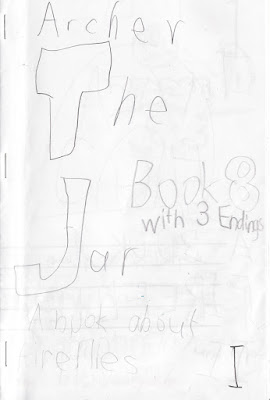
The Jar
Book 8 with 3 endings
A book about fireflies
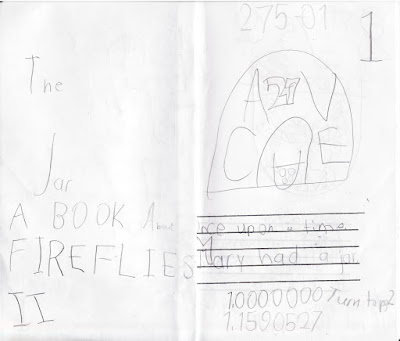
The Jar
A BOOK About FIREFLIES
II
Once upon a time, Mary had a jar.
1.0000000 Turn to pg 2
1.1590527
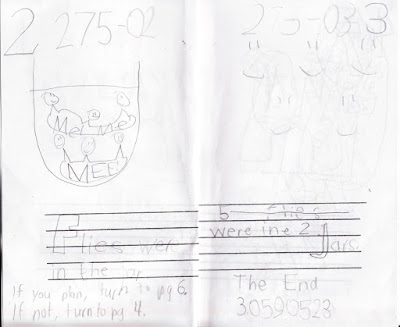
Flies were in the jar.
If you plan, turn to pg 6.
If not, turn to pg 4
5 flies were in the 2 Jars.
The End
3.0590523
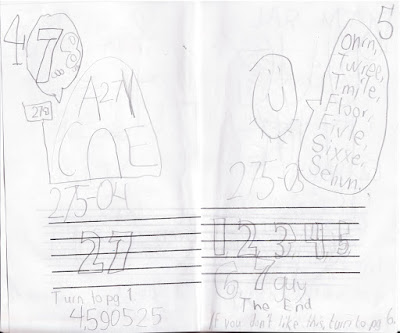
27
Turn to pg 1
4.590525
1, 2, 3, 4, 5, 6, 7 guy
The End
If you don't like this, turn to pg 6.

6 jars 7 jars 8!
The End
Turn to pg 7 to stop
At last, 35 Jars were here!
6.62900 Turn to pg 8.
7.995026
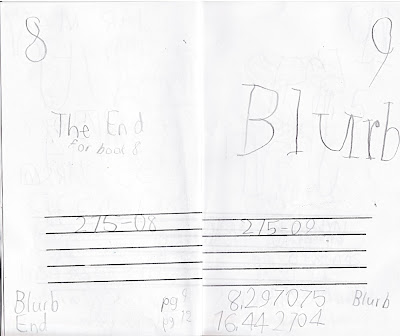
The End
for book 8
275-08
Blurb pg 9
End pg 12
Blurb
275-09
8.297075 Blurb
16.442704
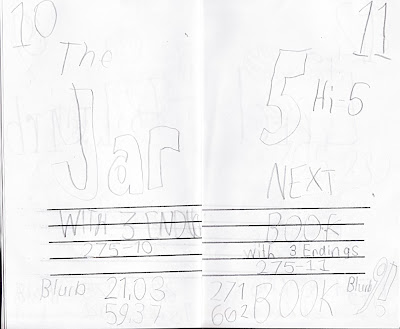
The Jar
WITH 3 ENDINGS
275-10
Blurb 21.03
59.37
5 Hi-5
NEXT
BOOK
with 3 Endings
275-11
271 BOOK Blurb 91
662
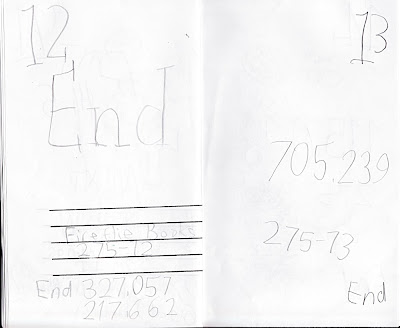
End
Fireflie Books
275-12
End 327.957
217.662
705.239
275-13
End

115.003
275-14
End
Take, for example, the following stapled storybook that came home in his backpack last week. He appears to have autistified the assignment by adding his usual obsessive numbers (random to me, but probably meaningful to him) and by sketching out the rough form of a choose-your-own-adventure novel.
If you're wondering what the inside of Archer's head really looks like, this is probably an accurate representation.
The Jar
Book 8 with 3 endings
A book about fireflies
The Jar
A BOOK About FIREFLIES
II
Once upon a time, Mary had a jar.
1.0000000 Turn to pg 2
1.1590527
Flies were in the jar.
If you plan, turn to pg 6.
If not, turn to pg 4
5 flies were in the 2 Jars.
The End
3.0590523
27
Turn to pg 1
4.590525
1, 2, 3, 4, 5, 6, 7 guy
The End
If you don't like this, turn to pg 6.
6 jars 7 jars 8!
The End
Turn to pg 7 to stop
At last, 35 Jars were here!
6.62900 Turn to pg 8.
7.995026
The End
for book 8
275-08
Blurb pg 9
End pg 12
Blurb
275-09
8.297075 Blurb
16.442704
The Jar
WITH 3 ENDINGS
275-10
Blurb 21.03
59.37
5 Hi-5
NEXT
BOOK
with 3 Endings
275-11
271 BOOK Blurb 91
662
End
Fireflie Books
275-12
End 327.957
217.662
705.239
275-13
End
115.003
275-14
End
Saturday, May 17, 2008
R.I.P. me
Today's post, about my sock-related death and the final blow I managed to strike before succumbing, is at Toxophily.
I taught the Methodist pastors all day today, so I have no kid anecdotes. (I hear they had an excellent time with Spiderman at the birthday party they attended today.). Go ahead and click over to the socks of doom -- I promise they can't hurt you through the internet.
I taught the Methodist pastors all day today, so I have no kid anecdotes. (I hear they had an excellent time with Spiderman at the birthday party they attended today.). Go ahead and click over to the socks of doom -- I promise they can't hurt you through the internet.
Friday, May 16, 2008
What happened to summer?
Since realizing earlier this week, with something of a jolt, that I had to teach one of my all-day classes this Saturday, I've been spending just about every moment at work transcribing my notes and grading homework.
But I did take half an hour out this afternoon to place another order at Dover Books. You all remember Dover Books, right? Ultra-cheap editions of public domain classics, paperbacks full of clip art, calligraphy and craft kits galore?
If you haven't checked out Dover lately, and you have kids, you're missing out. I got my first shipment of dot-to-dots, mazes, puzzles, crosswords, coloring books, and drawing instructional manuals about a week ago. Suddenly the clamor for new activities can be instantly quelled. I was hoping to hold back several of them for our June vacation, but the kids were too excited about the big box. So I just got 17 more items (2 of which are little box sets with five books apiece), planning to squirrel some away this time.
Order $50, and you get free shipping. (My 17 books and boxes totalled $52. If you buy kids' activity books at your local bookstore or big box, you know that you could get about 6 or 7 for that price from those outlets.)
Heck, you don't have to have kids to go for Dover. If you're a fan of medieval illustrations, origami, historical paper dolls, needlecrafts, stained glass, magic, or out-of-copyright fiction, Dover's got a bunch of $5 books for you! Check 'em out in their bare-bones Yahoo! store (the lack of website design is how they keep their costs super-low).
But I did take half an hour out this afternoon to place another order at Dover Books. You all remember Dover Books, right? Ultra-cheap editions of public domain classics, paperbacks full of clip art, calligraphy and craft kits galore?
If you haven't checked out Dover lately, and you have kids, you're missing out. I got my first shipment of dot-to-dots, mazes, puzzles, crosswords, coloring books, and drawing instructional manuals about a week ago. Suddenly the clamor for new activities can be instantly quelled. I was hoping to hold back several of them for our June vacation, but the kids were too excited about the big box. So I just got 17 more items (2 of which are little box sets with five books apiece), planning to squirrel some away this time.
Order $50, and you get free shipping. (My 17 books and boxes totalled $52. If you buy kids' activity books at your local bookstore or big box, you know that you could get about 6 or 7 for that price from those outlets.)
Heck, you don't have to have kids to go for Dover. If you're a fan of medieval illustrations, origami, historical paper dolls, needlecrafts, stained glass, magic, or out-of-copyright fiction, Dover's got a bunch of $5 books for you! Check 'em out in their bare-bones Yahoo! store (the lack of website design is how they keep their costs super-low).
Thursday, May 15, 2008
Where do we go from here now that all of the children are growing up?
Ever since Noel received (and reviewed) a DVD collection of classic episodes of The Price Is Right, Archer has added the show to the regular rotation of game shows that he "hosts" for us. It's quickly become his favorite, because it is more number-focused than either Merv Griffin's Crosswords or Wheel Of Fortune, while having the advantage of also featuring a big wheel to spin in the Showcase Showdown. (So enamored is Archer of the big wheel concept that he tends to add spinning numerical wheels even to games that don't have them, leading to us having to spin imaginary wheels to find out what our Merv Griffin's Crosswords clue will be worth.) We've added the Million Dollar Spectacular to our TiVo list so Archer can have a taste of prime-time Price Is Right on a weekly basis.
I used to watch quite a bit of Price Is Right in the summer, or whenever I was home sick. The bright seventies decor and populuxe prizes fit my emerging middle-class aesthetic perfectly.
And then there was always the possibility of seeing this:
It's a game carpet! From Jorges, maker of fine floor coverings, comes the Games People Play carpet, complete with game pieces for checkers, chess, parcheesi, hopscotch, and dozens of other games. Hours of gameroom fun for the entire family. "It's Perfectly Jorges!"
Jorges is my mother's maiden name, and Jorges Carpets was the company founded by my Uncle Eddie, her older brother, just down the road from us in Fort Oglethorpe, Georgia. He named a line of carpets after his oldest daughter, my cousin Joy, too. We had "Games People Play" carpet in our basement, and while I don't remember the box with the pieces so much (I wish I did -- those graphics are stellar), I'll never forget the hundreds of days we whiled away building Hot Wheels tracks and playing Kerplunk on that carpet.
I worked one summer while home from college at the Jorges Carpet plant, long after its heyday on nationally-televised gameshows, cutting and trimming carpet samples and pasting them in sample books. I really loved the job, actually, the only manual labor job I've ever had. Most of the samples were standard carpet types -- industrial and residential -- not novelty designs like the game carpet. But I did get to paste that one in a book occasionally, and I can still see a portion of an ornate "4" in the square that I held up to the rotating trimmer to bevel the edges to a beautiful smoothness before applying the hot glue and centering it carefully on the page.
I used to watch quite a bit of Price Is Right in the summer, or whenever I was home sick. The bright seventies decor and populuxe prizes fit my emerging middle-class aesthetic perfectly.
And then there was always the possibility of seeing this:
It's a game carpet! From Jorges, maker of fine floor coverings, comes the Games People Play carpet, complete with game pieces for checkers, chess, parcheesi, hopscotch, and dozens of other games. Hours of gameroom fun for the entire family. "It's Perfectly Jorges!"
Jorges is my mother's maiden name, and Jorges Carpets was the company founded by my Uncle Eddie, her older brother, just down the road from us in Fort Oglethorpe, Georgia. He named a line of carpets after his oldest daughter, my cousin Joy, too. We had "Games People Play" carpet in our basement, and while I don't remember the box with the pieces so much (I wish I did -- those graphics are stellar), I'll never forget the hundreds of days we whiled away building Hot Wheels tracks and playing Kerplunk on that carpet.
I worked one summer while home from college at the Jorges Carpet plant, long after its heyday on nationally-televised gameshows, cutting and trimming carpet samples and pasting them in sample books. I really loved the job, actually, the only manual labor job I've ever had. Most of the samples were standard carpet types -- industrial and residential -- not novelty designs like the game carpet. But I did get to paste that one in a book occasionally, and I can still see a portion of an ornate "4" in the square that I held up to the rotating trimmer to bevel the edges to a beautiful smoothness before applying the hot glue and centering it carefully on the page.
Wednesday, May 14, 2008
Grabbing a bite
I have a mental list of Things That People Do In Movies That Fascinate Me. Here's one that I can't wrap my brain around:
I don't just mean that they go to restaurants at non-meal hours (e.g., 10 am or 3 pm). I mean that these characters spontaneously decide to go "grab a bite to eat" regardless of whether they have recently had a meal, or whether it's about time for another one.
The typical scenario involves two people meeting, making a connection, and then one asking the other, "You hungry? Wanna go get something to eat?" What I can't understand is that the answer appears to have nothing to do with a calculation about the day's three squares. The other character will delightedly reply, "Sure!" Meanwhile, on the couch I'm thinking, "But ... you can't just have a meal because you want to spend more time with somebody! How can you order an entree when you don't intend for it to be breakfast, lunch, or dinner -- just hanging out?"
Don't these people understand that a meal rearranges your whole day? When you eat determines when you're going to eat next. How is this spontaneous late afternoon repast going to affect dinnertime? Are you going to skip it? Eat it at 9 or 10 pm? How can you claim to be hungry when presumably you ate lunch at a normal hour?
I find it easier to comprehend "Wanna grab a cup of coffee or something?" But it's amazing how often people on TV or in the movies eat full meals at the drop of a hat, seemingly without any concern for the normal rhythms of daily food ingestion. As if they are quasi-human creatures who eat only when they are hungry, untouched by the cultural conventions of mealtimes that we mere mortals find difficult to ignore.
People in movies and on TV go to restaurants when it is not time for a meal.
I don't just mean that they go to restaurants at non-meal hours (e.g., 10 am or 3 pm). I mean that these characters spontaneously decide to go "grab a bite to eat" regardless of whether they have recently had a meal, or whether it's about time for another one.
The typical scenario involves two people meeting, making a connection, and then one asking the other, "You hungry? Wanna go get something to eat?" What I can't understand is that the answer appears to have nothing to do with a calculation about the day's three squares. The other character will delightedly reply, "Sure!" Meanwhile, on the couch I'm thinking, "But ... you can't just have a meal because you want to spend more time with somebody! How can you order an entree when you don't intend for it to be breakfast, lunch, or dinner -- just hanging out?"
Don't these people understand that a meal rearranges your whole day? When you eat determines when you're going to eat next. How is this spontaneous late afternoon repast going to affect dinnertime? Are you going to skip it? Eat it at 9 or 10 pm? How can you claim to be hungry when presumably you ate lunch at a normal hour?
I find it easier to comprehend "Wanna grab a cup of coffee or something?" But it's amazing how often people on TV or in the movies eat full meals at the drop of a hat, seemingly without any concern for the normal rhythms of daily food ingestion. As if they are quasi-human creatures who eat only when they are hungry, untouched by the cultural conventions of mealtimes that we mere mortals find difficult to ignore.
Tuesday, May 13, 2008
The simple life
The pace of work has slowed down precipitously from its end-of-semester peak. Although I've still got deadlines and major projects, I've had time to participate in a speed-knitting competition (I'll beat my personal best, but no one else's), write a couple of book reviews, and go to the gym three or four times a week. On the last score, I matched the number of gym visits I made all semester during finals week -- that's the kind of semester it's been.
There's time to contemplate big doin's, and even to initiate a few of them. I'm mulling over a Pixar primer to coincide with the release of Wall-E. I've read more books in the last month than I had read the entire rest of the year. We got off our duffs and made arrangements to have the floor redone in the guest bathroom, finally ending the era of the ancient linoleum that was uncovered when the carpet got ruined during a plumbing crisis.
The weather is still cool and spring-like -- highs in the seventies most days. Usually in May we're already well into the first days of oppressive heat. Graduation is often a trial in high humidity and heavy robes, but this year I happily wore my gown over normal clothes on my walk to and from the arena, and arrived without breaking a sweat.
My boss is out of town this week, and while that means I've borne the brunt of a few minor crises in the office, it also means that my relaxed, low-key days are rarely interrupted by supervisory attention. Once again I've felt the joy of adulthood, of autonomy; unhurried lunches at restaurants of my choosing, impromptu shopping excursions, sophisticated chatter with friends online, the luxury of self-directed activity.
While running a few errands on the way to work this morning, I waited on a side street to make a left turn across traffic on a busy main road. I was in no hurry, and no one was behind me who might have been more impatient. At a certain point, the steady stream of cars crossing in front of me right to left was joined by a few cars waiting in the center lane to turn left onto my street. A minivan in the lead of the queue hung back, and when there was a break in the traffic, the ponytailed soccer mom at the wheel vivaciously waved me out in front of her.
As I was giving my usual animated acknowledgement of her generosity (a wave and a mouthed "Thanks!"), I suddenly wondered how I looked to her. Was I, in her eyes, the middle-aged mother dressed in professional clothes (there was a student interview today) -- something close to her own status and social position? Or was I the near-child I usually feel like inside, far too irresponsible to be let out on the streets alone? The gulf between how I'm perceived and how I feel -- a gap that sometimes leaves me feeling like an imposter playing dress-up in the adult world -- suddenly felt liberating. I fooled at least one kind-hearted driver into treating me like an equal. I can play this game, I thought, while never giving my my inner pigtails and skinned knees.
There's time to contemplate big doin's, and even to initiate a few of them. I'm mulling over a Pixar primer to coincide with the release of Wall-E. I've read more books in the last month than I had read the entire rest of the year. We got off our duffs and made arrangements to have the floor redone in the guest bathroom, finally ending the era of the ancient linoleum that was uncovered when the carpet got ruined during a plumbing crisis.
The weather is still cool and spring-like -- highs in the seventies most days. Usually in May we're already well into the first days of oppressive heat. Graduation is often a trial in high humidity and heavy robes, but this year I happily wore my gown over normal clothes on my walk to and from the arena, and arrived without breaking a sweat.
My boss is out of town this week, and while that means I've borne the brunt of a few minor crises in the office, it also means that my relaxed, low-key days are rarely interrupted by supervisory attention. Once again I've felt the joy of adulthood, of autonomy; unhurried lunches at restaurants of my choosing, impromptu shopping excursions, sophisticated chatter with friends online, the luxury of self-directed activity.
While running a few errands on the way to work this morning, I waited on a side street to make a left turn across traffic on a busy main road. I was in no hurry, and no one was behind me who might have been more impatient. At a certain point, the steady stream of cars crossing in front of me right to left was joined by a few cars waiting in the center lane to turn left onto my street. A minivan in the lead of the queue hung back, and when there was a break in the traffic, the ponytailed soccer mom at the wheel vivaciously waved me out in front of her.
As I was giving my usual animated acknowledgement of her generosity (a wave and a mouthed "Thanks!"), I suddenly wondered how I looked to her. Was I, in her eyes, the middle-aged mother dressed in professional clothes (there was a student interview today) -- something close to her own status and social position? Or was I the near-child I usually feel like inside, far too irresponsible to be let out on the streets alone? The gulf between how I'm perceived and how I feel -- a gap that sometimes leaves me feeling like an imposter playing dress-up in the adult world -- suddenly felt liberating. I fooled at least one kind-hearted driver into treating me like an equal. I can play this game, I thought, while never giving my my inner pigtails and skinned knees.
Monday, May 12, 2008
Dead sock walking
Today's post, about my imminent demise (cause of death: handknit sock), is over at Toxophily.
ObArcherAnecdote: On Mother's Day, Archer paused in his usual abstracted galloping around the house to embrace my leg briefly. "Like Mom," he said haltingly, "I just love you ... because you almost won one million dollars on The Price Is Right."
ObArcherAnecdote: On Mother's Day, Archer paused in his usual abstracted galloping around the house to embrace my leg briefly. "Like Mom," he said haltingly, "I just love you ... because you almost won one million dollars on The Price Is Right."
Sunday, May 11, 2008
Lest it be mistaken for actual affection
On the playground this afternoon, while playing hide and seek:
Cady Gray: (running up to me) Mom! Mom! Archer hugged me!
Me: Really? Was it nice?
Cady Gray: Yes!
Archer: (following at a walk) I also hugged a slide.
Cady Gray: (running up to me) Mom! Mom! Archer hugged me!
Me: Really? Was it nice?
Cady Gray: Yes!
Archer: (following at a walk) I also hugged a slide.
Saturday, May 10, 2008
Put them all together, they spell ...
I'm furiously, fruitlessly, pointlessly knitting my Detonator socks for Sock Wars III. So it's time to let Archer do my blogging for me, in our annual What Did Archer Make At School For Mother's Day segment!
Item 1! A laminated questionnaire, consisting of the following questions and answers:
My mother loves me when I get good as golds (2 or more).
My mother looks prettiest when she has on pretty clotes.
If I could give my mother something special from me, it would be flowers, and a very big lunch for every body.
My favorite thing about my mother is doing good attitudes.
I want to say "Thank you, Mother" for a new UNO® game.
Item 2! An acrostic on the word "Mother, as follows:
Letter | Word
M other's
O utstanding
T eaching
H ow
E xcellent
R eadings!
On the back, he wrote two acrostics with his own name:
A lien
R ock,
C arry
H arry To
E arth!
R ace!
A lien
R est,
C arry
H enley To
E arth!
R un!
Item 1! A laminated questionnaire, consisting of the following questions and answers:
My mother loves me when I get good as golds (2 or more).
My mother looks prettiest when she has on pretty clotes.
If I could give my mother something special from me, it would be flowers, and a very big lunch for every body.
My favorite thing about my mother is doing good attitudes.
I want to say "Thank you, Mother" for a new UNO® game.
Item 2! An acrostic on the word "Mother, as follows:
Letter | Word
M other's
O utstanding
T eaching
H ow
E xcellent
R eadings!
On the back, he wrote two acrostics with his own name:
A lien
R ock,
C arry
H arry To
E arth!
R ace!
A lien
R est,
C arry
H enley To
E arth!
R un!
Friday, May 9, 2008
You know the move
Combat was in the air today. Noel and I went out to the movies (for the first time in three months or so) to see Ironman and Redbelt. The latter made me wonder, even more so than usual, what a random moviegoer would think if he stumbled into a Mamet film. Imagine the martial arts fan who pays his money and sits down to see some fighting, only to hear Ricky Jay and Rebecca Pidgeon delivering their lines in that inimitable, mannered fashion. Yes. No. Yes. Come in. What? Come in. You're welcome here. Take the knife. What? No. Take the knife. Rubber. Take the knife.
And on a more metaphorical and personal level, I received an assassination commission today. As a competitor in Sock Wars III, I am assigned to knit a pair of socks (the "weapon") and mail them to a target. If my weapon reaches them before their own pair is finished, they are dead and must mail me their unfinished weapon and their target information. The game continues until only one knitter is left alive. (As seen in the media!)
The whole thing is rather comical, since I am the slowest sock knitter on five continents. I expect to be dead before the end of next week. But at least I'll have a pair of socks. Everybody dies. You want to do something for his widow? What? Take the knife.
And on a more metaphorical and personal level, I received an assassination commission today. As a competitor in Sock Wars III, I am assigned to knit a pair of socks (the "weapon") and mail them to a target. If my weapon reaches them before their own pair is finished, they are dead and must mail me their unfinished weapon and their target information. The game continues until only one knitter is left alive. (As seen in the media!)
The whole thing is rather comical, since I am the slowest sock knitter on five continents. I expect to be dead before the end of next week. But at least I'll have a pair of socks. Everybody dies. You want to do something for his widow? What? Take the knife.
Thursday, May 8, 2008
The competitive spirit (within limitations)
Here's a script that gets played out at least ten times a day at our house:
Cady Gray: Here's the starting line. Ready, set, go!
(pounding of feet)
Cady Gray: I'm in the lead!
(more pounding)
Archer: I win!
Cady Gray: It's not a race!
Cady Gray: Here's the starting line. Ready, set, go!
(pounding of feet)
Cady Gray: I'm in the lead!
(more pounding)
Archer: I win!
Cady Gray: It's not a race!
Wednesday, May 7, 2008
What I thought I taught you
I posted the following to an academics' group yesterday, in a thread for teaching success stories:
I taught a small seminar in the writing department this semester – first time I’ve taught outside my Honors home. It was a version of a class I pioneered in an Honors seminar, on writing pop culture criticism. Today I read the students’ finals, where they wrote about what they learned about pop culture, about themselves as consumers of media, about themselves as writers, and about criticism. I was never sure throughout the class, but thanks to comments like these, I know: they got it.Our little band finished the year strong, I must say. If you'd like to read their final reflections on the class, as well as the entries they wrote on subjects from The Umbrellas of Cherbourg to Diary Of A Mad Black Woman, from Nirvana to the Weather Channel, I encourage you to follow the links below:“I saw then that being a critic was more than just saying ‘thumbs up’ or ‘thumbs down.’ It is about understanding who we are, who we want to be, how culture changes, how it molds us, and so much more.”
“I can’t ever, ever afford to shut my eyes, or I’ll be like those people who say they like everything except rap and country. Gotta keep delving. (By the way, I prefer East Coast to West Coast hip-hop and Outlaw Country to Pop-Country. There is beauty EVERYWHERE, if you look for it.)”
“I didn’t just learn how to write like a critic. I learned about who I was as a critic. ”
Tuesday, May 6, 2008
Twister
2008 is turning out to be a record year for tornadoes in Arkansas. Eight people were killed in an outbreak last week in the center of the state (where I happen to live). There was another major outbreak on February 5. And May and June are the biggest tornado months of the year.
At some point in my Chattanooga upbringing, I was told that we were safe from tornadoes because the city is ringed with mountains and ridges. The tornadoes, I was assured, were prevented from coming into the city because of these natural barriers.
I don't know if it was true, but I felt immune from tornadoes throughout my childhood. Moving to Arkansas meant leaving the safety zone for the open plains. And now I spend any stormy night with one ear cocked for the tornado siren. We're just entering the peak of the severe weather season, and they're telling us it's a "fifty year event." If we survive this one, can we relax for the next forty-nine?
At some point in my Chattanooga upbringing, I was told that we were safe from tornadoes because the city is ringed with mountains and ridges. The tornadoes, I was assured, were prevented from coming into the city because of these natural barriers.
I don't know if it was true, but I felt immune from tornadoes throughout my childhood. Moving to Arkansas meant leaving the safety zone for the open plains. And now I spend any stormy night with one ear cocked for the tornado siren. We're just entering the peak of the severe weather season, and they're telling us it's a "fifty year event." If we survive this one, can we relax for the next forty-nine?
Sunday, May 4, 2008
Autism or incipient life of vice?
Today's post, celebrating the start of summer with a progress report on my foray into celebrity pattern knitting, is at Toxophily.
ObArcherAnecdote: Last night, Archer came out of his room fifteen minutes before lights out, and addressed Mom and Dad in the living room, with the brisk, slightly rising cadence of a inventory manager ticking off stock: "I need a fifty-two card poker deck?"
ObArcherAnecdote: Last night, Archer came out of his room fifteen minutes before lights out, and addressed Mom and Dad in the living room, with the brisk, slightly rising cadence of a inventory manager ticking off stock: "I need a fifty-two card poker deck?"
It's why you came to Toad Suck
Once again Toad Suck Daze, the local downtown festival, was scheduled on the same weekend as graduation. But this year the beautiful weather and a free Sunday afternoon lured us down to the Toad Dome to see the sights.
A Toad Suck Daze 2008 chronology:
1. Ask Archer if he wants to go to Toe Sock Daze. (He called it that back in 2005, which might have been the last time we went, come to think of it.)
2. Park at LifeWord Ministries near downtown, worry briefly that we'll be toad. (OK, I'll stop.)
3. Watch a local magician teaching kids the "torn and restored napkin trick" and then delight them with a rabbit-in-a-hat puppet named Puff.
4. Get a "kitty cat" balloon animal for Cady Gray which, frankly, doesn't look noticeably different from the "puppy dog" the girl in front of her got. The first balloon pops, and Archer spends the rest of kitty-cat fabrication with his hands over his ears.
5. Buy $20 worth of Toad Bucks (after some unpleasantness a few years ago, the food and midway stalls aren't allowed to take cash).
6. Watch a remote-control car race at a pretty darn cool banked track. (Archer, in hog heaven, spent the whole race yelling the numbers of the cars as they passed him: "01! 17! 8! 21!")
7. Wait while a train passes before we can cross over to Toad Suck Square. (Archer: "The red lights are blinking for walking this time.")
8. Spend 3 Toad Bucks on a plastic "keg" of root beer.
9. Watch two rounds of toad races, the marquee event of Toad Suck Days, in which kids who've caught toads and brought them in custom-printed "Toad Haulers" bang the astroturf behind them to try to make them jump forward in their lane. A toad named "Sonic Red" won the first round.
10. Spend 3 Toad Bucks on three deep-friend Oreos.
11. Ride the merry-go-round with the kids. (Biggest hit of the day. Cady Gray loves a merry-go-round, though she said afterwards that she likes the down part but not the up part. Archer couldn't contain his happiness; he struck up a conversation with the girl next to him, whom he later informed us was named Hannah and was 10 years old.)
12. Eat the deep-fried Oreos, now no longer dangerously hot from the fryer. Kids happy, covered with powdered sugar.
13. Turn the kids loose in a bouncy castle. Every time they slid down the slide and came back around the front, I had to encourage them to go back in ("Go again! Go go go!"). At one point, Archer started back in, but paused and turned back to me: "Mom, would you cheer for me?"
14. Spend 3 Toad Bucks on a lemonade.
15. Look for something to spend our last 2 Toad Bucks on. Kettle corn is the only thing we can find. Sweet and good.
16. Farewell until next May, Toad Suck Daze!
A Toad Suck Daze 2008 chronology:
1. Ask Archer if he wants to go to Toe Sock Daze. (He called it that back in 2005, which might have been the last time we went, come to think of it.)
2. Park at LifeWord Ministries near downtown, worry briefly that we'll be toad. (OK, I'll stop.)
3. Watch a local magician teaching kids the "torn and restored napkin trick" and then delight them with a rabbit-in-a-hat puppet named Puff.
4. Get a "kitty cat" balloon animal for Cady Gray which, frankly, doesn't look noticeably different from the "puppy dog" the girl in front of her got. The first balloon pops, and Archer spends the rest of kitty-cat fabrication with his hands over his ears.
5. Buy $20 worth of Toad Bucks (after some unpleasantness a few years ago, the food and midway stalls aren't allowed to take cash).
6. Watch a remote-control car race at a pretty darn cool banked track. (Archer, in hog heaven, spent the whole race yelling the numbers of the cars as they passed him: "01! 17! 8! 21!")
7. Wait while a train passes before we can cross over to Toad Suck Square. (Archer: "The red lights are blinking for walking this time.")
8. Spend 3 Toad Bucks on a plastic "keg" of root beer.
9. Watch two rounds of toad races, the marquee event of Toad Suck Days, in which kids who've caught toads and brought them in custom-printed "Toad Haulers" bang the astroturf behind them to try to make them jump forward in their lane. A toad named "Sonic Red" won the first round.
10. Spend 3 Toad Bucks on three deep-friend Oreos.
11. Ride the merry-go-round with the kids. (Biggest hit of the day. Cady Gray loves a merry-go-round, though she said afterwards that she likes the down part but not the up part. Archer couldn't contain his happiness; he struck up a conversation with the girl next to him, whom he later informed us was named Hannah and was 10 years old.)
12. Eat the deep-fried Oreos, now no longer dangerously hot from the fryer. Kids happy, covered with powdered sugar.
13. Turn the kids loose in a bouncy castle. Every time they slid down the slide and came back around the front, I had to encourage them to go back in ("Go again! Go go go!"). At one point, Archer started back in, but paused and turned back to me: "Mom, would you cheer for me?"
14. Spend 3 Toad Bucks on a lemonade.
15. Look for something to spend our last 2 Toad Bucks on. Kettle corn is the only thing we can find. Sweet and good.
16. Farewell until next May, Toad Suck Daze!
Saturday, May 3, 2008
Pomp and circumstance
Impressions from the graduation festivities ...

It was a perfect spring day in Arkansas.

The crowds massed outside the basketball arena where the degrees would be conferred (contingent on the completion of any remaining requirements).
Huggin' people outside ...
Huggin' people inside ...
Huggin' people in what Archer called "fancy meeting clothes."

Awaiting the big entrance.
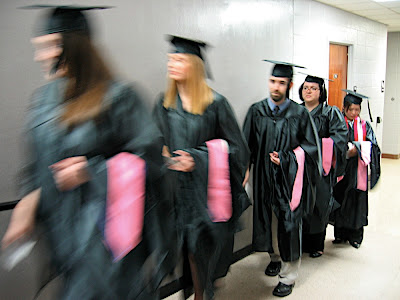
The music begins ...

Here's the view from the middle of the undergraduate crowd.
Walk across the stage, get an empty diploma holder.

Everybody wants to wear the haute couture. (Cady Gray: "Graduation-y!")
It was a perfect spring day in Arkansas.
The crowds massed outside the basketball arena where the degrees would be conferred (contingent on the completion of any remaining requirements).
Huggin' people outside ...
Huggin' people inside ...
Huggin' people in what Archer called "fancy meeting clothes."
Awaiting the big entrance.
The music begins ...
Here's the view from the middle of the undergraduate crowd.
Walk across the stage, get an empty diploma holder.
Everybody wants to wear the haute couture. (Cady Gray: "Graduation-y!")
Friday, May 2, 2008
Saying goodbye
There are certain advantages to having a poor memory for names, faces, and dates, like I do. For every student whose name you can't recall when you meet them in the student center -- or whom you ask about graduation when they're actually finishing their freshman year -- there's the peaceful, untroubled illusion that favorite students never really left. If you can't remember that they graduated, then you don't necessarily miss them, now, do you?
So I won't say goodbye to Leah, Garrett, Karyna, Jenn, Brian, Eric, Charlie, Erica, Gretchen, and the other seventy-odd Honors graduates this year. As far as I'm concerned, they're off in somebody else's class, just a semester away from enrolling in another course with me. In fact, I'll keep expecting them to drop by my office next week to catch up. Friends, colleagues, former students ... don't disturb my happy illusion. Because then I'll just be sad you're gone.
Until I forget again. Ah, blessed fuzzy details.
So I won't say goodbye to Leah, Garrett, Karyna, Jenn, Brian, Eric, Charlie, Erica, Gretchen, and the other seventy-odd Honors graduates this year. As far as I'm concerned, they're off in somebody else's class, just a semester away from enrolling in another course with me. In fact, I'll keep expecting them to drop by my office next week to catch up. Friends, colleagues, former students ... don't disturb my happy illusion. Because then I'll just be sad you're gone.
Until I forget again. Ah, blessed fuzzy details.
Thursday, May 1, 2008
Night of a thousand tissue-paper collages
Tonight was the Night of the Arts at Archer's elementary school. Everybody in the school had an art project hanging on the wall. There were award winners lining the cafeteria, refreshments, a pottery wheel demonstration, and music by the high school string ensemble.
The picture Archer had chosen to display was a marker, crayon, and watercolor study of the U.S. Capitol:

His art teacher chatted with us briefly, and said that he was a good artist -- if only she could get him to stop drawing numbers all over everything.
I must admit that I was impressed, as well. But I don't think we'll ever get him to stop drawing numbers all over everything. My only hope is that he'll be given scratch paper on which to sequester his numbers whenever he's doing work where random scores, temperatures, prices, times, cash prize totals, and equations are not appropriate. Without somewhere to keep the numerical patterns that make sense of his world, Archer would be lost.
The picture Archer had chosen to display was a marker, crayon, and watercolor study of the U.S. Capitol:
His art teacher chatted with us briefly, and said that he was a good artist -- if only she could get him to stop drawing numbers all over everything.
I must admit that I was impressed, as well. But I don't think we'll ever get him to stop drawing numbers all over everything. My only hope is that he'll be given scratch paper on which to sequester his numbers whenever he's doing work where random scores, temperatures, prices, times, cash prize totals, and equations are not appropriate. Without somewhere to keep the numerical patterns that make sense of his world, Archer would be lost.
Subscribe to:
Posts (Atom)