Eventful travels are not always welcome, especially when one's goal is to reach one's destination rather than have an adventure along the way. I did have some unusual twists and turns to my journey over the last 16 hours. But now I'm sitting in a first class car on the delightful Danish InterCity rail, having by chance made the earliest possible train to Aarhus after my arrival in Copenhagen, and even though it's an hour or so later than I had expected to be clickety-clacking toward my hotel, nothing gives you a sense of relief – that “ah, all is well” feeling – like a seat on a European train. Clean, efficient, on time, smooth as silk. It's travel the way it was meant to be.
Which I cannot say for air travel these days, although to be fair, my last two flights were on time and featured luxurious British service. There were only supposed to be two flights total, you see. I was going to Chicago, then straight to Copenhagen on SAS, then I was going to be on this train – or to be precise, the one that left an hour ago.
But after checking in for my Little Rock to Chicago flight about three hours early, having a leisurely lunch, and catching up on my e-mail, I presented my boarding pass when my group number was called, only to have the machine beep angrily and spit it back out. See, the airline had substituted a smaller plane from the one on whose basis advance tickets were sold. The agent had been searching for 14 volunteers to give up their seats, and had bumped about 7 people after he predictably didn't reach that number. But it turns out he should have been searching for 15 people; I checked in before the change was made, and my seat number was assigned to someone else. After a man gave up his seat but specified that it was for a businessman who was quite insistent, I was the one on the short end of the stick. Denied boarding.
I got a $300 travel voucher out of it, and the agent rebooked me as follows: Little Rock to Dallas/Fort Worth, Dallas/Fort Worth to London Heathrow, London Heathrow to Copenhagen. (He tried to give me a free upgrade to business class on the transatlantic flight – those lay-flat beds, you know? Oh, my Lord – but the system wouldn't let him.)
I was skeptical that my bag was going to follow me on this new itinerary. It was pulled off the Chicago flight at the last minute, then instructions were sent down to retag it. The flight to Dallas was about 25 minutes late, and by the time I took the train over to Terminal D, the London flight was already boarding. It seemed like a fifty-fifty shot that my bag made it onto that plane – added to the already uncertain probability that the bag got retagged correctly and was actually intending to follow my route.
My economy class flight to London, back with the tailies, was about as good as such cramped quarters can be; you still get good service on the transatlantic routes, it seems. I didn't catch more than 15 winks, I'd guess, in the eight and a half hours. I watched an episode of Old Christine I don't think I'd seen ("What About Barb?"), an episode of The Office I had enjoyed very much the first time around (“Complaint Resolution”), and the Tina Fey/Amy Poehler vehicle Baby Mama, which is just the kind of lightly amusing fare you need to see on a plane.
After landing in the maze of Heathrow and negotiating the bewildering series of buses needed to get from terminal to terminal, I landed in Terminal 5, where they have a system of departures that I hadn't encountered before. The gates aren't assigned to outgoing flights until 30-90 minutes before they leave. Everyone waits in a big shopping concourse and watches the computerized boards, and when a gate pops up for their flight, they book it – some of the gates are 20 minutes away and require you to take a train! It's a little nerve-racking waiting for that gate to appear, as your flight time draws nearer and nearer, and flights leaving only five minutes before yours show “boarding” or even worse “closing.” I ate a cheddar and pickle sandwich and tried not to think about where my suitcase might be.
The flight to Copenhagen was only half full, and I had a row to myself for a change. As I watched the mist and rain roll by the plane's windows on our descent and heard the temperature on the ground (10 degrees C), I worried more about my bag situation. You see, when I did my final packing yesterday morning, I had intended to put my fleece jacket in my carry-on, along with my usual change of clothes, computer and accessories, knitting, and books (this time in Kindle form). But the jacket was so bulky and made the bag so awkward to carry that I stuffed it in the front pocket of my suitcase instead. Either the suitcase will make it there with me, I reasoned, or the weather (which was supposed to be mild according to the international forecast), wouldn't be so awful early in the evening, when I expected to be walking to my hotel from the Aarhus station – the only outdoor leg of my trip.
But all my fellow passengers had jackets, rain gear, scarves – the whole nine yards. I began to prepare myself for buying a jacket in the Copenhagen airport so I wouldn't freeze in my thin rayon top and jeans.
Miracle of miracles, though – when I arrived in Copenhagen, got through passport control, changed some money, and made my way to the baggage belt – my suitcase came around. I said a silent thank-you to the harried American Airlines agent who had gotten me off on the right foot.
So here I am in the first-class car (the only seats available – an extra 100 Kröner, or about $20, over the normal second-class fare), typing away on my worktable, drinking complimentary water and eating complimentary apples, experiencing Skandinavia the way I would have chosen if I'd had all the modes of transport in the world from which to select. The sun is setting behind the clearing clouds, the car lighting is warm, the illuminated signs and streetlights of the towns we're speeding by are picturesque, even poignant. A little sleep – okay, a lot of sleep – is all I need now. Tomorrow, the conference begins, and today's weariness will be temporarily forgotten.
Thursday, October 16, 2008


Wednesday, October 15, 2008
Torn away
I travel four or five times a year on business -- to conferences and board meetings, mostly. It's not like I'm a salesman on the road five days a week 50 weeks a year. Travel's not my way of life. But I do it regularly enough that it's not an unusual sensation to say goodbye to the family and spend hours in airports.
So you'd think it would get easier to tear myself away from my home and my husband and my children. Not everyday routine, but not dreadful or extraordinary either.
And yet every time I stand at the door, sit in the garage, pause at the interstate on-ramp, and think -- Can I do this?
The bond between me and my home and family feels like the elastic cord that attaches the rubber ball to the bolo paddle. It stretches, it stresses; there's a risk of breaking that can be palpably felt in the muscles and the materials. Just the thought of pulling on the cord makes me nervous. At every segment of the journey, I have to take a deep breath to steel myself for stretching the bond again.
Here in the airport, ninety minutes away from the first leg of my trip to Aarhus by way of Chicago and Copenhagen, the urge to bail out and return home is less intense than it was when I closed the front door. In Chicago, it will be less still; in Copenhagen, almost gone; in Aarhus, I won't even remember it. The adventure takes over, and the homesickness recedes.
But traveling is a kind of powerlessness. The solo traveler's freedom of movement, of choice, of self-determination is purchased at the price of distance from the ordinary processes of home and hearth and loved ones, locations of control that she takes for granted. Temporary loss of contact with those people and places leaves the traveler weightless -- half exhilerated, half sick.
Tuesday, October 14, 2008
Crossing the ocean
Key items on my packing list for Denmark:
- camera and extra battery
- six days worth of clothes
- portable umbrella
- mittens and socks to knit
- brand new birthday Kindle loaded up with Project Gutenberg books, a few select Amazon titles, and all the 14-day free trial subscriptions to magazines and blogs that I can fit on the home screen
Monday, October 13, 2008
It's finally here
Earlier this week, Noel turned to me and said, "It's going to be a big week for Donna on Popless." The T's are in full swing on the alphabetical order as the year shades into gone. And that means it's time for Todd Rundgren and Tom Petty, two of my favorite musicians of all time. Well, let's amend that. I love Tom Petty with a great and passionate love, but Todd Rundgren is part of my identity.
So I wait all week with bated breath to see what Noel will write about them. This week's Popless goes up on the site late this afternoon, and I read through the entries while waiting to be picked up and taken to dinner.
It was really a foolish vigil. How could anybody sum up Rundgren and what he means to me without writing a dissertation? Obviously any fan as fanatical as I've been for decades is far too close to the subject to have any chance of understanding what the music might actually mean in a larger context. I have to say, Noel comes much closer than I ever could with this closing thought:
He's recorded a lot of adventurous, even groundbreaking albums, and he's established a public persona as a longhaired mad genius, and yet Rundgren's actual music is often aggressively uncool. He's like one of those sci-fi/RPG geeks who's cultivated a sense of personal style and has become the alpha geek of his tribe, yet is still out of place among regular folk. Then again, a lot of my closest friends are exactly those kinds of geeks, so over time I've developed a sense of affection and even protectiveness towards Rundgren. It helped that I began to hear in albums like Hermit Of Mink Hollow and The Ever Popular Tortured Artist Effect the sound of the true '80s pop—simple, buzzy, open—from those few glorious years before Trevor Horn, Arthur Baker and Mutt Lange screwed everything up.
There are only a few comments by that time I leave the office to get some Mexican food with the family, mostly about whether Tom Petty is any good or not. (I had this discussion with Noel around the time he appeared on the Superbowl halftime show; "I hope this lays to rest the question of whether Tom Petty is in the canon," I think I said.)
When I got back into the office, where I've got ninety minutes or so to blog and work before it's time to show tonight's foreign film, there were 133 comments. I read them. Nobody mentioned Todd Rundgren.*
Is it wrong to feel rejected?
*40 minutes later, one brave soul has taken a stand, as follows:
My secret crush and my publicly-avowed musical love. Discovered him in college and never stopped listening, even though I find myself occasionally mentally fixing his lyrics, as I'm sure he now wishes he could do. What complete oddness and sweetness. I adore Zen Archer and Does Anybody Love You? He's a genius producer too.Thanks for the support, commenter-whose-pseudonym-is-too-crass-to-repeat-here.
Sunday, October 12, 2008
Cheese pranish
This afternoon, thanks to some generous kidsitting by my generous husband of twelve years today (happy birthday, hubble!), I was able to finish a draft of the paper I'm going to give at the ISRLC conference in Aarhus next Saturday. It's a little on the long side still, and it's not quite as inspired as the piece I wrote for last year's Society for Biblical Literature Forum in San Diego. But cutting it down to a twenty-minute presentation is easier than having to add material. And I'm confident that I can beef it up by about 50% at a later date to submit for publication.
Which means that the period of time I had allotted for preparing the intellectual content of the trip to Denmark is now over. Which means that the period of time -- two days and change -- for preparing the practical side of the trip to Denmark is beginning.
In other words: Time to panic.
What do I pack? What's the weather like? (Note to self: Get a folding umbrella.) How will I get my luggage from airline to airline in Chicago? Can I find the train to Aarhus once I land in Copenhagen? Should I get Danish money in Chicago or Copenhagen? Will I remember to make copies of all my documents and put them in both carry-on and checked baggage? Will I be able to find my hotel once I get to Aarhus? Will I be able to find the conference site at the university the next day? Can I negotiate the public bus system? What if something goes wrong?
Actually, two days of panic is a lot better than my usual week-long panic in the face of overseas travel. Practically relaxing, in fact. As long as I get the car back from the shop by Tuesday, and pick up my new contact lenses, and maybe get my hair cut (not counting on having time), and leave behind instructions for the second paper assignment for the freshmen, and don't forget my passport ...
Deep breath. I'll be fine.
Saturday, October 11, 2008
To infinity and beyond
Today's post with springtime handknit socks repurposed for fall is at Toxophily.
Archer wrote a poem on a sticky note and left it on our front picture window this morning. He's fascinated by the idea that integers ("the counting numbers," as it's put in his schoolbooks) go on and on forever.
The 123s
I'm 1, 2, 3, you know.
I will not have 0.
I will have no stop!
Archer wrote a poem on a sticky note and left it on our front picture window this morning. He's fascinated by the idea that integers ("the counting numbers," as it's put in his schoolbooks) go on and on forever.
The 123s
I'm 1, 2, 3, you know.
I will not have 0.
I will have no stop!
Friday, October 10, 2008
I know you know the festival
Today was a big day. Here's what happened.
- Facebook birthday wishes continued to roll in. (On Facebook? Get in on the fun!)
- A student with whom I worked closely back in 2002 and 2003 visited campus, on a break from his pursuit of a doctorate in history. Our hour-long Starbucks discussion wasn't half long enough.
- Progress was made on the paper I'm reading at the International Society of Religion, Literature, and Culture meeting in Aarhus next week.
- Archer finally won the coveted "Gallery Good As Gold," a sticker he's been talking about ever since he started going to Marguerite Vann. It's like the rarest Pokemon of Good-As-Golds. You get it for having one of the two best art projects in the class, the ones that get hung up in the hallway. The project was a family portrait, and Archer worked on it during his one art period per week for about a month. (We got to see it this evening; it was excellent, in my unbiased opinion.) The Gallery Good As Good is "colored," as Archer has been telling us breathlessly for months: "They're pink, and purple, and green, and stuff like that!" He got a purple one.
- We went to the Fall Festival at Archer's school this evening, a huge fundraiser including a silent auction, chili cook-off, hot dog dinner, and carnival games. Archer won at bingo, to his great delight, and we took home a bag full of cheap trinkets that the kids won by throwing beanbags at things and picking up floating ducks. It's hard to overestimate how happy this made them.
Thursday, October 9, 2008
Happy birthday to me
I'm 43 years old today.
What I'd like to do:
What I'd like to do:
- Read the new Moomin collection
- Start a knitting project
- Catch up on reading my blogs
- Blog the new episode of It's Always Sunny In Philadelphia
- Dither over what knitting project to start
- Fret over whether I'm going get my paper finished in the next five days
Wednesday, October 8, 2008
Peer pressure
Over the last week, my fellow Honors administrators and I have made an interesting discovery about our university: it's riddled with multidisciplinary departments.
Now that might not seem like an important matter, but it's a eureka moment for those of us engaged in the campus-wide discussion over whether faculty should be tenured in interdisciplinary departments. A chief objection to that practice seems to be that no faculty member can be properly evaluated for tenure or promotion except by those who share his discipline. Only historians can evaluate the work of historians, only artists can evaluate the work of artists, only those with degrees in religious studies can evaluate the work of scholars in the field of religion. Since departments are the locations in which evaluation is done, departments must be defined by a common discipline (so the reasoning goes). Therefore there can be no interdisciplinary departments, because their denizens would not share a common discipline and therefore would be unable to form the committees needed to evaluate each other's work.
Yet there are multidisciplinary departments all over campus. Looking at the departments and degrees found in the six colleges, it's abundantly clear that departments are not organized around disciplines, but around functions suggested by the university and college missions. The Family and Consumer Science department encompasses disciplines as dissimilar as nutrition and interior design. The Mass Communications and Theater department houses journalism, theater, and digital filmmaking. The Health Studies department includes addiction studies and nuclear medicine. The Political Science department has faculty devoted to international studies and public administration. The Speech and Public Relations department -- well, you get the idea.
According to the procedures for tenure and promotion outlined in the faculty handbook, tenured faculty in each department form the primary committee for evaluating the work of their peers. Yet in these departments, the faculty are not peers in a disciplinary sense. According to the assumptions above, then, how is evaluation to be carried out?
Even more strikingly, many departments have added faculty with disciplines shared by no one else in their midst. There is one Chinese scholar in World Languages, one anthropologist in Sociology. What will happen when it comes time for them to be evaluated?
These facts seem to suggest that departments are not defined by disciplines. Instead, they are defined by their mission -- which is sometimes discipline-specific, but not always. In general, the mission of departments is to serve segments of educational need or demand in the student body. Those segments do not always conform to disciplinary boundaries.
If departments are defined by mission, then one's peers in the department don't have that status because they share a discipline, but because they pursue the same mission. It seems that the university has embraced, in fact if not in its self-reflection, this definition of a peer. Those who have no disciplinary peers in their departments are not stymied when it comes to tenure and promotion; instead, the members of that department rely on their shared experience to evaluate teaching and service, and rely on the solicited opinion of experts and on objective measures (such as the rejection rate of journals and conferences) to evaluate scholarship.
The important facet of this picture that is only now becoming clear for us is that the university (and its faculty) have not prevented any department from hiring faculty based on the objection that there will be no disciplinary peers on their tenure and promotion committees. If such objections were raised on the case of these multidisciplinary departments or peer-challenged junior faculty, it's difficult to imagine how the departments, colleges, or the university at large could ever add new specialties or programs. The reason they do, of course, is because such programs are needed to serve the student body -- because the missions of universities, colleges, and departments alike actually revolve around that service, not around disciplinary purity.
Tuesday, October 7, 2008
A gift of the past
My forty-third birthday is Thursday. (But I'm accepting congratulations early.) A few days ago my mom called and told me that she had just mailed my present, and she didn't know whether I'd like it.
Today it came: a photo album filled with pictures of me from babyhood all the way up through Archer's toddler years.
From this:

to this:

to this:

to this:

and beyond.
Years ago my dad started digitizing a generation's worth of 35mm slides, and those pictures are among the most well-thumbed in my iPhoto library. I had no idea we had as many prints as Mom found for this album. It's a treasure trove.
In other words: this present is awesome.
Today it came: a photo album filled with pictures of me from babyhood all the way up through Archer's toddler years.
From this:
to this:
to this:
to this:
and beyond.
Years ago my dad started digitizing a generation's worth of 35mm slides, and those pictures are among the most well-thumbed in my iPhoto library. I had no idea we had as many prints as Mom found for this album. It's a treasure trove.
In other words: this present is awesome.
Monday, October 6, 2008
My uncle Dave
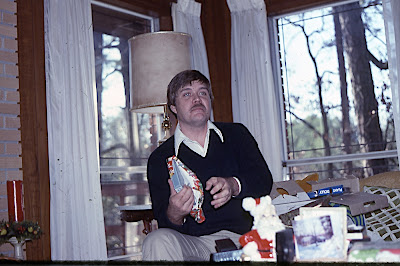
This is my uncle Dave. It's 1978, and he's at my grandparents' house on Lake Chickamauga opening Christmas presents.
I can hear him right now, as he rips open the paper. "Oh," he might say in his soft, expressive voice. "What's this? Oh my! Well, thankyouverymuch!" Uncle Dave was always understated. He had a low, ready laugh. He talked quickly, and usually quietly.
Every Christmas I looked forward to my present from Uncle Dave. He always got something unusual -- something a little exotic, usually with no practical purpose. I could never predict his presents. They were always a total surprise. I treasured them for their complete lack of utility.
Uncle Dave was my father's younger brother, the second of three boys. He studied music and became a renowned and accomplished pipe organist. He was the first in my father's family to get a Ph.D.
Uncle Dave was gay. Nobody in the family talked about it. I don't know anything about his relationships. I have vague memories of hearing my parents talk about his roommate. Of course I didn't understand anything about it until I was well into adulthood.
My uncle Dave died on Saturday, of complications brought on after a fall. I hadn't seen him in many, many years. I hope that for all those years of our separation he lived as I remember him: a world traveler, an effortless artist, a keeper of rare and unusual gifts.
Sunday, October 5, 2008
Good evening
Today's post detailing the penultimate step of garment completion and soliciting advice is at Toxophily.
Remember that post where I listed all the books I have to read in the next month or two? It's been trumped by a package that appeared this Friday, with this inside it.
Yep, I'm a fan. Scott Tobias is interviewing the author for publication at the end of the month. Meanwhile, you can find out what came up on his iPod shuffle back in 2006 by clicking here.
My delight knows no bounds.
Saturday, October 4, 2008
Reunited ...
... and it feels so gooooood ...
The seventies station to which I often listen while driving around town alone played that Peaches & Herb song today. (Fun fact: There have been five different Peaches, while Herb has remained constant. The third Peaches, Linda Greene, is the one featured on the group's biggest hits, "Reunited" and "Shake Your Groove Thing.") I was pulling out of a parking lot at the time, and as always happens when I hear that intro, I remembered a church trip to Six Flags Over Georgia when I was fourteen years old.
I wonder if the best friend who belted out the song with me on that bus remembers the moment like I do. We were inseparable for four years of elementary school. She lived at the bottom of the hill; I lived at the top. On summer days I'd follow the narrow trail through the undergrowth that separated her street from time and visit the little house where she lived with her mother. We'd listen to the music and watch the television shows that weren't entirely welcome at my house. Her life as the only child of a single mother was surely far from perfect, but from my privileged yet culturally restricted standpoint, her home was a paradise.
Although we went to different high schools, we spent time together at church. Something about our senses of humor clicked, and side by side we nourished mutual obsessions with the Beatles and the original cast of Saturday Night Live. That 1979 early morning pulling out of the church parking lot with the rest of the youth group, when "Reunited" came on the radio, it was like there was no one in the world but us. We put our arms around each other's shoulders and sang our hearts out.
This week in Popless Noel is writing about "Naive Melody (This Must Be The Place)," which is "our song"; it was playing when Noel proposed in 1995. Most of us probably have songs like that in our lives. But I'm intrigued by the songs that define moments meaningful to us and possibly no one else. What songs never fail to bring back memories for you?
Friday, October 3, 2008
Restorative
This week there's been a lot of talk around my office, from many sources, about the character of students. Specifically about their general desire to get something for nothing, sabotage as much of the authority structure as they can, and inability to be motivated by anything other than threats.
Such talk is not unusual. It's endemic in academia. Wherever two or three university employees are gathered together, yea, the image of the lazy, malicious, stupid student is there in the midst of them -- the object of complaints and the occasion for nostalgia about the golden age when students loved learning and Wikipedia had not yet been invented.
I know that I'm privileged to work with a class of student far brighter and more motivated than the general campus population. But even among people in my department, there is often an assumption that our students are trying to get away with as much as possible -- that all one can hope for is the occasional gem among the shuffling, plotting masses.
Even though I know it's often just a reflex among academic personnel to talk about students this way, it still gets me down. I'm wearied by the us vs. them assumptions built into it -- that we're in an arms race, with faculty and staff trying to stay one step ahead of students with an endless bag of learning-avoidance tricks; that the best we can hope for is to curtail their range of ignorance and sloth.
It's not that I'm a cockeyed optimist. It's that little of this talk has much relation to the experiences I have with students day in and day out. When I first starting teaching, my idea of a syllabus was to lay out readings and assignments I expected students to do, with penalties for non-compliance. My syllabi were dares: I put up a to-do list and waited to see who would defy it. And sure enough, most of the students wouldn't come through, and I'd blame it on their character.
But the real problem was the roles in which I placed them and myself. I was the agenda-setter; they were the dutiful followers. I thought that inviting them to take part in the design of the class meant putting a sentence in the syllabus asking for their suggestions, or having a blank day every three weeks where I asked for volunteers to lead class. Those aren't structures for student empowerment; they're a vacuum that I was asking them to fill.
Real structures that elicit student engagement and involvement aren't just spaces bereft of the instructor's agenda. They're carefully-constructed partnerships in which the students' contributions are systematically received and valued. An instructor values student contributions with her time. She takes the time to read, respond, and integrate student work into class -- not just a few times a semester, but every single class day. It has to be built into the structure of the class, as regular an occurrence as the class meeting itself. When student work rather than instructor knowledge is integral to the course -- by design, not by default -- most students do the reading, do the work, come prepared, and feel a part of what's going on. It can't be what we ask them to do; it's what we show them by our actions and our class structure that we need, value, and utilize.
Late today, after a very long, bewildering stint in the office watching power plays and cynicism and wary circling around each other, I went to a Soapbox. Soapboxes occur whenever a student has something to say to his peers. We provide a forum for the presentation, advertise it, serve snacks, set up chairs, and make A/V equipment available. Presenting a soapbox and attending a soapbox are both completely voluntary. It's not a requirement -- it's an opportunity. And it's an opportunity that we've shown students that we care about by spending administrative time and energy facilitating and promoting them.
They take place on Friday afternoons at 3 pm. How many students do you think would want to do a presentation at that time if they didn't have to? How many students do you think would attend if they didn't have to?
Answer #1: There are more Soapboxes scheduled this semester than there are Friday afternoons to hold them. A few have spilled over into weekday evenings.
Answer #2: This afternoon 30-40 students filled their residence hall lobby to hear a freshman -- someone who's only been a college student for a month and a half -- give a presentation on the fine art of thrift-store recycling.
Why? Because this is their time. They show up to support each other, to learn, to take the reins of their education. We provide the structure that makes it possible; they provide the content. And they do it not because they have to, but because they want to share what they have of value with each other.
When academics treat students as if they have something of value to share, whaddya know? Turns out they do. If we never expect anything of students but defacement of our own cherished values, well, it's not surprising that that's all we ever get. Just as a monument put up by the guardians of high culture invites graffiti, because onlookers resent being simply passive recipients of the messages of the elite, so a course that doesn't value student contributions in deed as well as in word stimulates mostly avoidance or revolt.
Thursday, October 2, 2008
In the spotlight
Almost since the semester began, I've had the strange and intermittently stressful feeling of being under scrutiny. There are several reasons that the eyes of others have been focused on me. At times it's been about me personally, and how I do my job. Other people see me as part of a group that's a problem on campus because we don't fit in one way or another.
Most of us like to do our job without attracting constant attention. Sure, we put ourselves in situations where all eyes are on us, and we have to perform. That's different from being examined for who you are -- characteristics of your personality -- or for the philosophy of education you represent. When the roving spotlight seems to be following you around, it can be a bewildering experience. You ask yourself what put you in the hot seat all of a sudden.
I haven't been going through this alone, and thank goodness I haven't been put in charge of justifying my existence. I've been getting plenty of support. It's been a valuable opportunity to learn more about myself and to think about what I do. But it will be nice to fade into the background and get back to doing my job, not a symbol nor an obstacle. Just me.
Wednesday, October 1, 2008
Books on the shelf
The start of the new semester put a real crimp in my summer reading schedule. For awhile there I was cranking out a book review a week, and I read some absolutely beautiful books -- The Story of Edward Sawtelle and The Condition chief among them.
While I'm teaching, it's hard for me to finish a single book in a month. But I'm going to have some concentrated reading time coming up during my late October trips. I probably can't haul hardbacks to Denmark, but the publisher was thoughtful enough to send a paperback advance reading copy of Malcolm Gladwell's latest, Outliers: The Story Of Success. Ditto for 2666 by Roberto Bolano, a posthumous publication by a cult Chilean-Mexican author.
I'm about halfway through the terrifying yet completely addictive Death From The Skies, a series of lessons in astrophysics, chemistry, and meteorology disguised as discussions of various apocalyptic scenarios (asteroid hitting the earth, massive solar flare, nearby supernova, etc.). And today Amitav Ghosh's Sea Of Poppies hit the mailbox.
I'm set through Thanksgiving at least. What's on your to-read shelf?
Tuesday, September 30, 2008
Incorruptible
Our "Strange Communities" class is reading Teresa of Avila's autobiography as part of our discussion of monastic life. I first read her Life as a graduate student in a class on the Reformation, and I've been fascinated by her ever since. Her voice and sense of self seem so modern, making the experience of reading her writing surprisingly intimate. As she examines herself and explains her spiritual progress at the behest of her superiors, we recognize an energetic, mostly unspoken discussion going on underneath the text -- a debate about culture, religion, gender, and the verdict of history.
I had the chance to give a presentation today on the strange fate of Teresa's body after death. Immediately after burial, nuns at the convent of Alba reported such a strong, sweet odor filling the building that they had headaches. The body was disinterred nine months later during a dispute over ownership with the convent at Avila, and it was found to be completely undecayed and oozing a sweet-smelling oil. The next several years saw it hacked into several pieces -- a hand, several fingers, an arm, and other parts were cut off and sent around the world so their miraculous powers could be experienced by Catholics everywhere.
The times in which Teresa happened to live made her far more significant than a nun, a mystic, or even a saint. Catholics asserted God's continued intervention in the human world, against the conclusion of Luther, Calvin, Zwingli, Bucer, and others that the biblical age of miracles was past and that history now unfolds according to God's primordial predestination. Teresa was Exhibit A for the Catholic worldview: Personal holiness is possible; heaven and earth intersect in the saints and their relics; the resurrected spiritual body exists among us now, tangible and concrete.
The Reformation and its associated culture wars are endlessly intriguing. The ideological issues are permeated with social, economic, and political freight. Maybe instead of the Great Depression, the historical precursor of our troubled and highly ideological times could be found in the sixteenth century. In any case, negotiating its rapid changes while trying to keep the faith certainly makes me feel a kinship with Teresa -- in terms of self-reflection, not sainthood.
Monday, September 29, 2008
Ritual
My upper-division students are watching Into Great Silence tonight, and therefore while showing them the ritual lives of Carthusian monks, my Monday rituals are interrupted. Noel is taking over my usual TV blogging duties while I'm here for three hours after closing time.
The month of October is upon us, and my routine is being eaten up by the sudden influx of urgent tasks. Freshman papers must be graded quickly, and then conferences scheduled with each student. A paper must be written for the conference in Denmark, a few remarks for the conference in Chicago. Soon the book of documents to be reviewed before the board of directors meeting will arrive. I'm in the midst of the unit I'm leading in our team-taught class, which means presentations to prepare, discussion questions to share with my colleagues, the organization of the class mostly on my shoulders. A grant application must be delivered next week.
I'm most productive when time pressures are the heaviest. Yet watching this movie, I could wish for a life of pure routine -- nothing to be done except observe the hours of the day. No extraordinary tasks. Only what always has to be accomplished: eat, sleep, pray, read, clean, grow, think.
We all long for such a completely dictated life at our moments of greatest freedom, when the responsibilities we have voluntarily taken on and the accomplishments we've so carefully nurtured drive us too hard. We want to give it all up for simple obedience.
I'm more susceptible than most because I've never minded repetitive work. I still remember fondly the summer I spent cutting, trimming, and gluing carpet samples into books at my uncle's factory. It was brainless labor, few choices to be made, no thought required. And so I thought about anything and everything while I worked. I contemplated the country songs on the radio. I composed poetry in my head. I let my mind wander and felt intensely alive in my own skin.
Naturally there's a big difference between a summer on the factory floor and a lifetime of unmitigated repetition. But my high tolerance for drudgery can probably also be seen in my passion for knitting. Nevertheless, I've clearly chosen against obedience and in favor of freedom and self-directedess. And in my most creative, productive moments, there's no way I would choose differently. I romanticize simpler ways, and who knows -- perhaps someday I'll live them. For now I'm too jazzed by what I can do when pushed, when I put my mind to it, when inspired.
Sunday, September 28, 2008
Drinking the Kool-aid
Like most of my academic colleagues, I tend to be skeptical of business culture. But I've had some opportunities over the past year to take part in a few meetings and retreats focused on business-style vision definition and mission discernment. And they've been surprisingly helpful in moving beyond what the various organizations do -- their traditions and programs -- and toward who they are.
This week the members of my church's vestry read a book about the missions of congregations. And again, I turn out to be a bigger fan of such discussion than I could have predicted ahead of time. Maybe it's because in the final analysis, talking about organizational goals and dynamics is meta-talk, and I've always been fascinated by the meta.
Here are a couple of the ideas in the book (Behold I Do A New Thing: Transforming Communities Of Faith by Kirk Hadaway) that I'm going to keep in mind:
- Even though we tend to focus on definite, measurable goals, there are such things as diffuse, intangible goals -- and they can be legitimate. A church's goal is transforming people, for example, and the outcome of that goal can't be defined in advance.
- Just because a need exists in your population, that doesn't mean it's your organization's job to address it. Distinct organizations can recognize the intersection between their mission and the needs of their members.
Saturday, September 27, 2008
The law west of the Pecos
When I heard the news this morning that Paul Newman had died, I immediately thought of his roles in The Verdict and The Hudsucker Proxy. Those were movies that meant a lot to me when they came out, and that I still remember as daring experiments in style and mood.
Although The Verdict was hardly groundbreaking, it came out when I was a junior in high school and was just beginning to be able to attend movies. I was shaken by its bleakness and moved by Newman's vulnerability and gravitas. Sidney Lumet, as he nearly always did, made me feel like an adult, and I loved the movie -- and Newman -- for that. What a cadre of nominees for the Best Actor Oscar that year -- Ben Kingsley (the winner for Gandhi), Newman, Dustin Hoffman (Tootsie), Peter O'Toole (My Favorite Year). (I'll pass over Jack Lemmon (Missing) without comment.)
Newman isn't indispensible to The Hudsucker Proxy, really, but his role symbolizes the seriousness with which he took his craft and his never-waning interest in cinematic experimentation. For such a box-office stalwart, Newman never seemed to sa
y no to the chance to work with great filmmakers on risky scripts. He stayed on the cutting edge right to the end.
But the performance that I'll always treasure most is his cranky, quirky star turn as Judge Roy Bean in The Life and Times of Judge Roy Bean, an oddball John Huston/John Milius comic western from 1972. It was one of a handful of pop culture artifacts that my circle in Athens was obsessed with. We quoted it incessantly.
- "Justice is the handmaiden of the law." "But you said the law is the handmaiden of justice!" "Works both ways."
- "This was the original Bad Bob. The albino."
- "I'm very advanced in my views and outspoken."
Friday, September 26, 2008
I'm delicious bacon
Today's post about selfless and selfish knitting is at Toxophily.
Wednesday marked Cady Gray's class field trip to the apple orchard. It would be too easy to blame Noel's negative vibes for what happened next; he's been on this particular field trip three or four times already, and he's pretty sick of it. He spent the previous week talking about how he was dreading the morning lost to productive work.
After a long wait for their turn and a rather mournful game of duck-duck-goose (in which Cady Gray never got picked), the class went on a hayride (which Cady Gray adored). Then just at the end of apple-picking time, Noel was trying to get the attention of her teacher so that she could snap a picture of Cady Gray picking an apple for the class photoessay about the field trip. That's when he heard Cady Gray say "Dad, my leg itches," followed by her bursting into tears. She was standing right in a nest of fire ants and they were swarming all over her ankles and legs.
Some timely intervention from other parents, including an emergency-room physician, saved the day, but Noel felt terrible about his lapse of attentiveness. He apologized to Cady Gray as they were driving home and asked her to forgive him. "I forgive you," she said.
"Do you think Mom will forgive me?" Noel asked. "I think so,"* said Cady Gray.
And that's when Noel made his second mistake. He joked, "I hope so, because otherwise I'd have to move out of our house."
For the rest of the ride, Cady Gray was very still and quiet. Occasionally she piped up uncertainly: "Dad, I think Mom will forgive you."
* I did forgive him.
 |
| From Toxophily |
Wednesday marked Cady Gray's class field trip to the apple orchard. It would be too easy to blame Noel's negative vibes for what happened next; he's been on this particular field trip three or four times already, and he's pretty sick of it. He spent the previous week talking about how he was dreading the morning lost to productive work.
After a long wait for their turn and a rather mournful game of duck-duck-goose (in which Cady Gray never got picked), the class went on a hayride (which Cady Gray adored). Then just at the end of apple-picking time, Noel was trying to get the attention of her teacher so that she could snap a picture of Cady Gray picking an apple for the class photoessay about the field trip. That's when he heard Cady Gray say "Dad, my leg itches," followed by her bursting into tears. She was standing right in a nest of fire ants and they were swarming all over her ankles and legs.
Some timely intervention from other parents, including an emergency-room physician, saved the day, but Noel felt terrible about his lapse of attentiveness. He apologized to Cady Gray as they were driving home and asked her to forgive him. "I forgive you," she said.
"Do you think Mom will forgive me?" Noel asked. "I think so,"* said Cady Gray.
And that's when Noel made his second mistake. He joked, "I hope so, because otherwise I'd have to move out of our house."
For the rest of the ride, Cady Gray was very still and quiet. Occasionally she piped up uncertainly: "Dad, I think Mom will forgive you."
* I did forgive him.
Thursday, September 25, 2008
Settle a bet
In Archer's last Scholastic book order, I got him a 2008 edition of the Guinness Book of World Records. With his delight in numbers and score-keeping, I thought it would give him plenty of browsing material.
But I was also thinking of the well-worn paperback copy of Guinness that I read as a kid. It was one of many books on our shelves to which I returned again and again. Its bite-sized chunks of facts and bizarre oddities were like salted peanuts; once I started reading them, I found it hard to stop. There always seemed to be time for just one more.
As a result, there are certain black-and-white pictures permanently engraved in my mind. The world's heaviest twins (riding the motorcycles, remember?). That Indian guy with the world's longest fingernails. The world's tallest man standing next to a normal-sized woman and a street sign.
A couple of years ago, one of our Honors students broke the record for world's largest Christmas stocking as her senior thesis. As you might imagine, the Guinness people had some regulations that had to be followed -- and their specificity made me imagine a huge vault full of the particular rules for each record category. The stocking had to be filled up to a certain height from the top, for example (the student got retailers to donate toys for this purpose, which were distributed to charity after the record attempt).
When I asked Archer whether he'd enjoyed the book, he told me that he'd read about sports records. That's all well and good, I thought, but what about the world's most fertile woman, surrounded by her dozens of offspring?
Wednesday, September 24, 2008
Decorate yourself
I went to the semi-annual Rhea Lana children's consignment sale this morning to put an initial dent in the kids' cold weather wardrobes. Normally the sale lasts a week, but this time it's only a few days, so I couldn't pursue my normal strategy of waiting until after the first weekend rush is over.
Although I arrived fifteen minutes after the opening bell, hoping that the midweek opening would limit the number of moms who could spare the time to shop, the parking lot was full. Inside, though, there were so many racks jam-packed with clothes that they all but swallowed up the shoppers and the kids they were toting or pulling. As a savvy long-time customer, I knew to bring a Tub-Trug to fill -- the arms tend to get tired holding stacks of pants, shirts, and sweaters for as long as it takes to get through every rack of the appropriate size.
When I got home with my purchases after school, I told Archer that I had gotten 29 items for $128.50. "How much did each item cost?" I asked. "That's going to have a remainder," he announced, before disappearing to tap it out on his calculator. "Each item cost four dollars and forty-three cents," he said when he came back. I confided in Noel that if you took out the red and gold princess dress I got Cady Gray for Halloween, which cost $10, that average would be even less.
It's strange to pick out clothes for your children, particularly when you've quietly discouraged the development of any particular style or color preferences on their parts. You're left with what you would like to see them in. Stripes? (Yes.) Pink? (Acceptable if small doses.) Ponchos? (If Cady Gray wants a poncho, I'll knit her one. Until then, no.) Corduroy? (With some trepidation.)
Essentially, you're decorating your children. This is fairly easy to live with when they're babies. The older they get, the weirder you feel about imposing your taste on them.
A few days ago I bought the justly-celebrated second Mason-Dixon Knitting book, Mason-Dixon Knitting: Outside The Lines. These ladies feel about clothes the way I do: "nothing too out there." Anything that will be wearable fifteen years from now has a place in my closest. A skirt with an interesting silhouette? An asymmetrical top? Too now! Too timely! Better boring and safe than exciting but possibly momentary.
But they, and I, are trying. One chapter is titled "Decorate Yourself." Now there's a concept. Not just cover yourself, not just fade into the background. Open the closet door and think not "what will function?" but "which of my many fabulous looks will adorn me today?"
Luckily, for now I can get Cady Gray excited about the new clothes I got for her just by telling her how much I love them. I wonder when the day will come when she will open her closet and think about how she wants to decorate herself?
Tuesday, September 23, 2008
Can I get into a more exclusive club?
Archer ginned up this computer printout for me yesterday -- a reproduction of the records he gets when he takes a reading comprehension test at school. My reading skills need some work, apparently, even though I've read that book approximately three dozen times in the past five years. I don't think I deserve to be in the 12.5% club.
Meanwhile, Cady Gray asked for a sheet of addition problems to do before leaving for school today. (I wrote the problems, she wrote the answers, and I tried to give her 100% with a red pen that wouldn't make a mark.) And between last weekend and today, she's figured out the concept of division. Lest we think that she's just a smaller version of her number-cruncher brother, she also delights in telling us that she has a boyfriend at preschool named Sam. "Sam says, 'I'll hug her but I won't kiss her!'" she repeats amid gales of laughter.
 |
| From blog elements |
Monday, September 22, 2008
Getting the touch
Noel had a mishap with his beloved iPod Touch while he was in Toronto. He was downloading an update on an unreliable internet connection, and the iPod got hung up; no matter what he did or how he reset it, it would never progress past the opening screen of startup. A visit to a genius bar at a suburban Toronto Apple store didn't fix the problem, so he sent it in for warranty replacement.
Today the new Touch arrived, and Noel has been reorganizing his apps, contacts, and music with a palpable sense of relief. He had a backup in the form of the old pre-Touch iPod that the Touch had replaced, so he wasn't without a way to listen to music. But since he got the Touch at Christmas, he'd come to rely on all the different ways it organized his life.
My birthday is coming up, and I've long thought that I might be getting a Kindle. The manifest awesomeness of the iPod Touch certainly casts a long shadow, though. I'm not sure it would be as useful for me as it is for Noel; nor am I sure that we need two of them in this house. It would certainly be great for me to have a little web device that I can carry in my pocket at work, but my experiment with a PDA a few years ago never really panned out for me. Do I really need a Kindle? Well, in some ways it also fulfills the function of a little web device; I can put documents like syllabi or presentations on it to have them accessible without the bulk of a laptop. And it would be nice to get books to review in Kindle format so I don't have so many huge stacks of printed material around the house; don't know if that's possible for books pre-release, though.
Where the Kindle would really shine is in getting books for class. For the class that I'm team-teaching this semester with my fellow administrators, we had some trouble getting the bookstore to order enough of our five texts for all three sections and 36 students. Students were telling us that they couldn't find the books anywhere. If they had Kindles and if the books have Kindle editions -- and there are for at least 3 out of the 5 -- then you could have the book in thirty seconds from the time you realized you needed it, for less than the cost of a used copy in the student center.
Sure, strictly speaking, I don't need either of these gadgets. But I've been around them enough to know how my life would change with them, and I like what I see.
Sunday, September 21, 2008
Would you like to buy an O?
Archer brought home his school fundraising kit this week. There was some fundraising project last year that we didn't participate in, but after buying magazines and popcorn from neighborhood kids going door to door in the past several days, I'm feeling more like taking my place in the ranks of parents hassling neighbors and co-workers to sign up.
There are three products: Three-pound tins of unbaked cookie dough (“Kosher!” brags the brochure); canvas 8x10 prints of your favorite photo; and handmade accessories from economic development projects in third-world countries. We'll probably buy some dough for ourselves, and I've got my eye on a couple of the products in the accessories catalog. The question then becomes how we get other people to participate.
Back when we worked at GE in Virginia, our co-workers would occasionally canvas the workgroup with catalogs of wrapping paper or scented candles. I vaguely disliked having a colleague standing over me while I searched for something I might be able to use or regift. If I ever have to do this, I vowed, I'll just have the stuff at my desk and send an e-mail out to everybody telling them that they can come by and look if they want.
And so I intend to do, although now that the time has come, I'm wondering if even that soft sell is too intrusive. It sure beats knocking on my neighbors' doors, though. Noel and I spent a few moments yesterday imagining what Archer would say if sent door-to-door with his catalogs:
"Umm ... as you know ... what are you going to buy?"
"How old are you? What is your total?"
"How much money do you have? I just have eighteen dollars and thirty-six cents."
"What number of items do you like?"
Saturday, September 20, 2008
The resurrection and the life
I attended the ordination of our new priest, the wholly wonderful Teri Daily, this morning at our church. The handbell choir played the prelude and postlude. I acquitted myself well with my G4, A-flat4, and A4 -- I even managed to play or pluck a couple of notes in the Vivaldi that I'd never been able to get to before.
But that was the prelude. By the time communion was over, I wasn't sure I was going to be able to see the music for the postlude through my tears. Someone put just about every hymn and anthem that makes me cry on the program. "Here I Am, Lord" was the offertory. "One Bread, One Body" and "And I Will Raise Them Up" were the communion hymns. I was a puddle by the recessional.
One reason these songs affect me is that they are aspirational -- they soar. That kind of music usually hits me in an emotional spot; I was always unusually susceptible to the praise music that was just becoming ubiquitous during my time in church youth groups.
But there are particular lines that stop me in my tracks, too. "Here I am, Lord," says the first song -- immediately followed by: "Is it I, Lord?" Maybe the lyricist didn't intend it, but that moment of questioning, querying, wondering -- perhaps even doubt -- suddenly makes the song applicable to me in a way that it never would have been as a song of triumph or submission, either one.
"They who believe in me, even if they die, they shall live forever," asserts another of these songs, paraphrasing the Gospel of John. Now this may or may not come as a shock to family members, students, or old friends reading this blog, but I don't believe in subjective life after death. Yet the mystical hope in these words attributed to Jesus, the paradoxical reversal of expectations, affects me all the same. I'm struck dumb by the audacity of the assertion, the mystery that is simply stated. In what sense to live? In what sense to die? In what sense to believe? It's not a moment of doctrine, but a moment of credo. I can only bow in respect to that human capacity for hope and for the community that nurtures it.
I once heard a famous scholar of religion respond to a mention of the Holy Spirit by saying, "I may not believe in God or Jesus, but I do believe in the Spirit." I know what he meant, although I certainly experience faith differently. When I repeat the Nicene Creed each Sunday morning, I always feel the tug of hope and raise my voice to join the chorus during the third section: "We look for the resurrection of the dead, and the life of the world to come." I may not know anymore what some of the rest of it means, or how to translate it into twenty-first century concepts that I can carry in my head and actualize in my behavior. But I know that I believe in the life of the world to come -- the one that's waiting just on the other side of the present moment, where whatever I become here and now will be resurrected and given as a gift to that vast and unknown future.
Friday, September 19, 2008
Paving the cowpaths
For as long as I've been at my institution, there have been two main ways students entered my building, McAlister Hall. It's a long, thin rectangle with four floors, each one consisting of a hallway running the length of the building with classrooms and offices on either side. A staircase ascends the floors on either end. The fourth floor is up in the gables, and it's truncated -- there's no hallways running its length. Instead, you can get to the fourth-floor classroom I often use only by going up the north staircase. If you go up the south staircase, you're out of luck; there's a computer lab smack in the middle of the floor with no way through to the other side.
There's a rather grand front entrance, but it faces nothing but a lawn and the road running in front of the campus; almost nobody enters that way. Instead, people come in at the minor entrances on either end of the first-floor hallway -- on the short ends of the rectangle.
If you're approaching from the campus center, and your classroom is on the south end of the building, you're in luck -- a sidewalk runs almost directly to the door on that end. But if you're going to a northerly classroom, you end up cutting across a lawn to the north doors. If you're moseying, you might feel like going directly north toward the library and then making a 90-degree turn onto the sidewalk that runs east toward that door. But more than likely, you'll hit that walkways square on your way from the student center and proceed right down the diagonal.
Students have been trodding that diagonal ever since I got here nine years ago, and surely at least nine years before that, when the building (which was first a dormitory, then married student housing) was first converted to academic space. In the rain it becomes a mudpit; in the summer it's a dustbowl.
This week I strolled toward my office on my daily walk to work and found workers digging with a small backhoe. The next day there were concrete forms up, and by today someone was scraping debris off the dried concrete of the new sidewalk, directly over that well-worn dirt path.
There's an old landscaping approach to university and corporate campuses: Rather than trying to predict where pedestrians will want to go and herding them onto sidewalks of your design, leave the grounds devoid of paved pathways. It won't take long for people to start wearing paths into the lawn. Then build the walkways where people have shown they actually walk.
It's taken our university quite a while to process the evidence of actual pedestrian behavior, but nevertheless, it's somehow greatly heartening to see the feedback loop closed at last. Somewhere, somebody's paying attention, however slowly.
Thursday, September 18, 2008
My kids are pretty awesome
I hate to brag, but my kids are pretty awesome. Here's the proof.
Exhibit A: A rough transcript of Cady Gray, age barely 4, solving the addition problem 106+355 in her head about five minutes ago.
"Ohhh-kay. So. 6+5=11, so I put a 1 in the tens place, and I put down a 1. 1+0+5, so 1+0=1, and then the answer is 6. Now. 2+3 ..."
"The problem was 106+355."
"Mom, do not give me three digits. Ohhh-kay. So 1+3=4. So the answer is ... four ... hundred .... sssssssssixty ... one. 461!"
Exhibit B: An acrostic poem Archer wrote in school -- age 7 years 1 month, second grade, Arkansas, USA, the universe.
F alling leaves
A ll falling from the trees to the
L and.
L et's let fall go away.
..........Whoosh!
............ And
............... now
.................. it's
..................... gone.
Wednesday, September 17, 2008
Back to the tube
The fall TV season is almost upon us, if it's not too old-fashioned to talk about such a thing as a season (let alone a fall one). The broadcast networks still premiere a slate of shows in September and October, although they hold others back until January and schedule others for times when the competition is presumed to be moribund. The cable networks, meanwhile, do whatever they like, often at a decidedly oblique angle to the traditional television timetable, and it probably helps them avoid getting lost in the shuffle.
One of the shows I blog for the A.V. Club's TV Club is returning this week -- the sick-funny, often inspired It's Always Sunny In Philadelphia. FX has ordered 13 episodes that they're going to burn off at a rate of two a week, at least at the start (just as they did last year, and I didn't understand it then either -- the show's entire run is over in two months). My other regular gig, How I Met Your Mother, starts next Monday. (All the evidence suggests that I specialize in shows with titles containing five or more words, which must be why I'm so keen on The New Adventures Of Old Christine.)
I've got a stand-in gig tonight blogging Project Runway for Amelie -- another show with an interesting meta-narrative this season. It's been bought up by Lifetime, so Bravo dumped the current season onto the air with almost no fanfare. This for the show that kick-started the network's whole reality franchise (Top Chef, Top Design, Tim Gunn's Guide To Style, Flipping Out, Shear Genius, Million Dollar Listing, ad nauseum). It's ignominious, I tell you.
Tasha's interview with Neal Patrick Harris went up today, and while I don't expect that the HIMYM crowd reads my recaps, I went a little squidey when Harris implied in response to a question about watching his own work that he does keep up with reviews and blogs. Very occasionally the subject of one of our reviews or essays will show up in the comment section and remind us that the audience isn't always a third party; Larry Gonick, for example, weighed in on my review of The Cartoon History Of The Modern World. And then there's the moment when your editor forwards you an e-mail from the creator of a show you spent the summer methodically analyzing the awesomeness thereof. I don't mind telling you that we all turn into fanboys and -girls at such times.
Tuesday, September 16, 2008
It smells like autumn
Note: Last night's post has just gone up, backdated, because the internet went down here at Chez Bowman-Murray just after I got home from yesterday's evening screening.
After Tropical Storm Ike blew through Arkansas Saturday night, scouring the atmosphere and leaving the state littered with fallen trees, fall seemed to arrive almost instantaneously. Morning temperatures dropped into the fifties, meaning that Cady Gray and I need sweaters when we stroll around the corner to school. The scent of smoke was in the air, although goodness knows who was burning what. Suddenly it's time to switch dresser drawers and find the kids' long pants, woefully small and inadequate for the new season.
Fall has always been my father's favorite season, and because I take after him in almost all things, I tend to take special notice of its glories. Here in Arkansas fall comes in time for Halloween, littering the ground with dry leaves, and winter's chill is short. The sky turns a brilliant deep blue, the color of a Caribbean bay. From the football stadium a block away, we can hear the roar of the crowd and the celebratory boom of the cannon marking a score for the home team.
The arrival of fall means that everyone feels more in the mood for school, no longer resentful because it's still summer outside. It's a philosophical feeling, a sense that a remote table tucked away in the corner of the library stacks is just the right place to be. Coffee drinks, sweaters, lingering in the dorm lobby on the way out to class ... fall on a college campus.
And if it's fall now and the semester has begun in earnest, that means holidays are not too far away. Next summer seems just a hop, skip, and jump through the class schedule.
Monday, September 15, 2008
Last of the summer swings
Today's post presenting a summer trinity of winter hats is at Toxophily.
I'm coming off my first foreign film evening at school, and blogging time on such evenings is always short (and will only get shorter once the new TV season starts in earnest and I have How I Met Your Mother and It's Always Sunny In Philadelphia responsibilities). Today I planned ahead and saved some end-of-summer playground pics for you. Enjoy!
Cady Gray can now pump herself on the spring, and she loves going high.
A celebration in honor of going down the sliding pole with no help. Kudos!
I'm coming off my first foreign film evening at school, and blogging time on such evenings is always short (and will only get shorter once the new TV season starts in earnest and I have How I Met Your Mother and It's Always Sunny In Philadelphia responsibilities). Today I planned ahead and saved some end-of-summer playground pics for you. Enjoy!
 |
| From Toxophily |
 |
| From Toxophily |
Sunday, September 14, 2008
Boxcars
Today's post about a lovable red scarf is at Toxophily.
On our way to dinner tonight, we got stopped at a railroad crossing. Cady Gray announced that she was going to count the boxcars, and then Archer topped her by saying that he would count all the cars. He commenced counting right away, and about at car 50 Cady Gray petitioned in a trembly voice for him to stop since he was counting her cars.
Archer, ever the peacemaker in the big brother role he's come to relish, interjected: "67 ... 68 ... 69 ... youcancountthetensCadyGray ... 71 ..."
"No," Cady Gray said in a small but petulant voice.
"78 ... 79 ... youcountthatone!"
"No."
"... 81 ... 82 ..."
The situation was not resolved until we were seated at dinner, when Archer was persuaded to say he was sorry for counting Cady Gray's boxcars (although he issued the justified caveat that "I tried to help her count them").
Saturday, September 13, 2008
Group therapy
We flipped our schedule today to take account of the latest Ike news. Rain was forecast to start in the afternoon, so instead of holding our writing workshop in the morning and sending the kids out to hike and capture-the-flag in the afternoon, we took advantage of cloudy but dry weather after breakfast for outdoor activities.
So after lunch we broke up into groups of six or seven, and scattered to meeting rooms all over the the conference center to work on the students' first papers for their very first Honors class. We spent about 90 minutes, first exchanging papers to read, then communicating praise and suggestions to the writers, then rewriting sections of particular concern. The last twenty minutes or so were devoted to talking together about the revision process and reading aloud before-and-after examples.
I get really animated when I'm talking about what these exercises reveal about students' topics and particular voices. One writer made a subtle change of wording and structure that suddenly created a bold dichotomy between the way she felt at one point, and the way she felt later. Another stretched himself to personalize the impact of his subject, rather than writing about it from an objective perspective as he was naturally inclined to do. I was excited about their discoveries and eager to join the team around the table providing ideas and encouragement.
When I asked for feedback after everyone had had their say, the students eyes went wide. “This was great,” one said with a bit of wonder in her voice. “I was dreading this, said another, “but it was the best thing we've done up here." "I didn't expect it to be so helpful," a student said, to general agreement.
I don't know what people expect when they hear the phrase "writing workshop" -- one of my colleagues mentioned that one of her students thought they were going to be lectured -- but it must be some kind of grammar slog or criticism fest. Those who do workshopping a lot know that the objective is not to conform everyone's writing to a Platonic ideal, but to push each individual's writing toward its personal best. That's necessarily going to be involve a celebration of what makes your writing uniquely yours -- a recognition of the self that you alone can communicate.
And there's no group that is more interested in finding out who they are than eighteen-year-olds. If we could call it a soul-locating workshop instead of a writing workshop, maybe they wouldn't be so surprised at the outcome.
Friday, September 12, 2008
Peak experience
Noel returned from Toronto last night and we enjoyed a typical evening of television and trivia. But the next day I was the one saying "so long," as I packed my bags for a weekend with our incoming Honors class, assorted upperclassmen in leadership positions, faculty, and a bunch of glutton-for-punishment alumni who gleefully pay good money to relive their undergraduate experience every fall.
Although we're going to catch some of Ike's wrath late tomorrow and Sunday, today was an unseasonably warm day that grew breezier up on the mountaintop. We come to the Winthrop Rockefeller conference center each September, and every year the place grows more luxurious and the staff more attentive. It's more like being pampered at some kind of Arkansas version of a resort hotel and spa than anything: copious delicious food (tonight's dessert table featured a smooth-as-silk chocolate cake with cream cheese icing decorated with "Welcome UCA!"), beautiful hotel and apartment-style lodging with wireless internet throughout, technologically-advanced meeting rooms, and 180 acres of recreation space including a fully-equipped fitness center, indoor tennis, volleyball, paddleboats, and easy access to hiking trails at the adjacent state park.
I've been looking forward to this weekend because it affords so much time for reading, knitting, socializing, and relaxing. We do some work, too -- a writing workshop tomorrow morning, a guest speaker tomorrow night. But there's something so freeing about not being in charge, being able to simply enjoy this pleasant place and these unscheduled hours. After a week of staying on point with the kids and at work, I'm ready to breathe deeply and enjoy simply ... being.
Thursday, September 11, 2008
Heading for the hills
Today's post celebrating impromptu fundraising is at Toxophily.
Noel is scheduled to return home a couple of hours from now. It's been a very smooth TIFF week for us -- the kids have by and large been angelic, the grandparents provided me with invaluable school pickup and cookery services, and while work has been up and down, I've had a remarkable lack of anxiety about it all.
There's no doubt that we're ready to return to situation normal, though ... for me, just for a few hours before I take off for the annual mountaintop retreat we provide for our incoming students. Unless Hurricane Ike takes that predicted sharp right turn and blankets Arkansas with rain, we're looking forward to a beautiful and relaxing couple of days away from it all -- reading, knitting, enjoying the company of the remarkable students we've recruited. I have a great book (Home, Marilynn Robinson's followup to Gilead), a bunch of satisfying projects on the needles, and valuable work to be done in helping my charges negotiate the challenge of their first formal paper in the class.
Time enough for that return to normalcy on Sunday.
Wednesday, September 10, 2008
The direction of others
As a child, I was apparently gregarious. My nickname was "Little Miss Sunshine" because I went around smiling at strangers.
As an adolescent, I grew introverted. My favorite companions were a good book, my headphones, and my diaries. Because this time in my life was so instrumental in shaping my personality, I've always thought of myself as essentially a loner.
Now that I'm deeply rooted in my career, I find that I am an inveterate extrovert once again. I'm a hugger. I hail colleagues loudly across the quad. I love interacting with students in class, and I'm known for the force of my personality and my unabashedly extravagant gestures.
Who is the real me? I suspect that the hearty, social Donna doesn't ring true to some people; I sense that sometimes they feel it's all a put-on. But it feels absolutely real and natural to me. I don't try to be that way; I just am, as a reflexive response to the energy I draw from the work I'm doing.
In fact, whenever I retreat into solitude, where I used to find my center, I find myself overflowing with ideas and emotion. There seems to be a surfeit of feeling -- too much to keep to myself. I fear that it will dissipate into the ether, lost forever. And because I experience every day the fruitfulness of contributing those thoughts to a larger conversation, it seems a terrible waste to generate them all by myself. I am brimming, and there is nowhere for what I am becoming to go.
This must be why all my solitary activities have morphed into public performances. I read books and watch movies and television mostly to write about them for the A.V. Club. I knit alone, but equally important is sharing knitting with the Ravelry crowd. I write my journal, but I do it here where the whole world can see.
Yes, I've shared these hobbies with large audiences because those observers motivate me to continue and to progress. But when you think about it, that's the very definition of extroversion. I'm drawing my inspiration and energy from others, and it enables me to find satisfaction in transforming and reflecting it back as my personal contribution to the whole.
Note: Actual reflective content courtesy of Granny Lou and Papa, who were playing Skip-Bo with the kids while I took the time to write.
Tuesday, September 9, 2008
Excellent sentences
Archer brought home a page of sentences using his spelling words for the week. (The spelling words are in red; on the page Archer has carefully scribbled yellow highlighter over them.) At the top his teacher wrote "10/10 Excellent sentences." I believe you will agree.
- I can do a job for my dad.
- My house dosen't have a pot.
- I can nod yes & nod no.
- The top of a building is the last floor.
- Mrs. Lea should not get on to someone. [Teacher's notation: "I should if they are doing something wrong. :)"]
- I drew a dot on the board.
- I can't pet a fox!
- Mop the floor if it's dirty.
- I only remember my spot in line.
- All frogs hop.
Monday, September 8, 2008
Can't blog -- dishragging
No time to write if I'm going to get the Scrubbing Stars box back in the mail tomorrow for Dish Rag Tag II: The Sequelling.
So all I'll say is that we may have been focusing a little too hard on Cady Gray's bowel movements lately, since this is now her version of the funniest joke ever: "When you are done pooping through this issue, be sure to recycle your poop!" We heard all about poop, four-leaf clovers, magazines, poop, jungle grass, poop, and poop on our walk through the neighborhood after dinner, while Archer pretended to play Dora Candyland ("Click on the orange square two spaces ahead of me! Muy bien!").
As with most developmental stages, Archer never became inordinately amused by excretory functions. Here's hoping he doesn't catch it from his precocious little sister.
Sunday, September 7, 2008
World's best grandparents
Grandparents always bring you something. The kids both got magic t-shirts that are black and white until they go out in the sun, when colors appear. But having read this, I'm sure you can all understand what excited me most:

Archer was pretty excited, too; he expressed it by running into the room repeatedly and tumbling onto the carpet with an expression of delight.
Then he and Cady Gray got down the serious business of playing.


Later Papa helped them practice on their bikes.


Happy kids riding off into the sunset ... that's what grandparents can do.

At lunch today:
Me: Cady Gray, what's your favorite thing about Granny Lou?
CG: That she loves me.
Me: Archer, what's your favorite thing about Granny Lou?
Archer: That she is 72 years old.
Me: Cady Gray, what's your favorite thing about Papa?
CG: That he loves me, too.
Me: Archer, what's your favorite thing about Papa?
Archer: That he is always the same age as Granny Lou -- 72 years old.
Archer was pretty excited, too; he expressed it by running into the room repeatedly and tumbling onto the carpet with an expression of delight.
Then he and Cady Gray got down the serious business of playing.
Later Papa helped them practice on their bikes.
Happy kids riding off into the sunset ... that's what grandparents can do.
At lunch today:
Me: Cady Gray, what's your favorite thing about Granny Lou?
CG: That she loves me.
Me: Archer, what's your favorite thing about Granny Lou?
Archer: That she is 72 years old.
Me: Cady Gray, what's your favorite thing about Papa?
CG: That he loves me, too.
Me: Archer, what's your favorite thing about Papa?
Archer: That he is always the same age as Granny Lou -- 72 years old.
Saturday, September 6, 2008
You forgot to say Uno
Uno is probably one of the first card games a lot of kids learn to play. I know that our kids were playing it from the moment they could recognize numbers. You've got to hand it to the Mattel folks -- they've managed to translate public-domain card games into merchandising empires. Uno, of course, is basically Crazy-Eights.
My mom and dad sent the kids Skip-Bo for their birthdays, and tonight after dinner they broke it out and played. I couldn't figure out what card game it was emulating until I looked it up on Wikipedia -- Spite and Malice! I had totally forgotten about that game. Our family went on a serious Spite and Malice kick sometime in the eighties, a few years after our King's Corner craze.
Now that the grandparents are here, I imagine we'll be playing games just about every night. They haven't stopped cycling through new games; a couple of years ago it was dominos, and now it's Rummikub. Maybe someday we'll make it all the way back around to the games we played growing up.
Friday, September 5, 2008
Fortunately
(With apologies to Remy Charlip.)
Fortunately, when I went to pick up the kids, everyone had had a good day.
Unfortunately, when we got home, Archer said he needed to go to bed. He seemed to feel sick in some way, but he wouldn't tell me how.
Fortunately, after he went to the bathroom, he said he was at 100%. We went to the park to play.
Unfortunately, after about 15 minutes at the park, Cady Gray had an accident. We went home to change her clothes.
Fortunately, we planned to go out to dinner at New China after we changed clothes.
Unfortunately, Cady Gray now said she didn't feel well. She went and lay down in her bed.
Fortunately, she said she would eat some soup, sandwich and jello at home if I fixed it.
Unfortunately, Archer was upset that the plan had changed and we were not going to New China.
Fortunately, he was able to displace his disappointment and brought me one of his birthday presents, a pair of walkie-talkies, to open for him later after dinner.
Unfortunately, we opened them after dinner only to find that the 9-volt batteries were not included, and we had none in the house.
Fortunately, Cady Gray had gotten another set of walkie-talkies for her birthday.
Unfortunately, when we found them in the guest room closet, they took 9-volt batteries too -- not included.
Fortunately, there was a new Cranium game Archer had gotten for his birthday that we hadn't opened, so I put it in Archer's room for him to play with at bedtime.
Unfortunately, the episode of Wheel of Fortune that Archer watched before bedtime was having transmission problems the night it was recorded, and it blacked out during the bonus round, only returning during the credits. (The category was "phrase," the letters RSTLNE and DMPI were guessed, and the result was I'M _ _ PE _ _ L -- without looking it up, can anybody figure out the answer?)
Fortunately, I heard hammering during dinner, and afterwards I peeked out the back window to find that the sections of the backyard privacy fence that had blown down during Gustav had been put back up, presumably by the strip mall leasing company that erected it in the first place.
Fortunately, Cady Gray went to the bathroom after dinner and pooped in the potty for the first time since her initial training.
Fortunately, we took a walk in the absolutely glorious 75-degree weather.
Fortunately, Cady Gray felt 100% after her accomplishment and proclaimed, "This is the smiliest day I've ever been in."
Thursday, September 4, 2008
Survival
Again it's come to this. Because my life is more hectic and harried in singlemomville than ordinary, I tend to have even fewer ideas for blog posts than normal. (Which practically speaking takes the total into negative numbers.) So the best I'll probably be able to do for the duration is bullet-pointed collections of mundanities of interest only to close friends and family, and really marginal even in those cases. If you get a blog post that's actually got a topic during the next week or so, consider it a bonus. If you want to check out until next Friday, I'll understand.
- The storm finally passed by, and the waters did not rise again; all that dark green and yellow and orange on the radar didn't translate into particularly heavy rain last night. It's been showers and mist all day today, sometimes so fine that a light breeze blows the drops around as if they were snowflakes. While putting the kids back in the car at Archer's school pickup, Cady Gray exclaimed that she was getting wet even those she was sitting in her carseat being buckled in. "I think it's raining in the car, Mom."
- Watched the season premiere of The Shield last night. Even during the "previously on The Shield" recap I was bumfuzzled by the number of complicated storylines I almost forgotten about. Then during the show I was further amazed at the number of balls that were left hanging in the air over the hiatus. It was nice to see that shot of the guys looking at the pile of money train cash, though -- a reminder that what seemed at the time like an inspired but out-of-left-field plotline is going to be the catalyst for the wrap-up of the whole series, and the final fates of all the players (it's already been really final for one).
- Speaking of television, was anybody watching the WSOP coverage of Main Event day one when they showed the quad aces getting beaten in a showdown by a royal flush? Talk about bumfuzzled; I couldn't believe what I'd just seen. Neither could the winner, who called over a photographer to document the cards lying face up on the table.
- Noel and Scott made it safely to Toronto, and last I heard they were schmoozing it up with the likes of Chris Stults and Sam Adams, having great food, and trying to deal with a one-bar internet connection. Here's hoping every day will bring new delights.
Wednesday, September 3, 2008
Animals are pairing up in the backyard
Former hurricane (now tropical depression) Gustav has pretty much covered the state of Arkansas in its roiling shades of green (with yellow and orange accents) since Tuesday morning. After Noel left for the wet, dark drive to Little Rock in the wee hours, and after I got up to prepare the kids for school, the steady light rain turned into a blowing torrent for twenty minutes or so.
That was enough to flood our street, which descends to a storm drain right in front of our property. When the flow overwhelms the drainage capacity, water quickly pools at the low spot, extending up and down the street. By the time the street gets covered with water where our driveway intersects it, the pool is two to three feet deep in the center.
This morning I was watching out the front window when an oversize pickup plowed through the pool, sending wake waves crashing up on our driveway. The turbulence knocked over the empty garbage can sitting at our curb, and I had to grab an umbrella and race out to pull it to safety before it floated away.
Years ago I was stunned to see water come within fifteen feet of my front door from what did not seem like excessive rain. Last summer the city dug new drainage channels across some of the roads in our neighborhood and raised some curbs. Since then the drains have seemed to handle heavy rains with ease, and indeed, after having to splash through an uncomfortably deep inlet on my way out to take the kids to school, I was surprised to find upon returning just 15 minutes later that the water had receded back into its normal channels, no longer covering the road.
Most of the storm will finally move to our north after tonight, but the line of thunderstorms that is its trailing edge seems to have drawn a bead on us for the next several hours. Right now everything is normal outside, but there have already been about four inches of rain since Gustav moved in 36 hours ago. If we have another downpour, or several, where will the water go? Looks like a long night with one eye on the radar and another on the water flowing down our street.
Tuesday, September 2, 2008
In a TIFF
Tomorrow morning, before the crack of dawn, Noel will head out into the remnants of Gustav on his yearly trip to the Toronto International Film Festival. It's a journey I know he looks forward to every September. Undiscovered cinematic gems, Vietnamese noodle bowls, street hot dogs, and late night poker games with fellow critics await him. (Even later nights trying to blog every film of the festival probably are anticipated less avidly.)
Here at home, my stint as a single mother should not be nearly as difficult as in years previous, at least in the scheduling. Both kids are in school from 8 am to 3 pm, leaving me a generous window for office hours and teaching. The grandparents will be here on Sunday to take over the drop-offs and pick-ups for a few days. And Noel is spending one less day in Toronto than usual, which gives us a cushion of almost 24 hours before I have to leave to spend the weekend on retreat with my department's incoming students.
Once Noel is back from Toronto and I'm back from Petitjean Mountain, we have about a month before the next spate of travel -- which is all me. I'm going to Aarhus, Denmark to deliver a paper at an international conference in mid-October, then less than two weeks later it's time to go to the American Academy of Religion annual meeting in Chicago. In between I'm having to skip my usual visit to the National Collegiate Honors Council annual meeting because of the back-to-back conferences.
I really love traveling alone on academic business, and I know Noel loves the freedom and immersion in adult concerns, too. Because the logistical hurdles aren't as great as in years past, I don't feel nearly as stressed about the time on my own -- which means I can wish Noel a pleasant trip with real sincerity.
Monday, September 1, 2008
Greatest show on dirt
We celebrated Labor Day in style by going to the last regular season game for the playoff-bound double-A Angels affiliate Arkansas Travelers. And the kids thoroughly enjoyed their first live baseball game.

Dickey-Stephens Park, the brand-new North Little Rock home of the Travs, just opened this year.

O'er the land of the freeeeeeeee ...

The kids industriously tucked into some sort of ice cream pellet treat that their dad found for them.

After a couple innings' practice, Archer became quite attached to the process of keeping score. While cheering during exciting plays, I would hear him at my elbow: "Mom, what do I put down?"

A light crowd for a very rare day game.

Toward the seventh inning stretch, Cady Gray became punchy from the excitement and started pretending she was a lemon.

Covered with chocolate sprinkles, flushed from a trip to the collection of inflatables behind the right field wall, she's feeling her oats.

Thanks for the fun, Travelers -- we'll be back!
Dickey-Stephens Park, the brand-new North Little Rock home of the Travs, just opened this year.
O'er the land of the freeeeeeeee ...
The kids industriously tucked into some sort of ice cream pellet treat that their dad found for them.
After a couple innings' practice, Archer became quite attached to the process of keeping score. While cheering during exciting plays, I would hear him at my elbow: "Mom, what do I put down?"
A light crowd for a very rare day game.
Toward the seventh inning stretch, Cady Gray became punchy from the excitement and started pretending she was a lemon.
Covered with chocolate sprinkles, flushed from a trip to the collection of inflatables behind the right field wall, she's feeling her oats.
Thanks for the fun, Travelers -- we'll be back!
Subscribe to:
Posts (Atom)