Eric asks for some ideas about comics to check out. His basic parameters: burned out on the most prominent superheroes, interested in alternative stuff, likes insider digs at geek culture, maybe not susceptible to the more audacious Alan Moore aesthetic.
Few of my suggestions are going to come as any surprise to those who've been following comics closely for the last decade. But here are some of my favorites for the one-time fan who's ready to dive back into the pool:
Chris Ware, Jimmy Corrigan, The Smartest Kid On Earth. Nothing in Eric's list of likes and dislikes really tells me whether he'll respond to Ware's architectural, nostalgic, melancholy sensibility. However, Ware is probably my favorite living cartoonist, and a genuine bona-fide certified dyed-in-the-wool genius -- one of those once-in-a-generation near-freaks. Nothing like starting at the top!
Kurt Busiek, Astro City. Even if you think you don't want any more superheroes, Busiek's bright, grounded reimagination of the genre has an invigorating spirit. Of all the superfolk-through-the-eyes-of-ordinary-folk experiments, this may be the most thoroughly entertaining and moving.
Dan Clowes, Caricature. "Caricature" is a story that rewards almost endless scrutiny, and Clowes' famous misanthropy perhaps reaches its artistic zenith in this collection -- just on the edge of disintegrating into postmodernism.
Craig Thompson, Blankets. Marrying the standard bittersweetness-of-adolescence autobiographical trope to outstanding draftsmanship and a deeply-felt religious angle, this massive graphic novel is compulsively readable.
Michel Rebagliati, Paul Has A Summer Job. Or any of the "Paul" books, beautiful and highly artistic pieces of storytelling with themes that sneak up on you -- about the awkward interlude between adulthood and real responsibility.
Guy Delisle, Pyongyang: A Journey In North Korea. A stunning travelogue by a gifted observer who spends time in the mysterious dictatorship supervising outsourced animators.
Rick Geary, The Fatal Bullet. Or any of his "Treasury of Victorian Murder" series (now shifting into the twentieth century with the upcoming volume on the Lindbergh baby). Geary's talents as an illustrator meet his perfect capacity for representing a romanticized past with a jaundiced eye, devoid of sentimentality, in this dissection of the assassination of President Garfield.
Frank King, Walt And Skeezix. Simply the most sublime experience reading comics I've had in the last five years. Nothing less than a celebration of life and humanity in the back alleys of the Roaring Twenties' gentler rural incarnation.
Monday, July 28, 2008


Sunday, July 27, 2008
And the dish ran away with the spoon
Today's post, about colorful hats and plastic beads, is at Toxophily. Meanwhile, Noel and I are going out for dinner and perhaps a post-prandial stroll through the picturesque downtown area if the heat index drops below 100. Enjoy your evening!
Saturday, July 26, 2008
A new golden age
Thanks to TiVo (I love you TiVo), we're watching more television than ever before -- but we're also watching better television than ever before. And lately it seems that there is too much good television to watch. Cable series like The Closer and Burn Notice have jumped the gun on the traditional fall season, and the justly-acclaimed Mad Men begins its second season tomorrow. Before long The Shield will open the curtain on its final season in about a month.
The struggle to fit all these entertaining and often masterful dramas into our viewing schedule caused me to have another crazy idea about popular culture's relationship to television in 2008. Have there ever been more outlets for scripted television? With basic cable channels like USA, TBS, FX, AMC -- heck, even ABC Family (we're enjoying The Middleman) -- filling their schedules with original series, creative types have more executives than ever to whom to pitch their series ideas. That's not to mention pay-cable stalwarts like HBO and Showtime, which have been airing original dramas in increasing numbers for more than a decade.
And the networks seems inclined to embrace shows that are unusual, edgy, or need time to build an audience. If I were a writer with an idea for a serialized story, I'd be thanking my lucky stars to be alive and working at the present moment.
The struggle to fit all these entertaining and often masterful dramas into our viewing schedule caused me to have another crazy idea about popular culture's relationship to television in 2008. Have there ever been more outlets for scripted television? With basic cable channels like USA, TBS, FX, AMC -- heck, even ABC Family (we're enjoying The Middleman) -- filling their schedules with original series, creative types have more executives than ever to whom to pitch their series ideas. That's not to mention pay-cable stalwarts like HBO and Showtime, which have been airing original dramas in increasing numbers for more than a decade.
And the networks seems inclined to embrace shows that are unusual, edgy, or need time to build an audience. If I were a writer with an idea for a serialized story, I'd be thanking my lucky stars to be alive and working at the present moment.
Friday, July 25, 2008
Renaissance
Noel and I are dedicated reality show connoisseurs -- and, truth be told, gourmands. We like a classy, well-staged reality competition, but there's also room on our TiVo for the guiltier pleasures.
This season we started watching Fox's So You Think You Can Dance again, after abandoning it in its first season. And while one might think that it tends toward the cheesier side of the spectrum, I've been surprised at how much I appreciate what the show tries to do -- and what it actually accomplishes. Nigel Lythgoe, quadrillionaire producer of American Idol, is an old hoofer from way back. And what he's done here is basically create a show that celebrates a form of entertainment he personally loves. The whole enterprise has a distinctly personal, labor of love feel. And while it hits the traditional Idol marks -- America voting dancers off the island, half-crazed judges screeching catch phrases -- don't you have to also give it credit for persuading viewers to watch foxtrots and Viennese waltzes even without the presence of B-list celebrities? Ballroom and modern dancing (liberally mixed with poppier forms like hip hop, disco, and Broadway) executed by actual trained artists, even professionals ... when's the last time that counted as Nielsen-busting entertainment on American television?
As I watched dancers from the Alvin Ailey company and the Los Angeles ballet on the So You Think You Can Dance results shows recently, I wondered whether anyone has noticed that these shows have turned back the clock in an interesting way. Haute cuisine, haute couture, classical dance -- thanks to reality competitions, these elite worlds are getting some serious popular exposure on television. Back in the golden age of television, variety shows freely mixed high culture and low; opera stars and classical pianists shared Ed Sullivan's stage with plate spinners and ventriloquists. Sure, the representatives of rarefied art forms that deigned to come on television risked being called popularizers, sullying the purity of their artistry by association with the vaudeville world of the vast wasteland. And that's still true today for the respected chefs, designers, choreographers and the like who appear on reality competitions.
But the stigma seems to have passed a tipping point. The best chefs in the world regularly serve as judges on Top Chef, for example. They seem to have accepted that shows like these can educate viewers about fine dining, without lowering standards or being crippled by commercialism. One determining factor in this acceptance is the presence of respected colleagues in the shows production team (Tom Collichio, Michael Kors, Mia Michaels, etc.).
Even though reality competitions have now been around for more than a decade, they're still pooh-poohed by many as evidence for the irreversible decline of television. Their role in exposing viewers to areas of culture and expertise far removed from mass culture is less appreciated -- but perhaps it shouldn't be ignored.
This season we started watching Fox's So You Think You Can Dance again, after abandoning it in its first season. And while one might think that it tends toward the cheesier side of the spectrum, I've been surprised at how much I appreciate what the show tries to do -- and what it actually accomplishes. Nigel Lythgoe, quadrillionaire producer of American Idol, is an old hoofer from way back. And what he's done here is basically create a show that celebrates a form of entertainment he personally loves. The whole enterprise has a distinctly personal, labor of love feel. And while it hits the traditional Idol marks -- America voting dancers off the island, half-crazed judges screeching catch phrases -- don't you have to also give it credit for persuading viewers to watch foxtrots and Viennese waltzes even without the presence of B-list celebrities? Ballroom and modern dancing (liberally mixed with poppier forms like hip hop, disco, and Broadway) executed by actual trained artists, even professionals ... when's the last time that counted as Nielsen-busting entertainment on American television?
As I watched dancers from the Alvin Ailey company and the Los Angeles ballet on the So You Think You Can Dance results shows recently, I wondered whether anyone has noticed that these shows have turned back the clock in an interesting way. Haute cuisine, haute couture, classical dance -- thanks to reality competitions, these elite worlds are getting some serious popular exposure on television. Back in the golden age of television, variety shows freely mixed high culture and low; opera stars and classical pianists shared Ed Sullivan's stage with plate spinners and ventriloquists. Sure, the representatives of rarefied art forms that deigned to come on television risked being called popularizers, sullying the purity of their artistry by association with the vaudeville world of the vast wasteland. And that's still true today for the respected chefs, designers, choreographers and the like who appear on reality competitions.
But the stigma seems to have passed a tipping point. The best chefs in the world regularly serve as judges on Top Chef, for example. They seem to have accepted that shows like these can educate viewers about fine dining, without lowering standards or being crippled by commercialism. One determining factor in this acceptance is the presence of respected colleagues in the shows production team (Tom Collichio, Michael Kors, Mia Michaels, etc.).
Even though reality competitions have now been around for more than a decade, they're still pooh-poohed by many as evidence for the irreversible decline of television. Their role in exposing viewers to areas of culture and expertise far removed from mass culture is less appreciated -- but perhaps it shouldn't be ignored.
Thursday, July 24, 2008
Breaking all the rules
A friend and mentor asked me about blogging today. Why do I do it? What do I write about? He's been writing all his life, and is looking for a way to share what he does with the many people who are interested in his wisdom.
I wish I were in his position. For all the years I've known him, he's been sharing thought-provoking bits of philosophy, personal existential reflection, and commentary on current events with his colleagues. He's got a storehouse of ideas and experiences that he could dole out daily for many, many years.
It's only occasionally that I feel like I have something to say through this medium. But then, I didn't start blogging because I had anything to say. If I'm being honest, I started blogging because I wanted to record what my children were doing, and what I thought about it. I knew I wouldn't have the discipline to keep a personal journal -- but maybe if some other people were out there reading and waiting for the next post, I'd be motivated to continue.
My intentions changed when I started blogging daily almost two years ago. I got hooked on the insight about writing -- composing, thinking, constructing, editing -- that blogging every day during NaBloPoMo '06 provided me. If I learned this much about my writing process and my writer's voice from blogging for 30 days, how much would I learn if I kept going?
So my blogging is more about process than content. I do it because writing in this blog teaches me something about myself. I don't do it because I think I'm writing well, or because I think I have a perspective that will enrich other's lives. If I thought that, I doubt I'd continue blogging daily, because I don't write well daily, and it's only on rare occasions that I believe I've gotten at something important or worth saying. I still want to record what's going on with my children as they grow up; I was never good at saving mementos or taking enough pictures or video. But I don't want to write about that every day, either. The only reason to write every day is because writing every day is a worthwhile thing for me to do.
That means it's doubly and triply kind of all of you to stop by. I don't intend to give you anything through this blog; it's not for you, ultimately, nor do I believe there's that much I have to give. So you readers are a gift to me that I have no way to repay.
If you blog ... why do you do it? If you don't ... why not?
I wish I were in his position. For all the years I've known him, he's been sharing thought-provoking bits of philosophy, personal existential reflection, and commentary on current events with his colleagues. He's got a storehouse of ideas and experiences that he could dole out daily for many, many years.
It's only occasionally that I feel like I have something to say through this medium. But then, I didn't start blogging because I had anything to say. If I'm being honest, I started blogging because I wanted to record what my children were doing, and what I thought about it. I knew I wouldn't have the discipline to keep a personal journal -- but maybe if some other people were out there reading and waiting for the next post, I'd be motivated to continue.
My intentions changed when I started blogging daily almost two years ago. I got hooked on the insight about writing -- composing, thinking, constructing, editing -- that blogging every day during NaBloPoMo '06 provided me. If I learned this much about my writing process and my writer's voice from blogging for 30 days, how much would I learn if I kept going?
So my blogging is more about process than content. I do it because writing in this blog teaches me something about myself. I don't do it because I think I'm writing well, or because I think I have a perspective that will enrich other's lives. If I thought that, I doubt I'd continue blogging daily, because I don't write well daily, and it's only on rare occasions that I believe I've gotten at something important or worth saying. I still want to record what's going on with my children as they grow up; I was never good at saving mementos or taking enough pictures or video. But I don't want to write about that every day, either. The only reason to write every day is because writing every day is a worthwhile thing for me to do.
That means it's doubly and triply kind of all of you to stop by. I don't intend to give you anything through this blog; it's not for you, ultimately, nor do I believe there's that much I have to give. So you readers are a gift to me that I have no way to repay.
If you blog ... why do you do it? If you don't ... why not?
Wednesday, July 23, 2008
We're not worthy
Ever mindful of the struggle to find daily blog fodder, Whit kindly left a question in her comment to yesterday's post:
And truth be told, most of us critics got a big chunk of our film education, at least early on, from the Oscars. Like any well-publicized award, the winners and nominations form a list that interested amateurs to can use as an entryway into the appreciation of that art. Sure, the Oscars are hopelessly "middlebrow"; there's a certain type of drama that the Academy seems not to be able to restrain itself from praising. Stories about physical affliction, serious (but not too dark or twisted) tales of violence, biopics, sobering portraits of war, stately historical melodramas, adaptations of lauded literary works. At the same time, comedies that are not artful enough, dramas that are too experimental, and most genre work (science fiction, horror, rom-coms, even animation) have a hard time breaking through to be considered for Oscars. Anybody who stops with the Academy Award lists is going to get a very narrow view of the cinematic art.
But nobody's ever claimed that the Oscars are the be-all and end-all of movie quality. Best they be considered a starting point -- and in fact, they don't make all that bad of one, like most lists and awards. Supplement them with Danny Peary's thought-provoking book Alternate Oscars, in which the indispensable writer on cult topics critiques each year's choices, and you're on your way. All you have to do then is follow the rabbit trails -- the other movies that appear on critics' lists, for example, from various genres or periods; the acclaimed directors, writers, and cinematographers whose body of work is honored by various organizations or canonized by critics; and so on. Pretty soon you're on your way to a solid grounding in at least the better-known areas of English-language film, and you probably know where to look to find out more.
The Oscars' limitations derive from the nature of the awards themselves -- self-congratulatory. Industry people giving awards to other industry people isn't exactly a recipe for objectivity. In fact, it inevitably leads to the kind of narrowness I just described. Industry people are naturally going to promote (and reinforce with awards) work that reflects what they believe the industry should be -- in this case, for many years, films that are socially relevant and serious without being unprofitable.
So saying what is "Oscar worthy" is a bit of a circular exercise. We might mean it as shorthand for "of the highest quality; laudable." But in fact, there's absolutely an Oscar-style performance: charismatic actors getting grubby and hiding their star quality under makeup or antiheroics or tragic underdoggery.
I don't think anybody who's keeping track of Oscar possibles at this stage has downgraded Ledger for being dead. (If anything, dying -- young or old -- causes your award stock to go way up.) And for actors, it's usually not a demerit to have a showy turn in genre fare. The acting awards range far wider than the awards for films themselves. And while the Academy hasn't been falling all over itself to give prizes to the recent spate of comic-book adaptations, that's not really because it turn up its nose at low culture -- it's more because the majority of the films haven't been all that good.
But we could be reaching a turning point with The Dark Knight and the upcoming Watchmen. Like the pulp novels that once provided the basis for The Godfather and its ilk, the superhero source material clearly can be turned into rich, relevant film art. The very best talent is being attracted to the genre, and it's being used as a vehicle for themes and commentary and character development. Of course none of this is new -- genre work has always had this potential and often this reality. But it often takes a visionary auteur's embrace of the form to get it into the mainstream of the cultural conversation pit. It's possible that the universal (and well-deserved) praise afforded to Nolan's work will mean that the movie itself breaks out of the technical-awards ghetto that most summer blockbusters occupy at the Academy Awards. I don't think there's any doubt that Ledger's remarkable performance will be in the mix for awards at the end of the year -- in contention if not nominated. The question for me is whether he will be plucked out of the movie's context to be considered solo, as the actors so often are, or whether he'll be part of a more broad spectrum of appreciation for The Dark Knight. I have great hope for the latter.
What is your definition of an Oscar worthy performance? There's a lot of debate going on now around Ledger's performance in The Dark Knight. I think people say he doesn't deserve it because a) he's no longer living, and b)he starred in a comic book movie. Those to me don't have any bearing on the fact that it was a great performance.Critics get asked about the Oscars a lot. Some profess to be completely weary of the subject, and refuse to engage in the yearly speculation and prognostication. Others recognize that the Oscars, although far from an independent evaluation of quality, are a media event that the public uses as a guide to the world of worthwhile film. Critics ignore the Oscars at their peril; far more people respond to Oscar nods when looking for a good movie to see or rent -- or just when trying to enter the general cultural conversation about movies -- than follow critics' top ten lists or (heaven forbid) read their reviews.
And truth be told, most of us critics got a big chunk of our film education, at least early on, from the Oscars. Like any well-publicized award, the winners and nominations form a list that interested amateurs to can use as an entryway into the appreciation of that art. Sure, the Oscars are hopelessly "middlebrow"; there's a certain type of drama that the Academy seems not to be able to restrain itself from praising. Stories about physical affliction, serious (but not too dark or twisted) tales of violence, biopics, sobering portraits of war, stately historical melodramas, adaptations of lauded literary works. At the same time, comedies that are not artful enough, dramas that are too experimental, and most genre work (science fiction, horror, rom-coms, even animation) have a hard time breaking through to be considered for Oscars. Anybody who stops with the Academy Award lists is going to get a very narrow view of the cinematic art.
But nobody's ever claimed that the Oscars are the be-all and end-all of movie quality. Best they be considered a starting point -- and in fact, they don't make all that bad of one, like most lists and awards. Supplement them with Danny Peary's thought-provoking book Alternate Oscars, in which the indispensable writer on cult topics critiques each year's choices, and you're on your way. All you have to do then is follow the rabbit trails -- the other movies that appear on critics' lists, for example, from various genres or periods; the acclaimed directors, writers, and cinematographers whose body of work is honored by various organizations or canonized by critics; and so on. Pretty soon you're on your way to a solid grounding in at least the better-known areas of English-language film, and you probably know where to look to find out more.
The Oscars' limitations derive from the nature of the awards themselves -- self-congratulatory. Industry people giving awards to other industry people isn't exactly a recipe for objectivity. In fact, it inevitably leads to the kind of narrowness I just described. Industry people are naturally going to promote (and reinforce with awards) work that reflects what they believe the industry should be -- in this case, for many years, films that are socially relevant and serious without being unprofitable.
So saying what is "Oscar worthy" is a bit of a circular exercise. We might mean it as shorthand for "of the highest quality; laudable." But in fact, there's absolutely an Oscar-style performance: charismatic actors getting grubby and hiding their star quality under makeup or antiheroics or tragic underdoggery.
I don't think anybody who's keeping track of Oscar possibles at this stage has downgraded Ledger for being dead. (If anything, dying -- young or old -- causes your award stock to go way up.) And for actors, it's usually not a demerit to have a showy turn in genre fare. The acting awards range far wider than the awards for films themselves. And while the Academy hasn't been falling all over itself to give prizes to the recent spate of comic-book adaptations, that's not really because it turn up its nose at low culture -- it's more because the majority of the films haven't been all that good.
But we could be reaching a turning point with The Dark Knight and the upcoming Watchmen. Like the pulp novels that once provided the basis for The Godfather and its ilk, the superhero source material clearly can be turned into rich, relevant film art. The very best talent is being attracted to the genre, and it's being used as a vehicle for themes and commentary and character development. Of course none of this is new -- genre work has always had this potential and often this reality. But it often takes a visionary auteur's embrace of the form to get it into the mainstream of the cultural conversation pit. It's possible that the universal (and well-deserved) praise afforded to Nolan's work will mean that the movie itself breaks out of the technical-awards ghetto that most summer blockbusters occupy at the Academy Awards. I don't think there's any doubt that Ledger's remarkable performance will be in the mix for awards at the end of the year -- in contention if not nominated. The question for me is whether he will be plucked out of the movie's context to be considered solo, as the actors so often are, or whether he'll be part of a more broad spectrum of appreciation for The Dark Knight. I have great hope for the latter.
Tuesday, July 22, 2008
Load letter paper
Archer has discovered the word processor on the computer he uses to play web games and CD-ROMs. I remember when word processing -- especially with laser printers -- first became available to me in college. It was such a thrill to produce documents that looked professionally printed.
I have a sneaking suspicion that Archer feels that same excitement. He's using his newly acquired ability to create documents to replicate the printed matter he finds most compelling: sales receipts.
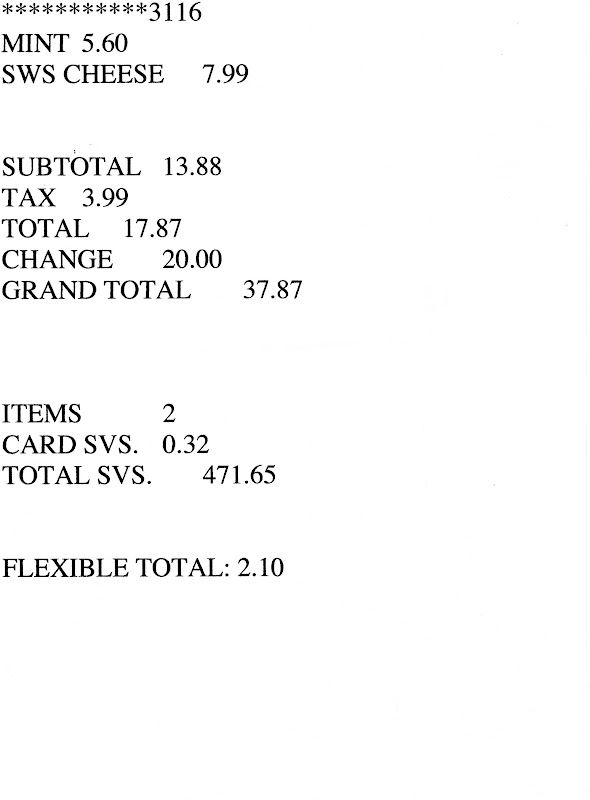
It appears that he's also fascinated by Google results, although he hasn't entirely grasped what they mean.

I have a sneaking suspicion that Archer feels that same excitement. He's using his newly acquired ability to create documents to replicate the printed matter he finds most compelling: sales receipts.
It appears that he's also fascinated by Google results, although he hasn't entirely grasped what they mean.
Monday, July 21, 2008
Secret messages
Every week I read Noel's Popless column for his insights and his eloquent prose. But I also read it to see what he's said about me and the kids -- to catch a glimpse of the life we live with him, filtered through the read-by-millions website and reflected back to me through all those eyes.
I appear in Popless -- and in Noel's occasional other posts on the A.V. blog -- in two ways. Sometimes I'm referenced directly, usually as "my wife" although sometimes by name. And sometimes I appear in a ghostly way, unseen by readers other than close friends and family, in the music Noel writes about -- music that I particularly love, music that he might not have chosen to highlight were in not for the fact that I would miss its absence.
Noel's written about Archer's autism before (and probably will again), and he sometimes can't resist a cute Cady Gray story. More often, the kids are set dressing for the world he's weaving with words, a way to remind the readers that he's not a teenager anymore and that parenthood has changed the way he relates to media past and present.
When I run across a reference to the kids in Noel's work, I feel a glow of pride. (I also feel a bit superior for knowing how wonderful and beautiful they are, in a way that the A.V. Club readers never will.) When I find myself in something he's written, I feel a flush, a prickle, as if everybody's looking at me. That's odd, because most of the time when Noel writes "my wife," people don't know it's me -- fellow A.V. Club writer. I'm the anonymous woman behind the phrase, a label into which readers can either pour a brief, indulgent bit of imagination (what's she like?) or, more likely, blip over without any thought or hesitation, the way Linus does with Russian names in Dostoevsky.
Every so often a commenter stumbles onto the knowledge that these two writers with different names are linked. I was amused by a vanity Google alert which informed me that somebody had blogged about that fact a few weeks back. If my media experience is any indication, that kind of contextual, real-world information is a bit intrusive for readers. We'd like to imagine that writers live in some Cloud-Cuckoo-Land from which they produce their work, unhindered by relationships except to the extent that such figures provide color or dramatic foils or a sense of humanity. But maybe in the new media age, when bloggers can become the axes around which communities gather and revolve, readers are more interested in writers as people -- in their lives, their minds, their struggles, their tastes, their opinions.
I know there are a couple of commenters who regularly visit the A.V. Club site who know Noel and me in real life, and I can tell by their comments that they feel pride in that -- as if they have an inside track in the little group who collect around our work online. It's almost like having fans. And being on the inside in Noel's life, the one that he writes about for thousands of unknown eyes, makes me feel like a superfan.
I appear in Popless -- and in Noel's occasional other posts on the A.V. blog -- in two ways. Sometimes I'm referenced directly, usually as "my wife" although sometimes by name. And sometimes I appear in a ghostly way, unseen by readers other than close friends and family, in the music Noel writes about -- music that I particularly love, music that he might not have chosen to highlight were in not for the fact that I would miss its absence.
Noel's written about Archer's autism before (and probably will again), and he sometimes can't resist a cute Cady Gray story. More often, the kids are set dressing for the world he's weaving with words, a way to remind the readers that he's not a teenager anymore and that parenthood has changed the way he relates to media past and present.
When I run across a reference to the kids in Noel's work, I feel a glow of pride. (I also feel a bit superior for knowing how wonderful and beautiful they are, in a way that the A.V. Club readers never will.) When I find myself in something he's written, I feel a flush, a prickle, as if everybody's looking at me. That's odd, because most of the time when Noel writes "my wife," people don't know it's me -- fellow A.V. Club writer. I'm the anonymous woman behind the phrase, a label into which readers can either pour a brief, indulgent bit of imagination (what's she like?) or, more likely, blip over without any thought or hesitation, the way Linus does with Russian names in Dostoevsky.
Every so often a commenter stumbles onto the knowledge that these two writers with different names are linked. I was amused by a vanity Google alert which informed me that somebody had blogged about that fact a few weeks back. If my media experience is any indication, that kind of contextual, real-world information is a bit intrusive for readers. We'd like to imagine that writers live in some Cloud-Cuckoo-Land from which they produce their work, unhindered by relationships except to the extent that such figures provide color or dramatic foils or a sense of humanity. But maybe in the new media age, when bloggers can become the axes around which communities gather and revolve, readers are more interested in writers as people -- in their lives, their minds, their struggles, their tastes, their opinions.
I know there are a couple of commenters who regularly visit the A.V. Club site who know Noel and me in real life, and I can tell by their comments that they feel pride in that -- as if they have an inside track in the little group who collect around our work online. It's almost like having fans. And being on the inside in Noel's life, the one that he writes about for thousands of unknown eyes, makes me feel like a superfan.
Sunday, July 20, 2008
New experiences
As the summer winds down, so does the time available to try new things. Archer is going to language camp for the next two weeks here on my campus -- Spanish next week, and French the week after that. Both the kids now have hand-me-down two-wheelers with training wheels, thanks to Freecycle, and they are working hard to master them.
I'll be trying something next in three weeks -- Fair Isle knitting, also known as stranded colorwork. This is the kind of knitting that produces beautiful, colorful small-scale designs like those associated with Norwegian sweaters. I'm starting out small, with these super-popular fingerless mittens.
What are you doing this summer that you've never done before?
I'll be trying something next in three weeks -- Fair Isle knitting, also known as stranded colorwork. This is the kind of knitting that produces beautiful, colorful small-scale designs like those associated with Norwegian sweaters. I'm starting out small, with these super-popular fingerless mittens.
What are you doing this summer that you've never done before?
Saturday, July 19, 2008
Beyond heroism
Today's post, about draping the rainbow around Cady Gray's neck, is at Toxophily.
We went to see The Dark Knight tonight. If I need to present Kierkegaard 101 to students in two and a half hours, I think I'll just show them this movie.
We went to see The Dark Knight tonight. If I need to present Kierkegaard 101 to students in two and a half hours, I think I'll just show them this movie.
Friday, July 18, 2008
Cars of my life, Part II: A car of one's own
Click here for Part I.
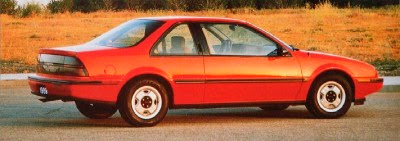
1988 Chevy Beretta. My parents bought my older brother a car (a 1984 Toyota Celica, I believe) when he graduated from college, and they continued the tradition with me. I remember test driving several cars before we settled on this little manual-transmission 5-speed. The silver paint job began to flake off the roof a few years later, and I found out that there was a recall on lots of GM cars with silver paint from that era. The car made it through one fairly significant wreck (a sun-in-your-eyes rear-ending in Athens that I'll not soon forget), and served me well for 12 years, making the journey from Chattanooga to Athens to Charlottesville and finally to Conway. It was retired in 2001 when I was seven months pregnant with Archer; we drove it to Little Rock one last time and traded it in for ...
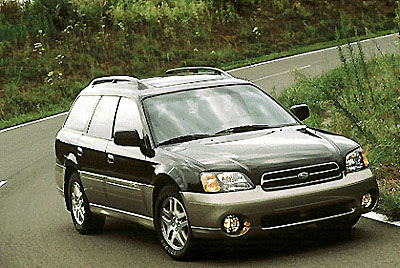
2000 Subaru Outback. This car was a one-year-old demo car when we bought it, and it's still going strong eight years later. With our no-commute lifestyle, we don't put the miles on very fast. I think we're up to about 70,000 miles now. I really love this car, and I love my mechanic (Skip's Foreign Car Repair) even more. Which reminds me, I need to get the brakes serviced -- I'm sure our neighbors are tired of the squealing.
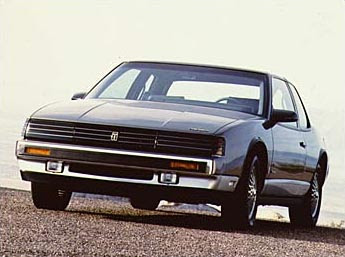
1989 Oldsmobile Toranado Trofeo. Noel bought this car used in Virginia in 1998 or thereabouts. The sale was brokered by one of our co-workers at GE Fanuc who was always wheeling and dealing several jalopies. We brought it here to Conway and used it as our emergency second car. After some kind of accident that I have blocked from my memory, the insurance labeled it totaled, and we basically stopped renewing the registration. We sold it to a couple of guys who were doing some work on the house and expressed interest. They apparently never filed for a title or registered it, because when it got seized in some kind of crime investigation about a year ago, we got notified by the police as if it still belonged to us.
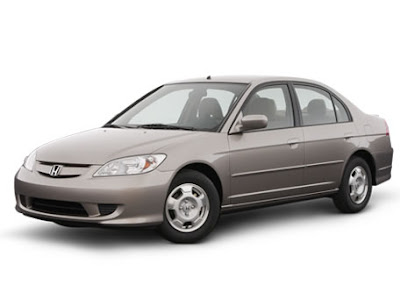
2005 Honda Civic Hybrid. Remember how all the talk about hybrid cars was just starting up in 2004-2005? I had seen a couple of early models when they were brought on campus as part of an environmental sustainability week we were sponsoring. When we knew we needed a real second car to replace the unreliable junker we'd been using as our backup, I decided on a hybrid. At the time it was about greenhouse gas emissions. Now when I'm getting 35 mpg tooling around town in stop-and-go traffic, I feel like a real smart cookie.
1988 Chevy Beretta. My parents bought my older brother a car (a 1984 Toyota Celica, I believe) when he graduated from college, and they continued the tradition with me. I remember test driving several cars before we settled on this little manual-transmission 5-speed. The silver paint job began to flake off the roof a few years later, and I found out that there was a recall on lots of GM cars with silver paint from that era. The car made it through one fairly significant wreck (a sun-in-your-eyes rear-ending in Athens that I'll not soon forget), and served me well for 12 years, making the journey from Chattanooga to Athens to Charlottesville and finally to Conway. It was retired in 2001 when I was seven months pregnant with Archer; we drove it to Little Rock one last time and traded it in for ...
2000 Subaru Outback. This car was a one-year-old demo car when we bought it, and it's still going strong eight years later. With our no-commute lifestyle, we don't put the miles on very fast. I think we're up to about 70,000 miles now. I really love this car, and I love my mechanic (Skip's Foreign Car Repair) even more. Which reminds me, I need to get the brakes serviced -- I'm sure our neighbors are tired of the squealing.
1989 Oldsmobile Toranado Trofeo. Noel bought this car used in Virginia in 1998 or thereabouts. The sale was brokered by one of our co-workers at GE Fanuc who was always wheeling and dealing several jalopies. We brought it here to Conway and used it as our emergency second car. After some kind of accident that I have blocked from my memory, the insurance labeled it totaled, and we basically stopped renewing the registration. We sold it to a couple of guys who were doing some work on the house and expressed interest. They apparently never filed for a title or registered it, because when it got seized in some kind of crime investigation about a year ago, we got notified by the police as if it still belonged to us.
2005 Honda Civic Hybrid. Remember how all the talk about hybrid cars was just starting up in 2004-2005? I had seen a couple of early models when they were brought on campus as part of an environmental sustainability week we were sponsoring. When we knew we needed a real second car to replace the unreliable junker we'd been using as our backup, I decided on a hybrid. At the time it was about greenhouse gas emissions. Now when I'm getting 35 mpg tooling around town in stop-and-go traffic, I feel like a real smart cookie.
Thursday, July 17, 2008
Cars of my life, Part I: My unglamorous youth
We all travel through our years in a succession of vehicles ... the ones our parents and siblings drove, the ones we drive, the ones we get for our kids (except for my kids, who due to peak oil and fortunately for my stress levels will come of age after personal automobiles are all but extinct). Here are the ones I remember best.
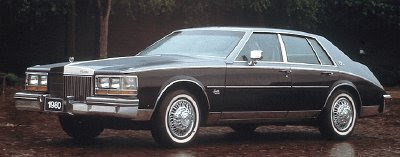
1980 Cadillac Seville. My mom drove Cadillacs ever since I can remember. This was one of the strangest. Remember that high, sloping trunk design that looked like somebody had sheered off the back end of the car with a giant rotating saw? It also featured little feedback LEDs on the right and left corners of the front end, which were supposed to tell you what lights were on (headlights, parking lights, turn signals). I still have a soft spot for the retro technology of the Cadillac -- wood grain instead of metal, plenty of knobs and dials, an embrace of digital readouts that seemed half-hearted at best -- they were always surrounded or even undercut by analog inputs and outputs. Whenever I hear "Looks Like We Made It" I think of the sample 8-track that came with the car, which had two Barry Manilow songs on it.
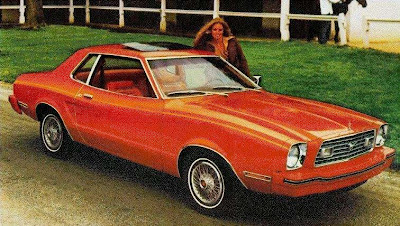
1978 Mustang II. This was my older brother's car for a few years. I grabbed every chance I could to ride in it so I could hear actual rock and roll coming out of the 8-track tape deck. It had an automatic transmission, but the shiny chrome shifter was between the front seats. I thought this car was completely badass. Whenever I hear ELO's Out of the Blue, I think about riding home from Sunday night services in the passenger seat of this car -- half an hour of swirling, Beatlesque pop cranked up to levels our parents wouldn't have tolerated.
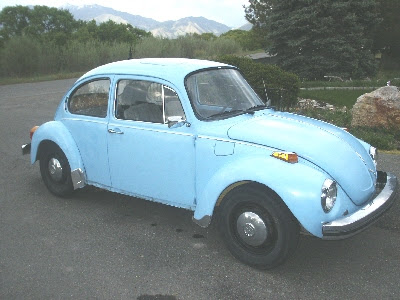
1975 Volkswagen Beetle. I learned to drive a stick in this car, out on the deserted country roads around our Apison, Tennessee home. I think Dad picked it up cheap just to teach us in. He loved to talk about the legends surrounding the car -- that if you drove it into a lake it would float; that you could fix the engine with rubber bands. It felt more like driving a toy than an actual vehicle, which is great for learning --the stakes seem so low. I believe it only had an AM radio.
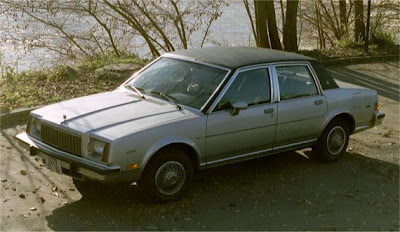
1981 Buick Skylark. My parents let me use this car during my senior year in high school. It was that boxy K-car look -- about as unsexy as cars got. But it was a measure of freedom, until I got stuck in the middle of a three-car pileup on I-24 East just before the East Brainerd Road exit. The car was totaled. No cassette deck, so I listened to KZ106 exclusively in this car; I believe Kansas was playing when I had the wreck.
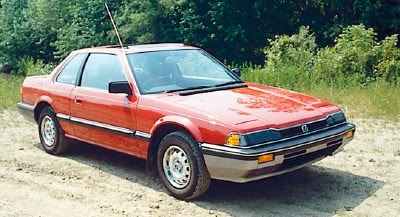
1984 Honda Prelude. My dad traded in his usual Audis and Mercedes for this sporty number when I was just about ready to leave home. It was red and zippy and vaguely triangular and low to the ground and had the sunroof and the headlights that swiveled up out of the front end. I loved that car. Still to this day, I think I crave that car. It's everything I thought a sports car should be.
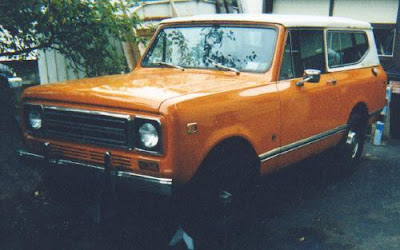
1978 International Harvester Scout II. ... But whenever I came home from college, this is what I drove. It was brown with a white hard top when we got it as the third or fourth owner. I swung in too close to the row of mailboxes at the end of our driveway on my way home one day and took off the passenger side mirror. When the radio cut out or dissolved into short-circuity static, it could be fixed most of the time by vigorous flathanded thumps on the dashboard. I think it was my younger brother rather than me who sideswiped some of those yellow concrete poles set up to protect gas pumps and suck, leaving a set of yellow scrapes down the passenger side that made it look as though the Scout had survived a run-in with a school bus. After my carless years were over and I was out on my own, my folks had it painted flat blue and my younger brother continued driving it. Lap belt only, and a suspension like our Kubota tractor -- you bounced all the way around town. Mom and Dad swear that the person they sold it to still uses it, and although I don't see how we'd get confirmation, it's a believable tale; the proto-SUV was indestructible. Even after Doug's collision with a city bus in the Brainerd Road tunnel, the Scout abides.
Note: All errors of dates and attribution of vehicular damage are my personal responsibility, and I'm sure they will be corrected quickly by my siblings.
Tomorrow! Part II: A car of one's own.
1980 Cadillac Seville. My mom drove Cadillacs ever since I can remember. This was one of the strangest. Remember that high, sloping trunk design that looked like somebody had sheered off the back end of the car with a giant rotating saw? It also featured little feedback LEDs on the right and left corners of the front end, which were supposed to tell you what lights were on (headlights, parking lights, turn signals). I still have a soft spot for the retro technology of the Cadillac -- wood grain instead of metal, plenty of knobs and dials, an embrace of digital readouts that seemed half-hearted at best -- they were always surrounded or even undercut by analog inputs and outputs. Whenever I hear "Looks Like We Made It" I think of the sample 8-track that came with the car, which had two Barry Manilow songs on it.
1978 Mustang II. This was my older brother's car for a few years. I grabbed every chance I could to ride in it so I could hear actual rock and roll coming out of the 8-track tape deck. It had an automatic transmission, but the shiny chrome shifter was between the front seats. I thought this car was completely badass. Whenever I hear ELO's Out of the Blue, I think about riding home from Sunday night services in the passenger seat of this car -- half an hour of swirling, Beatlesque pop cranked up to levels our parents wouldn't have tolerated.
1975 Volkswagen Beetle. I learned to drive a stick in this car, out on the deserted country roads around our Apison, Tennessee home. I think Dad picked it up cheap just to teach us in. He loved to talk about the legends surrounding the car -- that if you drove it into a lake it would float; that you could fix the engine with rubber bands. It felt more like driving a toy than an actual vehicle, which is great for learning --the stakes seem so low. I believe it only had an AM radio.
1981 Buick Skylark. My parents let me use this car during my senior year in high school. It was that boxy K-car look -- about as unsexy as cars got. But it was a measure of freedom, until I got stuck in the middle of a three-car pileup on I-24 East just before the East Brainerd Road exit. The car was totaled. No cassette deck, so I listened to KZ106 exclusively in this car; I believe Kansas was playing when I had the wreck.
1984 Honda Prelude. My dad traded in his usual Audis and Mercedes for this sporty number when I was just about ready to leave home. It was red and zippy and vaguely triangular and low to the ground and had the sunroof and the headlights that swiveled up out of the front end. I loved that car. Still to this day, I think I crave that car. It's everything I thought a sports car should be.
1978 International Harvester Scout II. ... But whenever I came home from college, this is what I drove. It was brown with a white hard top when we got it as the third or fourth owner. I swung in too close to the row of mailboxes at the end of our driveway on my way home one day and took off the passenger side mirror. When the radio cut out or dissolved into short-circuity static, it could be fixed most of the time by vigorous flathanded thumps on the dashboard. I think it was my younger brother rather than me who sideswiped some of those yellow concrete poles set up to protect gas pumps and suck, leaving a set of yellow scrapes down the passenger side that made it look as though the Scout had survived a run-in with a school bus. After my carless years were over and I was out on my own, my folks had it painted flat blue and my younger brother continued driving it. Lap belt only, and a suspension like our Kubota tractor -- you bounced all the way around town. Mom and Dad swear that the person they sold it to still uses it, and although I don't see how we'd get confirmation, it's a believable tale; the proto-SUV was indestructible. Even after Doug's collision with a city bus in the Brainerd Road tunnel, the Scout abides.
Note: All errors of dates and attribution of vehicular damage are my personal responsibility, and I'm sure they will be corrected quickly by my siblings.
Tomorrow! Part II: A car of one's own.
Wednesday, July 16, 2008
Buy me something
Last night Archer came out of his bedroom about twenty minutes before lights out. "Um, tomorrow we can buy me something to measure corners," he said.
"What do you need to measure, big man?" I asked.
"I just need to measure some right angles," he said. "And I can make angles with my hands."
"Where did you see these angles you need to measure? Was it in a workbook?"
"Yeah, in my workbook. We can just go buy me one tomorrow," he asserted hopefully.
Some kids are constantly demanding special food, special toys, special whatever. Archer asks for protractors.
"What do you need to measure, big man?" I asked.
"I just need to measure some right angles," he said. "And I can make angles with my hands."
"Where did you see these angles you need to measure? Was it in a workbook?"
"Yeah, in my workbook. We can just go buy me one tomorrow," he asserted hopefully.
Some kids are constantly demanding special food, special toys, special whatever. Archer asks for protractors.
Tuesday, July 15, 2008
Castles in the sky
Our lieutenant governor, elected in 2006, made the inauguration of a state lottery the centerpiece of his campaign. Now that he's in office, he's spearheaded a petition drive that will put a constitutional amendment on this year's ballot -- Arkansas has a constitutional prohibition against gambling (with exceptions for the Oaklawn racetrack and West Memphis dog track, and a recently-crafted one for charitable bingo).
Evangelical forces have always been able to block lottery proposals in the past, but it looks like their ability to mobilize against it on the grounds of personal morality have been crippled by the economy, continuing news about education in decline, and the belief that millions of Arkansas dollars are flowing into border states with lotteries.
I was heartened today, however, to see that the United Methodist Church in the state announced its opposition to the lottery -- not because gambling is a sin, but because (a) it's socially irresponsible and (b) it doesn't deliver on its promises.
My own opposition to state-run lotteries was solidified while I was living in Virginia and read an illuminating newspaper series about the disappointments of its lottery. Here are the dirty secrets:
Lotteries are not mysterious, untried enterprises. There is ample data. Yet most of the debate rests on appeals to common sense, hope, and fear (people are going to play anyway -- they should spend their money at home; we can give scholarships to everybody; without lottery money our education system will inevitably fail). When nobody's talking about the facts, you can bet that the facts aren't on the side of public opinion -- the one thing nobody wants to be against.
Evangelical forces have always been able to block lottery proposals in the past, but it looks like their ability to mobilize against it on the grounds of personal morality have been crippled by the economy, continuing news about education in decline, and the belief that millions of Arkansas dollars are flowing into border states with lotteries.
I was heartened today, however, to see that the United Methodist Church in the state announced its opposition to the lottery -- not because gambling is a sin, but because (a) it's socially irresponsible and (b) it doesn't deliver on its promises.
My own opposition to state-run lotteries was solidified while I was living in Virginia and read an illuminating newspaper series about the disappointments of its lottery. Here are the dirty secrets:
- Lotteries earn impressive profits when they are new, but the revenue plateaus after a few years. The only way to goad the public into buying more tickets (to meet the projections of ever-growing revenue on which budgets have already been based) is to raise the payouts and introduce new games. Soon the enormous jackpots start eating away at the cash that's supposed to be flowing into the state coffers. Once it's joined a multi-lottery coalition, like Powerball, the state has just about run out of ways to finance the outrageous jackpots that motivate players to spend more. Georgia's lottery, always touted as the success story on which other states model their pitches of scholarships for all, forever, cut its scholarships several years ago and proposed tightening eligibility requirements for them because of declining reserves.
- In order to get people to play, the state must advertise. Those who live in states with lotteries are inured to the constant promotion of the games in all media; it's a fact of life. Yet the state thereby becomes a gambling promoter, hustling as hard as it can to get people to ante up. My moral objection to the lottery is that the state should not be hawking snake oil. Sure, I know that the state isn't always on the up and up with its citizens. But a program that puts the government in the position of a carnival barker, desperate to fleece as many people out of as much cash as possible just to make its nut, is demeaning at best and close to fraudulent at worst.
- And of course, it's been well known for decades who plays the lottery -- poor people. Maryland's lottery is funded at a rate of 3 to 1 by people with incomes below the poverty line. Just ten percent of the players produce 50% of the revenue. You can argue about voluntary taxation all you want, but combine the state promotion of effortless wealth with a group of people in desperate need of said wealth, and who exactly were we expecting to play?
Lotteries are not mysterious, untried enterprises. There is ample data. Yet most of the debate rests on appeals to common sense, hope, and fear (people are going to play anyway -- they should spend their money at home; we can give scholarships to everybody; without lottery money our education system will inevitably fail). When nobody's talking about the facts, you can bet that the facts aren't on the side of public opinion -- the one thing nobody wants to be against.
Monday, July 14, 2008
Raise your hand before answering
Today's post, about the simple things in life (and in the bathroom), is at Toxophily.
Here I'll give you the last chapter of the painting-the-desks saga (read part one here):
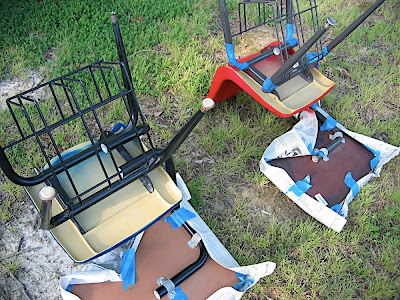
Once the sun came out again, I painted the bottom of the chairs. Easy enough, although requiring lots of wiping off the metal with a rag soaked with mineral spirits, since masking all of it was impossible. I didn't obsess over it.
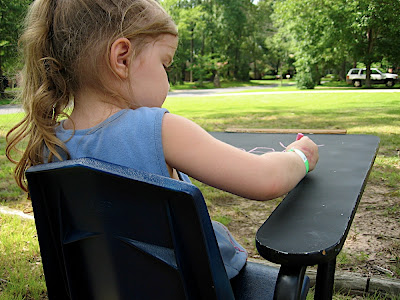
After the paint dried, it was time for the kids to try them out! Here's Cady Gray in her blue version ...
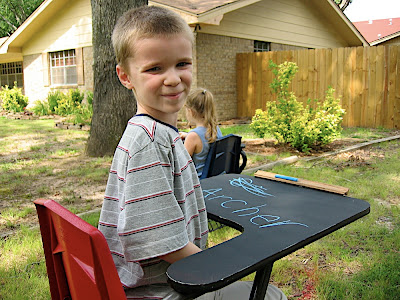
... and Archer in red.
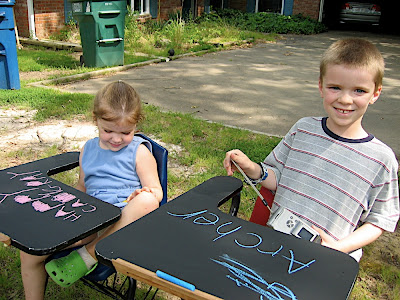
Success!
Here I'll give you the last chapter of the painting-the-desks saga (read part one here):
Once the sun came out again, I painted the bottom of the chairs. Easy enough, although requiring lots of wiping off the metal with a rag soaked with mineral spirits, since masking all of it was impossible. I didn't obsess over it.
After the paint dried, it was time for the kids to try them out! Here's Cady Gray in her blue version ...
... and Archer in red.
Success!
Sunday, July 13, 2008
Blame Google
Today's Arkansas Democrat-Gazette reprinted this scattershot story from the Chicago Tribune and headlined it "Is the internet making us duh-mer?"
The underlying question is this: Does increased accessibility of information result in a shallower knowledge base among the populace? Well, of course it does. It's a completely rational choice: Why spend time and effort placing information in your brain's long-term memory, when the long-term random-access memory of the internet already holds it?
The real question is why this rational behavior has resulted in a generation that (to paraphrase all the alarmist stories from the last ten years) can't find China on a map with both hands and a GPS-enabled 3G China-Locator 240Z (tm). And to my mind, the answer is that education has been very slow to evolve in the new information-rich, information-accessible environment. We have a lumbering brontosaurus of a primary and secondary education system that still stresses putting bits of information in students' heads for recall, instead of teaching them critical thinking, connected thinking, and problem solving to use the information they have at their fingertips.
Now I think there is a set of general, broad pictures that everyone ought to place in their personal memory banks in order to put the detailed information available on the internet in instant context. They should know what continent France is on, in what century Europeans discovered the Americas, and in what decades the Vietnam War happened. The closer to the students' own time and place we get, the more detail should appear on that general, broad map; we should have a richer context for the last twenty years in America than we need for the last 500 years in Europe.
By all accounts students are not getting this general, broad picture that will help them use the informational nuggets it's so easy to find online. One could argue that the internet is generally making them lazy, or that it's rotting their brains, or whatever you like. But isn't it also plausible that (once again) the education system isn't helping them distinguish between the framework they need in their heads and the content that hangs on that framework? Which side of the knowledge equation are the tests testing and the teach-to-the-test classes teaching?
Just like you can do more math if you let a calculator do the calculating, concentrating on understanding relationships and developing solution strategies, you can get more education if you let the internet do your storage and retrieval. But we won't see the benefit until the inherently conservative educational system -- and I include everything from primary through graduate school therein -- stands up to the traditionalists (for whom only bits in the memory bank count as knowledge) and stumbles into the nineteen-nineties.
The underlying question is this: Does increased accessibility of information result in a shallower knowledge base among the populace? Well, of course it does. It's a completely rational choice: Why spend time and effort placing information in your brain's long-term memory, when the long-term random-access memory of the internet already holds it?
The real question is why this rational behavior has resulted in a generation that (to paraphrase all the alarmist stories from the last ten years) can't find China on a map with both hands and a GPS-enabled 3G China-Locator 240Z (tm). And to my mind, the answer is that education has been very slow to evolve in the new information-rich, information-accessible environment. We have a lumbering brontosaurus of a primary and secondary education system that still stresses putting bits of information in students' heads for recall, instead of teaching them critical thinking, connected thinking, and problem solving to use the information they have at their fingertips.
Now I think there is a set of general, broad pictures that everyone ought to place in their personal memory banks in order to put the detailed information available on the internet in instant context. They should know what continent France is on, in what century Europeans discovered the Americas, and in what decades the Vietnam War happened. The closer to the students' own time and place we get, the more detail should appear on that general, broad map; we should have a richer context for the last twenty years in America than we need for the last 500 years in Europe.
By all accounts students are not getting this general, broad picture that will help them use the informational nuggets it's so easy to find online. One could argue that the internet is generally making them lazy, or that it's rotting their brains, or whatever you like. But isn't it also plausible that (once again) the education system isn't helping them distinguish between the framework they need in their heads and the content that hangs on that framework? Which side of the knowledge equation are the tests testing and the teach-to-the-test classes teaching?
Just like you can do more math if you let a calculator do the calculating, concentrating on understanding relationships and developing solution strategies, you can get more education if you let the internet do your storage and retrieval. But we won't see the benefit until the inherently conservative educational system -- and I include everything from primary through graduate school therein -- stands up to the traditionalists (for whom only bits in the memory bank count as knowledge) and stumbles into the nineteen-nineties.
Saturday, July 12, 2008
Gee whiskers
The inspirationally gigantic Complete Little Orphan Annie, Volume 1 is sitting on our bedside table, and Noel and I have both made it through the first three story arcs, digesting them in marathon edge-of-our-seats sessions spanning several months of the strip at a time. Although it's hardly as gentle or character-driven (not to mention as gag-filled and fantastical) as my beloved Gasoline Alley, it shares a remarkably clear and unpretentious style.
What's amazing about these artifacts from eighty years ago is how easy it is to get caught up in Annie's drama. Annie is a boondocks saint, an orphan who is alternately misunderstood and exploited by adults, a hard-case street urchin who prefers to stick up for everyone else rather than herself. And yet her story, so melodramatic in outline (snooty rich lady hates kids but flaunts her "charity" work with Annie; middle-class shopkeeper takes Annie in to help in her shop six days a week and returns her to the "home" on Sundays to save feeding her; beleaguered farmers love her like a daughter but are on the verge of losing her along with their land), is presented almost documentary-style. Drawn at the height of the silent film era, almost none of the close-ups, exaggerations, and flowery tropes of the cinema make it into Harold Gray's panels.
There's a ethical treatise in Gray's worldview. Good-hearted people can be found in any class -- working, middle, even war profiteers. The pure of heart can recognize each other intuitively, but if they are inexperienced in the ways of the world, they tend to believe the best of all the louts and mercenaries and criminals and scam artists that surround them, clinging to their illusions until they've been fleeced. What's needed are street-smart individuals with hearts of gold, who have no problem socking the baddies in the jaw and giving a hand to the poor unfortunates who need it most. Annie does her part at ground level, but she's at the mercy of an adult society that sees her as a problem and not an asset. Daddy Warbucks is much more powerful, with his money and his willingness to brawl with lowlifes who don't understand reason -- but he's at the mercy of the business world that gives him the money. He's always disappearing for months at a time to attend to overseas munitions interests, during which Annie tries to hang on to three squares and stay ahead of the dogcatcher.
The parts of society that wouldn't become visible in most media until the Great Depression -- debt-riddled landowners, tramps and hobos, homeless waifs -- are already at the center of Gray's strips in the mid-1920's. It's a fascinating sociological artifact. But more than that, it's a cracking story with frequently lyrical writing and effortless emotional pull. I can't wait to dive back in.
What's amazing about these artifacts from eighty years ago is how easy it is to get caught up in Annie's drama. Annie is a boondocks saint, an orphan who is alternately misunderstood and exploited by adults, a hard-case street urchin who prefers to stick up for everyone else rather than herself. And yet her story, so melodramatic in outline (snooty rich lady hates kids but flaunts her "charity" work with Annie; middle-class shopkeeper takes Annie in to help in her shop six days a week and returns her to the "home" on Sundays to save feeding her; beleaguered farmers love her like a daughter but are on the verge of losing her along with their land), is presented almost documentary-style. Drawn at the height of the silent film era, almost none of the close-ups, exaggerations, and flowery tropes of the cinema make it into Harold Gray's panels.
There's a ethical treatise in Gray's worldview. Good-hearted people can be found in any class -- working, middle, even war profiteers. The pure of heart can recognize each other intuitively, but if they are inexperienced in the ways of the world, they tend to believe the best of all the louts and mercenaries and criminals and scam artists that surround them, clinging to their illusions until they've been fleeced. What's needed are street-smart individuals with hearts of gold, who have no problem socking the baddies in the jaw and giving a hand to the poor unfortunates who need it most. Annie does her part at ground level, but she's at the mercy of an adult society that sees her as a problem and not an asset. Daddy Warbucks is much more powerful, with his money and his willingness to brawl with lowlifes who don't understand reason -- but he's at the mercy of the business world that gives him the money. He's always disappearing for months at a time to attend to overseas munitions interests, during which Annie tries to hang on to three squares and stay ahead of the dogcatcher.
The parts of society that wouldn't become visible in most media until the Great Depression -- debt-riddled landowners, tramps and hobos, homeless waifs -- are already at the center of Gray's strips in the mid-1920's. It's a fascinating sociological artifact. But more than that, it's a cracking story with frequently lyrical writing and effortless emotional pull. I can't wait to dive back in.
Friday, July 11, 2008
Defining taste
Last night I watched The Greatest American Dog, the latest CBS reality show clogging up the summer airwaves. It was seriously low fare, all dysfunctional relationships and delusional dog owners, with a few salt-of-the-earth types sprinkled in for salubrious moral contrast.
But even with all its horrors -- Nathan Rabin at the A.V. Club's TV Club gave it an F -- I didn't want to turn my back in disgust. In fact, I asked Noel to record it again next week. When Nathan asked me in the comments to his review why I would watch it again, I wrote:
If you can figure out and articulate what attracts you to crap, then you're a long way toward knowing yourself -- which will help you better understand your relationship to the whole spectrum of quality, as well as avoid being bamboozled by products engineered to your particular brain receptors. It's easy to confuse personal pleasure with the presence of real value in what engendered the pleasure, and it's helpful to know that the effect of enjoyment is not as intimately or directly connected with the cause of quality as we might like to imagine.
But even with all its horrors -- Nathan Rabin at the A.V. Club's TV Club gave it an F -- I didn't want to turn my back in disgust. In fact, I asked Noel to record it again next week. When Nathan asked me in the comments to his review why I would watch it again, I wrote:
Actually, the whole performance thing is going on here, which is part of why I watch so much reality TV. Can you get this creature (which, as the judges point out, really means yourself) to perform under pressure? "Dog" kind of externalizes that whole question, which makes it interesting enough for me to watch. (The contestants' despair over dogs that indicated in rehearsals that they would be unreliable -- that's what fascinates me. What does that say about them -- them more than their dogs?)There's nothing so enlightening about one's own taste than trying to figure out why you enjoy something that lacks quality. Whatever it is that you enjoy there has something to do with what interests you, with what pushes your buttons, with what tickles your pleasure centers. It's not about educated taste, which is the recognition of quality; it's about who you are underneath that education.
If you can figure out and articulate what attracts you to crap, then you're a long way toward knowing yourself -- which will help you better understand your relationship to the whole spectrum of quality, as well as avoid being bamboozled by products engineered to your particular brain receptors. It's easy to confuse personal pleasure with the presence of real value in what engendered the pleasure, and it's helpful to know that the effect of enjoyment is not as intimately or directly connected with the cause of quality as we might like to imagine.
Thursday, July 10, 2008
Reclamation
Over the July 4 weekend, I freecycled two old school desks for the kids and set about rehabilitating them into something a little less institutional.
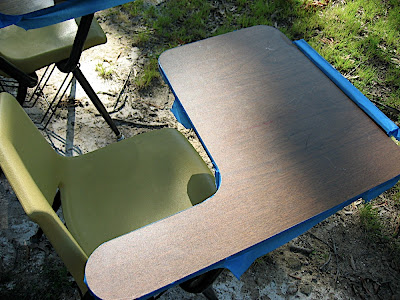
Here's how they looked before I started painting. Mustard yellow plastic chairs, wood-grain laminate desks.
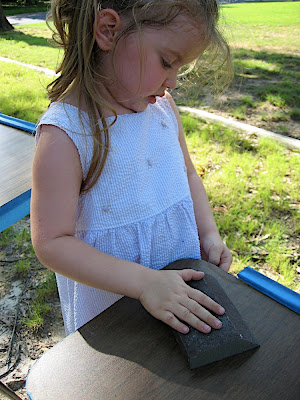

We had to scuff up the coated laminate as much as we could before priming with latex. Even then, it took three coats of primer.
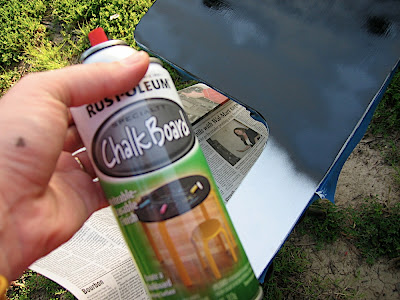
Then I used this spray-on chalkboard paint. The advantage of spray paint is that you can do coats in quick succession, and you get a very even surface.
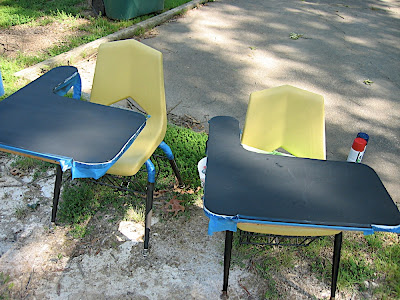
My painting was interrupted by a few days of rain, but today I took advantage of some afternoon sun and some pent-up frustration from work to paint the plastic chairs. I used the Rustoleum version of that Krylon Fusion paint that came out a few years ago.
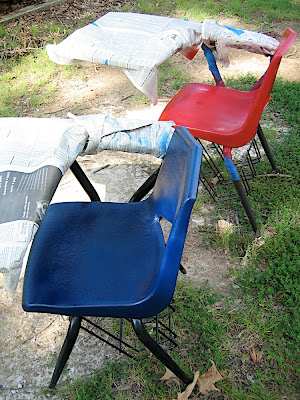
Check out those bright colors! Really brings that harvest gold into the twenty-first century, doesn't it?
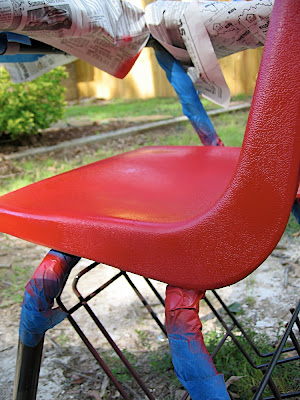
The red one is for Archer ...
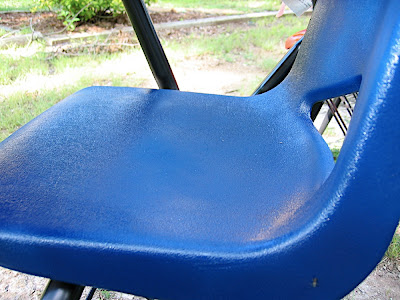
and the blue one is for Cady Gray. They picked out the colors themselves on a trip to Home Depot. The selection of colors of plastic paint there wasn't extensive (I thought for a while Cady Gray would have to settle for forest green until we found blue on an endcap). The Krylon might come in more colors, but they don't carry it at the Depot.
I still have to paint the bottoms of the plastic chairs. I'm trying to keep the black metal legs and frame as paint-free as I can, but they're darn hard to mask. Instead I'm just keeping a rag soaked with mineral spirits handy to wipe off the metal after I've put a coat of paint on the plastic.
I'll reveal the finished products as soon as I get another sunny day in the forecast!
Here's how they looked before I started painting. Mustard yellow plastic chairs, wood-grain laminate desks.
We had to scuff up the coated laminate as much as we could before priming with latex. Even then, it took three coats of primer.
Then I used this spray-on chalkboard paint. The advantage of spray paint is that you can do coats in quick succession, and you get a very even surface.
My painting was interrupted by a few days of rain, but today I took advantage of some afternoon sun and some pent-up frustration from work to paint the plastic chairs. I used the Rustoleum version of that Krylon Fusion paint that came out a few years ago.
Check out those bright colors! Really brings that harvest gold into the twenty-first century, doesn't it?
The red one is for Archer ...
and the blue one is for Cady Gray. They picked out the colors themselves on a trip to Home Depot. The selection of colors of plastic paint there wasn't extensive (I thought for a while Cady Gray would have to settle for forest green until we found blue on an endcap). The Krylon might come in more colors, but they don't carry it at the Depot.
I still have to paint the bottoms of the plastic chairs. I'm trying to keep the black metal legs and frame as paint-free as I can, but they're darn hard to mask. Instead I'm just keeping a rag soaked with mineral spirits handy to wipe off the metal after I've put a coat of paint on the plastic.
I'll reveal the finished products as soon as I get another sunny day in the forecast!
Wednesday, July 9, 2008
Should we order a pizza?
I've been head-over-heels in love with Macintosh computers since my older brother worked for Apple, back in the late eighties and early nineties. Actually, it was probably before that -- perhaps the Apple ][s in the computer lab in my eighth-grade hallway, or the Mac Classics in the composing room at the university newspaper.
Dwayne was probably living in Atlanta working for Peachtree Software or the Corbis archive when he showed us the Talking Moose. Anyone who had an early Mac remembers it. The Moose sat in a little window on top of your desktop and made snide remarks at odd intervals. Its robotic, yet oddly emotive voice commented if you didn't do anything (my favorite: "You are getting sleeeeepy ... your eyelids are getting heavier and heavier") or if you did something (the oddly wistful "I wish I had a brain").
All those memories came flooding back when I went to see WALL*E a couple of weeks ago. Wall*E's voice is produced by MacInTalk, the speech synthesis engine that Apple included in the earliest Macs, more than 20 years ago. Listening to it, I couldn't help thinking of the Talking Moose -- his mismatched googly eyes, his amateurish outline, his minimal animation.
You can get the Moose for Mac OS X and for Windows XP now. And you can make him say anything you want. But for all the improvements (color, better mouth animation, more choices and settings), I'll always be nostalgic for that crude line drawing and Steven Hawking-esque approximation of human charm that my brother demonstrated with such delight, showing us that the Mac had personality.
Dwayne was probably living in Atlanta working for Peachtree Software or the Corbis archive when he showed us the Talking Moose. Anyone who had an early Mac remembers it. The Moose sat in a little window on top of your desktop and made snide remarks at odd intervals. Its robotic, yet oddly emotive voice commented if you didn't do anything (my favorite: "You are getting sleeeeepy ... your eyelids are getting heavier and heavier") or if you did something (the oddly wistful "I wish I had a brain").
All those memories came flooding back when I went to see WALL*E a couple of weeks ago. Wall*E's voice is produced by MacInTalk, the speech synthesis engine that Apple included in the earliest Macs, more than 20 years ago. Listening to it, I couldn't help thinking of the Talking Moose -- his mismatched googly eyes, his amateurish outline, his minimal animation.
You can get the Moose for Mac OS X and for Windows XP now. And you can make him say anything you want. But for all the improvements (color, better mouth animation, more choices and settings), I'll always be nostalgic for that crude line drawing and Steven Hawking-esque approximation of human charm that my brother demonstrated with such delight, showing us that the Mac had personality.
Tuesday, July 8, 2008
Culture, secondhand
Whit's answer to Saturday's question about pop culture quotes we use in daily life opens a whole 'nother can of worms. Like most people of her generation -- and maybe most Americans overall -- she identifies the quote "Maybe the dingoes ate your baby" (delivered in an Australian accent) with Seinfeld. But of course the line is a reference to another pop culture product: the movie A Cry In The Dark, in which Meryl Streep blames dingoes for the death of her baby although others suspect she did it herself.
All of us who grew up in the age of mass media get some portion of our cultural literacy secondhand. We know about Wagnerian opera because of What's Opera, Doc?, or about twentieth-century British politics because of punk rock lyrics. Everything I know about the Napoleonic Wars is courtesy of Patrick O'Brian. Noel's familiarity with the works of Thomas Hardy is limited to this Monty Python sketch, but it's enough to provide a few key details.
Every night Noel and I quiz each other with the daily trivia questions in Ken Jennings' addictive Trivia Almanac. And regularly we run across pieces of knowledge about literature or music or art that we know only because it was referenced on television, in movies, or in comic books.
What's your source of secondhand culture, and did it ever save your bacon on a pop quiz?
All of us who grew up in the age of mass media get some portion of our cultural literacy secondhand. We know about Wagnerian opera because of What's Opera, Doc?, or about twentieth-century British politics because of punk rock lyrics. Everything I know about the Napoleonic Wars is courtesy of Patrick O'Brian. Noel's familiarity with the works of Thomas Hardy is limited to this Monty Python sketch, but it's enough to provide a few key details.
Every night Noel and I quiz each other with the daily trivia questions in Ken Jennings' addictive Trivia Almanac. And regularly we run across pieces of knowledge about literature or music or art that we know only because it was referenced on television, in movies, or in comic books.
What's your source of secondhand culture, and did it ever save your bacon on a pop quiz?
Monday, July 7, 2008
Tennis, anyone?
Sunday's epic battle at Wimbledon between Federer and Nadal took me back to my youth. My parents were avid tennis players, and all of us got lessons at Cumberland Youth Foundation, the recreation center to which we belonged. When we moved out of town and built our house in the country, Mom and Dad decided to put a tennis court right in the front yard -- really, instead of a front yard. Morning and night, someone was hitting a few balls; I remember many evenings where we played until we couldn't see the ball anymore.
All the Grand Slam events were must viewing at our house, but especially Wimbledon. The problem was that the men's final took place on Sunday morning, so usually by the time we got home from church we'd only be able to catch the last set or two, if we were lucky. I seem to remember a couple of occasions where we stayed home from church to see the match, but perhaps I'm only channeling my wishes from those days.
When I became interested in professional tennis, the age of Ilie Nastase and Jimmy Conners was just ending, and the age of John McEnroe and Bjorn Borg was arriving. I learned to play with a wooden racket that I kept in a press, and I remember vividly the controversy over the larger composite rackets that were starting to appear on the professional circuit.
The match at this year's Wimbledon brought back memories of a time when pro tennis was at the center of American sports consciousness, when as many people talked about it and followed it as followed pro basketball, for example. Even though we weren't watching, legends were being made and genius was happening on the courts of the world. Sometimes a great rivalry can regenerate interest in a sport; is Federer-Nadal that tipping point to bring tennis back from the well-groomed lawns of the rich into the mainstream of the middle class, as Tiger Woods did for golf?
All the Grand Slam events were must viewing at our house, but especially Wimbledon. The problem was that the men's final took place on Sunday morning, so usually by the time we got home from church we'd only be able to catch the last set or two, if we were lucky. I seem to remember a couple of occasions where we stayed home from church to see the match, but perhaps I'm only channeling my wishes from those days.
When I became interested in professional tennis, the age of Ilie Nastase and Jimmy Conners was just ending, and the age of John McEnroe and Bjorn Borg was arriving. I learned to play with a wooden racket that I kept in a press, and I remember vividly the controversy over the larger composite rackets that were starting to appear on the professional circuit.
The match at this year's Wimbledon brought back memories of a time when pro tennis was at the center of American sports consciousness, when as many people talked about it and followed it as followed pro basketball, for example. Even though we weren't watching, legends were being made and genius was happening on the courts of the world. Sometimes a great rivalry can regenerate interest in a sport; is Federer-Nadal that tipping point to bring tennis back from the well-groomed lawns of the rich into the mainstream of the middle class, as Tiger Woods did for golf?
Sunday, July 6, 2008
The big show
On our way to Home Depot this afternoon to pick up materials for a couple of projects (details later), Archer said that he wanted to write down three songs for a show he would do "on the stage." I gave him a piece of paper on which Cady Gray had drawn a turtle at church this morning, the back of a Chili's receipt, and a cardboard DVD mailer -- the best writing materials I could find in the car. Here's what he wrote (all sic except for the footnotes):
HERE'S YOU
Here^s you, Take a ride, Make a sec, Pick Case 26*, Were Friends! 3x
Here's you, Here's you, This is you! (repeat)
* a "Deal Or No Deal" reference
SAY THANKS**
The one who will give it to you!
Say thanks to them!
(repeat)
**Archer specified that he would say this one, rather than singing it.
DO IT RIGHT AWAY
Do it right away! Make it! Make it! Do it right away! Do it now! Do it right now! (repeat)
(We did indeed get a performance of all three songs outside after dinner, complete with the specified number of repeats, although it wasn't what Archer had in mind -- he wanted to go to his school at 7:00, and I was afraid for a moment that the substitution wouldn't be acceptable.)
HERE'S YOU
Here^s you, Take a ride, Make a sec, Pick Case 26*, Were Friends! 3x
Here's you, Here's you, This is you! (repeat)
* a "Deal Or No Deal" reference
SAY THANKS**
The one who will give it to you!
Say thanks to them!
(repeat)
**Archer specified that he would say this one, rather than singing it.
DO IT RIGHT AWAY
Do it right away! Make it! Make it! Do it right away! Do it now! Do it right now! (repeat)
(We did indeed get a performance of all three songs outside after dinner, complete with the specified number of repeats, although it wasn't what Archer had in mind -- he wanted to go to his school at 7:00, and I was afraid for a moment that the substitution wouldn't be acceptable.)
Saturday, July 5, 2008
Miscellaneous quotations for everyday use
Last week, in my Newsradio blog, I asked commenters to produce a Newsradio version of the famous A.V. Club feature "Simpsons Quotes For Everyday Use." Since then I've become more acutedly attuned to the quotations from various pop culture sources that have become indispensable around our house. Here are just a few from this summer:
Quote: "Eat a nut. Look at view. Eat a nut. Look at view."
Source: Scaredy Squirrel by Melanie Watt
Context: The daily routine of a squirrel who is afraid to leave his tree.
Real-life uses: Description of any monotonous or repetitive process.
Quote: "Directive."
Source: WALL*E
Context: Eve explains to Wall-E why she has collect plants and take them to the captain.
Real-life uses: Whenever you've gotta do what you've gotta do.
Quote: "Great ____, or the greatest _____?"
Source: Stephen Colbert on The Colbert Report
Context: Asking interviewees how history will remember George W. Bush.
Real-life uses: Commentary on anything you hear described by the adjective "great."
Quote: "Whatever, mole."
Source: The Mole
Context: A contestant isn't interested in the explanations of another contestant.
Real-life uses: To dismiss anyone, anytime!
What quotations are frequently employed at your house, and for what purpose?
Quote: "Eat a nut. Look at view. Eat a nut. Look at view."
Source: Scaredy Squirrel by Melanie Watt
Context: The daily routine of a squirrel who is afraid to leave his tree.
Real-life uses: Description of any monotonous or repetitive process.
Quote: "Directive."
Source: WALL*E
Context: Eve explains to Wall-E why she has collect plants and take them to the captain.
Real-life uses: Whenever you've gotta do what you've gotta do.
Quote: "Great ____, or the greatest _____?"
Source: Stephen Colbert on The Colbert Report
Context: Asking interviewees how history will remember George W. Bush.
Real-life uses: Commentary on anything you hear described by the adjective "great."
Quote: "Whatever, mole."
Source: The Mole
Context: A contestant isn't interested in the explanations of another contestant.
Real-life uses: To dismiss anyone, anytime!
What quotations are frequently employed at your house, and for what purpose?
Friday, July 4, 2008
Finishing touches
Today's post, wherein I get to the finish line on a few knitting projects and start a few more, is at Toxophily.
We spent the Fourth celebrating America's freedom to jump on giant inflated pieces of plastic in imaginative shapes. Archer took his camera to chronicle Cady Gray's encounter with inflatable Batman. Remember: If you don't jump, the terrorists win.
We spent the Fourth celebrating America's freedom to jump on giant inflated pieces of plastic in imaginative shapes. Archer took his camera to chronicle Cady Gray's encounter with inflatable Batman. Remember: If you don't jump, the terrorists win.
Thursday, July 3, 2008
The tote board
Halfway through the year. Noel is about to take stock of the first half of his Popless project. I'm trying to pull the cord to start the fall semester lawnmower (it's kinda sticky). Time to make a list of what I've accomplished in 2008. Will it make me feel like I've been busy, and therefore I should rest on my laurels? Or will it make me feel like I've been lazy, and there's no way to salvage the year so I might as well not even try? (Either way, I can take it easy for the next six months!)
- read 20 books
- saw 22 movies
- wrote 15 book reviews
- wrote 18 television reviews
- had 4 academic publications
- wrote 4 encyclopedia entries
- completed 10 knitted items (3 pairs of gloves, 2 pairs of socks, 2 hats, 1 sweater, 2 miscellaneous)
Wednesday, July 2, 2008
Call it morning driving through the sound
Almost a year ago, I wrote about the Conway street department's embrace of roundabouts as a tool for traffic management at problematic intersections. At that point the second roundabout in the city, only a mile or so from our house, had just opened.
It was with great excitement earlier this year that we saw the signs of a roundabout coming at the four-way stop right at the entrance to our neighborhood. Painted lines appeared on the street designating crosswalks. The corners of the intersection were shaved off and curved curbs put in where the cars would enter and exit the circle. Several weeks ago, segments of the circle at the middle -- the ones that wouldn't block the straight-through roads still operating -- were completed.
Today, in a flurry of all-at-once activity, the city took the plunge. They blocked off the crossing roads, filled in the circle, set up yield signs and marked off the medians that will insistently urge traffic to flow to the right.
And now ... we have our very own roundabout!

Cars are going around instead of through!

Brand-new signs remind the drivers what to do!
There's a new sidewalk to lead students from the apartments down the street toward the campus just on the other side of the roundabout.
The wheelchair grip-bumps for the sidewalk curb cut-outs are so new, they haven't had the plastic taken off yet.

No time to pour concrete medians yet -- these temporary barriers will do for now.

Orange fences stand in for the parts of the red circle that will become permanent later. Yesterday, cars were driving over the spaces now blocked off by those fences.

A roundabout is a thing of love.
It was with great excitement earlier this year that we saw the signs of a roundabout coming at the four-way stop right at the entrance to our neighborhood. Painted lines appeared on the street designating crosswalks. The corners of the intersection were shaved off and curved curbs put in where the cars would enter and exit the circle. Several weeks ago, segments of the circle at the middle -- the ones that wouldn't block the straight-through roads still operating -- were completed.
Today, in a flurry of all-at-once activity, the city took the plunge. They blocked off the crossing roads, filled in the circle, set up yield signs and marked off the medians that will insistently urge traffic to flow to the right.
And now ... we have our very own roundabout!
Cars are going around instead of through!
Brand-new signs remind the drivers what to do!
There's a new sidewalk to lead students from the apartments down the street toward the campus just on the other side of the roundabout.
The wheelchair grip-bumps for the sidewalk curb cut-outs are so new, they haven't had the plastic taken off yet.
No time to pour concrete medians yet -- these temporary barriers will do for now.
Orange fences stand in for the parts of the red circle that will become permanent later. Yesterday, cars were driving over the spaces now blocked off by those fences.
A roundabout is a thing of love.
Tuesday, July 1, 2008
Dance party
One of my favorite pastimes is watching Cady Gray dance. She twists her palms like she's doing the King Tut, bobs her head, and twirls in kind of a hippy-dippy fashion. And I can make her dance at the drop of a hat -- by dancing myself, by saying "move and groove," or by just rocking my head back and forth to the radio.
I'd really like to see her tackle some of the steps you can make Mo Willem's characters Elephant and Piggie do on this page. Check it out -- if you pick the dances in the right order, you can make them do power combo moves!
I'd really like to see her tackle some of the steps you can make Mo Willem's characters Elephant and Piggie do on this page. Check it out -- if you pick the dances in the right order, you can make them do power combo moves!
Monday, June 30, 2008
Day to day
Today on NPR I heard a snippet of an interview with David Morneau, who has composed at least 60 seconds of music every day for the past year.
A couple of days ago I finished reading Haruki Murikami's brief memoir What I Talk About When I Talk About Running, in which he recalls Somerset Maugham once writing that in each shave lies a philosophy.
If you do something regularly enough, long enough, it becomes not an action directed at an outcome but an opportunity for deepened self-knowledge, for meditation on the process, for a journey with no destination.
I write every day in this blog. All of you have something you do every day, whether it's your commute or your cappuccino. What philosophy lies therein?
A couple of days ago I finished reading Haruki Murikami's brief memoir What I Talk About When I Talk About Running, in which he recalls Somerset Maugham once writing that in each shave lies a philosophy.
If you do something regularly enough, long enough, it becomes not an action directed at an outcome but an opportunity for deepened self-knowledge, for meditation on the process, for a journey with no destination.
I write every day in this blog. All of you have something you do every day, whether it's your commute or your cappuccino. What philosophy lies therein?
Sunday, June 29, 2008
So rare as a day in June
After relatively gentle thunderstorms most of the day on Saturday -- the rain on the roof made my morning to sleep in even more restful than usual -- today is spectacularly bright, cool and breezy. Here in Arkansas we don't get many summer days under ninety degrees. I wish I could have just sat at the park and worked on my Clapotis all afternoon, but the kids were running out of things to do at the playground and we had to bring them home.
June is about over, and that means there are about seven more weeks of summer vacation to go. We've done pretty well so far keeping the kids occupied, but the hardest slog -- July -- is still to come. Cady Gray is in day care three days a week, Archer has therapy on Monday and Wednesday, but there are still many long hours that both kids are at home while Dad's trying to get his New York film openings reviewed and his Popless tracks listened to.
I think we're going to enroll Archer in two weeks of language camp starting mid-July. There's a week of Spanish camp and a week of French camp for kids in grades 1-4, separated into two age groups. I don't know how Archer will do, but he seems enthusiastic about the idea. The price is right. And most importantly, it will give his days structure, keep his social skills sharp, and involve him with something other than the TV, computer, or magnadoodle.
I read a few days ago that one of the special school districts here in Arkansas had ended an experiment with an extended school year that was not quite year-round school (month-long breaks in midwinter, midspring, and late summer), but close. Parents didn't like it because it restricted their summer vacations to a relatively short period of time. Students didn't like it for obvious reasons. The school board didn't like it because it cost quite a bit more money.
Nobody asked me, but I'd be all for it. The long, tedious summer break may be a tradition in American culture, but it's counter-productive in almost every way. There's no reason we can't get our relaxation in less concentrated bursts, and I'm willing to bet that students and parents would be all the better for it. And after it became widespread, it wouldn't cost any more, assuming that you live in an area where the schools are already air-conditioned.
June is about over, and that means there are about seven more weeks of summer vacation to go. We've done pretty well so far keeping the kids occupied, but the hardest slog -- July -- is still to come. Cady Gray is in day care three days a week, Archer has therapy on Monday and Wednesday, but there are still many long hours that both kids are at home while Dad's trying to get his New York film openings reviewed and his Popless tracks listened to.
I think we're going to enroll Archer in two weeks of language camp starting mid-July. There's a week of Spanish camp and a week of French camp for kids in grades 1-4, separated into two age groups. I don't know how Archer will do, but he seems enthusiastic about the idea. The price is right. And most importantly, it will give his days structure, keep his social skills sharp, and involve him with something other than the TV, computer, or magnadoodle.
I read a few days ago that one of the special school districts here in Arkansas had ended an experiment with an extended school year that was not quite year-round school (month-long breaks in midwinter, midspring, and late summer), but close. Parents didn't like it because it restricted their summer vacations to a relatively short period of time. Students didn't like it for obvious reasons. The school board didn't like it because it cost quite a bit more money.
Nobody asked me, but I'd be all for it. The long, tedious summer break may be a tradition in American culture, but it's counter-productive in almost every way. There's no reason we can't get our relaxation in less concentrated bursts, and I'm willing to bet that students and parents would be all the better for it. And after it became widespread, it wouldn't cost any more, assuming that you live in an area where the schools are already air-conditioned.
Saturday, June 28, 2008
Robot dreams
Tonight Noel and I are going to see WALL-E, a movie we've been anticipating ever since we saw the teaser trailers last year. The fact that it's turned out to be the best reviewed movie of 2008 is no surprise to us, just a confirmation of Pixar's ability to make something amazing out of an unlikely premise, a bold conception, and the best technology in the business.
We're unabashed fans of Pixar, the studio that both invented and perfected the computer-animated film. This week we co-authored an introduction to the Pixar body of work for the A.V. Club's Primer series. Rarely is it possible to witness such a string of success building upon success as Pixar has put together since the release of Toy Story in 1995. And it warms our geeky hearts that the way John Lasseter, Andrew Stanton, Pete Docter, and Brad Bird have done it is by caring far more about the timeless elements of moviemaking -- character and story -- than the high-tech bells and whistles.
There are still a few folks out there -- I hear from them both in real life and on the net -- who think animation is all kid's stuff, not worth serious consideration. It's a common example of a much more general problem: the notion that there are subjects that are just beneath attention. A.V. Club commenters chastise us for writing about Disney Channel movies or reality shows. They have some kind of division in mind between the stuff that bears thinking about and the stuff that simply does not. I don't agree. There's something of interest nearly everywhere you look, and cultural phenomena that don't happen to be aimed at your demographic don't, therefore, become unworthy of notice.
In the case of Pixar, though, the dismissal is even more misguided. These are not just good animated films or good children's films. They are great movies, the Wizard of Oz and Casablanca and Star Wars of our time. Like the greatest art, they transcend their genre and should be cherished by anyone who cares about quality and the unique, miraculous conditions that produce it.
We're unabashed fans of Pixar, the studio that both invented and perfected the computer-animated film. This week we co-authored an introduction to the Pixar body of work for the A.V. Club's Primer series. Rarely is it possible to witness such a string of success building upon success as Pixar has put together since the release of Toy Story in 1995. And it warms our geeky hearts that the way John Lasseter, Andrew Stanton, Pete Docter, and Brad Bird have done it is by caring far more about the timeless elements of moviemaking -- character and story -- than the high-tech bells and whistles.
There are still a few folks out there -- I hear from them both in real life and on the net -- who think animation is all kid's stuff, not worth serious consideration. It's a common example of a much more general problem: the notion that there are subjects that are just beneath attention. A.V. Club commenters chastise us for writing about Disney Channel movies or reality shows. They have some kind of division in mind between the stuff that bears thinking about and the stuff that simply does not. I don't agree. There's something of interest nearly everywhere you look, and cultural phenomena that don't happen to be aimed at your demographic don't, therefore, become unworthy of notice.
In the case of Pixar, though, the dismissal is even more misguided. These are not just good animated films or good children's films. They are great movies, the Wizard of Oz and Casablanca and Star Wars of our time. Like the greatest art, they transcend their genre and should be cherished by anyone who cares about quality and the unique, miraculous conditions that produce it.
Friday, June 27, 2008
Look, up in the sky
Today Archer completed Super Kids camp, a science and math day camp for first through third graders. One year ago when he finished his first weeklong stint there, we attended the closing ceremony and watched him stand with about 50 other kids and sing (or not sing, more often) five songs. I wrote about it here.
During this year's closing ceremony, Archer sang the same five songs -- and sang a lot more of them. His attention was much better, although it wandered during the last couple of songs, when he was unsure of the words. (I was prepared for this because when he sang me all the songs yesterday, after writing each song's total time on his magnadoodle, he mumbled his way through the later ones.)
But as the kids sang the last song, "You've Got A Friend In Me," you could see him gathering himself for a big moment. He kept glancing at the children on either side of him. Then it happened: the students put their arms around each other's shoulders and swayed. Last year Archer also clearly enjoyed that moment, although he could not bring himself to actually touch those kids; he held his arms straight out to the sides and swayed along. This year he enthusiastically threw his arms around the girls on either side, a huge smile on his face. This was the moment he'd been waiting for.
Most charmingly, he failed to read the social cues of the group when Dr. Cooper, the Super Kids director, asked them all whether he would stop being a super kid if he did something wrong or had a problem. "Noooooooooo," answered all the kids in unison. But Archer didn't stop there. Pointing emphatically, he continued after everyone else had fallen quiet. "You will still be a super kid," he assured Dr. Cooper.
During this year's closing ceremony, Archer sang the same five songs -- and sang a lot more of them. His attention was much better, although it wandered during the last couple of songs, when he was unsure of the words. (I was prepared for this because when he sang me all the songs yesterday, after writing each song's total time on his magnadoodle, he mumbled his way through the later ones.)
But as the kids sang the last song, "You've Got A Friend In Me," you could see him gathering himself for a big moment. He kept glancing at the children on either side of him. Then it happened: the students put their arms around each other's shoulders and swayed. Last year Archer also clearly enjoyed that moment, although he could not bring himself to actually touch those kids; he held his arms straight out to the sides and swayed along. This year he enthusiastically threw his arms around the girls on either side, a huge smile on his face. This was the moment he'd been waiting for.
Most charmingly, he failed to read the social cues of the group when Dr. Cooper, the Super Kids director, asked them all whether he would stop being a super kid if he did something wrong or had a problem. "Noooooooooo," answered all the kids in unison. But Archer didn't stop there. Pointing emphatically, he continued after everyone else had fallen quiet. "You will still be a super kid," he assured Dr. Cooper.
Thursday, June 26, 2008
Information flow
You may remember that I'm a big fan of the Amazon Kindle. Noel had the bright idea a few days ago to request a Kindle for review, and sure enough, it came in the mail today, already loaded with Noel's Amazon account (all his recommendations were listed right there on the home page). I'm pretty sure I'll be getting one this fall, maybe in time to take with me on my conference trip to Aarhus, Denmark.
In a world where the end of fossil fuels is in sight, there's nothing that makes less sense that shipping information around the world in the form of physical objects. Sure, there will always be a need and a desire for beautiful books. But how many books are essentially information -- bits, easily represented by 0's and 1's and completely susceptible to being transmitted electronically rather than on trucks and planes? And I think it's a given that music and movies have outgrown the plastic discs on which we encode them in order to get them from place to place. Yes, we all remember when albums had nice big surfaces for cover art. But the market downsized those covers to CD size without blanching, and I think the fact that we don't really miss them proves that the packaging is quite incidental, and the music is the product. And that product is simply information, most efficiently delivered over the airwaves and not over the roads.
The desire to create, own, and proliferate physical objects that hold information still exists. We all love our books and our album collections. But can't we all recognize that preference as mostly nostalgia? Why should material resources be expended to deliver information, just because that's what we're all used to?
In a world where the end of fossil fuels is in sight, there's nothing that makes less sense that shipping information around the world in the form of physical objects. Sure, there will always be a need and a desire for beautiful books. But how many books are essentially information -- bits, easily represented by 0's and 1's and completely susceptible to being transmitted electronically rather than on trucks and planes? And I think it's a given that music and movies have outgrown the plastic discs on which we encode them in order to get them from place to place. Yes, we all remember when albums had nice big surfaces for cover art. But the market downsized those covers to CD size without blanching, and I think the fact that we don't really miss them proves that the packaging is quite incidental, and the music is the product. And that product is simply information, most efficiently delivered over the airwaves and not over the roads.
The desire to create, own, and proliferate physical objects that hold information still exists. We all love our books and our album collections. But can't we all recognize that preference as mostly nostalgia? Why should material resources be expended to deliver information, just because that's what we're all used to?
Wednesday, June 25, 2008
In print part 2
In this post I talked about the transporting, illuminating power of language. There is a postscript to that short discussion that I left for another day, however -- today, as it turns out.
It seems to me that the quality of writing to re-enchant the world, to fill it with significance as if lit from within and reorder its chaos into a cosmos, is contingent on a certain willingness to accept the world as ultimately valuable and meaningful. I well remember the taken-for-grantedness of this attitude in the books I voraciously consumed as a child, and how untethered and free it made me feel. And I still get that sense, that spiritual, truth-telling sense, from great writing that takes the natural and human worlds as its subjects.
So I suppose I'm fundamentally oriented against any cultural efforts to establish a transcendent realm as more real, more significant, more important than this one we inhabit. That always seemed stifling to me, a lesson that your elders and your betters tried to get you to take at their word. I know that everyone who regards themselves as "just a-passin' through" this world, and tries to pass on that message about their ultimate home "somewhere beyond the blue" is not an enemy of free thought. But the notion that the wonders of our own experience, especially as they can be revealed and enhanced by language, art, architecture, and other human works, are to be disparaged by right-thinking folks as secondary and potentially idolatrous -- it has always seemed like a denial of the power that is so obviously right in front of us to be grasped, used, and appreciated.
I know many people for whom every work that fails to acknowledge the supremacy of the transcendent realm is of trivial worth at best, and is dangerous at worst. I understand their point of view because it was to some extent the way I was brought up. But I was seduced early on by the limitless horizons revealed to me by those very works. Far from finding them flawed or hobbled, I grew to find the works that hewed to the "correct" order of value stunted and blinkered. I can't say that my bias is in the better direction -- I can only say that it is my bias, brought on by early experience and a deep sense that I cannot deny about where freedom is to be found.
It seems to me that the quality of writing to re-enchant the world, to fill it with significance as if lit from within and reorder its chaos into a cosmos, is contingent on a certain willingness to accept the world as ultimately valuable and meaningful. I well remember the taken-for-grantedness of this attitude in the books I voraciously consumed as a child, and how untethered and free it made me feel. And I still get that sense, that spiritual, truth-telling sense, from great writing that takes the natural and human worlds as its subjects.
So I suppose I'm fundamentally oriented against any cultural efforts to establish a transcendent realm as more real, more significant, more important than this one we inhabit. That always seemed stifling to me, a lesson that your elders and your betters tried to get you to take at their word. I know that everyone who regards themselves as "just a-passin' through" this world, and tries to pass on that message about their ultimate home "somewhere beyond the blue" is not an enemy of free thought. But the notion that the wonders of our own experience, especially as they can be revealed and enhanced by language, art, architecture, and other human works, are to be disparaged by right-thinking folks as secondary and potentially idolatrous -- it has always seemed like a denial of the power that is so obviously right in front of us to be grasped, used, and appreciated.
I know many people for whom every work that fails to acknowledge the supremacy of the transcendent realm is of trivial worth at best, and is dangerous at worst. I understand their point of view because it was to some extent the way I was brought up. But I was seduced early on by the limitless horizons revealed to me by those very works. Far from finding them flawed or hobbled, I grew to find the works that hewed to the "correct" order of value stunted and blinkered. I can't say that my bias is in the better direction -- I can only say that it is my bias, brought on by early experience and a deep sense that I cannot deny about where freedom is to be found.
Tuesday, June 24, 2008
Secret identity
Last summer, when Cady Gray had a sunny yellow dress covered with bright red apples, I dubbed her Apple Girl and made up a song celebrating her prowess. This year she has a green dress covered with strawberries, but she has suddenly embraced the Apple Girl persona.
Exactly where she absorbed the conventions of superherodom, I don't know. But she claims to have a cape (with apples on it) as she dashes around the house (with sound effects) going on "missions." I have been named "Second Apple Girl" and sometimes I am addressed by pretend walkie-talkie: "Second Apple Girl! Come in! Over!" When you ask her for an apple, she extends her hands dramatically as if there were lightning bolts coming from her palms, sending the apple to you.
The delight she takes in this particular pretense is unmistakeable; her eyes light up and her whole body gets into the act. If you send her on a mission, she says, "Ooooh-kay!" in a plucky can-do voice, and when she's completed the task, she comes running back to accept the accolades of her adoring public.
It touches me that she has claimed her first alternate identity with such joy. I know the comfort and thrill of feeling yourself to have special powers. On at least half of my walks to work, I look forward to my day in the persona of a medieval scholar or a fantasy heroine. Everything and everyone around me become props for my roleplay; all the world's a stage. A rich inner life can transform your world, your place in it, and ultimately, your self. Perhaps because Archer's ability to pretend has been slow to emerge, I'm moved by Cady Gray's easy engagement with her own imagination, and her excitement about exercising it.
Exactly where she absorbed the conventions of superherodom, I don't know. But she claims to have a cape (with apples on it) as she dashes around the house (with sound effects) going on "missions." I have been named "Second Apple Girl" and sometimes I am addressed by pretend walkie-talkie: "Second Apple Girl! Come in! Over!" When you ask her for an apple, she extends her hands dramatically as if there were lightning bolts coming from her palms, sending the apple to you.
The delight she takes in this particular pretense is unmistakeable; her eyes light up and her whole body gets into the act. If you send her on a mission, she says, "Ooooh-kay!" in a plucky can-do voice, and when she's completed the task, she comes running back to accept the accolades of her adoring public.
It touches me that she has claimed her first alternate identity with such joy. I know the comfort and thrill of feeling yourself to have special powers. On at least half of my walks to work, I look forward to my day in the persona of a medieval scholar or a fantasy heroine. Everything and everyone around me become props for my roleplay; all the world's a stage. A rich inner life can transform your world, your place in it, and ultimately, your self. Perhaps because Archer's ability to pretend has been slow to emerge, I'm moved by Cady Gray's easy engagement with her own imagination, and her excitement about exercising it.
Monday, June 23, 2008
How football and baseball are different
George Carlin was one of the fringe figures of my youth, relegated to furtive moments away from home. I remember sharing headphones with my friends on a glee club trip, listening to Carlin do his "place to put your stuff" routine, cackling and repeating the best lines.
He's been a part of my children's lives through his participation in Thomas The Tank Engine and Cars. I suppose it's a part of an entertainer's career evolution to take on these different kinds of roles late in life -- even ones that are diametrically opposed to his previous image. In time, transgressiveness mellows into nostalgia.
But of course Carlin had a mainstream appeal even during his edgiest days, appearing regularly on network television. It was his singular genius to remain committed to speaking frankly and not pulling punches, even as he became such a cultural fixture that just about anything funny that gets passed around via e-mail eventually gets his name attached to it.
Noel had the chance to interview him a couple of years ago. People often ask Noel whom he's interviewed lately, and while many of those names don't ring a bell with people over or under a certain age, when Noel mentioned Carlin everybody was impressed.
By the way, football is rigidly timed. Baseball -- we don't know when it's going to end! Maybe we'll have extra innings!
He's been a part of my children's lives through his participation in Thomas The Tank Engine and Cars. I suppose it's a part of an entertainer's career evolution to take on these different kinds of roles late in life -- even ones that are diametrically opposed to his previous image. In time, transgressiveness mellows into nostalgia.
But of course Carlin had a mainstream appeal even during his edgiest days, appearing regularly on network television. It was his singular genius to remain committed to speaking frankly and not pulling punches, even as he became such a cultural fixture that just about anything funny that gets passed around via e-mail eventually gets his name attached to it.
Noel had the chance to interview him a couple of years ago. People often ask Noel whom he's interviewed lately, and while many of those names don't ring a bell with people over or under a certain age, when Noel mentioned Carlin everybody was impressed.
By the way, football is rigidly timed. Baseball -- we don't know when it's going to end! Maybe we'll have extra innings!
Sunday, June 22, 2008
Curbside pickup
Today's post, featuring hot lace for your hands, is at Toxophily.
I picked up this awesome easel through Freecycle today. The kids immediately set to work tutoring each other (and me).
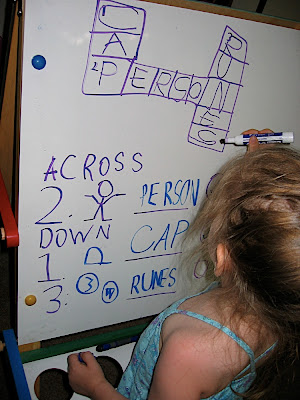
Archer created a pictorial crossword puzzle for Cady Gray. (Some of the clues had to be altered as he realized that the words weren't going to intersect correctly -- for example, that cap on 1 Down was originally a hat.) I especially liked his representations of the runes that the kids quested for on their recent vacation. Shown here, left to right: Lightning Rune and Freezing Power Rune!
Cady Gray gave me a spelling test. I'm trying to make it through "person."

Here's the story problem Archer wrote for me. The last line is: "Did this problem X 5 [multiply by 5] ?"
I picked up this awesome easel through Freecycle today. The kids immediately set to work tutoring each other (and me).
Archer created a pictorial crossword puzzle for Cady Gray. (Some of the clues had to be altered as he realized that the words weren't going to intersect correctly -- for example, that cap on 1 Down was originally a hat.) I especially liked his representations of the runes that the kids quested for on their recent vacation. Shown here, left to right: Lightning Rune and Freezing Power Rune!
Cady Gray gave me a spelling test. I'm trying to make it through "person."
Here's the story problem Archer wrote for me. The last line is: "Did this problem X 5 [multiply by 5] ?"
Saturday, June 21, 2008
Senses of humor: A study in contrasts
Cady Gray: Mom, I'm going to tell you a joke. Knock knock!
Me: Who's there?
CG: Bunny shoes!
Me: Bunny shoes who?
CG: Bunny shoes that are the biggest you've ever seen ... and the bunnies wear them ... and then monsters come and all break up the world ... and it's all broken up and that's the funniest joke ever!
Archer: Now I will tell you a joke. Knock knock!
Me: Who's there?
Archer: Savannah.
Me: Savannah who?
Archer: Savannah Wertz.
Me: Who's there?
CG: Bunny shoes!
Me: Bunny shoes who?
CG: Bunny shoes that are the biggest you've ever seen ... and the bunnies wear them ... and then monsters come and all break up the world ... and it's all broken up and that's the funniest joke ever!
Archer: Now I will tell you a joke. Knock knock!
Me: Who's there?
Archer: Savannah.
Me: Savannah who?
Archer: Savannah Wertz.
Friday, June 20, 2008
In print and in "print"
My office re-entry this morning yielded a couple of items for the year-end performance review:
There's so much text in the world and it's so overwhelmingly available (even thrust upon one unasked-for) that it's hard to remember how miraculous writing is, and how noble the calling of the writer should be considered. I tend to reconnect with that magic at lunchtime on weekdays, when I go get a Tropical Smoothie chicken habernero wrap and read whatever I'm currently reviewing.
Today it was Jamie James' nonfiction book The Snake Charmer: A Life And Death In Pursuit Of Knowledge. As I read about Joe Slowinski's fanatic love of naturalism and herpetology, culminating in a (surprisingly rare) science-related snakebite in the wilds of Burma, I frequently glance up and out the window, at the cloud-chased sky and the passing cars and the McDonald's across the street. Good writing -- illuminating, revealing, humane writing -- enchants the world.
Every time I feel like my dailyblogging, my blogs and reviews for the A.V. Club, my academic work, my administrative memos and handbooks and policies and so forth, are all Byzantine wheelspinning, far removed from anything that actually matters a damn ... I read something that lights up the world like stained glass, and I remember that language turns the chaos of experience into a cosmos that can be communicated. And that's a power not to be disparaged. Indeed, it may be the fundamental power of consciousness.
- a complimentary copy of Handbook Of Whiteheadian Process Thought, a German-produced, Belgian- and Irish-edited volume (in English!) for which I contributed an article on theological anthropology titled "Communities and Destinies";
- the posting of my Society of Biblical Literature presentation from last November, "The Bible-Shaped Mirror: Biblical Women and Contemporary Culture in Recent Film" (on the presentation of Mary and Esther in the 2006 films The Nativity Story and One Night With The King) in the online journal SBL Forum.
There's so much text in the world and it's so overwhelmingly available (even thrust upon one unasked-for) that it's hard to remember how miraculous writing is, and how noble the calling of the writer should be considered. I tend to reconnect with that magic at lunchtime on weekdays, when I go get a Tropical Smoothie chicken habernero wrap and read whatever I'm currently reviewing.
Today it was Jamie James' nonfiction book The Snake Charmer: A Life And Death In Pursuit Of Knowledge. As I read about Joe Slowinski's fanatic love of naturalism and herpetology, culminating in a (surprisingly rare) science-related snakebite in the wilds of Burma, I frequently glance up and out the window, at the cloud-chased sky and the passing cars and the McDonald's across the street. Good writing -- illuminating, revealing, humane writing -- enchants the world.
Every time I feel like my dailyblogging, my blogs and reviews for the A.V. Club, my academic work, my administrative memos and handbooks and policies and so forth, are all Byzantine wheelspinning, far removed from anything that actually matters a damn ... I read something that lights up the world like stained glass, and I remember that language turns the chaos of experience into a cosmos that can be communicated. And that's a power not to be disparaged. Indeed, it may be the fundamental power of consciousness.
Thursday, June 19, 2008
What I learned about the twenty-something sitting behind me on the plane ...
... while she was chatting with her polite and tolerant seatmate.*
- Her parents got divorced when she was thirteen, and her dad took up with a woman named Charmin [note: spelling not provided].
- Once her whole family was getting together for some event, and her mom stormed out with her kids in tow after Charmin served her a beer.
- Her sister is gay, "but sporty gay."
- She worked on her tan all week (although she hastens to add that she "SPFed up"), but didn't get as dark as she wanted.
- On the Sex and the City weekend she had with her girlfriends, Jeannette was totally making out with that guy.
- Charmin's one to talk about the responsibilities of parents -- her son dropped out of high school when he was 16.
- She's dating a black guy, but she told her mom to think of him as just very tan. [Note: Polite and tolerant seatmate is older black woman.]
Wednesday, June 18, 2008
Lessons from Jamestown
- Cady Gray would have been a great Powhatan Indian maiden. She absolutely adored grinding corn in hollowed-out logs with a big wooden pestle. Whenever I managed to pry her away from one hut and move her along, she would skip forward exclaiming, "I want to smash more corn!"
- The colonists must have had a hard time figuring out on which side their cornbread was buttered when Oliver Cromwell briefly took over the British government.
- We may feel like cattle on airplanes today, but I think we would prefer it to being stuck on a 500-square-foot 'tween deck with 53 other passengers for months.
- Archer will sit through a 24 minute movie if it is liberally interspersed with dates.
- If you see a rope going down through a grate on a replica ship, do not haul on it.
- It's hard for children to recognize animals from their skins hanging limply on a hook.
- To my disappointment, none of the re-enactors called the Indians "the Naturals" the way Christopher Plummer did in The New World.
Tuesday, June 17, 2008
Waterparkin'
Another hot one in the Commonwealth meant that we spent our day cooling off in the waterpark yet again. And the rewards were great. Cady Gray was enthusiastic about the kiddie slides. Archer, who started his water experience quite tentatively yesterday, spent an hour reconnoitering the "cub" pool, getting out at each depth and jumping in to see where it came up to on his body.
By the time we repaired to the outdoor pool midmorning, the kids were ready to try new things. Archer continued what he called "pacing practice," walking to different depths and then getting out. His sense of accomplishment even made him receptive to other kinds of "practice" -- sitting practice (sitting on the bottom of the pool in shallow water), floating practice (sticking his toes up above the water surface), even a little bit of swimming practice (kicking his legs behind him).
I gently pushed Cady Gray to try some floating and swimming, and almost came to regret it -- she refused to stop, meaning that I had to support her in each position. Even when I guided her to where the water was only inches deep, she wouldn't stop kicking her legs and padding her arms. I showed her how to dip her mouth in the water and blow bubbles, and by the time we broke for lunch, she was insisting on doing this while swimming. I got a hint of her independence as we practiced her jumping from the side of the pool into my arms -- she said a couple of times, "Don't catch me jumping. I want to do it myself."
I even got in some knitting-by-the-pool-with-fruity-drink time during the kids' naps. At bedtime Mom and Dad kindly stayed with the kids while we scooted down to the waterpark to ride the thrill rides, bruise the everliving heck out of my coccyx on the thrilliest of said thrill rides, and nurse our wounds in the hot tub. Great Wolf Lodge, you've earned your keep today.
Tomorrow we're going to Jamestown in the morning for a stab at shoving some history down the throats of the seven sensation-happy children in our party. And then no doubt we'll be back at the waterpark one last time before our last night in the bunk beds that Archer and Cady Gray carefully swap between naptime and bedtime to ensure a just distribution of the top bunk.
Monday, June 16, 2008
A dream come true
Today at the insanely packed Great Wolf Lodge in Williamsburg, we:
- went down water slides
- played mini-golf
- went on quests with a magic wand
- ate burgers beside a lagoon (along with some of the best lemonade I've ever had)
- met up with all the cousins and aunts and uncles and grandparents.
But the greatest thing that happened to Archer was when he was selected to help the girl calling bingo numbers. He was only supposed to turn the cage and hand her the balls, but he couldn't resist taking on more responsibility.
Sunday, June 15, 2008
The power of prayer
Not only were the flights on time, they both left a few minutes early.
Not only were the flights not overbooked, but all standbys were accommodated.
Not only did we make our connection, our arrival and departure were only five gates apart.
I know Mom was praying for us not to have a repeat of the Christmas travel disaster, and it could be that her faith has done the trick. Tomorrow I'm going to let her know she needs to start praying for Thursday's return trip immediately.
If you want to know where we are, check this out. It's theme park craziness in hotel form. I'll fill you in on the indoor waterpark tomorrow. Meanwhile the kids are sacked out on their bunk beds in the "Kid Kamp" room of our suite, with the Golf Channel lulling them to sleep. Nighty night!
Saturday, June 14, 2008
Taking to the air
Today's post, celebrating the somewhat early arrival of Baby Kate, is at Toxophily. What follows is nothing more than petty whining about living too far away from where we have to be tomorrow; please do not read.
With a great deal of trepidation, we are committing ourselves once again into the hands of the airlines in order to join the rest of my family in Williamsburg, Virginia to celebrate my parents' fiftieth wedding anniversary.
I seriously considered driving across the eastern half of the country to make this trip, after what we endured at Christmastime combined with the massive cutbacks and other trouble in the industry at the current time. But finally I just couldn't face four full days on the road in order to spend three days at our destination, and I gave in to the air option.
Delta was good to us at Christmas, getting us home on the same day we left St. Simons. Nevertheless, our two 50-minute layovers in Atlanta do not inspire confidence, given the seeming chronic lateness of all flights. I'm planning for an enforced night in Atlanta and hoping to be pleasantly surprised. Tune in tomorrow for the results.
With a great deal of trepidation, we are committing ourselves once again into the hands of the airlines in order to join the rest of my family in Williamsburg, Virginia to celebrate my parents' fiftieth wedding anniversary.
I seriously considered driving across the eastern half of the country to make this trip, after what we endured at Christmastime combined with the massive cutbacks and other trouble in the industry at the current time. But finally I just couldn't face four full days on the road in order to spend three days at our destination, and I gave in to the air option.
Delta was good to us at Christmas, getting us home on the same day we left St. Simons. Nevertheless, our two 50-minute layovers in Atlanta do not inspire confidence, given the seeming chronic lateness of all flights. I'm planning for an enforced night in Atlanta and hoping to be pleasantly surprised. Tune in tomorrow for the results.
Friday, June 13, 2008
Brace yourself
On May 23, 2008, the Arkansas Democrat-Gazette printed the following provocative letter about the anniversary of the founding of the state of Israel:
Anniversary also tragic
With that said, it's ...
The Arkansas Democrat-Gazette Letter Of The Week!
From the June 13, 2008 final edition:
Soldiers are prepared
In a previous letter, Amjad Saleh Faur expressed his disgust with “bloodthirsty” Israeli and Christian Falangist soldiers while he lamented so-called Palestinian victims. Hold onto your head wrap, camel jockey.
I will not waste time exposing the distortions that I believe saturated Faur’s hate-filled diatribe against the free world. . . . What is an American-hating terrorist sympathizer doing in Arkansas? Does he have something planned?
If he wants to kill Americans, he is free to join his comrades in Iraq. But there’s something he should understand. Our soldiers in Iraq are not unarmed civilians sitting unexpectedly at their desks. They are armed, ready and willing. So, Mr. Faur, what are you waiting for? Quit complaining and go join the killing.
PHILIP MULLINS SR.
Dardanelle
Anniversary also tragic
While Israel celebrates its 60 th birthday and American leaders glad-hand it with childish glee, I lament the almost complete refusal by American media and government to acknowledge the tragedy that is synonymous with Israel's creation. For Palestinians, this is the 60th birthday of Al Nakba (the catastrophe). Sixty years ago, over three-quarters of a million Palestinians were forcibly and permanently removed from their homes. Over 500 Palestinian villages were destroyed, depopulated or occupied by the victorious Israelis.
Of course, mainstream American media and no doubt [your] Editorial page would rather wallow in journalistic complicity than dare to acknowledge the systematic dehumanization of an entire population by America's favorite European colony. All the while good Zionist Christians give the infallible state of Israel a pat on the back whilst "What Would Jesus Do?" bracelets dangle callously upon their wrists. Now Israel celebrates its sham democracy by continuously appropriating Palestinian land and resources for Jewish settlers. Farms in the West Bank are either confiscated for Jews or destroyed to deter an Arab family's viability on the land. Israel continues to construct the unimaginably huge separation wall, built upon and cutting deep into Palestinian land. This wall will no doubt demarcate the area's new geographic reality when Israel unilaterally declares its final borders. Finally, thousands of Palestinian civilians (spare me your "human shield" drivel) have died at the hands of bloodthirsty Israeli and Christian Falangist soldiers. Here's to 60 years of getting away with murder.
AMJAD SALEH FAUR
Fayetteville
With that said, it's ...
The Arkansas Democrat-Gazette Letter Of The Week!
From the June 13, 2008 final edition:
Soldiers are prepared
In a previous letter, Amjad Saleh Faur expressed his disgust with “bloodthirsty” Israeli and Christian Falangist soldiers while he lamented so-called Palestinian victims. Hold onto your head wrap, camel jockey.
I will not waste time exposing the distortions that I believe saturated Faur’s hate-filled diatribe against the free world. . . . What is an American-hating terrorist sympathizer doing in Arkansas? Does he have something planned?
If he wants to kill Americans, he is free to join his comrades in Iraq. But there’s something he should understand. Our soldiers in Iraq are not unarmed civilians sitting unexpectedly at their desks. They are armed, ready and willing. So, Mr. Faur, what are you waiting for? Quit complaining and go join the killing.
PHILIP MULLINS SR.
Dardanelle
Subscribe to:
Posts (Atom)